Saturday, June 4, 2016

"It's a Good Life"

Little Anthony Fremont (Bill Mumy). He's a real good boy.
You had better not think bad thoughts about him.
“It’s a Good Life”
Season Three, Episode 73
Original Air Date: November 3, 1961

Cast:
Mr. Fremont: John Larch
Mrs. Fremont: Cloris Leachman
Anthony Fremont: Billy Mumy
Dan Hollis: Don Keefer
Ethel Hollis: Jeanne Bates
Aunt Amy: Alice Frost
Pat Riley: Casey Adams (Max Showalter)
Thelma Dunn: Lenore Kingston
Bill Soames: Tom Hatcher

Crew:
Writer: Rod Serling (based on the story by Jerome Bixby)
Director: James Sheldon
Producer: Buck Houghton
Production Manager: Ralph W. Nelson
Director of Photography: George T. Clemens
Art Direction: George W. Davis and Phil Barber
Set Decoration: H. Web Arrowsmith
Assistant Director: E. Darrell Hallenbeck
Editor: Jason H. Bernie
Story Consultant: Richard McDonagh
Sound: Franklin Milton and Bill Edmondson
Casting: Stalmaster-Lister
Music: Stock

And Now, Mr. Serling:
“Next week we borrow from the exceptional talent of author Jerome Bixby. It’s an adaptation of what has been called one of the most terrifying modern fantasies ever written. What you’ll see is, in a sense, a portrait of a monster as a young boy. Next week’s very special excursion into the Twilight Zone is called ‘It’s a Good Life.’ I hope we see you then.”

Rod Serling’s Opening Narration:
“Tonight’s story on the Twilight Zone is somewhat unique and calls for a different kind of introduction. This, as you may recognize, is a map of the United States, and there’s a little town there called Peaksville. On a given morning not too long ago, the rest of the world disappeared and Peaksville was left all alone. Its inhabitants were never sure whether the world was destroyed and only Peaksville left untouched or whether the village has somehow been taken away. They were, on the other hand, sure of one thing: the cause. A monster had arrived in the village. Just by using his mind he took away the automobiles, the electricity, the machines, because they displeased him. And he moved an entire community back into the Dark Ages, just by using his mind. Now I’d like to introduce you to some of the people in Peaksville, Ohio. This is Mr. Fremont. It’s in his farmhouse that the monster resides. This is Mrs. Fremont. And this is Aunt Amy, who probably had more control over the monster in the beginning than almost anyone. But one day she forgot. She began to sing aloud. Now, the monster doesn’t like singing, so his mind snapped at her, turned her into the smiling, vacant thing you’re looking at now. She sings no more. And you’ll note that the people in Peaksville, Ohio have to smile. They have to think happy thoughts and say happy things because, once displeased, the monster can wish them into a cornfield or change them into a grotesque, walking horror. This particular monster can read minds, you see. He knows every thought, he can feel every emotion. Oh yes, I did forget something, didn’t I? I forgot to introduce you to the monster. This is the monster. His name is Anthony Fremont. He’s six years old with a cute little-boy face and blue, guileless eyes. But when those eyes look at you, you better start thinking happy thoughts because the mind behind them is absolutely in charge. This is the Twilight Zone.”

Summary:
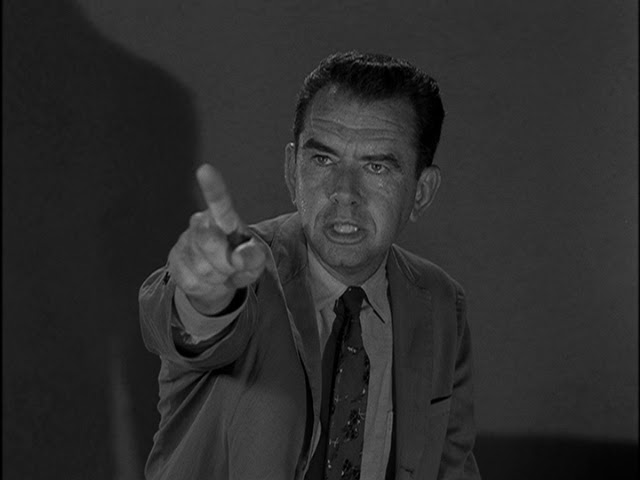
Don Keefer as the unfortunate Dan Hollis
There is trouble in the town of Peaksville, Ohio. There isn’t enough food. There are no telephones and no electricity. There hasn’t been any contact from outside of the town in months and the population is dwindling. There is no way to leave town and the inhabitants live under a constant cloud of fear and hopelessness. Except for one particular resident who feels just fine.
Little Anthony Fremont has a special talent: the ability to do anything he wants simply by thinking about it. He can turn a person or animal into anything he wants. Or if he wants them gone he just wishes them into the cornfield and they never return. He can make it rain or snow. He can move things with his mind. He can also read thoughts so the townsfolk have to be extra careful to think happy thoughts around Anthony.
            Anthony doesn’t like barking dogs. He doesn’t like machines, telephones, radios, or automobiles. He is especially cross about singing. He also doesn’t like when people think or say bad things about him. And for those unfortunate souls who make the mistake of thinking bad thoughts about Anthony, time is severely limited. But everyone in Peaksville loves little Anthony. He’s a real good boy and he does real good things.
            Except for Dan Hollis, of course.
 Dan doesn’t care for the way Anthony has been treating everyone. So one night after too many drinks at the Fremont house he tells him so. He begins to scream at Anthony, who simply stares back at him with unchecked rage. Everyone in town is present and Hollis pleads with them to kill the boy while his attention is focused elsewhere. But to his horror no one moves. And he realizes that he has written his death sentence. Anthony turns Hollis into a jack-in-the-box right there in front of everyone. His father pleads with him to wish the horrifying spectacle away. So he does.
It begins to snow outside. Concerned for the summer crops, Anthony’s father asks him if he is responsible for the snow and the boy admits that he is. Baffled by annoyance and rage his father almost loses his temper but catches himself. Snow is a good thing, he tells his son. A real good thing. And tomorrow is going to be a real good day.

Rod Serling’s Closing Narration:
“No comment here. No comment at all. We only wanted to introduce you to one of our very special citizens: little Anthony Fremont, age six, who lives in a village called Peaksville in a place that used to be Ohio. And if by some strange chance you should run across him, you had better think only good thoughts. Anything less than that is handled at your own risk. Because if you do meet Anthony you can be sure of one thing. You have entered the Twilight Zone.”

Commentary:

“The men on the couch whispered and whispered to Ethel Hollis, and when they took their hands away, she mumbled too.
            While Anthony sat on top of the set and made television, they sat around and mumbled and watched the meaningless, flickering shapes far into the night.
            Next day it snowed, and killed off half the crops – but it was a good day.”

                                    -“It’s a Good Life” by Jerome Bixby 

            “It’s a Good Life,” Rod Serling’s adaptation of Jerome Bixby’s exceptional short story, is an unapologetic horror story set in a bleak, hopeless world full of bleak, hopeless people who live in constant fear for their lives from an omnipotent, unpredictable monster who feels no sympathy for others and no remorse for his actions. It begins on a grim note and progressively grows worse. There are no happy endings or morality lessons and there isn’t a single moment of optimism anywhere in the episode. It’s only a glimpse into the miserable lives of very unfortunate people.
“It’s a Good Life,” the short story upon which the episode is based, is arguably the best-known work of author Jerome Bixby. It was first published by Frederick Pohl in volume 2 of the uniformly excellent Star Science Fiction series in 1953 and later included in the 1960 volume Star of Stars, gathering the best stories from the Star series (seven volumes, including Star Short Novels, 1953-1959). The story was translated as early as 1957, quickly recognized for its excellence in artistry and originality of concept, arriving at a time in English language literature in which the child as an instrument of violence was gaining traction as a sociological subject among fiction writers. The following year would see the publication of two pivotal, and highly regarded, mainstream works approaching the topic with William March’s The Bad Seed (adapted for stage in 1954 and filmed in 1956) and William Golding’s Lord of the Flies (filmed in 1963 and again in 1990).
Serling’s adaptation remains faithful to Bixby’s story with only a handful of noticeable changes. In the original story Bixby implies that Anthony is capable of teleportation although he never describes it extensively. Dan Hollis's fate is also different. Instead of turning him into a jack-in-the-box he turns him into “something like nothing anyone would have believed possible.” The most significant change was switching Anthony’s age from three to six which gives him a more developed personality. This switch is interesting because it paints Anthony as a different kind of villain. Fans and critics have often speculated as to whether Anthony is truly a psychopath or simply a child that has not learned how to empathize with others. Bixby’s version leans towards the latter and features Anthony performing acts of charity for various characters. Serling’s Anthony is colder and more controlling. He seems to function completely for his own enjoyment and destroys anything that doesn’t bring him pleasure.
If Bixby’s story was not initially as well received as the novels of March and Golding it is due less to literary craftsmanship and more to the limits of genre publications at the time. It has since become a classic in the subgenre of the science fiction horror story, greatly due to Rod Serling’s excellent adaptation for The Twilight Zone, and was awarded inclusion in the 1970 volume The Science Fiction Hall of Fame, which was compiled in an attempt to retroactively honor exceptional science fiction stories published before the establishment of the Science Fiction Writers of America in 1965.
Notable reprints include Alfred Hitchcock Presents: Stories for Late at Night (1961), an excellent volume of horror stories ghost-edited by Robert Arthur, co-creator of The Mysterious Traveler radio program and creator of The Three Investigators series of mystery novels for children, the latter of which was initially published with the participation of Alfred Hitchcock. Arthur also included Bixby’s 1964 short story “The Young One” in the 1965 anthology Alfred Hitchcock’s Monster Museum, a volume of horror stories aimed at younger readers. In October of 1966, Isaac Asimov reprinted “It’s a Good Life” in the anthology Tomorrow’s Children not long after Asimov, in March of the same year, published the novelization of the film Fantastic Voyage, which was based on a short story by Bixby and Otto Klement. “It’s a Good Life” has since become a standard of both science fiction and horror anthologies and seen republication in dozens of volumes. It is also included in the 1985 anthology The Twilight Zone: The Original Stories edited by Richard Matheson, Martin Harry Greenberg, and Charles G. Waugh. Rod Serling’s teleplay adaptation of the story was initially published in the Nov/Dec, 1983 issue of Rod Serling’s The Twilight Zone Magazine and can also be found in As Timeless as Infinity: The Complete Twilight Zone Scripts of Rod Serling, Volume 8 (ed. Tony Albarella, Gauntlet Press, 2011).
Jerome Bixby was born Drexel Jerome Lewis Bixby in Los Angeles on January 11, 1923 and enjoyed a long and fruitful career working in various capacities within the science fiction field. He sold his first science fiction story, “Tubemonkey,” to the pulp magazine Planet Stories, an early market for fellow Zone writer Ray Bradbury, for the Winter, 1949 issue. Two issues later, in the summer of 1950, Bixby assumed editorship of Planet Stories, a position he held until July, 1951. Bixby found additional editing work in the dying days of the pulps, guiding Jungle Stories from the Fall, 1949 issue to the Spring, 1951 issue, Stories of Sheena, Queen of the Jungle for the Spring, 1951 issue, and Two Complete Science Fiction Adventure Novels from the Winter, 1950 issue to the Summer, 1951 issue.
Bixby soon began to write a series of regular columns detailing movements in science fiction fandom. For Startling Stories he wrote “Review of the Current Science Fiction Fan Publications” from January, 1952 until March, 1953, and supplemented this with “The Frying Pan: A Commentary on Fandom” in Thrilling Wonder Stories from December, 1951 until February, 1953. Bixby began to fully concentrate on writing short fiction in 1953, culminating in the excellent 1964 collection Space by the Tale.
            Bixby began writing for feature films with 1958’s It! The Terror from Beyond Space, an independent, low-budget offering from producer Robert E. Kent and director Edward L. Kahn, which featured Ray “Crash” Corrigan in an alien suit designed and created by Paul Blaisdell terrorizing a group of astronauts inside a claustrophobic spacecraft. The film is generally considered to have influenced Dan O’Bannon when writing the screenplay for Ridley Scott’s 1979 film Alien, a film which also concerns a hostile alien stowaway which begins killing the crew aboard a spacecraft. Bixby wrote two additional science fiction films in 1958, Curse of the Faceless Man, again for producer Robert E. Kent and director Edward L Cahn, and The Lost Missile.
Bixby contributed significantly to the television program Men into Space, a series which fumblingly attempted a more accurate and realistic depiction of manned space travel. The series lasted only one season, thirty-eight episodes, from September, 1959 to September, 1960. Bixby was one of several science fiction writers who found work on Gene Roddenberry’s Star Trek (1966-1969), along with Zone writers Richard Matheson, George Clayton Johnson, and Jerry Sohl. He contributed to four episodes of the series ("Mirror, Mirror," "By Any Other Name," "Day of the Dove," and "Requiem for Methuselah") and is credited with creating the “mirror universe” concept used in subsequent episodes, originating from his Hugo Award nominated teleplay, “Mirror, Mirror,” the fourth episode of the second season, which was an adaptation of his 1954 short story originally published in Future Science Fiction for August, 1954, with additional elements used from his 1953 short story "One Way Street" (Amazing Stories, Dec, 53/Jan, 54). Another of Bixby’s highly regarded episodes, “Day of the Dove,” the seventh episode of the third season, was adapted and published as #10 in the Star Trek Fotonovel series in August, 1978.
Bixby, with writer Otto Klement, wrote the story treatment upon which the 1966 film Fantastic Voyage was based. The film concerns a crew of scientists that are reduced to microscopic size in order to enter the body of a dying scientist and alleviate a blood clot in his brain. Bixby and Klement originally envisioned the film as a period piece inspired by the scientific romances of Jules Verne. Screenwriter David Duncan adapted the story to a futuristic setting and provided a structured context which was written as a screenplay by Harry Kleiner. As stated before, Isaac Asimov was hired to write the novelization of the film, a book which inadvertently appeared in bookstores six months before the film’s release, creating the impression that Fantastic Voyage was an original novel from Asimov. The story was previously serialized in two parts as “Fantastic Voyage: Into the Human Brain” in the Saturday Evening Post issues for February 26 and March 12, 1966. The book, published in hardcover by Houghton Mifflin, subsequently became a bestseller.
Bixby’s final work was a screenplay titled The Man from Earth, about an ageless man who has survived since primitive times and eventually reveals his true nature to a group of friends. Bixby completed the screenplay shortly before his death in 1998 and the film was realized in 2007 (alternately titled Jerome Bixby’s The Man from Earth) by Bixby’s son, Emerson Bixby. Emerson Bixby, along with Jean Marie Stein, also collected a number of his father’s best science fiction stories for the 2014 book Mirror, Mirror: Classic SF by the Famed Star Trek and Fantastic Voyage Writer (Strange Particle Press). Jerome Bixby died on April 28, 1998 in San Bernardino, California, age 75.
“It’s a Good Life” was one of three original Twilight Zone episodes, along with “Kick the Can” and “Nightmare at 20,000 Feet,” chosen to be reimagined for Twilight Zone: The Movie, a 1983 Warner Brothers film. The film was spearheaded by John Landis and Steven Spielberg, each of whom directed a segment of the film, who recruited Joe Dante, following his successful werewolf film The Howling (1981), and George Miller, following his successful post-apocalyptic film The Road Warrior (1981), the second film in the Mad Max series, to direct the two additional segments that comprise the film.
Landis directed the first segment of the film, “Time Out,” the only segment which was not a remake of an original series episode. The segment concerns a racist (Vic Morrow) who discovers himself transported into times of civil oppression as one of the oppressed. The segment is now infamous for the deaths of Morrow and two child actors resulting from the disastrous staging of a special effects shot, which saw an explosion engulf a helicopter which subsequently fell on top of Morrow and the two children who were unable to move to safety due to being partially submerged in water below.
Spielberg chose to remake George Clayton Johnson’s third season episode “Kick the Can” and George Miller took on Richard Matheson’s unforgettable “Nightmare at 20,000 Feet,” the final segment of the film. In between these two segments was Joe Dante’s version of “It’s a Good Life.”
Original series writer Richard Matheson was brought on to adapt “It’s a Good Life,” going back to the original episode as well as Jerome Bixby’s story. The result was a special effects bonanza with a superficial happy ending tacked onto what is naturally a very bleak concept. Backlash from viewers was immediate due to the happy ending, which stood in stark contrast to the original episode, one of the bleakest episodes of the original series. He also includes glimpses into the world outside of Peaksville which provides a possible escape scenario for his captives and waters down the feeling of isolation that is so present in the two previous versions. In his book, Science Fiction Stars and Horror Heroes (McFarland, 1991), film historian Tom Weaver prints his interview with Richard Matheson in which Matheson states that the happy ending was a conscious attempt to alter the harshness of the story, one which he admitted was not very successful. Still, Matheson rates Dante’s segment as the best of the film.
The segment’s numerous special makeup effects were handled by Rob Bottin. Bottin was a protégé of makeup artist Rick Baker, who first brought Bottin on as an assistant for the 1976 version of King Kong. Bottin also worked with Baker on the 1978 film Fury, whose makeup effects were supervised by Twilight Zone makeup artist William Tuttle. Rick Baker was initially set to provide the makeup effects for Joe Dante’s The Howling when John Landis received funding for a long-gestating project, An American Werewolf in London, on which Baker had previously agreed to provide the effects. Baker left the production of The Howling and Bottin was subsequently left in charge of providing the effects. The resultant effects were impressive enough to ensure Bottin a long career in Hollywood, where he would provide exceptional work on films ranging from John Carpenter’s The Thing (1982), Legend (1985), for which he was nominated for an Academy Award, and Total Recall (1990), for which he was part of team of visual effects artists that won a Special Achievement Academy Award.    
The film segment stars Kathleen Quinlan as a traveling young school teacher named Helen Foley, the name an homage to an original series character from the first season episode “Nightmare as a Child,” which was itself an homage to Rod Serling’s favorite school teacher, who encounters, and ultimately educates, the powerful boy Anthony Fremont, played in the film by Jeremy Licht. The segment is notable for containing a number of actors with ties to the original Twilight Zone series, including Kevin McCarthy (“Long Live Walter Jameson”), Patricia Barry (“The Chaser” and “I Dream of Genie”), and William Schallert (“Mr. Bevis”). Bill Mumy, star of three original series episodes and the original Anthony Fremont, also makes a brief appearance in the segment as well as original series producer Buck Houghton. The cast is rounded out by Nancy Cartwright, Cherie Currie, and Dick Miller.  
"It's a Good Life" was also the (partial) inspiration for an episode of the first The Twilight Zone revival series titled "The Toys of Caliban," which originally aired on December 4, 1986. "The Toys of Caliban" concerns also parents who live in fear of their son, who possess the unusual and frightening powers of a deity, able to bring into existence anything he can imagine. It was based on a story by Terry Metz, adapted for the series by George R.R. Martin, and directed by Thomas J. Wright.
“It’s a Good Life” was given a sequel over forty years later with “It’s Still a Good Life,” an episode of the second Twilight Zone revival series, which ran for one season (twenty-two episodes) from 2002-2003 on the UPN Network. The series was hosted by Forest Whitaker and followed a one-hour format typically comprised of two thirty minute segments. Upon original broadcast, “It’s Still a Good Life” was paired with “The Monsters Are on Maple Street,” a reimagining of Rod Serling’s classic original series episode, “The Monsters Are Due on Maple Street.”
*SPOILERS* “It’s Still a Good Life” finds Bill Mumy and Cloris Leachman reprise their roles from the original episode as Anthony Fremont and his mother, Agnes Fremont. Anthony still controls Peaksville with his terrifying powers and remains the spoiled, petulant, easily angered boy he was despite forty years of physical aging. It is suggested that Anthony has sent his own father into the cornfield, that metaphor for the nothingness into which those that anger Anthony are cast. At some point Anthony married and had a child, Audrey, but Anthony’s wife angered him and she, too, was eventually sent away into the cornfield. Anthony is displeased when it becomes apparent that Audrey does not possess his awesome powers yet it is revealed that Audrey’s powers are both latent and much stronger than Anthony’s. One particular aspect of Audrey’s power is that she can bring things back, things that Anthony has sent away, including objects and people. This is something that Anthony cannot do.
When Agnes discovers Audrey’s power she is elated. Since Audrey appears to resent her father and his behavior, Agnes believes the girl can be the savior of the people of Peaksville and finally end Anthony’s reign of terror. When confronted, however, Audrey cannot bring herself to harm her father and instead sends everyone in Peaksville away, including her grandmother.
When this saddens her father, who quickly becomes lonely with no more people to control, Audrey brings back everything that Anthony had sent away, all the countries and cities and people and objects. The two then set off to explore the world, comfortable in the knowledge that anyone or anything that gets in their way will quickly be dealt with.
“It’s Still a Good Life” was written by series executive producer Ira Steven Behr, who wrote three additional episodes of the series, and directed by Allan Kroeker, who directed two additional episodes of the series. It is both a faithful and effective sequel to the original series episode, managing to retain the feeling of nervous tension that permeates the original episode while introducing an engaging subplot concerning Anthony’s daughter and the townspeople’s willingness to believe there could be an end to Anthony’s terrible reign of power. It comes recommended to those that enjoyed the original episode.
           An interesting comparison to this episode of The Twilight Zone is the second aired episode of the original series of Star Trek, "Charlie X," which bears a striking resemblance to Jerome Bixby's story. Scripted by Dorothy (D.C.) Fontana, from a story idea by series creator Gene Roddenberry, it concerns a teenage boy named Charles Evans who has survived on an isolated planet since he was a small child (he was the sole survivor of a crashed transport ship). Charles (or Charlie) is picked up by the Antares and hastily passed on to the USS Enterprise so that Captain Kirk and company can transport Charlie to his nearest relatives. It soon becomes apparent that Charlie possesses God-like powers just by using his mind, powers he is only too willing to use to coerce others to do his bidding. Kirk and the crew of the Enterprise are thereafter pitched into a battle of wills against an all-powerful adolescent boy who can destroy them all with a single thought. Charlie transforms crew members into animals and hideously transforms others (erasing one woman's face and severely aging another young female crew member) when he is not sending crew members away into nothingness. Anyone who resists Charlie is severely punished. It is finally revealed that Charlie was given his powers by the Thasians, a powerful alien race, in order that the young boy may survive on an isolated planet. The Thasian commander appears on the bridge of the Enterprise and takes Charlie away at the end of the episode, freeing his hold on Captain Kirk and his crew. It is likely that Roddenberry either viewed or read "It's a Good Life," especially considering that Jerome Bixby was one of a number of successful science fiction writers Roddenberry brought on to write for the series. Wikipedia sources the original version of D.C. Fontana's script as bearing the original working title or "Charlie's Law,"  a law which consisted of: "You'd better be nice to Charlie . . . or else!" This was left out of the final episode for obvious reasons. It is interesting to consider what Bixby thought of the similarities, or if he perhaps encouraged the exchange of ideas. It is similar to the way in which Rod Serling occasionally borrowed from the writers he brought on to write for his series (the striking similarity between "A Thing About Machines" and Richard Matheson's 1953 short story "Mad House" comes to mind). This is not intended to stand as a judgment of any sort but only to illustrated the unavoidable exchange of ideas within the relatively small community of science fiction writers.
        Star Trek approached similar material with the second of Roddenberry's proposed pilot episodes, "Where No Man Has Gone Before," scripted by Samuel Peeples. The episode concerns two crew members gaining extraordinary mental powers after suffering shock received when the Enterprise passed through a strange electrical field. As their mental powers grow, so does their God complexes, and they begin to view all human life as weak and insignificant. It is clear that "It's a Good Life" was an enormously influential story and developed an idea (the corrupting influence of a God-like mental power) which has had a wide-spanning impact on the genre. 
           While Serling delivers a solid adaptation of Bixby’s story, it is the performances that take center stage in this episode. Bill Mumy returns here for his second appearance on the show, the first being in the second season episode, “Long Distance Call.” He also appears in the premiere episode of the fifth season, “In Praise of Pip.” He is the only child actor to appear in more than two episodes. It is largely his performance that fuels the debate as to whether Anthony is biologically a psychopath or a product of his circumstances. In his episode commentary to The Twilight Zone, The Definitive Edition DVD (Image Entertainment) Mumy says that Anthony believes he is helping people and that he approached his performance with this in mind. Regardless of the reason Anthony does what he does it is no question that he is one of if not the most terrifying monster ever featured on the show and Mumy delivers a genuinely unforgettable performance. The episode seems to have made a tremendous impact on the actor and he has stated in several interviews that it was one of his favorite projects. He even named his radio show, The Real Good Radio Hour, which air on FM station KSAV, after the episode.
             But it's the performances of the rest of the cast which give “It’s a Good Life” such an intense atmosphere. Because of the nature of the plot no character is ever really allowed to say or express their true feelings, except of course for Don Keefer who plays Dan Hollis. So the performer have to be able to express feelings of dread and misery through the guise of happiness. Cloris Leachman, who plays Anthony’s mother, was no stranger to television in the early days of the medium and would go on to become one of the most prolific actresses in its history, winning eight Primetime Emmy Awards. She also won an Academy Award for Best Supporting Actress for her performance in Peter Bogdanovitch’s The Last Picture Show (1971). John Larch, who plays Anthony’s father, was also a prolific television actor, appearing largely in westerns. Don Keefer gives an amazing performance in this episode and the moment when he realizes that all of his friends have abandoned him to ensure their own survival is probably the best scene in the episode.
An atypical offering, “It’s a Good Life” has become one of the most recognizable episodes of the show. From Serling’s unusually long opening monologue to its overtly bleak storyline, it’s an episode that has encountered its share of criticism over the years. But despite this it’s one that has become a fan favorite. It has helped solidify a place for Jerome Bixby in the science fiction community and has become a notable mark on the resumes of its cast. A genuinely flawless episode, it has managed to stand the test of time and has deservedly become an immortalized piece of American popular culture.

Grade: A+

Grateful acknowledgement is made to The Internet Speculative Fiction Database (isfdb.org) for images and bibliographic information, and to the Internet Movie Database (imdb.com) for filmographic information.  

Notes:
--James Sheldon directed five additional episodes for the series: “The Whole Truth,” “A Penny for Your Thoughts,” and “Long Distance Call” for the second season, and “Still Valley” and “I Sing the Body Electric” for the third season.
--John Larch also appeared in the first season episode “Perchance to Dream” and the third season episode “Dust.”
--Don Keefer also appeared in the fourth season episode “Passage on the Lady Anne” and the fifth season episode “From Agnes-With Love,” as well as in "The Time Element" episode of Westinghouse Desilu Playhouse. Keefer appears in an episode of Rod Serling's Night Gallery titled "You Can Come Up Now, Mrs. Millikan."
--Bill Mumy also appeared in the second season episode “Long Distance Call” and the fifth season episode “In Praise of Pip.” In 2002 he co-wrote an episode of the second Twilight Zone revival series with Frederick Rappaport called “Found and Lost.” It originally aired on the UPN network on November 27.
--Alice Frost also appeared in the first season episode “The Sixteen Millimeter Shrine.”
--Cloris Leachman also appears in an episode of Rod Serling's Night Gallery titled "You Can't Get Help Like That Anymore."
--“It’s a Good Life” was adapted as part of Twilight Zone: The Movie, released by Warner Brothers on June 24, 1983. The segment was directed by Joe Dante, written by Richard Matheson, with special makeup effects by Rob Bottin. The segment starred Kathleen Quinlan, Jeremy Licht, Kevin McCarthy, Patricia Barry, William Schallert, and Nancy Cartwright.
--A sequel, “It’s Still a Good Life,” was produced for the second revival series and was originally aired on the UPN Network on February 19, 2003, starring Bill Mumy, Lilana Mumy, and Cloris Leachman.
--“It’s a Good Life” was produced as a Twilight Zone Radio Drama starring Mike Starr.
--The proper title of the original Jerome Bixby story is “It’s a Good Life,” which places an emphasis on “Good,” something which is decidedly represented in the episode’s dialogue.
--The beginning portion of Rod Serling's opening narration, "Tonight's story on the Twilight Zone is somewhat unique and calls for a different kind of introduction. This as you may recognize is a…" is reused for the Twilight Zone Tower of Terror ride at Disney's theme parks. The remainder of the narration is custom to the ride and perfomed in a Serling imiation by Mark Silverman.
--The song that Pat Riley (Casey Adams) is playing during the birthday party scene is “Moonglow,” written by Will Hudson, Irving Mills, and Eddie DeLange and originally recorded by Joe Venuti in 1933. The song eventually became a jazz standard with notable version by Benny Goodman, Doris Day, Billie Holiday, and The Coasters.

--Jordan Prejean and Brian Durant

Wednesday, May 18, 2016

Television Work of the Early Makeup Masters:

William Tuttle, Dick Smith, and John Chambers 
by Jordan Prejean
William Tuttle with his makeup creations

Much has been made recently about the fact that television has caught up to Hollywood not only in terms of acting and storytelling but also in terms of technical production. Production design, costuming, music, visual effects, photography, and the myriad other technical aspects of a television production now rival in quality the finest the big screen has to offer. One need only look to the work of artists such as Greg Nicotero on The Walking Dead, Nick Dudman on Penny Dreadful, or Eryn Krueger Mekash on American Horror Story to realize that special makeup effects work in television is equal to, and in many cases superior to, anything contained in a recent Hollywood production. Many of the finest makeup artists in the industry are returning to work on the small screen due to rising production values, a cooperative creative environment, and an opportunity to craft something singular using techniques that many feature film productions have begun to replace with digital means.
            The suggestion, however, that such excellent achievements in special makeup effects on television are a recent development is wholly mistaken. Television has been a showcase for innovative makeup designs from its earliest days and the medium has often displayed exceptional work from the most revered names in the industry.
If you were to only take three television anthology series from the early years 1959-1963 and examine the three makeup artists who made each of these shows memorable for unusual, inventive, and highly influential makeup designs, you would have three of the most significant makeup artists in the history of the film and television industries. Between them, these men would claim four Academy Awards and a slew of Emmy, Saturn, and BAFTA Award nominations and wins over the course of long and fruitful careers. In fact, one could likely trace the entire lineage of special makeup effects artists of the late twentieth and early twenty-first centuries to the three men responsible for this early television work: William Tuttle on The Twilight Zone (1959-1964), Dick Smith on ‘Way Out (1961), and John Chambers on The Outer Limits (1963-1965).

I. William Tuttle

In early 1959, Emmy Award winning writer Rod Serling, fed up with his confrontational scripts being censored by fearful corporate sponsors, developed a science fiction and fantasy television program with the CBS network, intending the science fiction genre to mask the controversial style of drama he was determined upon writing. Serling called his series The Twilight Zone and the West Coast production utilized the vast resources at Metro Goldwyn Mayer Studios.
A publicity photo of Tuttle's work on "The Masks"
William Tuttle had been the head of the MGM Makeup Department since 1950. When Serling and company arrived at the studio to produce their unique anthology series, Tuttle sensed an opportunity to contribute makeup designs that would set the series apart from television’s relatively crowded science fiction and fantasy landscape. After the show’s fifth and final season, when the series began its eternal existence in syndication, the aesthetic of Tuttle’s inimitable makeup designs would see reproduction and reinterpretation in a variety of marketing material, from comic books to board games to lunchboxes to toys to posters and art prints, not to mention the memories of any viewer who happened upon the show.
Tuttle was born in Jacksonville, Florida in 1912 and was forced to leave school early in order to support his mother and younger brother after his father abandoned the family. He gravitated early to art and music, trying his hand as both a comic performer and as a violin player in Vaudeville before completing the required schooling to gain entrance into the University of Southern California in the spring of 1930. Tuttle focused on art and developed a talent for molding and sculpture, skills he later utilized as an innovator in creating life masks to fine-tune the application of prosthetic appliances. Tuttle’s time at USC would direct the entire course of his professional life. He returned to the university to teach from 1970-1995, beginning a year after he vacated his position as head of the MGM Makeup Department due to a change in ownership of the studio. A permanent collection of more than 100 of Tuttle’s creations for film and television reside at the university.
Pioneering makeup artist Jack Dawn arrived at USC in early 1934 seeking a recommendation for a sculptor and a painter to assist in his increasing workload at nearby MGM. Dawn was directed to Tuttle and Tuttle’s colleague, a highly talented sculptor named Charles Schram. Dawn took both young artists under his tutelage and put them to work as assistants on film productions. It was at MGM and the 1935 production of Tod Browning’s Mark of the Vampire that a simple yet convincing bullet hole effect in the forehead of Bela Lugosi persuaded Dawn that Tuttle was capable of work beyond ordinary assistant procedures.
Two years later, Tuttle was applying Dawn’s innovative flexible appliances to transform white actors into Chinese farmers for the 1937 film The Good Earth. 1939 brought a career defining moment for Jack Dawn with The Wizard of Oz, likely the most intensive production in terms of makeup design and application in feature films to that point. Tuttle and Schram applied Dawn’s improved prosthetic appliances as well as their own makeup designs to create the rigorous production’s iconic characters. Among the other uncredited makeup artists toiling on the set of the film was Fred Phillips, who fell under the guidance of Tuttle and who would later work extensively with makeup artist John Chambers on properties such as The Outer Limits (1963-1965) and Star Trek (1966-1969).
For Tuttle, The Wizard of Oz was the beginning of a long climb to the top of MGM’s Makeup Department, earning the position after it was vacated by Jack Dawn in the fall of 1950. Tuttle became as renowned in the 1940's and 1950's for beautifying MGM’s contract stars (in part leading to a marriage with Donna Reed from 1943-1945) as he would become for his strange creations of the 1960's and beyond. By the time Rod Serling and The Twilight Zone came along in 1959, Tuttle had applied his skills to dozens of genre productions including Forbidden Planet (1956), North by Northwest (1959), and television’s Alcoa Presents: One Step Beyond (1959-1961).
Tuttle's work aging Kevin McCarthy for "Long Live Walter Jameson"
Though Tuttle was initially expected to consult and occasionally supervise episodes of The Twilight Zone which required a unique or challenging makeup effect, he frequently elected to work directly with the show’s production team by crafting and applying his own makeup designs. Ably assisted by the sculpting talents of Charles Schram, Tuttle created some of the finest special makeup effects ever seen on television to that point, including a life-like facial cast of Anne Francis for the first season episode “The After Hours,” in which Francis’ character reverts to a mannequin state. Before this, Tuttle transformed Kevin McCarthy into a withering pile of ancient dust for another first season episode, “Long Live Walter Jameson,” about an immortal man who is murdered after centuries of existence. Tuttle achieved the initial stages of the effect by a process of color makeup application with corresponding color filters placed over the camera lens. As the color filters were removed, the makeup became visible, giving the impression of a transformation. This technique for black-and-white film was most memorably used by Paramount Studios makeup artist Wally Westmore to transform Fredric March into Mr. Hyde for director Rouben Mamoulian’s 1931 version of Dr. Jekyll and Mr. Hyde.
Tuttle's designs for "Eye of the Beholder"
Tuttle’s method was to cast life masks of actors and actresses in order to craft fitting appliances without the necessity of having the actor or actress present. Tuttle utilized this for the deep aging process on Kevin McCarthy, as well as for the idiosyncratic makeup designs (exemplified by large, twisted lips, pig-like noses, and a pronounced shelf of bone above the eyes) for Twilight Zone episodes ranging from “The Eye of the Beholder,” in which Tuttle transformed a hospital staff into swine-like visages with forehead and nose appliances, to “The Dummy,” in which Tuttle and Schram were tasked with sculpting a ventriloquist dummy to resemble actor Cliff Robertson as well as apply a dummy-like makeup design to actor George Murdock. Tuttle and Schram subsequently crafted the face of the famous “thing on the wing of the airplane” which terrorized William Shatner in the fifth season episode, “Nightmare at 20,000 Feet,” as well as the grotesque masquerade makeup for Rod Serling’s last great episode of the series, “The Masks.” 
Prosthetic piece for male nurse in
"Eye of the Beholder," which went to auction
late in 2018. Asking price: $10,000-$15,000
Tuttle also displayed his ability for traditional stage makeup with the third season episode “Five Characters in Search of an Exit,” which required makeups for a traditional clown and hobo among others archetypal characters. Even when Tuttle’s makeup design was not particularly effective, such as in the second season’s “Will the Real Martian Please Stand Up?,” he is capable of producing an iconic image, in this case a man with a third eye in the center of his forehead. This effect was initially to be achieved by optical means, projecting the eye onto the head of the actor, only to be abandoned as unfeasible at the last minute, forcing Tuttle to scramble to create a workable application.
Tuttle's design for the Morlocks in George Pal's "The Time Machine"
After the end of the series, Tuttle produced memorable makeup effects for director/producer George Pal at MGM in the 1960's, beginning with The Time Machine (1960) on to The Wonderful World of the Brothers Grimm (1962) and 7 Faces of Dr. Lao (1964), the latter for which he became the first makeup artist to win an Academy Award, given to Tuttle as a Special Achievement Award 17 years before Achievement in Makeup became a regularly given award in 1981.
After vacating his position as head of makeup at MGM in 1969, Tuttle concentrated on teaching and occasional, but memorable, freelance film and television work. He created the makeup effects for the Mel Brooks film Young Frankenstein in 1974 as well as contributing makeup to the futuristic design of Logan’s Run in 1976. Tuttle’s last great work was as supervisor of special makeup effects for director Brian de Palma on The Fury in 1978, for which he shared a Saturn Award with Rick Baker. Tuttle’s last film work was for Zorro: The Gay Blade in 1981 for Twentieth Century Fox and director Peter Medak.
In 1989, Tuttle established his own makeup company, Custom Color Cosmetics, and was the subject of a 1968 MGM documentary short titled King of the Duplicators, in which he discusses his techniques alongside frequent collaborator Charles Schram. Tuttle died at his home in Pacific Palisades on July 27, 2007, age 95.

II. Dick Smith

Dick Smith with his creations
In the spring of 1961, as William Tuttle was creating memorable makeups for The Twilight Zone, celebrated film and television producer and talk show host David Susskind was tasked with developing a summer replacement series for CBS. Jackie Gleason’s triumphant return to television on January 20th of that year resulted in the debacle that was You’re in the Picture, a ludicrous game show so poorly received it lasted but a single episode before Gleason returned the following week to publicly apologize for insulting the intelligence of the television audience.
David Susskind, like Rod Serling, was committed to producing intellectually engaging material for the young medium. Two years before, in the formative year 1959, which marked the beginning of both Alcoa Presents: One Step Beyond and The Twilight Zone, NBC passed on Susskind’s idea for a series of macabre half-hour plays, partially due to the unreliability of a genre anthology series to garner a dedicated viewership. The idea stayed with Susskind, however, and he pitched the idea to CBS as a possible replacement for the Gleason show. CBS, in a more receptive position, gave Susskind the green light and a hurried production began in New York on the series Susskind titled ‘Way Out.
Susskind hired British author Roald Dahl to host the program as well as provide the script for the premier episode, "William and Mary," about a disembodied brain. At the time, Dahl was best known for his macabre and darkly humorous short stories published in the pages of The New Yorker, a half-dozen of which had been adapted for Alfred Hitchcock Presents during the three years prior. Dahl's 1953 short story, "Lamb to the Slaughter," with its combination of humor and horror, was, in fact, the initial inspiration for the Hitchcock's series, and Susskind desired much of the same quality for ‘Way Out. It quickly became apparent to Susskind and his production team that the nature of the show required a talented makeup artist to achieve the bizarre effects indicated by several of the scripts for the series. Susskind recruited a makeup artist he’d previously worked with at NBC named Dick Smith.
Smith was a native New Yorker, born in Larchmont in 1922, and initially set out on a path in dentistry. He was admittedly not a traditionally talented visual artist but was inspired to try his hand at makeup from the discovery in his late teen years of Ivard Strauss’ 1936 book Paint, Powder and Make-up: The Art of Theater Makeup from the Amateur and Class Room Viewpoint. After his discharge from the Army in 1944, Smith repeatedly tried but failed to land a position at a Hollywood studio and so began submitting his work to the emerging arena of television. Smith eventually landed a position at NBC in 1945. The New York station began as a very small outfit which broadcast only two days a week. By 1950, however, the industry had grown to the point that Smith had twenty additional artists working for him in the art department crafting makeup for a variety of programs. 
By 1961 and the beginning of production on ‘Way Out, Smith had mastered a technique for sectional prosthetic appliance to allow an actor greater freedom of facial expression. Despite the participation of Susskind, Dahl, and a host of talented stage and television actors, ‘Way Out is best remembered today for Smith’s shocking makeup effects.
‘Way Out lasted a mere 14 episodes from late March to the middle of July, 1961, where it directly preceded The Twilight Zone, airing at 9:00 P.M. EST on Friday nights. Despite such brevity, the series provided enough material to showcase Smith’s prodigious talent for makeup effects.
Dick Smith erases half of Barry Morse's face
His most renowned achievement on the series was for the penultimate episode, “Soft Focus,” which concerned a photographer who discovers a chemical which possesses the astonishing ability to alter the appearance of the person in a photograph. The episode ends on a ghastly note when the chemical spills across an image of the photographer, erasing half of his face. Smith used a makeup base to blend a large, flexible appliance over the left side of actor Barry Morse’s face, producing a convincing illusion of erasure.
Smith's Quasimodo makeup on Martin Brooks

The seventh episode, “False Face,” written by cult film director Larry Cohen, draws particular attention to the art of film and stage makeup. It concerns an arrogant actor (Alfred Ryder) who uses a hideously deformed man (Martin Brooks) as model for his stage makeup for the role of Quasimodo, the Hunchback of Notre Dame. After his performance, the actor is horrified to discover that he cannot remove the makeup, which has somehow fused with his own flesh. For the episode, Smith admirably recreated Lon Chaney’s makeup design from Universal’s 1923 historical epic The Hunchback of Notre Dame on both Ryder and Brooks, adding more defined elements (exaggerated lips and nose) made possible by the advancement in prosthetic appliances, allowing for several hideous close angle shots.
Smith's makeup on Alfred Ryder
For the claustrophobic and frightening eighth episode, “Dissolve to Black,” Smith created a believable pallor of death across the faces of several actors using heavy black around the eyes and a withered, textured composition on the skin. “Side Show” is the memorably chilling twelfth episode which required Smith to craft a horrifying old hag makeup using a fright wig and appliances to exaggerate the nose and lower portion of the face while creating a wrinkled, aged appearance which would become a trademark of his skill set. Smith completed the effect by adding stitching where the head had been sewn to a beautiful body.
Smith's aging makeup on Jonathan Frid for Dark Shadows
Smith would win an Emmy Award in 1967 for transforming Hal Holbrook into Mark Twain for Mark Twain Tonight! on CBS and would continue to apply his skills to television productions long after he established a successful career in feature films. He worked on Dan Curtis’ Dark Shadows series and feature films, House of Dark Shadows (1970) and Night of Dark Shadows (1971), and also served as makeup effects consultant on the syndicated horror anthology series Monsters (1988-1991) and the television miniseries Stephen King’s Golden Years (1991).
Though Smith, working with Ben Nye, then head of the makeup department at 20th Century Fox, created the makeup effects for 1959’s The Alligator People, starring Beverly Garland and Lon, Chaney, Jr., his first significant film work was again with producer David Susskind, for Columbia’s production of Rod Serling’s Emmy Award-winning Playhouse 90 drama Requiem for a Heavyweight in 1962, starring Anthony Quinn, Jackie Gleason, and Mickey Rooney.
Once given the production values of a feature film, Smith would create some of the most enduring special makeup effects in the history of the medium. In 1970, he aged a thirty-two year old Dustin Hoffman into a 121 year old man in Arthur Penn’s Little Big Man. With a custom dental insert, he gave Marlon Brando the sagging jowls of an aged Mafia don in Francis Coppola’s The Godfather in 1972. A career watershed arrived in 1973 with The Exorcist, from director William Fiedkin and author William Peter Blatty. Smith, assisted by a young Rick Baker, turned cherubic Linda Blair into the gaunt, lacerated figure of a demon-possessed girl and should have been given an Academy Award for the astonishing results.
The film brought Smith an bevy of offers to create makeup effects for technically challenging productions in the horror and science fiction genres. In 1980, he crafted the most effective full-body prosthetic suit since 1954’s The Creature from the Black Lagoon to affect William Hurt’s physiological changes in Altered States, creating a unique situation a year later when two of Smith’s films fostered a tie for the Saturn Award for makeup effects as voters could not decide between awarding his work on Altered States or his work on David Cronenberg’s Scanners, the latter for which he served as makeup effects consultant, working with future Academy Award winners Chris Walas and Stephan Dupuis. Four years earlier, Smith was recruited by Martin Scorsese to fit Robert De Niro with a menacing Mohawk hairstyle and compose the blood-splattered conclusion to Taxi Driver.
Smith’s highly accomplished makeup effects appeared in The Sentinel (1977), Ghost Story (1981), and The Hunger (1983) before garnering an Academy Award, with Paul LeBlanc, for his work aging F. Murray Abraham’s Salieri in Milos Forman’s 1984 Best Picture winner Amadeus. Smith would be honored with a special ceremony, “A Tribute to Dick Smith: The Godfather of Special Makeup Effects,” hosted by Rick Baker, from the Academy of Motion Picture Arts and Sciences in 2009 before being awarded a second Academy Award in 2012 in recognition of his astonishing career and his remarkable influence on the makeup effects industry.
Smith was always willing to teach artists interested in the industry and freely divulged the many secrets of his methods, something which was highly unusual at the time. Smith’s final film work was designing the makeup effects for House on Haunted Hill in 1999, after which he concentrated on Dick Smith Special FX Makeup Training, a series of courses for developing up-and-coming special effects artists. He was the subject of Scott Essman’s 1998 documentary short A Tribute to Dick Smith and died in Los Angeles on July 30, 2014, age 92. 

III. John Chambers
              
John Chambers with his ape creations
On Monday, October 14, 1963, at 7:30 PM, EST, television audiences with an interest in science fiction could have tuned in to the ABC Network and viewed one of the finest special makeup effects created for a television series to that point. The series was The Outer Limits and the episode, “The Sixth Finger,” sees an angry young man (David McCallum) rapidly change, physically and mentally, into a highly evolved, and highly dangerous, human through the experimentation of a well-meaning scientist (Edward Mulhare). The makeup was designed and applied by special makeup effects artist John Chambers and included a series of appliances laid in increment stages over the face of David McCallum, culminating in a full-head appliance to complete the transformation.
       The Outer Limits was the brainchild of precocious playwright Leslie Stevens (he sold a play to Orson Welles and the Mercury Theatre while still a teenager) who aimed to create a science fiction program which would elicit awe in the view audience. This, of course, precluded the idea of a series light on special effects. Stevens placed Joseph Stefano, the screenwriter of Alfred Hitchcock’s Psycho, in charge of production and positioned himself as Executive Producer and frequent contributor.   
Chamber's makeup for "The Sixth Finger"
The show was a demanding production for a special effects artist due to a number of reasons, not the least of which was the quick production schedule (one episode every seven days), the relatively low budgets, or the fact that the show featured an intricate creature design in nearly every episode of the first season.
The heavy lifting in the special effects department was accomplished by Project Unlimited, a freelance company established in 1957 by technicians Gene Warren, Wah Chang, and Tim Baar, designed to handle a multitude of special effects procedures for film and television productions. 
Chamber's makeup for "The Man Who Was Never Born"
The members of Project Unlimited were skilled designers and sculptors who created the numerous creatures for the series, beginning with the pilot episode’s irradiated alien, “The Galaxy Being,” and continuing on to such classic designs as Robert Culp’s full-body transformation into the Thetan alien in “The Architects of Fear” and the ghastly alien ants with humanoid faces in “The Zanti Misfits.”
John Chambers was brought on board for episodes which required more intricate makeup effects as well as for simpler applications, such as the manipulation of the eyes, nose, or chin of an actor. Once he began to find steady work in feature films in the 1960's, Chambers became particularly well-known for his ability to change or exaggerate a feature of an actor’s face or hands, undoubtedly resulting from earlier time spent in government service crafting dental and body prosthetic appliances.
Like William Tuttle, Chambers used life masks to create molds in order to insure makeup appliances not only fit the unique contours of an actor’s face but also allowed the actor to be recognized beneath the makeup. Chambers worked on The Outer Limits with frequent collaborator Fred Phillips, who served as makeup supervisor for the series, and had a hand in a number of first season episodes, most notably “The Hundred Days of the Dragon” in which the face of an Asian spy is physically manipulated to resemble a murdered presidential candidate, and “The Man Who Was Never Born,” which sees Martin Landau changed into a malformed human from a bleak future Earth.
John Chambers was born in Chicago in 1922 and became interested in art at a young age, finding early work as a commercial artist and jewelry designer before serving in the Army first as a dental technician and later crafting prosthetic appliances to repair the faces and bodies of wounded veterans. Chambers decided to apply his artistic skills in the entertainment industry, sensing an opportunity when his work with wounded veterans became a point of emotional stress.
In 1953, Chambers landed a position creating makeup for NBC’s live television programs. By 1959, Chambers had moved into regular feature film work under Bud Westmore at NBC’s parent company, Universal Studios.
Chambers soon became dissatisfied with the burdens inherent in being a contract artist for either a network or a studio and retrofitted a garage adjacent to his Burbank, California home to function as a freelance makeup laboratory. He remained firmly entrenched in the television industry, however, since by the early 1960's he had begun to receive positive recognition for his makeup effects on a number of programs. He created ghoulish makeups for Boris Karloff’s horror anthology series Thriller (1960-1962), working alongside longtime NBC makeup artist Jack Barron, who himself handled makeup duties for Alfred Hitchcock on both the director’s television series and films (Psycho (1960), Marine (1964) and Torn Curtain (1966)) and would later assist Chambers with the makeup effects on the Planet of the Apes films. For Gene Roddenberry’s Star Trek (1966-1969), again working with makeup supervisor Fred Phillips, Chambers created numerous bizarre alien makeup effects as well as famously designing Mr. Spock’s pointed ears.
It was Chambers’ work creating disguises for the espionage television series Mission: Impossible (1966-1973) and I Spy (1965-1968) that drew the attention of the Central Intelligence Agency, who recruited Chambers in the early 1970's, along with makeup artists Tom Burman (who became a frequent collaborator) and Michael Westmore, a member of the Westmore dynasty of makeup artists, to create disguises for government field agents. The declassification of CIA documents in 1997 revealed Chambers to be a crucial part of a 1979 operation that successfully freed six American diplomats during the Iranian Hostage Crisis. Chambers was portrayed by actor John Goodman in Ben Affleck’s Academy Award winning 2012 film about the operation, Argo.
Chambers continued to stay busy with television projects, working with Ben Nye on Irwin Allen’s Lost in Space (1965-1968) for CBS, and with Bud Westmore on Rod Serling’s Night Gallery (1969-1973) for NBC. It was Nye, then head of makeup for 20th Century Fox, who approached Chambers about working on a project adapting Pierre Boulle’s 1963 novel Planet of the Apes.
The resultant 1968 film marked a significant turning point not only in the career of John Chambers but in the area of special makeup effects as an industry. Chambers, who spent much of pre-production time on the film studying primates at the Los Angeles Zoo, would use life masks of the principle actors to craft pliable prosthetic appliances which would allow the actors an impressive range of facial movement beneath the heavy ape makeups. Chambers supervised nearly sixty makeup artists for the film, many of whom were non-union workers, in an effort to battle time and the required workload.
Many of the artists working under Chambers on the film were recruited from the Don Post Studios, a California-based producer of high quality masks and props for commercial consumption as well as for the entertainment industry. Chambers had previously assisted at the studio on mask designs pertaining to apes and primitive man. Noted mask designer Verne Langdon was hired to create the realistic ape masks worn by the many background performers. Langdon, who followed career paths ranging from professional wrestler to recording artist, became a legend among collectible masks hobbyists for his revolutionary work with sculptors Pat Newman and Ellis Burman (father of makeup artists Ellis Burman, Jr. and Tom Burman) at the Don Post Studios in the 1960's, crafting highly detailed masks based on famous monsters from film and television, as well as his own unique designs, including "The Zombie," a prototype design never mass produced as a mask and likely the most sought after monster collectible from the 1960's era. Langdon, Newman, and the Burman brothers all used the time spent on Planet of the Apes as a springboard into regular work in the film and television industries.
For his work on Planet of the Apes, Chambers was given a Special Achievement Academy Award at the 41st Ceremonies in 1969. Chambers and William Tuttle were the only two makeup artists to receive such an award before 1981, when the award became standard.
Though Planet of the Apes was unquestionably the pinnacle of his career, Chambers continued to create impressive makeup effects in the years following. He worked with director Brian De Palma on the 1974 cult film Phantom of the Paradise and again worked with artist Tom Burman to create the beast-men in the 1977 film version of The Island of Dr. Moreau.
His final television work was for the short-lived series Beyond Westworld in 1980. He finished his film career on two high notes, however, by creating makeup effects on John Carpenter’s Halloween II (1981) and prosthetic appliances for Ridley Scott’s future-noir Blade Runner a year later, after which Chambers quietly retired.
He is the subject of Scott Essman’s 1998 documentary short A Tribute to John Chambers and died in hospital on August 25, 2001, age 78.
It stands to reason that without the early television work of Tuttle, Smith, and Chambers, as well as the film work which followed, the special makeup effects industry would have evolved in a very different, and likely less interesting, way. To simply take an account of the young artists that each man took the time to mentor and teach would alone define the successive progression of the industry and continues to stand as a defining monument to three pioneering titans of special makeup effects.  


Grateful acknowledgement is given to the following for providing information used in the text:

-Bergan, Ronald. “William Tuttle: Eminent Hollywood Makeup Artist Who Worked With the Glamorous and Great,” The Guardian, 23 August 2007.

-Essman, Scott. “John Chambers: Maestro of Makeup,” Cinefex, issue 71, September 1997.

-Fox, Margalit. “William J. Tuttle, Master Makeup Man, Dies at 95,” New York Times, 4 August 2007.

-Gilbey, Ryan. “Dick Smith: TV and Film Makeup Artist Who Transformed Hollywood Idols into Misshapen Grotesques,” The Guardian, 5 August 2014.

-Nelson, Valerie J. “William J. Tuttle, 95; Pioneering Film Makeup Artist Was First to Get an Oscar,” Los Angeles Times, 3 August 2007.

-Nelson, Valerie J. “Dick Smith Dies at 92; ‘Exorcist’ Makeup Man Won Oscar for ‘Amadeus’,” Los Angeles Times, 31 July 2014.

-Yardley, William. “Disc Smith, Oscar-Winning Makeup Artist, Dies at 92,” New York Times, 1 August 2014.

Visit the Hugh M. Hefner Moving Image Archive for William Tuttle's collection here.

Watch William Tuttle in “King of the Duplicators” here.


Thursday, May 5, 2016

"The Grave"

Hired gun Conny Miller (Lee Marvin) arrives at the grave of outlaw
Pinto Sykes to await his doom.
“The Grave”
Season Three, Episode 72
Original Air Date: October 27, 1961

Cast:
Conny Miller: Lee Marvin
Mothershed: Strother Martin
Johnny Rob: James Best
Steinhart: Lee Van Cleef
Ione: Ellen Willard
Ira Broadly: Stafford Rep
Jasen: William Challee
Corcoran: Larry Johns
Pinto Sykes: Richard Geary
Man on Rooftop: Bob McCord (uncredited)

Crew:
Writer: Montgomery Pittman (original teleplay)
Director: Montgomery Pittman
Producer: Buck Houghton
Production Manager: Ralph W. Nelson
Director of Photography: George T. Clemens
Art Direction: George W. Davis and Phil Barber
Set Decoration: H. Web Arrowsmith
Editor: Leon Barsha
Sound: Franklin Milton and Bill Edmondson
Music: Stock

And Now, Mr. Serling:
“It’s traditional in the great American western that the climax of any given story is the gun-down on the main street. Next week, Montgomery Pittman has written a story in which we have our gun-down and then go on from there. It’s a haunting little item about a top gun as he was alive…and his operation after death. This is one for rainy nights and power failures, but wherever you watch it, I think it will leave its imprint.”

Rod Serling’s Opening Narration:
“Normally, the old man would be correct. This would be the end of the story. We’ve had the traditional shoot-out on the street, and the bad man will soon be dead. But some men of legend and folk tale have been known to continue having their way even after death. The outlaw and killer, Pinto Sykes, was such a person. And shortly, we’ll see how he introduces the town, and a man named Conny Miller in particular…to the Twilight Zone.”

Summary:
            America, the Old West. A group of vigilante killers and lawmen converge on a lone gunman in the middle of a small town. Armed men are stationed up and down the main street: on rooftops, in windows and doorways, behind wagons, behind buildings, in every possible route of escape. The man they are tracking is named Pinto Sykes. As he exits a saloon a man calls out to him and tells him to surrender. Sykes draws and is shot dead.
            Several days later, night. Conny Miller, a hired gun in pursuit of Sykes, rides into town. He enters a saloon where three patrons, all of whom were involved in the shooting, inform him that Sykes is dead. They also tell him that Sykes had claimed that Miller was afraid of him and deliberately remained a day behind to avoid a confrontation. According to those were by his side when he died, Sykes issued a warning for Miller to stay away from his grave or the outlaw would rise from the dead and grab him.
Miller denies the claim just as Sykes’s sister, Ione, enters the saloon. She repeats her brother’s threat and dares Miller to visit the grave. Then she leaves. The three patrons also dare him to visit the grave and they propose a wager. If Miller can visit Sykes’s grave and plant a knife in it to prove he was there, he wins forty dollars. Furious, but wanting to prove his courage, Miller accepts.
When he arrives at the graveyard, he spots a drunk Ione leaving. She offers him a drink of whiskey to calm his nerves but he declines. She tells him that her brother is waiting for him and then leaves. Miller makes his way over to Sykes’s grave. All around him the wind howls. He hears strange noises and begins to lose his nerve but forces himself to ignore it. He kneels by the grave and plunges the blade of a long hunting knife into the fresh dirt. As he prepares to stand up, however, he is pulled back down.
          The next morning. When Miller fails to come back the three patrons speculate over what happened. They notice that Miller’s horse and belongings are still at the bar so they know he hasn’t left town. They decide to accompany Ione to the graveyard to find out what happened. When they get there they find Miller sprawled over Sykes’s grave, dead. One of the patrons, a gambler named Steinhart, attempts to explain what happened. He believes that Miller mistakenly pinned his coat to the ground after the wind blew it over the grave and died of fright when he tried to stand up. But Ione claims that this is not possible for the wind would have been blowing in the wrong direction. Claiming that the wind is blowing in the same direction as the previous night, she demonstrates by standing where Miller would have stood. She gives the three men a haunting smile as the wind blows her long, black cloak behind her, far away from the grave of outlaw Pinto Sykes.

Rod Serling’s Closing Narration:
“Final Comment: you can take this with a grain of salt or a shovel of Earth, as shadow or substance. We leave it up to you. And for any further research, check under ‘G’ for ghosts…in the Twilight Zone.”

Commentary:
            “The Grave” wasn’t the first time The Twilight Zone explored the Western genre nor would it be the last. Probably the most interesting thing about the show, and the thing that distinguishes it from other anthology programs, is that it created a recognizable world for the audience. Not one that can be defined in terms of geography or time, but one immediately familiar just the same. No writer, except Serling, was ever under contract to the show or to CBS. This allowed each writer the freedom to develop their own voice. It also established a nice dynamic for the series as one that could discuss many different themes and ideas but somehow formulate them into one universal approach. Writers could hop genres and time periods liberally and the episodes would still feel like pieces of the same show.
            Although “The Grave” was written and directed by Montgomery Pittman, no stranger to the Western genre, all of the other Western-themed episodes were written by Rod Serling. It seems obvious that Serling, a writer deeply concerned with social prejudice, would have had an affinity for Westerns, a genre which continuously explored the struggle between right and wrong and the price of the human condition. The Western was also the genre that most accurately reflected the pulse of the era in which it was made. Although the stories were set in the American frontier of the nineteenth century they commented on contemporary issues, which is what Serling was trying to accomplish with fantasy. The portrayal of the archetypal good-guy-hero-gunslinger and the absolute distinction between good and evil in traditional Westerns appealed to post-war audiences and the genre flourished in virtually every medium between the late 1940’s and mid-1960’s. However, as the nation changed so did the Western.
By the end of the 1950’s many filmmakers had begun to shed certain tropes of the genre in exchange for realistic themes and characters. Films like The Searchers (1956), The Left-Handed Gun (1958), and The Magnificent Seven (1960) began to showcase a new kind of Western, one that was adapting to a rapidly changing social and political landscape. These films, and countless others, often featured flawed heroes, unrealistic expectations, and unhappy endings. They reflected a nation moving further and further away from the Norman Rockwell idealism of the early twentieth century and closer to a Vietnam War-era mentality. These films were the beginning of the end for the genre, the last great wave of Westerns to be produced by Hollywood before the collapse of the studio system. And the Westerns that followed throughout the next decade or so, namely Sam Peckinpah’s The Wild Bunch (1969) and Pat Garret and Billy the Kid (1973) and the spaghetti westerns of Sergio Leone, had far more in common with the bleakness and realism of the emerging independent film movement than with their predecessors in the Hollywood studio system. Even the television Western, once a fan favorite of viewers of all ages, was vanishing. By the middle of the 1970’s the reign of the Western, one of the oldest and most celebrated genres of the cinematic landscape, was over. Filmmakers would revisit the genre in the subsequent decades (there are several A-list Westerns scheduled for release this year) but America’s fascination with the genre it had created and so often relied upon was gone.
While the movement towards a more mature and reflective Western had been present in film since the 1950’s, television was far more reluctant to push creative boundaries. This is most likely due to the industry’s inexperience at diversifying content to such a broad audience on such a new medium. Another reason was that the networks were in constant fear of losing sponsorship. However, on a fantasy program, especially an anthology series, networks were far more tolerant of creative experimentation. If the viewers or advertisers didn’t like something about a particular episode it was easier to reassure them that it would not occur again if the following week’s episode was going to be completely different.
This is likely one of the reasons Montgomery Pittman found himself working on The Twilight Zone. Thus far in his career, he had written mostly within the confines of serial dramas such as 77 Sunset Strip, Cheyenne, and Sugarfoot. Like Serling, he had taken measures to ensure his artistic freedom due to his frustration with studios and networks altering his scripts. On a fantasy program, especially one where the writer was held in such high regard, he was free to create misunderstood characters or blend genres, as he does here.
“The Grave,” doesn’t subscribe to the somber themes that run throughout the Westerns of the 1960’s, but it isn’t a return to traditional Westerns either. On the contrary, it almost seems to be poking fun at them a little. None of the characters here are particularly redeemable and the hero, who may or may not be a coward, is ridiculed by the supporting cast. “The Grave” is a combination of the classic American Western and traditional horror folklore, which makes it an early example of the Horror Western. Pittman isn’t working toward a moral at the end of the story. He only wants to entertain the audience. This episode could have taken place anywhere, as the origin story demonstrates. But the desert setting lends it an overtly Gothic atmosphere which makes it unsettling and fun at the same time.
Many will recognize this story from American and European folklore. It is often referred to as “The Graveyard Dare” or simply “The Dare.” The setting and characters differ with each version but the basic plot, someone being challenged to visit a graveyard alone and then dying of fright, is always present. A well-known version, entitled “The Dare,” appears in The Thing at the End of the Bed and Other Scary Stories (1953) by American folklorist Maria Leach. In her version a group of boys talk around a fire. The town curmudgeon has recently died and the boys dare one another to visit his grave, which is supposedly haunted. Finally, a boastful young man announces that he will visit the elderly man’s grave and leave his knife as proof. He follows through with his plan but pins himself to the ground and dies of a heart attack. In her notes, Leach claims that the tale is too old and widespread to be traced to a single source but she does list several versions that predate hers. The oldest version on her list appears in a 1934 collection by Dr. Ralph S. Boggs called North Carolina White Folktales and Riddles. Probably the most widely-read version of this story appears in Alvin Schwartz’s classic 1981 collection, Scary Stories to Tell in the Dark. This version features kids, presumably teenagers, at a party where a boy dares a girl to visit the graveyard down the street and stand on top of the grave. The rest of the story is much the same as the others.
“The Grave” is one of two episodes (the other is George Clayton Johnson’s “Nothing in the Dark”) filmed during Season Two but held until Season Three. Principle photography took place in March, 1961, six months before it actually aired. This makes “The Grave” Montgomery Pittman’s first appearance on the show as it predates his first screen credit in Season Two’s “Will the Real Martian Please Stand Up?” by several weeks. The reason for shelving these episodes is likely due to CBS’s concerns over production costs. Despite its immense popularity, The Twilight Zone was always a program in danger of cancellation. In an effort to save the show Buck Houghton asked CBS for an early commitment on the third season. This way the show could begin filming in the spring of 1961 (before the end of the second season) and continue through the summer, when the salaries of the cast and crew would be lower and the MGM backlot would be readily available. The network agreed and after the second season officially ended the show continued shooting new episodes well into June. But by the time the second season was drawing to a close they had more episodes than they had time slots. So the decision was made to hold two episodes until the third season. As a result, “The Grave” and “Nothing in the Dark” are the only Season Three episodes that do not feature a title or production credits at the start of Act I. Instead, they are listed during the closing credits as was the format for Season Two. “The Grave” was one of several episodes considered as the season premiere. But Houghton and Serling choose to hold it until October and promote it as a Halloween episode, which ended up being a wise decision.
As an actor turned writer/director Pittman seemed to have an eye for talent. All of his Twilight Zone episodes feature early performances from actors who went on to establish successful careers in film and television. “The Grave,” however, has perhaps the best collection of well-known Hollywood faces of any episode of the show. James Best  was a friend of Pittman's. He had a prolific career in television, appearing largely in Westerns, before landing the role of Sherriff Rosco P. Coltrane in The Dukes of Hazzard. This is the first of three Twilight Zone appearances for Best who also appears in Season Three’s “The Last Rites of Jeff Myrtlebank” (also written and directed by Pittman) and Season Four’s “Jess-Belle.” The rest of the leading actors (Lee Marvin, Strother Martin, and Lee Van Cleef) all went on to enormously successful film careers. Their credits, which include dozens of highly-regarded Western classics, are too many to list. Less than a year after this episode aired all three appeared together in John Ford’s The Man Who Shot Liberty Valance—considered by many to be the best Western film of all time. Marvin plays the title character, the villain of the film, and Martin and Van Cleef play his two cronies. I was unable to locate the production date for the film but it was released in April of 1962 and “The Grave” had most likely finished filming by the time casting began on the Ford film.
           Lee Marvin’s struggle with alcoholism and his resulting behavior on this and various other projects has been well documented. Houghton reportedly had to postpone the first day of filming after Marvin arrived on the set intoxicated. The next day, however, the actor arrived on time and gave a formal apology to the cast and crew. The incident does not seem to have affected his performance for he is totally believable as ridiculed tough guy Conny Miller.
What’s frustrating about “The Grave” is that it’s an enjoyable episode with great performances from an all-star cast and a fun, well-crafted atmosphere that is marred by a slow, dreary final scene. For starters, it is the only scene to take place during the day which removes the established mystique almost immediately. Also, the twist demands a detailed explanation—rarely a good strategy—which brings the pace of the story to a halt. The fact that the first twenty minutes are so enjoyable only makes the final two or three minutes of the episode that much more disappointing. It’s a lot of built up anticipation for little reward. The fateful scene in which Marvin pins himself to the grave is also awkward. Because he cannot reveal the twist Pittman cannot shoot Marvin from the waist down nor can he show the grave. This gives the shot a clumsy, confusing feeling which weakens the suspense to some extent. 
            But the “The Grave” still manages to be an entertaining episode despite the lackluster ending and it's one that audiences may find more enjoyable in subsequent viewings. The performances really are spectacular and Pittman’s direction here is possibly his best work on the show. The high contrast lighting and gothic set pieces give it a strong resemblance to the German horror films of the 1920’s. The fact that the cemetery scene, with its absurd prop department grave markers and roaring wind soundtrack, was so clearly shot on a sound stage only adds to the atmosphere somehow. It appears to have been a conscious decision but it works. For anyone who may have been turned off from the episode after a single viewing I would suggest giving it another look. It’s a fun episode that is equal parts Hollywood nostalgia and solid, honest storytelling from a writer whose work warrants more attention than it is often given.

Grade: B

Illustration by Molly Bang for "The Stake in the Graveyard" by Americo Paredes,
a folktale from Mexico similar to the one dramatized in "The Grave"

Notes:
--Lee Marvin (1924 – 1987) also appeared in Season Five’s “Steel.” Marvin won an Academy Award for Best Actor in 1966 for his performance in Cat Ballou.
--James Best (1926 – 2015) also appeared in Season Three’s “The Last Rites of Jeff Myrtlebank” and Season Four’s “Jess-Belle.”
--Stafford Repp (1918 – 1974) also appeared in Season Two’s “Nick of Time” and Season Five’s “Caesar and Me.” A prolific television actor, he is mostly remembered for his role as Chief O’Hara in the 1960’s Batman series.
--William Challee appeared in an episode of Rod Serling's Night Gallery titled "The Little Black Bag." 
--Montgomery Pittman (1917 – 1962) wrote and directed the Season Three episodes, “Two” and “The Last Rites of Jeff Myrtlebank.” He also directed Season Two’s “Will the Real Martian Please Stand Up?” and Season Three’s “Dead Man’s Shoes.” The Twilight Zone was one of his last projects.
--“The Grave” was adapted into a Twilight Zone Radio Drama starring Michael Rooker.

--Brian Durant