 |
| Illustration by Arthur Rackham for A Christmas Carol by Charles Dickens, from a 1915 edition |
"The story had held us, round the fire, sufficiently breathless, but except the obvious remark that it was gruesome, as, on Christmas eve in an old house, a strange tale should essentially be . . ."
-Henry James, The Turn of the Screw (1898)
Dickens did much to
establish the traditions of the Victorian Christmas but the telling of seasonal ghost
stories dates farther back in time than A
Christmas Carol, or even Christmas itself. The oral tradition dates to the festival of the Winter Solstice
and the festival of Yule, when, during the long, cold, and dark nights of winter, a greater intimacy with death was believed to bring the material world closer to the world of spirits and
the afterlife. Elements of these winter festivals were assimilated into the festival of Christmas after the spread of Christianity.
By the middle of the twentieth century, television became the dominant medium through which the Christmas ghost story tradition was kept alive, notably on the BBC, where an annual series of programs,
broadly titled A Ghost Story for Christmas, turned artful adaptations of tales
by M.R. James and Dickens into a holiday tradition. In America, the premier
showcase for supernatural drama was Rod Serling’s The Twilight Zone, a series which, beginning in 1980, would become, through syndicated marathons on local and, later, national stations, uniquely associated with the celebration of New Year's.
Though The Twilight Zone is most often considered as a science fiction program, the show’s writers were equally fascinated by the implications of tales of fantasy and horror. There they found useful material for exploring the wonders, terrors, and anxieties of the modern age as well as the ever-encroaching nature of the past. The series dabbled in tales of murderous doubles, devils, premonitions, nightmares, killer dolls and dummies, wax figures come to life, monstrous creatures, witchcraft, existential terror, and, of course, ghosts, including Rod Serling's Christmas ghost story, "The Changing of the Guard."
Though The Twilight Zone is most often considered as a science fiction program, the show’s writers were equally fascinated by the implications of tales of fantasy and horror. There they found useful material for exploring the wonders, terrors, and anxieties of the modern age as well as the ever-encroaching nature of the past. The series dabbled in tales of murderous doubles, devils, premonitions, nightmares, killer dolls and dummies, wax figures come to life, monstrous creatures, witchcraft, existential terror, and, of course, ghosts, including Rod Serling's Christmas ghost story, "The Changing of the Guard."
In a previous post we
compiled a viewer’s guide to the Christmas and winter themed episodes of The Twilight Zone. This Christmas we
thought to examine the series through the lens of the ghost story tradition and
compile a viewing guide to the best the series has to offer for tales of ghosts
and hauntings. As a general guideline we have adopted a primary rule from the
twentieth century’s greatest writer of ghost stories, Montague Rhodes James,
who writes in the introduction to his More
Ghost Stories of an Antiquary (1911): “Another requisite, in my opinion, is
that the ghost should be malevolent or odious: amiable and helpful apparitions
are all very well in fairy tales and in local legends, but I have no use for
them in a fictitious ghost story.” We agree with Dr. James and thus this guide
will highlight eight episodes wherein the supernatural elicits if not outright
terror then a great deal of unease.
The post is rounded out
with a list of additional ghostly episodes as well as a list of recommended
reading.
We hope you'll revisit some of these haunting Twilight Zone episodes over the winter months and that they bring to your Christmas some of the pleasing terror of the ghost story
tradition. Let us know your favorite ghostly episodes in the comments. Merry Christmas and Happy New Year's from the Vortex!
-JP & BD
This
guide contains minor spoilers

“Judgment
Night” Season 1, Episode 10
Written
by: Rod Serling
Directed
by: John Brahm
Original
Air Date: December 4, 1959
Rod Serling excelled at the tale of
supernatural vengeance and “Judgement Night” is one of his finest efforts in
this vein. Nehemiah Persoff plays Carl Lanser, a German man who finds himself
on a British ship during wartime with no memory of how he arrived there.
Instinctively he knows that somewhere amid the fog and the ocean lies his doom.
Will he unlock his memory in time to save himself?
Though director John Brahm previously helmed
the fan favorite “Time Enough at Last,” “Judgment Night” was the first episode
which allowed the German director to fully display his masterful command of
atmosphere and pacing. The episode boasts a marvelously uncanny setting,
perfectly staged by Brahm and brilliantly performed by Persoff. “Judgment
Night” remains a tense, frightening, and underrated gem.
Read our full review of “Judgment
Night.”

“The
Hitch-Hiker” Season 1, Episode 16
Written
by: Rod Serling, from the radio play
by Lucille Fletcher
Directed
by: Alvin Ganzer
Original
Air Date: January 22, 1960
Perhaps no other episode better captures
the frightening, disorienting, and ultimately melancholy qualities of the
supernatural than does Rod Serling’s adaptation of Lucille Fletcher’s “The
Hitch-Hiker.” What begins as a race from supernatural pursuit becomes a
poignant study in isolation and fear. Strengthened by Inger Stevens’s
performance as the doomed Nan Adams and Leonard Strong’s subtle menace as the
titular character, “The Hitch-Hiker” remains one of the most accomplished
episodes of the series. Director Alvin Ganzer’s direction is subtly artistic,
as the use of mirrors and the gradual eclipse from sunny daylight to lonely
nighttime are masterful.
Read our full review of “The
Hitch-Hiker”

“Long
Distance Call” Season 2, Episode 58
Written
by: William Idelson and Charles
Beaumont
Directed
by: James Sheldon
Original
Air Date: March 31, 1961
Perhaps the most intimately disturbing
episode of the series, “Long Distance Call” uses a young boy’s toy telephone
and a grandmother’s undying love to create an unnerving atmosphere of domestic
menace. Lili Darvas is exceptional as the doting grandmother, managing to be
both heartbreaking and horrifying. A last minute change to the script by the
writers while on set created a more intense and ultimately more satisfying
climax to the drama. Often maligned as part of the failed videotape experiment
on the series, “Long Distance Call” rises above these technical limitations
with the shocking force of its narrative and the power of its performances.
Read our full review of “Long Distance
Call.”

“A
Game of Pool” Season 3, Episode 70
Written
by: George Clayton Johnson
Directed
by: Buzz Kulik
Original
Air Date: October 13, 1961
“A Game of Pool” is highlighted by two
of the finest performances on the series. Jack Klugman plays Jesse Cardiff, an
obsessive young pool player who gets a shot to beat the best when the greatest ever
player, the long-dead “Fats” Brown (Jonathan Winters), accepts Cardiff’s
challenge late one night in an empty pool hall. What transpires is a tense game
of pool and of life and death, where the dialogue lands like blows. Despite a
questionable ending, changed from Clayton Johnson’s original script, “A Game of
Pool” remains a haunting mediation on personal legacy and the afterlife.
Read our full review of “A Game of
Pool.”

“Deaths-Head
Revisited” Season 3, Episode 74
Written
by: Rod Serling
Directed
by: Don Medford
Original
Air Date: November 10, 1961
Like “Judgement Night,” “Deaths-Head
Revisited” is, on the surface, a highly effective tale of supernatural
vengeance. Beyond this the episode is a devastating study of the deep scars of
the Holocaust. Inspired by news stories of the pursuit and capture of Nazi
fugitive Adolf Eichmann, Rod Serling brought the horrors of the Nazi camps into
American living rooms, staging his supernatural drama amid the doom-laden
grounds of Dachau seventeen years after the liberation of the camp. Oscar
Beregi, Jr. portrays the callous Nazi fugitive Gunther Lutze who is forced to
face his past sins in the form of the dead who haunt the camp. Joseph
Schildkraut is exceptional as Alfred Becker, Lutze’s former victim who presides
over the judgment of the Nazi at the hands of the vengeful dead.
Read our full review of “Deaths-Head
Revisited.”

“Young
Man’s Fancy” Season 3, Episode 99
Written
by: Richard Matheson
Directed
by: John Brahm
Original
Air Date: May 11, 1962
Despite its flaws, Richard Matheson’s
“Young Man’s Fancy” remains an unnerving domestic ghost story with the type of
telling detail of character which was a hallmark of Matheson’s work. Phyllis
Thaxter portrays Virginia Lane Walker, newly married to Alex Walker (Alex
Nichol), a man who still clings to his childhood with a fierce affinity. When
his regression threatens to destroy the happiness of their marriage, Virginia
forces Alex to confront his past, with horrible and unforeseen consequences. The
atmosphere is one of suffocating domesticity and the effects are likely to linger
in the viewer’s mind.
Read our full review of “Young Man’s
Fancy.”

“Death
Ship” Season 4, Episode 108
Written
by: Richard Matheson, based on his
story
Directed
by: Don Medford
Original
Air Date: February 7, 1963
The only episode on this list which is
both a product of the hour-long fourth season and an episode with the trappings
of science fiction, Richard Matheson’s “Death Ship” remains a haunting
meditation on fate, circumstance, free will, and the horrors of the purgatory
we make for ourselves. Jack Klugman plays the commander of a spacecraft who
exerts an unwavering control over his crew, played by Ross Matin and Fredrick
Beir, even in matters of life and death. When the crew is confronted by
evidence of their own deaths, they must make the choice to accept what their
senses tell them or deny the evidence to try and find proof that they still
live. Their journey into darkness makes for perhaps the finest hour-long drama
produced on the series.
Read our full review of “Death Ship.”

“Night
Call” Season 5, Episode 139
Written
by: Richard Matheson, based on his
story
Directed
by: Jacques Tourneur
Original
Air Date: February 7, 1964
Director Jacques Tourneur was known for
directing film noir and atmospheric, low-budget horror films such as Cat People, I Walked with a Zombie, and Night of the Demon (based on M.R.
James’s “Casting the Runes”) when he stepped behind the camera for his sole
episode of The Twilight Zone. The
director’s work was admired by writer Richard Matheson, who lobbied for
Tourneur’s hire to direct Matheson’s adaptation of his 1953 story “Sorry, Right
Number” (aka “Long Distance Call”). Matheson’s original story was a tense
shocker with a grim ending. For its adaptation on The Twilight Zone Matheson maintained the story’s essential engine
of suspense, an invalid old woman receiving strange, indecipherable phone calls,
but changed the ending to something more poignant and filtered the story
through additional themes of grief, regret, and the hauntings of the past.
Gladys Cooper shines as the invalid Elva Keene but the episode largely owes its
considerable power to Matheson’s script and Tourneur’s direction.
Read more of our thoughts on “Night
Call.”
 Additional
Episodes:
Additional
Episodes:
“Nightmare as a Child” S1, Ep 29
“The Trouble with Templeton” S2,
Ep 45
“Twenty-Two” S2, Ep 53
“The Arrival” S3, Ep 67
“The Passersby” S3, Ep 69
“The Grave” S3, Ep 72
“Dead Man’s Shoes” S3, Ep 83
“The Changing of the Guard” S3,
Ep 102
“The Thirty-Fathom Grave” S4,
Ep 104
“He’s Alive” S4, Ep 106
“The New Exhibit” S4, Ep 115
“In Praise of Pip” S5, Ep 121
“Spur of the Moment” S5, Ep 141
Recommended
Reading:
Christmas
Spirits, ed. Peter Haining (William
Kimbler, 1983)
The
Complete Ghost Stories of Charles Dickens, ed. Peter Haining (Franklin Watts, 1983)
Christmas
Ghosts, ed. Kathryn Cramer &
David G. Hartwell (Arbor House, 1987)
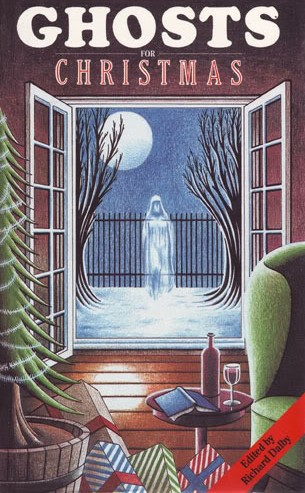
Ghosts
for Christmas, ed. Richard Dalby
(Michael O’Mara, 1988)
Chillers
for Christmas, ed. Richard Dalby
(Michael O’Mara, 1989)
Spirits
of Christmas, ed. Kathryn Cramer
& David G. Hartwell (Wynwood, 1989)
Horror
for Christmas, ed. Richard Dalby
(Michael O’Mara, 1992)
Shivers
for Christmas, ed. Richard Dalby
(Michael O’Mara, 1995)


