“Living Doll”
Season Five, Episode 126
Original Air Date: November 1, 1963
Cast:
Erich
Streator: Telly Savalas
Annabelle:
Mary LaRoche
Christie:
Tracy Stratford
Voice
of Talky Tina: June Foray
(uncredited)
Crew:
Writer:
Jerry Sohl (credited to co-plotter
Charles Beaumont)
Director:
Richard C. Sarafian
Producer:
William Froug
Director
of Photography: Robert Pittack
Production
Manager: Ralph W. Nelson
Art
Direction: George W. Davis and
Malcolm Brown
Film
Editor: Richard Heermance
Set
Decoration: Henry Grace and Robert R.
Benton
Assistant
Director: Charles Bonniwell, Jr.
Casting:
Patricia Rose
Music:
Bernard Herrmann
Sound:
Franklin Milton
Mr.
Serling’s Wardrobe: Eagle Clothes
Filmed
at MGM Studios
And Now, Mr. Serling:
“Next
on Twilight Zone a show that might very aptly be called “The Living End,” and with
comparable aptness is called “Living Doll.” It’s written by colleague and
cohort Charles Beaumont, and stars Telly Savalas and co-stars Mary LaRoche. Mr.
Beaumont supplies us with a little weirdy involving a man and a doll. It comes
well recommended. Next time out, “Living Doll.”
Rod Serling’s Opening Narration:
“Talky
Tina, the doll that does everything, a lifelike creation of plastic and springs
and painted smile. To Erich Streator, she is a most unwelcome addition to his
household. But without her, he’d never enter The Twilight Zone.”
Summary:
Annabelle
and her young daughter Christie arrive home from shopping with their arms laden
with packages. Annabelle instructs Christie to go directly upstairs to her bedroom
when they go inside the house. As they arrive inside, Erich Streator,
Annabelle’s husband and Christie’s stepfather, is seated at a desk in
the living room. He stops them before Christie can go upstairs to ask what they
purchased. Annabelle tells Erich it’s just a doll and Erich counters that
Christie doesn’t need another doll. Reluctantly, Annabelle tells Christie to
show “Daddy” her new doll.
Christie
places the large box on the coffee table and unwraps the strings that bind it. From
the box she removes a pretty doll in a plaid dress with pigtails, ribbons and
an impish grin. “She’s alive, Daddy,” Christie says, “and her name is Talky
Tina.” Erich fumes at the thought of how much a doll like that must cost.
Christie
winds a key in back of the doll and Talky Tina’s head and arms move as she
speaks in a child’s voice. “My name is Talky Tina and I love you very much.” Erich
pushes Annabelle on the cost of the doll and Annabelle counters that it isn’t really
the cost of the doll that bothers him. Erich derisively refers to the “Freudian”
ideas of Christie’s doctor. Annabelle tells him that it isn’t the doctor’s
fault that Christie feels rejected. This further angers Erich. When Christie
turns the key to activate Talky Tina again, Erich yells at the girl to “shut
that thing off!”
Christie
drops Talky Tina and dashes upstairs. Annabelle scolds Erich for speaking to
the girl that way and follows her daughter upstairs. Left alone, Erich walks
over and picks up the doll. He turns the key in back of the doll and is stunned
when Talky Tina says: “My name is Talky Tina and I don’t think I like you.” Not
believing what he’s just heard, Erich turns the key again. “My name is Talky
Tina and I think I could even hate you.”
Erich
flings the doll away from him. Talky Tina crashes against the far wall and
falls to the floor. Erich stares in disbelief as Talky Tina’s eyes slowly open
and she speaks. “My name is Talky Tina and you’ll be sorry.”
Annabelle
comes downstairs and looks at the doll lying on the floor. “I don’t like what
it says,” Erich tells her. Annabelle picks up the doll. Erich takes it from her
and attempts to demonstrate the strange things the doll says. He winds the key.
“My name is Talky Tina and I love you very much.” Erich shoves the doll at
Annabelle. “That’s not what it said a minute ago.”
Annabelle
confronts Erich about his anger toward Christie. Erich turns defensive, mocking
Annabelle for suggesting that he is incapable of loving children because they
can’t have children of their own. Annabelle denies this and suggests that he
could love Christie if he’d only give himself a chance. Annabelle says that she
knows Erich got the short end of a bargain when they married but that she and
Christie will do anything to make him happy.
Christie
comes downstairs and tells Erich she’s sorry for making him angry. Erich
relents and tells the girl it was all his fault. Annabelle gives Talky Tina to
Christie and the girl turns the key in back of the doll as she returns upstairs.
“My name is Talky Tina and I love you very much.”
Later,
at the dinner table, Talky Tina is seated next to Christie and the girl is
pretending to feed the doll from her plate. Erich looks at the doll and Talky
Tina winks at him. “I didn’t know your doll could wink,” he says to Christie.
“Tina can’t wink, Daddy,” Christie responds. Annabelle says that Tina will be
an ideal playmate for Christie, a statement which causes Erich to turn
defensive again, insinuating that Annabelle is mocking him for being unable to
produce a brother or sister for Christie, and that Annabelle bought the doll to
remind Erich of his impotence.
The
doorbell rings. It’s Christie’s friend Linda. Christie goes out to play,
leaving Talky Tina at the dinner table. Erich is left alone with the doll as
Annabelle carries the dinner dishes into the kitchen. Talky Tina activates as
Erich sits next to her. “My name is Talky Tina and I’m beginning to hate you.” Erich
chuckles as he says to the doll: “My name is Erich Streator and I’m gonna get
rid of you.”

Talky
Tina informs Erich that he wouldn’t dare get rid of her because Annabelle and
Christie would hate him, and she, the doll, would hate him. Erich places the
doll on the table in front of him and removes a pack of cigarettes from his
shirt pocket. Annabelle reenters the room and Erich explains that he’s seeing
how the doll works. When Annabelle leaves again, Erich strikes a match and dabs
the flame to the doll’s nose before lighting his cigarette. When the doll lets
out a small cry, Erich asks if it has feelings. “Doesn’t everything?” responds
Talky Tina. “Then I can hurt you,” Eric says. “Not really,” the doll responds,
“but I could hurt you.”
“Threats
from a doll,” Erich says in disbelief, chuckling uneasily. Annabelle reenters
the room. Erich pushes the doll across the table and stabs out his cigarette.
He tells Annabelle the game is over. Annabelle doesn’t know what he is talking
about. Erich believes Annabelle and Christie are playing a trick on him, using
a walkie-talkie to make Talky Tina say threatening things. Christie returns briefly to collect
Talky Tina to show the doll to her friend.
Annabelle
denies playing any tricks but Erich won’t let go of the idea, convinced she and
Christie are using microphones to affect the speech of the doll. Erich asks why
the doll doesn’t speak when Annabelle is in the room. Annabelle is stunned as
she realizes that Erich is serious. Erich storms out of the room, telling
Annabelle that she’ll be sorry for playing games and keeping secrets.
Erich
enters the garage calling for Christie where instead he finds Talky Tina alone.
The doll looks at him, seeming to be alive. Erich picks up the doll and opens
the lid to the trash can. “You are going be sorry,” says the doll as Erich
drops Talky Tina into the trash can and replaces the lid.
Later
that evening, Annabelle and Christie search for the doll. Erich denies any
knowledge of its whereabouts. Mother and daughter go upstairs to continue their
search. The telephone rings. Erich picks up the receiver and hears the doll’s
voice on the other end. “My name is Talky Tina and I’m going to kill you!”
The
line goes dead as Erich says “Hello?” and “Annabelle?” into the receiver. He
returns to the garage and removes the lid of the trash can. The doll is no
longer inside. Erich storms back into the house, calling for Annabelle. “Where
is she?” he demands, still convinced a trick is being played on him. Erich
admits to throwing the doll in the trash can and Annabelle is horrified by his
behavior. She swears to Erich that she is not playing a trick on him. It dawns
on Erich that it couldn’t have been Annabelle on the phone. He begins to
consider the horrifying possibility that the doll really is alive and trying to
harm him, but he clings to the notion that Christie is the one playing a trick
on him. He finds the girl asleep upstairs with the doll next to her in bed.

As
Erich approaches the bed, Talky Tina’s eyes open as she says: “I told you you’d
be sorry.” When Erich reaches for the doll, Talky Tina says: “Christie, Christie,
wake up, Christie.” The girl awakens and Erich wrestles the doll from her,
leaving the girl in tears. “Daddy! Daddy!” cries Christie. “I’m not your
Daddy!” Eric spitefully tells her as he leaves the room with the doll.
Erich
carries Talky Tina to the garage. He places the doll in a vice and tightens it
on the doll’s head. “Die!” he whispers to the doll. “You’ll die,” the doll
responds, giggling. Erich tries to burn the doll with a blowtorch but the flame
extinguishes each time he brings it near the doll. He removes the doll from the
vice and places it before an electric saw. He runs the saw against the doll’s
neck but cannot make a mark on the doll.
Annabelle
catches him in this insane act and tells him to stop this behavior. Erich
angrily pushes her away. As a last, desperate attempt to be rid of the doll,
Erich shoves Talky Tina into a burlap sack and binds it with rope. He drops the
doll into a trash can and stacks bricks on top of the lid.
Erich
finds Annabelle packing suitcases upstairs. Annabelle tells him that he’s
become a stranger to her, a sick, neurotic stranger, and that he needs to see a
doctor. “Tell him you tried to kill a doll.” Erich sits on the edge of the bed
and says he’ll give the doll back to Christie if it will make Annabelle change
her mind.
He
returns to the garage and removes the sack from the trash can. As he pulls the
doll from the sack, Talky Tina says: “My name is Talky Tina and I don’t forgive
you.” Erich pleads with the doll to shut up. He carries the doll back inside
the house and gives it to Christie.
Later
that night, Erich is awakened in bed by the sound of Talky Tina’s whirring
mechanism. He slowly gets out of bed to investigate. Annabelle wakes up but
Erich tells her to stay there. He first looks into Christie’s room. The girl is
asleep but the doll is not in bed with her. Erich looks around the room but
cannot find the doll. He hears the whirring mechanism of the doll in the
hallway. He walks to the edge of the stairs, listening. Erich takes two steps down
the stairs when his foot comes down on the body of the doll, sending him
tumbling violently down the length of the stairs.

Talky
Tina tumbles down the stairs and lands next to him. The doll is the last thing
Erich sees before he dies. Annabelle appears at the top of the stairs, calling
out Erich’s name. She rushes down the stairs to check on him, finding him dead.
Her hand picks up the doll next to his body. Talky Tina’s eyes slowly open as
she says: “My name is Talky Tina . . . and you’d better be nice to me.” Annabelle drops the doll in horror.
Rod Serling’s Closing Narration:
Of
course, we all know dolls can’t really talk, and they certainly can’t commit
murder. But to a child caught in the middle of turmoil and conflict, a doll can
become many things: friend, defender, guardian. Especially a doll like Talky
Tina, who did talk and did commit murder – in the misty region of The Twilight Zone.”
Commentary:
I.
Ghostwriting: Charles Beaumont and Jerry Sohl
.PNG) |
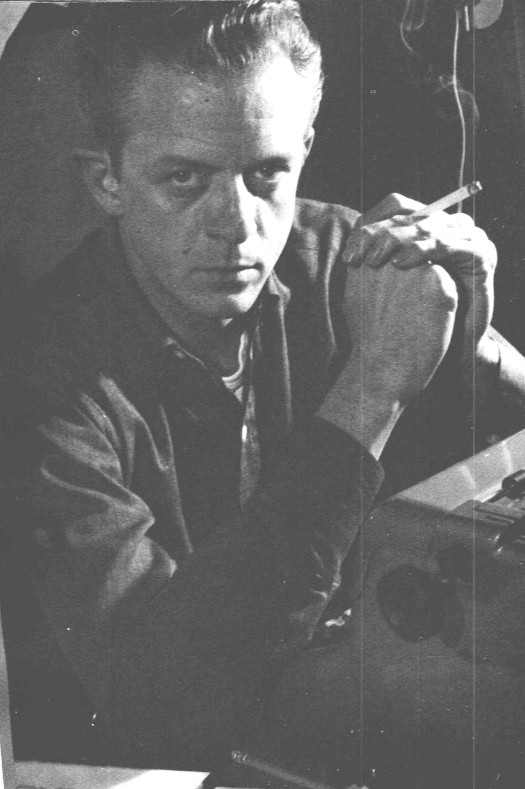
| Jerry Sohl in 1973 |
In
1977, when author Marc Scott Zicree began work on The Twilight Zone Companion (published in 1982), he contacted surviving
members of the series (actors, writers, directors, producers) for interviews.
When Zicree interviewed George Clayton Johnson, the writer of such memorable
episodes as “Nothing in the Dark,” “A Game of Pool,” and “Kick the Can,”
Johnson suggested Zicree interview Jerry Sohl, whom Johnson said would have an
interesting story to tell about The
Twilight Zone. Zicree knew Jerry Sohl (1913-2002) from Sohl’s science
fiction novels Costigan’s Needle (1953)
and Point Ultimate (1955), as well as
from Sohl’s scripts for Alfred Hitchcock
Presents, The Outer Limits, and Star
Trek. But Zicree could not connect Sohl with The Twilight Zone. There was a simple reason for this.
Jerry
Sohl never received a writing credit on The
Twilight Zone, although, as he revealed to Zicree, he wrote three teleplays
that were produced on the series, including “Living Doll.” The reason Sohl did
not receive credit on the series was that he ghostwrote the teleplays for his
friend Charles Beaumont, who received on-screen credit for the episodes.
 |
| Charles Beaumont in 1960 |
Charles Beaumont (1929-1967)
was second only to series creator Rod Serling in the production of scripts for The Twilight Zone, writing such
memorable episodes as “Perchance to Dream,” “Long Live Walter Jameson,” “The
Howling Man,” “Miniature,” and many more. Beaumont was not averse to
collaboration during his writing career, writing a collaborative novel under a
pseudonym with John Tomerlin (Run from
the Hunter by Keith Grantland) as well as many collaborative teleplays and
articles, some of which were solely credited to Beaumont. The numerous articles
Beaumont wrote for Playboy magazine,
for example, collected in Remember?
Remember? (1963), were often partially or entirely written by others. As
Beaumont’s biographer Roger Anker wrote, “Beaumont was always full of a
thousand ideas and a thousand projects, and approached them all with fantastic
energy.” However, Beaumont was “often so busy he would enlist the help of his
friends to complete the assignments.”
These friends included
such writers as William F. Nolan, John Tomerlin, OCee Ritch, George Clayton
Johnson, William Idelson, Ray Russell, and Jerry Sohl. The typical arrangement
was that Beaumont would acquire the assignment through his connections in
publishing, film, and television, work with the other writer on a basic plot or
outline, and then split the money fifty-fifty after the finished work was
turned in. Sometimes Beaumont and the other writer worked collaboratively on
the script or article, while other times the other writer solely composed the
work based on Beaumont’s story, idea, or outline. There are several examples of
this on The Twilight Zone, including
“The Prime Mover,” “Long Distance Call,” “Dead Man’s Shoes,” and “Number Twelve
Looks Just Like You,” episodes which credited Beaumont in collaboration with
another writer. Then there are the three episodes written by Jerry Sohl, which
solely credit Beaumont.
Jerry Sohl was initially
reluctant to reveal his role on The
Twilight Zone to Marc Scott Zicree (the ghostwriting was a violation of
Writers Guild rules) but eventually related his involvement with the series and
the method of his collaborations with Charles Beaumont. Beaumont and Sohl would
typically meet on a Sunday in a coffee shop or restaurant. The two writers
would then verbally work out the plot for an episode from Beaumont’s initial
idea. Once the story was established, Beaumont would pitch the idea to
producers on the series, sometimes with a written outline. If the pitch was
accepted, Sohl would write the script and Beaumont would turn it in. Beaumont,
as the contracted writer on the series, was responsible for revisions to the
script during production. Of the three episodes written by Sohl, the others
being “The New Exhibit,” from the fourth season, and the later fifth season
episode “Queen of the Nile,” “Living Doll” saw the most changes from script to
screen, making the episode perhaps the most purely collaborative of the three. More
on this in a moment.
Beaumont initially used ghostwriters or
uncredited collaborators as a means to complete the large number of assignments
for which he’d been contracted. As writer William F. Nolan related to Marc
Scott Zicree: “He’d have like five different TV scripts, a movie script that
he’s supposed to be working on – and each one, the producers thought Beaumont
was working on exclusively. But meanwhile, he’d have OCee Ritch holed up in one
part of the city writing a draft of one, he’d have Jerry Sohl holed up writing
a draft of another, John Tomerlin would be writing a draft of a third, I’d be
polishing a magazine article for him, he’d be trying to get the movie written,
Ray Russell would be working with him on a Roger Corman project, and he’d just
be running and running, making different appointments.”
By the middle of 1963,
however, Beaumont’s need for ghostwriters was due to a different, and more
tragic, reason. Beaumont began exhibiting the symptoms (advanced aging, memory
loss, speech impairment, rapid physical decline) of the early-onset Dementia
that would ultimately take his life on February 21, 1967. Beaumont was only thirty-eight
years old at the time of his death. The true nature of the disease that took
Beaumont’s life has not been firmly established. At the time of his diagnosis
by doctors at UCLA in 1964, it was believed to be either Alzheimer’s or Pick’s
Disease. Some of Beaumont’s friends, however, believed the writer may have
fallen victim to Bromide poisoning, due to the large amounts of Bromo-Seltzer Beaumont
ingested to battle chronic headaches.
During production on
the fifth season of The Twilight Zone, Beaumont
was, for a time, still able to meet with producers and pitch ideas for the
series, though his ability to write scripts rapidly diminished. Jerry Sohl
wrote scripts for the series, without receiving credit or the benefits that
came along with credit, as a means of helping the Beaumont family, which
included four young children, during Charles Beaumont’s growing health crisis. Although
Sohl later told Marc Scott Zicree it was foolish on his part to write the
scripts without receiving credit, he also acknowledged that it ultimately freed
him from having to deal with producers or directors, allowing him to simply
write.
Beaumont had a close
circle of friends who were shocked, saddened, and angered by the diagnosis of
an incurable, terminal disease for the talented writer. Although his friends
and family were helpless to stop the effects of the disease, efforts were made
to assist the Beaumont family during Charles Beaumont’s decline, including the
publication of the aforementioned Remember?
Remember? as well as a collection of Beaumont’s best stories, The Magic Man and Other Science-Fantasy
Stories, published in 1964 by Fawcett Crest with a foreword by Ray Bradbury
and an afterword by Richard Matheson. John Tomerlin also wrote the fifth season
Twilight Zone episode, “Number Twelve
Looks Just Like You,” based on Beaumont’s 1952 story “The Beautiful People,”
sharing credit for the script with Beaumont.

The final script
written entirely by Beaumont for The
Twilight Zone was the fourth season’s “Passage on the Lady Anne,” based on his
story “Song for a Lady” from his 1960 collection Night Ride and Other Journeys. Another Beaumont script, “Gentlemen,
Be Seated,” based on his story from the April, 1960 issue of Rogue, was slated for production during
the fifth season but went unproduced on the series. The same fate befell two
scripts by Jerry Sohl, “Who Am I?” and “Pattern for Doomsday,” scripts which
would have properly credited Sohl on the series. All three of these scripts
have been published. “Gentlemen, Be Seated” appeared in The Twilight Zone Scripts of Charles Beaumont, Volume One, edited
by Roger Anker (Gauntlet Press, 2004), while Sohl’s unproduced scripts appeared
in Filet of Sohl, edited by
Christopher Conlon (BearManor Media, 2003). Charles Beaumont’s original outline
for “Pattern for Doomsday” was published in Forgotten
Gems from the Twilight Zone, Volume 1, edited by Andrew Ramage (BearManor
Media, 2005).

Since the publication
of The Twilight Zone Companion, Jerry
Sohl has been acknowledged numerous times for his contributions as writer on
the series. Furthermore, Sohl is now recognized as the author of one of the
most memorable episodes of the entire series, as “Living Doll” is regularly
placed near the top of any poll of the best episodes and is used prominently in
marketing the series. Sohl gave several interviews in the latter portion of his
life in which he discussed his role on the series, resulting in Sohl now being firmly
established as the writer of “The New Exhibit,” “Living Doll,” and “Queen of
the Nile.” This latter episode, which also aired during the fifth season, was,
despite its similarities to Beaumont’s first season episode “Long Live Walter
Jameson,” the only one of the three episodes written by Sohl under Beaumont’s
name based entirely on Sohl’s idea, which was inspired by a scarab ring that
had been gifted to Sohl.

Final validation for
Jerry Sohl’s contributions to the series came twofold upon the writer’s passing
on November 4, 2002. The Los Angeles
Times noted in their obituary Sohl’s work on such television series as Alfred Hitchcock Presents, Star Trek, The
Outer Limits, Route 66, Naked City, and The
Twilight Zone. More importantly, The
Twilight Zone Scripts of Jerry Sohl, edited by Christopher Conlon, appeared
in 2004, finally collecting Sohl’s scripts for the series under his name.
II.
Creating “Living Doll”
Few
television series respected the work of the writer to the degree of The Twilight Zone. Rod Serling, perhaps
the greatest television writer in the history of the medium, created the series
largely for the purpose of writing teleplays free from meddling censors. Serling
fought to ensure that the writers he brought to the series received the same
level of respect for their work. Even so, it was rare for an episode to be
filmed exactly as written, as elements such as production limitations often
required revisions to the teleplay. Occasionally, the dramatic structure of the
teleplay was altered to achieve a desired effect of character, narrative, or
staging, as in “Long Distance Call” or “A Game of Pool.”
.jpg) |
| Cover art by David Christiana |
Although the structure
of the story remained intact, “Living Doll” saw a number of changes, some small,
some significant, from Jerry Sohl’s original teleplay. Although there is no way
of knowing for certain, especially considering the state of Charles Beaumont’s
health at the time, it is reasonable to assume that Beaumont, as the contracted
writer, performed the revisions to “Living Doll.” Let’s look at alterations to
the script in its transition to the screen.
The
most significant alteration is that Erich Streator is Christie’s father in the
original teleplay. The character was changed to Christie’s stepfather in the
episode. This change was likely made to further distance the character from the
sympathies of the audience. Many viewers see Erich as an ogre, undeserving of
any sympathy in his plight. Radio host George Noory, who contributed a
commentary for the episode alongside Marc Scott Zicree, several times refers to
Erich Streator as “evil,” giving some indication of the average response to the
character. In the original teleplay, Erich is certainly unpleasant at times,
but he is less the unloving bully presented in the episode.
This change required
the addition of a significant amount of dialogue, which in turn required the
removal of incidents in the original script. These cuts resulted in an
occasional rough transition in the episode, as we will see in a moment.
To
achieve the change from father to stepfather, dialogue concerning the “Freudian
gibberish” of Christie’s doctor was added, as was Annabelle’s response that
Christie feels rejected. Later, a significant scene was added in which
Annabelle tells Erich she can no longer tolerate his anger toward Christie. She
pleads with Erich to accept Christie and to try and find it in his heart to
love her. Also added was the shocking moment late in the episode when Erich
spitefully tells Christie: “I’m not your Daddy!” Dialogue was also added when
Annabelle is packing suitcases in which she tells Erich that she can’t let him
treat her daughter this way.
Scenes
from the original teleplay that were excised to accommodate this new material
include a scene after Erich throws Talky Tina against the wall in which
Christie comes back into the room and Erich reluctantly hands the doll to the
girl. There is also a scene later in the story in which Erich offers to buy a
different doll for Christie.
A more significant
excised scene involved Christie and her friend Linda, the latter of whom has a
speaking role in the original teleplay. After the scene at the dinner table,
Erich finds the girls outside in front of the house, playing with Talky Tina.
Erich gives the girls money for the ice cream van down the street but instructs
Christie to leave the doll behind. After the girls set off for ice cream, Erich
takes the doll to the garage, where he throws the doll in the trash. This scene
makes the later statement made by Christie when looking for the doll, “You had
her, Daddy,” make sense.
In
the dinner scene in the episode, after Christie returns to retrieve Talky Tina and
takes the doll outside, Erich argues with Annabelle for a moment and then walks
to the garage. There he finds Talky Tina alone, only minutes after Christie
took the doll, compressing the pace of the transition.
Despite such changes
removing, or altering, the narrative bridges in Sohl’s original teleplay, changes
apparent only on comparison between the original teleplay and the finished
episode, it offers a view of the construction of one of the finest episodes of
the series, from verbal development to outline to script to finished episode.
Furthermore, the fantasy is so brilliantly developed in the episode, so
concisely staged and effectively performed, that the viewer hardly notices any
compression of narrative. We’re simply drawn effortlessly along as events
unfold, believing every moment in this man’s battle with a toy doll. Such is a
major part of the enduring appeal of the series, this naturalistic staging of
the fantastic intruding upon everyday life.
Additional,
less significant changes were also made. These include the moment in the
episode at the dinner table when Talky Tina winks at Erich. In the original
teleplay, the doll’s staring eyes disturb Erich and he asks Christie to close
them. Later in the same scene, Erich dabs the flame from a match on the nose of
the doll. In the original teleplay, Erich twists the doll’s leg to get a reaction.
Changes were also made concerning Erich’s efforts to destroy the doll. In the
original teleplay, Erich places the doll in a broiler and attempts to light the
doll’s clothes on fire with matches. When this doesn’t work (the doll’s clothes
won’t catch fire), Erich attempts to cut off the doll’s head with a large
cooking knife, again to no avail. This resulted in a small change to dialogue.
In the episode, Annabelle tells Erich to see a doctor. “Tell him you tried to
kill a doll,” she says. The original teleplay has this line as: “Tell him you
burned a doll.” To which Erich gloomily responds: “I didn’t burn it.”
Changes
in the appearance of Talky Tina were also made for the episode. In the original
teleplay, Talky Tina is larger and less attractive. Sohl writes: “She withdraws
an ugly doll about half her size.” Erich’s line in the original teleplay, “For
heaven’s sake, Annabelle, a doll that big -” is thus changed to: “For heaven’s
sake, Annabelle, a doll like that would cost -”
In
the original teleplay, Talky Tina is equipped with a key that activates her
head and arms as well as a pull-ring on the side of her neck which activates
her speech function. In the episode, the key, when turned, activates both
effects, since the voice of Talky Tina, provided by veteran voice actress June
Foray (1917-2017), was added in post-production. Jerry Sohl likely had the
popular Chatty Cathy doll from Mattel in mind when creating Talky Tina, thus
the alliterative name and the presence of a pull-ring to make the doll speak, both
features of Chatty Cathy.
Chatty Cathy was
developed by Ruth Handler (1916-2002) at Mattel in 1959 and introduced the
following year as the first mass market doll that spoke. Handler, who founded
Mattel with her husband Elliot in 1945, is remembered as the creator of the
Barbie doll. Chatty Cathy was created to offer a larger, younger doll in
contrast to the small, adult Barbie. Chatty Cathy spoke eleven phrases via an
innovative sound system designed by Mattel employee Jack Ryan. Furthermore, the
voice of Chatty Cathy was provided by the aforementioned June Foray, which may
have led to Foray being hired to voice Talky Tina for “Living Doll.” Either way,
Foray does a wonderful job capturing both the initial sweetness and growing malevolence
of Talky Tina. “Living Doll” remains, despite Foray having voiced numerous
cartoon characters, including Rocky the Flying Squirrel and several characters
for Warner Brothers, one of her signature performances. Foray, who passed away
in 2017, also contributed voice work to the final episode of The Twilight Zone, “The Bewitchin’
Pool.”
 |
| via WorthPoint |
The doll licensed for
use in the episode, however, was not Chatty Cathy but rather Brikette from the
Vogue Doll Company (pictured), a doll introduced in 1959 as a companion to the company’s
popular Ginny doll. Brikette, “the red-headed doll with the impish grin,” was
not a talking doll, and brunette and platinum versions of the doll were also
offered. It is likely that many families viewing “Living Doll” on its initial broadcast,
or soon afterwards, were familiar with a doll like Talky Tina from the dolls in
their own homes.
The
production crew, including prolific director and occasional actor Richard
Sarafian (1930-2013), in his only credit on the series, and cinematographer
Robert Pittack (1899-1976), did an outstanding job of giving life to Talky
Tina, aided by Foray’s performance and the doll’s impish grin and expressive
eyes, which were wonderfully manipulated along with the doll’s head and arms to
give the doll a semblance of life. This is particularly effective in the final
scene, aided by a rare but expert use of slow-motion, where Talky Tina warns
Annabelle after the death of Erich. This scene also functions to dispel the
notion that the events could be interpreted as having taken place in Erich’s
mind. With this powerful final scene, Jerry Sohl avoided the ambiguity that
marred the denouement of his earlier episode, “The New Exhibit.”
.PNG)
A viewer who wishes to
own Talky Tina could purchase an original Brikette doll or a talking replica, offered
in color (pictured) and black and white, released in 2013 by the toy company Bif Bang Pow!
Talky Tina may be the
star attraction but she is supported by a small but strong cast in a closely
contained episode. Telly Savalas (1922-1994) is familiar to most television
viewers of a certain age from his Emmy Award-winning role in the series Kojak (1973-1978), spun off from the
television film The Marcus-Nelson Murders
(1973). Savalas returned to the role of the lollipop-loving Lt. Theo Kojak after
the series ended for a series of television films. Savalas, a WWII veteran and
Peabody Award-winning radio host, landed in television in 1959 during a chance
audition for the CBS anthology series Armstrong
Circle Theatre. Savalas is remembered for his bald appearance and
commanding presence and for his roles as tough guys, if not outright sinister
characters like Erich Streator in “Living Doll.” Some of Savalas’s most
memorable work came alongside Burt Lancaster in the John Frankenheimer films The Young Savages (1961) and Birdman of Alcatraz (1962), the latter
of which earned the actor an Academy Award nomination. Savalas is also
remembered for roles in such films as Cape
Fear (1962), The Dirty Dozen (1967),
On Her Majesty’s Secret Service (1969),
and Kelly’s Heroes (1970).
 |
| Telly Savalas |
Savalas’s career on the
small screen included appearances on The
Alfred Hitchcock Hour, Kraft Suspense Theatre, and Tales of the Unexpected, among many others. Savalas appeared on the second season of The Alfred Hitchcock Hour in “A Matter of Murder,” directed by
David Lowell Rich, a producer on the series, who also helmed the fourth season Twilight Zone episode “Of Late I Think
of Cliffordville.” Savalas appeared in two episodes during the first season of Kraft Suspense Theatre, appearing
alongside such Twilight Zone performers
as Jack Warden, Oscar Beregi, Jr., Ed Kemmer, and Paul Comi. Savalas was
directed on the series by Sydney Pollack, who appeared on The Twilight Zone as the gruff theater director Arthur Willis in “The Trouble with Templeton,” and an
uncredited Leslie Stevens, creator of The
Outer Limits. In 1981, Savalas appeared on the fourth series of Roald
Dahl’s anthology series Tales of the
Unexpected in the episode “Completely Foolproof,” based on a story by
Robert Arthur from the March, 1958 issue of Alfred
Hitchcock’s Mystery Magazine. Arthur’s story was previously adapted for the
third season of The Alfred Hitchcock Hour
and featured Twilight Zone actress
Patricia Barry.
 |
| Mary LaRoche |
Savalas is supported in
“Living Doll” by two familiar faces on The
Twilight Zone, Mary LaRoche and Tracy Stratford. Mary LaRoche (1920-1999), alternately billed as Mary La Roche, is
remembered for her roles as screen mother to young actresses Sandra Dee and
Ann-Margret in the films Gidget (1959)
and Bye Bye Birdie (1963),
respectively. LaRoche previously appeared on The Twilight Zone in the final episode of the first season as Mary, the (second) perfect wife
created by playwright Gregory West (Keenan Wynn) via dictation machine in
Richard Matheson’s “A World of His Own.” LaRoche also appeared alongside Ray
Milland and Virginia Gregg (Twilight
Zone’s “Jess-Belle” and “The
Masks”) on The Alfred Hitchcock Hour in
“A Home Away from Home,” the opening episode of the second season scripted by
Robert Bloch from his story published in the June, 1961 issue of Alfred Hitchcock’s Mystery Magazine.
Tracy Stratford (b.
1955) was last seen on The Twilight Zone
as Tina Miller, the “Little Girl Lost” in the excellent third season episode
scripted by Richard Matheson. Stratford’s voice was dubbed by actress Rhoda
Williams in “Little Girl Lost,” which slightly mars that episode, but the young
actress is more than capable of using her own voice to elicit a great amount of
sympathy for Christie in “Living Doll.”
The last, but certainly
not least, element that contributes to the success of “Living Doll” is the
original score by Bernard Herrmann (1911-1975). The spare and haunting woodwind
and harp composition Herrmann provided for “Living Doll” is one of only eight
original compositions Herrmann created for the series. Herrmann’s presence on
the series is seemingly ubiquitous, however, due to the show’s frequent use of Herrmann’s
contributions to the CBS music library. Herrmann composed a final original
score for the series later in the fifth season for “Ninety Years Without
Slumbering.”
III.
Night Gallery: “The Doll”
The Twilight Zone explored the theme of
dolls in such varied episodes as “The After Hours,” “Five Characters in Search of an Exit,” and “Miniature,” and presented stories in which characters
figuratively assume the role of dolls in such episodes as “The Little People”
and “Stopover in a Quiet Town.” “Living Doll,” with its tale of a vengeful
guardian protecting a child from an abusive parent, is very different from the
bittersweet or ironic treatments of the doll theme in other episodes of the
series. More in-line with “Living Doll” is “The Doll,” the memorable first
season segment from Rod Serling’s Night
Gallery.

Adapted by Rod Serling
from the story by Algernon Blackwood, directed by Rudi Dorn, “The Doll” tells
of Colonel Hymber Masters (John Williams), who returns to England after service
in India to take guardianship of his orphaned niece, Monica (Jewel Blanch). A
package containing a doll was delivered to the Colonel’s residence prior to the
Colonel’s arrival. Although the doll is frightening in appearance, Monica
refuses to part with the doll. Colonel Masters explains to Monica’s governess,
Miss Danton (Shani Wallis), who believed the Colonel sent the doll as a present
for his niece, that the doll was not sent by him nor was it meant for Monica
but rather for him. He also explains that the doll is dangerous and that they
must get the doll away from Monica without mentioning their intentions in the
presence of the doll.
The Colonel buys a new
doll for Monica but the other doll tears it to pieces. He attempts to get rid
of the doll but it returns to Monica. Colonel Masters is visited by an Indian man
named Pandit Chola (Henry Silva), an occultist who has sent the doll as vengeance
for the death of his brother, who was executed under orders from Colonel
Masters. The man tells the Colonel that the doll will never stop and will
always return until its task is complete. “The doll has teeth,” Chola warns
Colonel Masters before leaving, “and there is no medicine on earth to save you.”
Colonel Masters hears
Monica crying upstairs in her bedroom moments later. With fireplace poker in hand, he
rushes upstairs only to face the hideous doll at the top of the stairs. Miss
Danton rushes to Monica’s bedroom to comfort the girl, who tearfully tells her
governess that she’s seen the doll walk out of her bedroom. Miss Danton and Monica
hear the Colonel cry out. Miss Danton finds him on the stairs with a bloody
gash on his arm being tended to by a manservant.
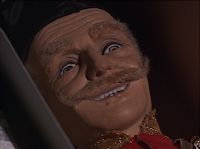
The Colonel instructs
Miss Danton to pick up the doll where it lay on the stairs and take it to his
study. In the study, Colonel Masters throws the doll into the fire in the grate.
“Now it’s destructible,” he tells Miss Danton. “Now that it’s done its job.”
Colonel Masters collapses into a chair, dying from his wound. He knew this day
would come and he has prepared for it. He instructs Miss Danton to remove a
sealed envelope from the top drawer of his dresser and to immediately deliver
it to the Indian man to whom it is addressed. “Tell him the thing has
happened.” The Colonel tells Miss Danton that he has a considerable life insurance
policy and that he took the precaution of making a will which names her as
executrix of his estate. He then asks Miss Danton to take care of Monica, to
take the girl to some other place where there are other children. With this, Colonel
Masters dies.
Sometime later, Pandit
Chola is in his lodgings hurriedly packing in order to make his escape. There
is a knock at the door. It is a messenger with a package, a gift from Colonel
Masters. Chola unwraps the package to find a doll in the image of Colonel
Masters. The eyes of the doll open and it bares its teeth in a menacing grin.
.jpg) |
| Cover art by Ronald Clyne |
Algernon Blackwood
(1869-1951) is one of the pillars of English supernatural fiction and the prolific
author of such classic tales as “The Willows” (1907), “The Wendigo” (1910), the
John Silence occult detective stories, and many, many others. “The Doll,” written
late in Blackwood’s career, first appeared in The Doll and One Other, published by Arkham House in 1946. Arkham
House publisher August Derleth reprinted the tale the following year in his
anthology The Sleeping and the Dead:
Thirty Uncanny Tales (published by Pellegrini & Cudahy). “The Doll” was
collected in Blackwood’s Tales of the
Uncanny and Supernatural, published by Peter Nevill in 1949. The story has
been reprinted a number of times in anthologies of supernatural fiction, but
its novelette length has prevented it from appearing as often as other
Blackwood stories.
 |
| John Williams |
Despite a hurried and
somewhat troubled production, “The
Doll” remains one of the most effective and fondly remembered segments from Night Gallery. John Williams (1903-1983), playing
the staunch colonial soldier Colonel Masters, is a familiar face on the small
screen. He appeared on The Twilight Zone as
William Shakespeare in Rod Serling’s fourth season farce “The Bard,” as well as
in several episodes of Alfred Hitchcock Presents.
Williams also appeared in such Hitchcock films as Dial M for Murder (1954) and To
Catch a Thief (1955).
The memorably creepy
doll in the segment is never seen committing an act, its movements kept hidden
from the viewer, but it is effectively posed to give it a semblance of menacing
intelligence. Once seen, the image of the doll is difficult to forget. The
design and construction of the doll was the work of sculptor Chris Mueller (1906-1987),
whose career in films included work on The Creature from the Black Lagoon (1954), 20,000 Leagues Under the Sea (1954), This Island Earth (1955), and Jaws 2 (1978).
Rod Serling’s script
required changes from Blackwood’s story, largely due to the time limitations of
the segment and the novelette length of Blackwood’s tale. Serling changed the
relationship between Colonel Masters and Monica from father-daughter to
uncle-niece, and added details of Colonel Masters’s actions in India which
brought about the doll’s vengeance (Blackwood leaves out these details). The
character of Pandit Chola is also Serling’s creation, as it is a largely silent
and unnamed man in Blackwood’s story, a character fleeting in appearance. Serling
likely added Chola to create a speaking role for dramatic effect, and to
achieve the epilogue to the segment. This twist ending, in which Colonel
Masters sends a vengeful doll of his own, is also Serling’s addition to the
tale. In Blackwood’s story, the doll bites Colonel Masters on the throat in
Monica’s bedroom, almost like the bite of an insect. Masters casually throws
the doll away from him and the doll is removed from the story by the hand of an
unseen person through Monica’s bedroom window. Masters accepts his fate and
dies quietly in his study.
Blackwood tells the
story from the perspective of Monica’s Polish governess, Madame Jodzka, who
shares the strange experiences concerning the doll with the cook and a maid
before spurring Colonel Masters into action to protect Monica and thus seal his
fate.
Blackwood’s tale has in
common with many other tales of dolls in horror and fantasy fiction the element
of magic, typically some form of witchcraft, as the engine which drives the
machinations of the doll. Talky Tina is driven by no such engine, at least none
that is revealed to the viewer. The final sequence of the episode dispels the
notion that the actions of Talky Tina were the product of Erich Streator’s
mind. Could it be that the doll is spurred by the rage and resentment in
Streator’s character, like the machines that attack Bartlett Finchley in Rod
Serling’s first season episode “A Thing About Machines,” or the household items
that destroy the unfortunate protagonist of Richard Matheson’s story “Mad
House” (1953)? There is no way of knowing, nor does the story need to reveal
this to function as effectively as it does. It is, in part, this unnerving
ambiguity which lends a timelessness to the episode, and has allowed the
episode to remain highly memorable and effective even amid the wave of numerous
imitators that have followed in its wake. I give it my highest recommendation.
Grade:
A+
See Also: "Jerry Sohl's Legacy in The Twilight Zone"
Next
Month in the Vortex: We continue our episode guide with a look at “The Old
Man in the Cave,” starring James Coburn and John Anderson, directed by Alan
Crosland, Jr., and scripted by Rod Serling from a story by Henry Slesar. Thanks
for reading!
Acknowledgments:
-The
Twilight Zone Companion (3rd
ed.) by Marc Scott Zicree (Silman-James, 2018)
-The
Twilight Zone: Unlocking the Door to a Television Classic by Martin Grams, Jr. (OTR, 2008)
-A
Critical History of Television’s The Twilight Zone, 1959-1964 by Don Presnell and Marty McGee (McFarland & Co.,
1998)
-Rod
Serling’s Night Gallery: An After-Hours Tour by Scott Skelton and Jim Benson (Syracuse University Press, 1999)
-“Introduction: Jerry Sohl and The Twilight Zone” by Christopher Conlon
(The Twilight Zone Scripts of Jerry Sohl,
edited by Christopher Conlon (BearManor Media, 2004))
-“The Ghost in the Zone” by Marc Scott
Zicree (Filet of Sohl, edited by
Christopher Conlon (BearManor Media, 2003))
-Commentary on “Living Doll” by Gary
Gerani (The Twilight Zone: The 5th
Dimension DVD Box Set, 2014)
-Commentary on “Living Doll” by Marc
Scott Zicree and George Noory (The
Twilight Zone: The 5th Dimension Box Set, 2014)
-“Living Doll” (teleplay) by Jerry Sohl
(as by Charles Beaumont) (Rod Serling’s
The Twilight Zone Magazine, December, 1982)
-“Remembering Charles Beaumont” by Roger
Anker (Rod Serling’s The Twilight Zone
Magazine, June, 1989)
-Chatty
Cathy Documentary (Mattel Creative
Advertising Services, 1998)
-The Internet Speculative Fiction
Database (isfdb.org)
-The Internet Movie Database (imdb.com)
Notes:
--Jerry
Sohl also wrote the teleplays (uncredited) for the fourth season episode, “The
New Exhibit,” and the fifth season episode, “Queen of the Nile.”
--Mary
LaRoche also appeared in the first season episode, “A World of His Own.”
--Tracy
Stratford also appeared in the third season episode, “Little Girl Lost.”
--June
Foray also provided uncredited voice work for the fifth season episode, “The
Bewitchin’ Pool.”
--“Living
Doll” was adapted as a Twilight Zone
Radio Drama starring Tim Kazurinsky.
--The
teleplay for “Living Doll” was first printed, as by Charles Beaumont, in the
December, 1982 issue of Rod Serling’s
The Twilight Zone Magazine. Editor T.E.D.
Klein wrote: “Charles Beaumont (1929-1967) was one of the most formidable
talents ever to write for The Twilight Zone, though in the work he produced toward the end of his life – as in this
issue’s Living Doll – it’s important
to acknowledge the significant contribution of fellow writer Jerry Sohl.” The
teleplay for “Living Doll” was collected in The Twilight Zone Scripts of
Jerry Sohl, edited by Christopher Conlon
(BearManor Media, 2004).
--In The Work of Charles Beaumont: An Annotated Bibliography and Guide (Bibliographies of Modern Authors No. 6) by William F. Nolan (Borgo Press, 1986), Nolan provides this entry for "Living Doll": page 34, item E 30: "Living Doll," ghost-written by Jerry Sohl, produced for The Twilight Zone, first aired on November 1, 1963. Adapted from an unpublished story by Beaumont and Sohl.
--A
Shirley Temple doll that may be an homage to Talky Tina can be seen seated on a
sofa in the queue at The Twilight
Zone Tower of Terror in Walt Disney
World.
--Those
interested in additional reading on the topic of dolls in horror and fantasy
fiction are directed to three anthologies: The Haunted Dolls, edited
by Seon Manley and Gogo Lewis (Doubleday, 1980), which contains Algernon
Blackwood’s “The Doll,” Doubles, Dummies and Dolls: 21 Terror Tales of
Replication, edited by Leonard Wolf
(Newmarket Press, 1995), and a recent selection of tales, Deadly Dolls: Haunting Tales of the Uncanny, edited by Elizabeth Dearnley (British Library, 2024), part of the British Library's Tales of the Weird publication series. Also of interest are Sigmund Freud's 1919 paper on The Uncanny (Das Unheimliche), centered on dolls and doppelgangers, and The Guide to Supernatural Fiction by E.F. Bleiler (Kent State University
Press, 1983), which lists and describes dozens of novels and stories on the
theme.
--In an interesting connection within the subjects of this post, Ronald Clyne, the cover artist for Algernon Blackwood's The Doll and One Other (Arkham House, 1946), was a friend and collaborator of Charles Beaumont. Beaumont and Clyne grew up in Chicago and entered science fiction fandom as teenagers. Roger Anker, in his introduction to Charles Beaumont: Selected Stories (1988), describes Beaumont's relatively brief career as a pulp illustrator. Anker writes that, in the early 1940s, Beaumont's "interests then shifted from typewriter to drawing board and his illustrations began to appear in a number of pulp magazines under the brush name E.T. Beaumont. His first cartoon, done in collaboration with his friend and fellow artist, Ronald Clyne, appeared in Fantastic Adventures in October, 1943." Ronald Clyne (1925-2006) provided the cover for Charles Beaumont's first collection of stories, The Hunger and Other Stories (1957) and for Beaumont's novel The Intruder (1959), as by Robert Clyne. Clyne contributed several cover illustrations for Arkham House in the 1940s, including for books by J. Sheridan LeFanu, H.P. Lovecraft, H. Russell Wakefield, Robert Bloch, A.E. Coppard, Henry S. Whitehead, Carl Jacobi, Fritz Leiber, and Arkham House publisher August Derleth. Clyne also provided covers for The Arkham Sampler and Weird Tales, and continued working for Arkham House (and other fantasy and SF publishers) into the early 1970s.
-JP


.jpg)


 Martine Bartlett was also
active in television during the 1960s including a role in the miniseries Sybil
in 1976. Her most recognizable role was as Miss Metcalf in Elia Kazan’s
Splendor in the Grass (1961).
Martine Bartlett was also
active in television during the 1960s including a role in the miniseries Sybil
in 1976. Her most recognizable role was as Miss Metcalf in Elia Kazan’s
Splendor in the Grass (1961). 


.PNG)


.jpg)

.PNG)


.jpg)

