|
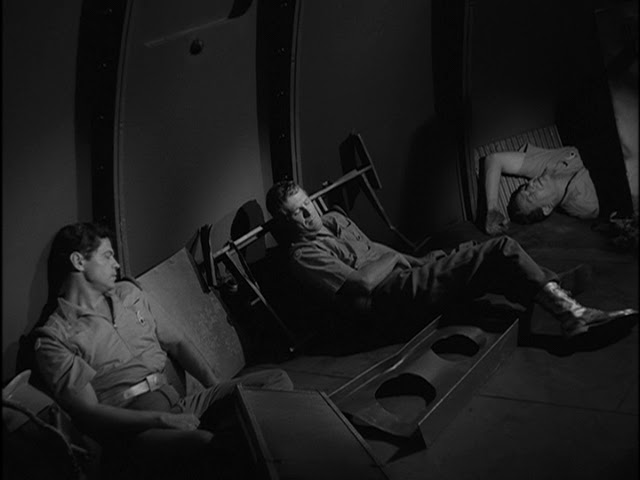
| Picture of the crew of E-89. From left: Jack Klugman, Ross Martin, Fredrick Beir |
“Death Ship”
Season Four, Episode 108
Original
Air Date: February 7, 1963
Cast:
Cpt.
Ross: Jack Klugman
Lt.
Mason: Ross Martin
Lt.
Carter: Frederick Beir
Ruth:
Mary Webster
Kramer:
Ross Elliott
Mrs.
Nolan: Sara Taft
Jeannie:
Tammy Marihugh
Crew:
Writer:
Richard Matheson (based on his story)
Director:
Don Medford
Producer:
Herbert Hirschman
Director
of Photography: Robert Pittack
Production
Manager: Ralph W. Nelson
Assistant
to the Producer: John Conwell
Art
Direction: George W. Davis &
Edward Carfagno
Film
Editor: Richard W. Farrell
Set
Decoration: Henry Grace & Edward
M. Parker
Assistant
Director: Ray De Camp
Sound:
Franklin Milton & Joe Edmondson
Music:
stock
Optical
Effects: Pacific Title
Rod Serling’s Wardrobe provided by Eagle
Clothes
Filmed at Metro-Goldwyn-Mayer Studios
And Now, Mr. Serling:
“Mr.
Richard Matheson lets his typewriter pay us a return visit next time out on
Twilight Zone with a story called ‘Death Ship.’ Now, this one is for science
fiction aficionados, ghost story buffs, and any and all who file away clues
with an eye toward out-guessing the writer. Next on Twilight Zone Messrs. Jack
Klugman, Ross Martin, and Fred Beir take an extended trip through space on
‘Death Ship.’"

“Picture
of the spaceship E-89, cruising above the thirteenth planet of star system
fifty-one, the year 1997. In a little while, supposedly, the ship will be
landed and specimens taken: vegetable, mineral, and, if any, animal. These will
be brought back to overpopulated Earth where technicians will evaluate them
and, if everything is satisfactory, stamp their findings with the word
‘inhabitable,’ and open up yet another planet for colonization. These are the
things that are supposed to happen.
“Picture
of the crew of the spaceship E-89: Captain Ross, Lieutenant Mason, Lieutenant
Carter. Three men who have just reached a place which is as far from home as
they will ever be. Three men who in a matter of minutes will be plunged into
the darkest nightmare reaches of The Twilight Zone.”
Summary:

The
Spaceship E-89 scans an unexplored planet while cruising high above the surface.
Lt. Mason sees a blip on the view screen, a possible indication of life on the
planet below. The crew, which also includes Capt. Ross and Lt. Carter, gathers
around the view screen. Capt. Ross quickly assumes a stern command of the
situation and tampers the excitement of the other two men. Though Capt. Ross is
wary of landing on the planet, the other men convince him otherwise.
E-89
makes a smooth landing but the crew is horrified to see a ship exactly like
their own crashed nearby. After a show of tension with Lt. Mason, Capt. Ross
reluctantly agrees to explore the crashed ship. Inside, the men are further
horrified to discover what appears to be their own dead bodies. Capt. Ross
dismisses the grisly discovery as deception and orders the men back to their
ship.
Capt.
Ross comes to the conclusion that what they have witnessed is only a possible
future, perhaps one created by their passage through a time warp. It is an
outcome which will only occur if they take off again. He decides they are to
remain on the planet’s surface indefinitely. The other men staunchly oppose
this drastic measure but are overruled by their captain.
Lt.
Carter closes his eyes in a moment of despair. When he opens them again he
finds himself standing near the road which leads to his home on Earth. Confused,
he slowly walks down the road until he is happily met by a man named Kramer,
who appears to have been hunting in the nearby woods. The two men are soon met
by Mrs. Nolan, a kindly old woman. At the mention of his wife Mary’s name, Lt.
Carter runs down the road toward his home, leaving Kramer and Mrs. Nolan
behind. Carter arrives at his home but cannot find his wife anywhere. In the
bedroom he sees an ominous sign. Laid upon the bed are the black veil and
gloves which a woman in mourning might wear. Worse still is a telegram laid
beside the veil and gloves. It is from the Space Exploration Agency and states that
Carter was killed in the line of duty. Suddenly, Carter is called back by the
voice of Capt. Ross and inexplicably finds himself again on the spaceship.
Cater
realizes that the people he met on the road are dead and that he too must be
dead. Capt. Ross refutes the idea. Their resultant argument is interrupted when
they realize Lt. Mason has vanished.
Mason
awakens in a grove near a lake. He is astonished to see his young daughter
Jeannie and gathers her in an emotional embrace. He then rushes to his wife,
Ruth, who is setting up for a picnic in a nearby clearing. She asks if he is
asleep. “Oh, if I am I hope I never wake up,” Mason replies. Suddenly, Capt.
Ross pushes his way through the overgrowth and into the clearing. He’s come to
take Mason back to the ship. A fight ensues and Ross manages to drag the other
man back to the imprisoning spaceship.
Capt.
Ross removes a newspaper clipping from Mason’s shirt pocket. It tells of how
Mason’s wife and daughter died in a car accident. “They’re dead, you’re alive,”
Ross insists. Ross has a new theory about their predicament. He believes there
are alien lifeforms on the planet and through some unknown method are causing
the men to have hallucinations. He is determined that they must go up in order
to escape.
The
ship takes off with the crew bracing for a crash. They celebrate once they are
free of the atmosphere. Capt. Ross, though, decides that they will go back down
now that they have broken free of their delusions. He ensures the other men
that the crashed spaceship will no longer be there. Lt. Carter attempts to
wrench control of the ship from Capt. Ross, nearly sending them crashing down
onto the planet. At the last moment, the men manage to regain control of the
ship and make a safe landing.
 To
their horror, the cashed ship is still there. Lt. Mason and Lt. Carter have
accepted their deaths but cannot convince Capt. Ross of their fates. Ross is
determined to go over it again and again until he can reach a conclusion other
than the one suggested by his crewmen.
To
their horror, the cashed ship is still there. Lt. Mason and Lt. Carter have
accepted their deaths but cannot convince Capt. Ross of their fates. Ross is
determined to go over it again and again until he can reach a conclusion other
than the one suggested by his crewmen.
The
Spaceship E-89 scans an unexplored planet while cruising high above the
surface. Lt. Mason sees a blip on the view screen, a possible indication of
life upon the planet below . . .
Rod Serling’s Closing Narration:
“Picture
of a man who will not see anything he does not choose to see, including his own
death. A man of such indomitable will that even the two men beneath his command
are not allow to see the truth; which truth is that they are no longer among
the living, that the movements they make and the words they speak have all been
made and spoken countless times before, and will be made and spoken countless
times again, perhaps even unto eternity. Picture of a latter-day Flying
Dutchman, sailing into The Twilight Zone.”
Commentary:
“He
stood before the bodies. His foot bumped into one of them as he held himself
from going down any further, as he shifted his weight on the incline.
Now he heard Mickey’s footsteps, his
voice. A whisper. A bated, horrified whisper.
‘Mother of God.’
Nothing from Ross. Nothing from any
of them then but stares and shuddering breaths.
Because the twisted bodies on the
floor were theirs, all three of them. And all three dead.”
-“Death
Ship” by Richard Matheson
 |
| Ross Elliott & Frederick Beir |
There
is also the likelihood that the series expansion to a one-hour format
encouraged Matheson to look at expanding some of his stories. Matheson was
vocal in his dislike of the hour-long change though he likely relished the
opportunity to take another run at some of his older stories with the
opportunity to rework the material for the dramatic medium.
 |
| Ed Emshwiller magazine illustration for "Death Ship" |
“Death
Ship” was originally published in the March, 1953 issue of Fantastic Story Magazine. Matheson changed little about the story
and the resultant episode functions primarily as an expansion of the material,
particularly in relation to the two extended afterlife sequences for the
characters of Carter and Mason (absent in the story). Although a decade
separated the publication of the original story and Matheson’s adaptation for The Twilight Zone, little needed to be
altered in the original narrative to suit the series. Matheson lifted Rod
Serling’s opening narration nearly whole from his original story. It reads in
the story thus: “In a little while they’d
land and take specimens. Mineral, vegetable, animal – if there were any. Put
them in the storage lockers and take them back to Earth. There the technicians
would evaluate, appraise, judge. And, if everything was acceptable, stamp the
big, black INHABITABLE on their brief and open another planet for colonization
from overcrowded Earth.”
Matheson made slight changes to the
three principal characters in the tale. There is a clearer delineation between
the men in the original story in terms of duty. Ross is the captain and pilot,
Mason the navigator, and Carter the engineer. These lines of duty blur a bit in
the adaptation, particularly in relation to Mason and Carter. Ross is the only
of the three to significantly change in terms of character. In the original
story Ross’s fatal flaw is not will but vanity; he is not a man who must be
obeyed but a man who believes he is always right. Jack Klugman, when speaking
with the Academy of Television Arts and Sciences Foundation (1998), stated
multiple times that he did not care for “Death Ship.” One assumes this is
because of Ross’s unattractive characteristics. As dramatized, Ross is not
simply an arrogant man burdened by duty and mission but a dominating,
villainous force that refuses to let his crew pass into the afterlife, holding
the men in a hellish, imprisoning limbo. It is no wonder Klugman would not look
back upon this role with fondness, despite his excellent performance, as his
sympathies were aligned more with the redemptive characters he portrayed in “A
Passage for Trumpet” and “In Praise of Pip.” One ironic characteristic of Ross’s
ascent to the role of villain is that, in both story and episode, he must be
convinced by the other men to descend to the planet’s surface. Ross does not
want to land, does not want to see what caused the blip on the view screen. There
is no escape from the situation, of course, but it is interesting to consider
that Ross became the monster at least in part because of the will of the Mason
and Carter, who set in motion the series of events which forced Ross to see
that which he was unwilling to acknowledge.
Richard
Matheson knew that the key to engaging the viewer in a story with little
physical action was to lean on the dramatic tension inherent in the
ever-widening rift between Ross and Mason, an aspect less fully formed in the
story. “Death Ship” largely hinges on the tension between these two men,
beautifully played out by Jack Klugman and Ross Martin. In point of fact, the
original story displays the decision to remain indefinitely on the planet to
avoid a possible crash as agreed upon by all three men in a democratic process.
The alteration made for the episode, in which Ross demands they stay in the
face of ardent opposition from Mason and Carter, deepens the tension and lends
an aspect of non-physical combat to the episode which did not appear to
interest the writer a decade earlier. This shift from a focus on the mystery of
the narrative to the foibles of character was facilitated not only by the
necessary expansion of the material but also by the enclosed nature of the
stage upon which the drama played out. In this way, “Death Ship” bears
similarities to such previous episodes as “The Shelter,” “The Mirror,” and
“Five Characters in Search of an Exit,” in which the players are placed in an
enclosed environment and the drama is played out through the violence of human
tension (which frequently devolves to actual physical violence).
The
director selected to bring out this violence of human tension was Don Medford
(1917-2012), who previously appeared behind the camera for such claustrophobic
and tension-heavy episodes as “The Mirror” and “Deaths-Head Revisited.” Buck
Houghton, who produced four of Medford’s five Twilight Zone episodes, initially recognized the director’s ability
to draw out engaging tension between characters when there was little physical
action to otherwise engage the viewer. With The
Twilight Zone’s limited production budget and economically enclosed
settings, this was a skill highly prized by the production and fourth season
producer Herbert Hirschman was wise to place Medford on such an episode as
Houghton had before. Medford perfected his craft on Tales of Tomorrow (1951-1953),
a science fiction anthology series which was a significant precursor to The Twilight Zone. Medford directed 36
episodes of the series. Medford’s other genre work includes crime and suspense
series such as Alfred Hitchcock Presents (the
original and revival series), Climax!, and
Suspicion. Jack Klugman and Mary
Webster previously worked with Medford on his first Twilight Zone episode, “A Passage for Trumpet.”
Another
interesting aspect of Matheson’s story is a veiled homage to Ray Bradbury’s
1948 story “Mars Is Heaven!” a tale later included by Bradbury as “The Third
Expedition” in The Martian Chronicles (1950).
This occurs when Capt. Ross suggests that there is alien life on the planet
upon which they have landed, aliens who haven’t the physical strength to carry
out an attack on the interlopers so instead resort to mental suggestion,
causing the men to hallucinate and see things which are not really there. This
innovative plot device was a key element of the Bradbury story. Bradbury was a
mentor to Matheson and a particularly strong creative influence. Matheson later
adapted Bradbury’s The Martian Chronicles
for a television miniseries in 1980. “Mars Is Heaven!” is one of Bradbury’s
most frequently anthologized and adapted tales. It was adapted multiple times
on radio, most memorably on Escape (1950),
and into comic book form in the EC Comics title Weird Science #18 (April, 1953), illustrated by Wallace Wood. Bradbury
adapted the story for television on his Ray
Bradbury Theater, broadcast July 20, 1990. Another Twilight Zone writer, Charles Beaumont, produced his own homage to
the Bradbury story with his 1953 tale “Elegy,” adapted by Beaumont for the
first season of The Twilight Zone.
The
legend of the Flying Dutchman forms the broader thematic backbone of Matheson’s story. Matheson calls attention to this
parallel in the final paragraphs of his story:
“Then,
in a split second, with the knowledge, he saw Ross and he saw Carter. As they were.
And he took a short shuddering breath, a
last breath until illusion would bring breath and flesh again.
“ ‘Progress,’ he said bitterly and
his voice was an aching whisper in the phantom ship. ‘The Flying Dutchman takes
to the universe.’”
The
folk legend of the ghost ship which can never make port and serves as a portent
of doom to other vessels has been around since the late 17th century
and proven to be a pliable legend, able to be adapted across a wide range of
themes, subjects, and settings. The
Twilight Zone approached tales of this type in such episodes as “Judgment
Night,” “King Nine Will Not Return,” and “The Arrival.”

The
production design of “Death Ship” will likely be a divisive aspect for the
modern viewer. One will either enjoy the retro-future style (perhaps in an unintentionally humorous way) or abhor it as unconvincing and distracting. The
uniforms and external ship were borrowed from the MGM production Forbidden Planet (1956), a film whose
futuristic props and design permeate the series as Twilight Zone was filmed at MGM and thus had access to the sets,
props, and costumes of the studio’s signature science fiction film. Although
the series did occasionally use footage from the film to show travel in outer
space, such footage in “Death Ship” was original to the production. Other
aspects, including some impressive visual effects, stand out as innovative and
unique, particularly the scanning effect of the view screen and the launch and
landing of the spacecraft, complete with billowing dust and fiery exhaust, an
expensive effect conceived by producer Herbert Hirschman and designed by the
MGM FX Department using miniatures and painted backdrops.
The
most effective sequences of the episode occur outside the construct of the
spacecraft during the afterlife experiences of Carter and Mason. Not only is
the emotional impact of these sequences acutely felt but it allowed Don Medford
to juxtapose the expansiveness of the open setting with the imprisoning nature
of the ship. This juxtaposition is expertly displayed when Ross invades Mason’s
passage to the afterlife and physically drags the man back to the ship. The cut
from the wide open outdoors to a tight shot of the ship interior is highly
effective. There follows a gut-wrenching moment when Mason circles the
enclosure of the ship, devastated to have been taken from his wife and
daughter.
Other
notable aspects of the production include the use of a varied selection of
stock music for the episode. Particularly effective are selections from Jerry
Goldsmith’s unnerving composition for Rod Serling’s first season time travel
episode, “Back There,” and Bernard Herrmann’s melancholy score for Serling’s
“Walking Distance,” utilized for Lt. Mason’s afterlife sequence. Also notable
is the work of cinematographer Robert Pittack, an experience photographer who
worked on an array of feature-length and short films for major studios before
moving into television in 1952. Pittack was brought on board Twilight Zone to alternate the filming
of episodes with the show’s principal photographer George T. Clemens due to an
increase in the production schedule for each episode. Pittack more than upheld
the show’s high standard for black-and-white photography and perhaps no episode
better displays this than “Death Ship,” particularly the sequence inside the
crashed ship and the discovery of the bodies. The episode offered a number of
challenging aspects for the photographer, including a wide range of lighting
effects and complex editing techniques such as quick transition cuts and
split-screen photography.
The
final anchoring aspect of the episode is, of course, the performances. The performances
were always a hugely important aspect on the series but this was especially
true in “Death Ship,” which depended greatly upon the tension established
between the three men.
Jack Klugman
(1922-2012), despite his dislike of the episode, is suitably dominating in the
role of Captain Ross, using both physical strength and impenetrable will to
imprison his fellow crew members. Klugman is a familiar face to viewers of the
series, joining Burgess Meredith as the only actors to be featured in a lead
role in four episodes. Klugman previously appeared in Rod Serling’s first
season episode, “A Passage for Trumpet,” and George Clayton Johnson’s excellent
third season episode, “A Game of Pool.” Klugman saved perhaps his finest performance
for last when he appeared as a father who trades his own life for that of his
son in Rod Serling’s moving fifth season episode, “In Praise of Pip.” Best
remembered for such films as 12 Angry Men
(1957) and the television series The
Odd Couple and Quincy, M.E., Klugman
was a staple of early television anthology series. He previously worked with
Rod Serling in the Playhouse 90 production,
“The Velvet Alley” (1959). Klugman’s genre work includes episodes of Suspense, Inner Sanctum, Climax!, Alfred Hitchcock
Presents, Kraft Suspense Theatre, and the revival The Outer Limits series.
 |
| Mary Webster and Ross Martin |
Ross
Martin (1920-1981), who gives a powerful performance as the tortured Lt. Mason (we rated it #19 on our list of the 20 greatest performances on the series), also
previously appeared on the series as one of Arch Hammer’s “faces” in Rod
Serling’s adaptation of George Clayton Johnson’s “The Four of Us Are Dying.” Here,
Martin is given a much larger role and runs with it, eliciting an emotional
response in the viewer perhaps unrivaled on the series. Martin was born in
Poland and immigrated to the Unites States as a child, his family settling on
the Lower East Side of New York. An incredibly learned man who spoke multiple
languages, Ross followed his passion for acting into a prolific television and
film career. Best known for the role of Artemus Gordon on The Wild, Wild West, Martin also appeared in episodes of Lights Out, Suspense, One Step Beyond, and
Rod Serling’s Night Gallery. Martin
provided the voice of the main character in the Academy Award-nominated short
animated film Icarus Montgolfier Wright (1962),
adapted from Ray Bradbury’s 1956 short story by Bradbury and George Clayton
Johnson. Martin also featured in the 1973 television film Dying Room Only, adapted by Richard Matheson from his 1953 short
story.

Although
Frederick Beir (1927-1980) only appeared in this one episode of the series, he
is likely a familiar face to television viewers from his frequent guest
appearances. Among those appearances was plenty of genre work as Beir featured
in episodes of One Step Beyond, Men into
Space, Thriller, The Outer Limits, The Munsters, The Time Tunnel, and Kolchak: The Night Stalker. Beir is
given the difficult task of portraying the young, idealistic Lt. Carter in
“Death Ship,” a man who suffers a clear mental break when confronted with the
image of his own death. There is a disturbing and effective quality to Beir’s
performance, particularly his physical mannerisms and his shocked, open-eyed
expression.
The
three performances are highly symbolic of fundamental aspects of the human
personality, the mental makeup of the rational and willful (Ross), the
sensitive and melancholy (Mason), and the fearful and childlike (Carter). The
performances are singularly impressive but are more effective when taken as a
unit, with one meeting the other meeting the next in an emotionally resonate
way.
“Death
Ship” is Twilight Zone at its most
successful: an existential nightmare presented by an engaging script, performed
by excellent actors, under strong direction, aided by innovative production
design and special effects. The story is a perfect blend of horror and science
fiction with an emotional resonance brought to its zenith
by a devastating twist which keeps the viewer playing out mental scenarios long
after the play is over. It remains an episode which lends itself to multiple
viewings and a sterling example from the much-derided fourth season which can
stand with the best of the series.
Grade:
A
Grateful
acknowledgment is made to the following:
-Richard
Matheson’s The Twilight Zone Scripts, Volume Two, edited by Stanely Wiater (Edge Books, 2002)
-The
Twilight Zone: Unlocking the Door to a Television Classic by Martin Grams, Jr. (OTR, 2008)
-The
Twilight Zone Companion by Marc Scott
Zicree (2nd edition, Silman-James, 1992)
-Interview with Jack Klugman conducted
by Sunny Parich (5/1/1998) for the Academy of Television Arts and Sciences
Foundation.
-The Internet Movie Database (imdb.com)
-The Internet Speculative Fiction
Database (isfdb.org)
Notes:
 |
| Illustration by Karel Thole for Urania #322, an Italian SF magazine which included "Death Ship" as "Il relitto," or "The Wreck" |
--Richard
Matheson’s original story appeared in the March, 1953 issue of Fantastic Story Magazine. The story was collected in Shock! (Dell, 1961). Most often anthologized as a time travel tale, it
appeared in The Best Time Travel Stories of the 20th Century, edited by Harry Turtledove and Martin H.
Greenberg (Del Rey, 2005) and The Time Traveler’s Almanac, edited by Ann and Jeff VanderMeer (Tor, 2014).
--Don
Medford also directed “A Passage for Trumpet,” “The Man in the Bottle,” “The
Mirror,” and “Deaths-Head Revisited.”
--Jack
Klugman also appeared in “A Passage for Trumpet,” “A Game of Pool,” and “In
Praise of Pip.” Klugman also appeared in Rod Serling’s Playhouse 90 episode,
“The Velvet Alley” (1959).
--Ross
Martin also appeared in “The Four of Us Are Dying” and the segments of Rod Serling’s Night Gallery titled “Camera Obscura” and “The Other Way Out.”
--Mary
Webster also appeared in “A Passage for Trumpet.”
--Ross
Elliott also appeared (uncredited) in “In Praise of Pip.”
--The
road which leads to Carter’s home in his afterlife sequence is the same road
used to stage Philip Redfield’s (Ed Nelson) crash into an invisible barrier in
“Valley of the Shadow.”
--“Death
Ship” was adapted as a Twilight Zone
Radio Drama starring John Schneider.
-JP