 |
| "Steel" Kelly (Lee Marvin) and his masked android fighter Battling Maxo, hours before the big match |
And Now, Mr. Serling:
“Next on Twilight Zone, we dabble into the manly arts with a show called ‘Steel’ written especially for us by Richard Matheson. This one isn’t just for prize fighting buffs because the story is above and beyond anything remotely involving the Marquis of Queensbury. Rather, it’s a tender, touching, and tough analysis of some very bizarre people. Lee Marvin and Joe Mantell take a walk in the Twilight Zone next in ‘Steel.’”
Rod Serling's Opening Narration:

“Sports item, circa 1974. Battling Maxo,
B2 heavyweight, accompanied by his manager and handler arrives in Maynard,
Kansas for a scheduled six-round bout. Battling Maxo is a robot or, to be
exact, an android. Definition: an automaton resembling a human being. Only
these automatons have been permitted in the ring since prize-fighting was
legally abolished in 1968. This is story of that scheduled six-round bout, more
specifically the story of two men shortly to face that remorseless truth: that
no law can be passed which will abolish cruelty or desperate need nor, for that
matter, blind animal courage. Location for the facing of said truth: a small
smoke-filled arena just this side of the Twilight Zone.”
Summary:
August, 1974. The Future.
Two men stumble out of a bus onto a scorching city sidewalk. They wheel between them a masked figure roughly the size of the average man. The figure does not speak, nor does it appear to move on its own. The men find a nearby diner and decide to grab something to eat.
Once inside the men begin to argue. No one in the diner seems to find the masked figure unusual. Their conversation seems to derive from their lack of money. We learn that the masked figure is not a human being but a robot, specifically an android, built to fight other robots in a new spectator sport that has taken the place of boxing. The android, Battling Maxo, is an older model, a B2, and his opponent that night is a B7 and is seemingly more advanced in every way. One of the men, Pole, Maxo’s mechanic, thinks that they should forfeit and return home to avoid the certain destruction of their fighter. Steel, Maxo’s manager, says that they don’t have enough money to return home and that they need the money from the fight to pay for new parts. He believes that Maxo isn’t obsolete yet and that he can win the fight against the newer model.
Later, at the venue, they enter the promotor’s office to see about getting paid. Insecure about Maxo’s age, Steel begins to boast to the uninterested occupants of the office that Maxo was once a celebrated fighter. He also lets it slip that he once won championships himself, under the name “Steel” Kelly, before the sport was outlawed. Nolan, the promotor of the fight, informs them that they will get their money after the fight. He also informs them that they were a last-minute booking because the original fighter couldn’t make it. He normally doesn’t accept fighters as old as Maxo. Already feeling somewhat defeated, Steel thanks him and leaves the room.

Back in the ready room, we see Battling Maxo’s face for the first time. It is primitive in its design but resembles the face of a man convincingly enough. Steel begins to spar with Maxo to test his reflexes when something in the android malfunctions. Pole says that he won’t be able to fix it in time for the fight. Steel thinks for a moment and informs Pole that he will disguise himself as Maxo and fight in his place. No one has actually seen Maxo yet so they will not know the difference. Pole pleads with him to change his mind, claiming that it is far too dangerous, but Steel has made up his mind. He threatens Pole with violence if he does not help him.

9:00pm. Pole wheels Steel to the ring and removes his mask. Loud boos and taunting fill the arena. His opponent, Maynard Flash, is noticeably larger and stares back at him with a calm indifference. Steel does his best to look mechanical. At the sound of the bell, the two begin to fight. Steel is beaten severely and fakes a knockout before the end of the first round.
After
Pole wheels him back to the ready room, Steel collapses on the floor. Pole goes
to Nolan’s office to get the money but returns with only half of it. He says
that Nolan refuses to pay them in full because the fight was too short.
Physically and mentally exhausted, Steel looks at Maxo and tells the android
not to worry. They will get him new parts and everything will be okay. Maxo
stares back at him, calm and motionless, never saying a word.
Rod Serling’s Closing Narration:
“Portrait of a losing side, proof positive that you can’t outpunch machinery. Proof also of something else: that no matter what the future brings, man’s capacity to rise to the occasion will remain unaltered. His potential for tenacity and optimism continues, as always, to outfight, outpoint, and outlive any and all changes made by his society, for which three cheers and a unanimous decision rendered from the Twilight Zone.”
Commentary:
Writer Richard Matheson begins what is probably his most creatively successful season on The Twilight Zone, delivering this noir-soaked futuristic boxing tale where machines battle one another inside the ring instead of people. Matheson saw four of his scripts made into episodes during the show’s final season with a fifth script, “The Doll,” slated for production. This script was ultimately canned by the show’s final producer, William Froug, when he took over production duties from Bert Granet mid-season. “The Doll” was eventually made into a segment of Steven Spielberg’s anthology series Amazing Stories in 1986 for the show’s first season. It was directed by Phil Joanou and features John Lithgow as a lonely man who becomes lovingly infatuated with a doll that he purchases for his niece, a performance that won Lithgow an Emmy. Matheson’s script was nominated for a Writers Guild of America Award for Outstanding Teleplay in an Anthology series. Ironically, all of his fellow nominees were scripts from the 1980’s Twilight Zone reboot series—Harlan Ellison’s script for "Paladin of the Lost Hour" took home the prize. By this point in Matheson’s career he had made a name for himself as a writer who could produce quality material in a variety of genres relatively quickly. After leaving the show he would enjoy a highly successful career as a novelist and screenwriter and would leave behind a body of work that spans over half a century. But his work on The Twilight Zone remains the most recognizable part of his legacy.
“Steel” is a seamlessly blended hybrid of the film noir boxing tale and of dystopian allegories that warn of the threat of artificial intelligence, two genres that were used multiple times on the show. Boxing had long been a staple of American cinema dating all the way back to the silent era but found its niche in the film noirs of the forties and fifties. Film noir was an ideal vehicle for boxing stories due to its gritty aesthetic and its pervasive elements of fear and desperation that inhabit so many of its characters. Films like Robert Rossen’s Body and Soul (1947), Robert Wise’s The Set-Up (1949), and Mark Robson’s Champion (1949) and The Harder They Fall (1956) are all often cited as some of the best boxing-related movies of the film noir era. Serling’s own masterful dissertation on boxing, Requiem for a Heavyweight, which he penned for Playhouse 90 in 1956 and again in 1962 as a feature-length film—both directed by Ralph Nelson—is also considered one of the best boxing stories of the twentieth century. Serling, a former amateur boxer in the United States Army 11th Airborne Division, was fascinated with the sport and wrote multiple boxing-related scripts throughout his career. Matheson was not a boxer and “Steel” is his only venture into the boxing world but it is flawlessly executed and is one of his best episodes of the show.
By the time this episode aired in 1963, boxing was entering what would become its golden age, with the advent of television providing more coverage of the sport than ever before. Due to several highly televised fights that resulted in the deaths of boxers like Benny Paret and Davey Moore and the Pope’s declaration of the sport as “barbaric” public debate concerning the violent nature of the sport and the safety of its fighters was at the forefront of the public conscience. Whether it was intentional or not, “Steel” acts almost as a commentary to this debate.
“Steel” also offers somewhat of a nuanced approach to a genre that had, by this point in the show, been all but exhausted. The fear of artificial intelligence, specifically robots and androids, was one of the most frequently used tropes in science fiction at the time, and The Twilight Zone was no exception—there are six episodes featuring sentient machinery in the fifth season alone. The vast majority of mid-twentieth century science fiction concerning artificial intelligence is overwhelmingly cautionary and tends to comment on things like xenophobia, greed, neglect, violence, and the loss of human identity. Matheson touches on several of these themes but doesn’t attempt to force any kind of authoritative commentary on the story and simply allows it to be a story about a man and his fear of becoming irrelevant.
For the most part, there is a clear visual distinction between how the show would portray either robots or androids. Robots were usually clunky bulks of metal that fit together awkwardly in episodes such as “Uncle Simon,” “The Brain Center at Whipple’s” and “The Old Man in the Cave.” Androids, which appeared on the show far more often, were usually just actors who were revealed to be machines at some point during the episode. “The Mighty Casey,” “The Lonely,” “In His Image” and “The Lateness of the Hour” are all examples of this trend which Serling and the producers likely figured would prevent the show from feeling dated to future audiences.
 |
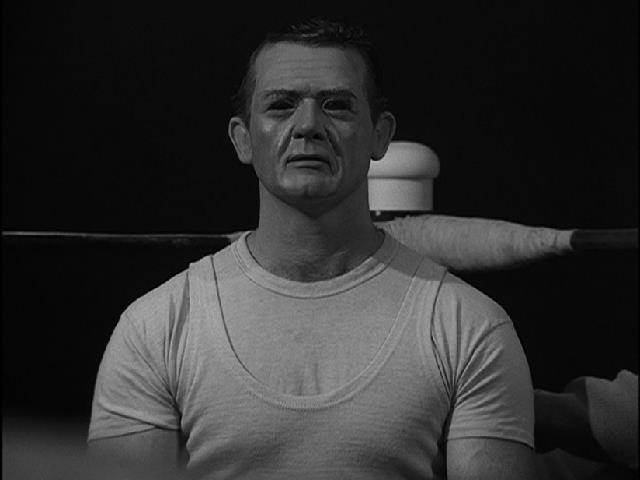
| Battling Maxo |
 |
| Maynard Flash |
The androids in “Steel” are unique in that their physical appearance seems to aim somewhere between these two approaches. While they are played by actors Chuck Hicks and Tipp McClure, there is an effort by makeup artist William Tuttle to make them appear less than human, the result of which is quite haunting. The masks the actors wear are made of stretched latex and the eyes are ping pong balls which were painted black with a small hole drilled in the center so they could see. A mention should be made of the terrific performances by both actors in portraying the restricted movements of what are essentially early generation androids.
 |
| The Shores of Space (Bantam, 1957) |
Matheson claimed in numerous interviews and essays over the years that this episode was his favorite of the sixteen that he wrote for the show. He first published the short story in the May, 1956 issue of The Magazine of Fantasy and Science Fiction and it later appeared in his collection The Shores of Space (Bantam, 1957). His teleplay is incredibly faithful to his short story and the episode is filmed almost shot for shot from his script. The only significant differences are that the year is changed from 1997 to 1974 and the fight is changed from a ten-round bout to six rounds. Also, in the story, Steel is given a first name, Tim, and there is a very brief mention of a woman he was once in love with. Other than these few exceptions, the two versions are very similar.
A much less faithful adaptation is the 2011 Dreamworks film Real Steel starring Hugh Jackman and Dakota Goyo. Directed by Shawn Levy and written by John Gatins, Dan Gilroy, and Jeremy Leven, the film contains only the basic idea of fighting robots as a substitution for real, live people while sacrificing the emotional struggle of its main character, the element which made Matheson’s original story so powerful. In the film Jackman plays Charlie Kenton, a former boxer who owns a string of obsolete fighting robots, keeping each until it can no longer fight and then discarding it for a newer one. After learning that his ex-girlfriend has died, he is now the sole guardian to his son, Max, whom he has had no contact with since he was born. An avid boxing fan, Max helps Charlie find an early generation robot which is enhanced with a shadow function allowing the robot to mimic Charlie’s exact moves. So Charlie is once again able to fight but, unlike Steel Kelly, does not have to risk physical annihilation to do so. Max and Charlie pit their underdog robot, named Atom, against increasingly harder opponents until they are unofficially declared the best fighting team in the league. The film ends on a predictably happy note with Charlie realizing that he has the ability to love others as well as himself. While it is fairly clear that the basic premise of fighting robots comes from Matheson’s story, the similarities between the two stories ends there. There is so significant a difference in the film’s plot that Matheson’s opening screen credit reads: “based in part upon the short story ‘Steel’ by Richard Matheson.” The film received mixed reviews with much of the criticism directed at its uneven plot and clichéd, unrealistic ending. The film’s special effects team did receive a lot of positive mentions and was even nominated for an Academy Award for Best Visual Effects. It lost to Martin Scorsese’s Hugo.
Director Don Weis makes his only venture into The Twilight Zone with this episode. Weis began his career at MGM making popular light comedies and musicals such as I Like Melvin (1953), A Slight Case of Larceny (1953), and The Affairs of Dobbie Gills (1953) and was known for being able to produce quality films quickly and under budget. He would continue to make feature-length films throughout his career, which spanned nearly half a century, including a biopic of jazz drummer Gene Krupa, The Story of Gene Krupa (1959), an adaptation of Ira Levin’s play Critic’s Choice (1963), and the World War II film The Longest Hundred Miles (1967). It was in television, however, where Weis made his mark, owing his success to the speed with which he could deliver quality productions. Over several decades he directed episodes of some of the best television series of all time including Wagon Train, The Thin Man, The Jack Benny Program, The Andy Griffith Show, Alfred Hitchcock Presents, Batman, Ironside, Kolchak: The Night Stalker, M.A.S.H., Hawaii Five-O, and Hill Street Blues to list just a fraction of his catalog. His direction in “Steel” is quite impressive. He allows the camera to move naturally through each scene and his still shots are framed well. He also creates the illusion of a crowded arena effectively as there are only a handful of extras present in that particular scene. Considering that at this point in his career he had directed mostly light situational comedies, he captures the seediness of the film noirs of the forties and fifties incredibly well.

This is the second appearance on the show for actor Joe Mantell who gave a great performance as panic-stricken loser Jackie Rhodes in the season two episode “Nervous Man in a Four Dollar Room.” Mantell was a terrific actor who unfortunately did not have as famous a career as his co-star, despite a handful of roles in very famous films. In 1955 he was nominated for an Academy Award for Best Supporting Actor for his role as Ernest Borgnine’s best friend, Angie, in Delbert Mann and Paddy Chayefsky’s smash hit Marty (1955). He played the part of the traveling salesman in the café in Alfred Hitchcock’s The Birds (1963) and was Jack Nicholson’s assistant, Lawrence Walsh, in Roman Polanski’s Chinatown (1974), where he utters to Nicholson the film’s famous final line, “Forget it, Jake. It’s Chinatown.” The film’s sequel, The Two Jakes (1990), was Mantell’s last screen appearance. He also appeared in numerous other early anthology series including Alfred Hitchcock Presents, Climax!, Out There, Inner Sanctum, Suspense, and Lights Out. His performance here is brilliant. As well written and directed as this episode is, it is the chemistry between its two leading stars which steals the show. Mantell gives Pole a seamless mix of angry frustration and genuine concern for Marvin’s troubled, washed up fighter.
Lee Marvin carved out an enormously successful career for himself becoming one of the most recognizable actors of the sixties and seventies. He was known for playing tough, often violent characters similar to the one he plays here. This is Marvin’s second and final appearance on the show, having appeared in the star-studded season three episode “The Grave.” Less than a year after that episode, a western, aired in October of 1961 Marvin and two of his co-stars from the episode, Lee Van Cleef and Strother Martin, appeared as a gang of sadistic criminals in John Ford’s The Man Who Shot Liberty Valance (1962). Considered by many to be one of the best western films ever made, Marvin’s performance as the title character is probably the role most responsible for launching him into the Hollywood A-list for the next few decades. So by the time this episode aired exactly two years after his first appearance on the show he was like more familiar to the audience.
Marvin’s stardom took longer to come to fruition than for many of his contemporaries. After being wounded in action during World War II, Marvin returned to the states and decided to pursue acting, appearing dozens of stage productions throughout the late forties. After being famously thrown out of the Actor’s Studio for screaming profanities at Lee Strasberg he moved to Hollywood and began a career in film and television. During the first fifteen years of his career, Marvin appeared in numerous television series including Suspense, Dragnet, Wagon Train, Route 66, Bonanza, The Virginian, and The Untouchables as well as many live drama anthology series including an Emmy nominated performance on Alcoa Premiere. From 1957 to 1960 Marvin starred as gritty Detective Lieutenant Frank Ballinger on the NBC series M Squad. The creators of Police Squad, the short-lived series that launched the Naked Gun franchise, admitted years later that M Squad was one of the main influences for their show and that Leslie Nielsen’s Detective Frank Drebin was a direct satire of Marvin’s character.
During this time, he also racked up a number of credits playing memorable minor characters in now famous films like The Wild One (1953), The Caine Mutiny (1954), Bad Day at Black Rock (1955), The Killers (1964), and the feature-length adaptation of Serling’s The Rack (1956). Two years after he appeared in “Steel” Marvin won an Academy Award for his dual performance in Elliott Silverstein’s Cat Ballou (1965). After that he left television behind and concentrated solely on film, strengthening his image as an actor who liked playing dark and often controversial characters. Roles in films like The Professionals (1966), The Dirty Dozen (1967), and Point Blank (1967) helped to solidify this image.

His performance here as Steel Kelly is remarkable. A more restrained performance, perhaps, than some of his more well-known characters but this only adds to the level of desperation and insecurity that Steel inhabits. The scene in which he has to speak to the fight promoter inside his small, cramped office is brilliant because Marvin’s speech pattern and facial expressions perfectly convey how clearly uncomfortable and humiliated Steel is. Matheson recalled in several interviews that he was on the set during the rehearsal and filming of this episode and claimed that to help build his character and to prepare for the fight scene, Marvin would walk around the set of the boxing ring, throwing random jabs into the air, and would imitate the sound of the crowd taunting him. Marvin had actually worked with Don Weis several times before on episodes of M Squad and episodes of Schlitz Playhouse and Jane Wyman Presents the Fireside Theatre.
While
not as well known as some of the other teleplays Matheson wrote for the show,
“Steel” is an incredibly powerful and moving episode about the strength of
friendship and the importance of feeling relevant. It is fair to mention that
there have been many who see Steel’s decision to step into the ring with an
opponent that he most certainly will not defeat and who might very possibly
kill him as nothing more than a death wish. This is a valid point and one that
only complicates Steel Kelly’s already complex character. Steel is afraid of
accepting change because it would mean that he loses who he is as a person.
Boxing is all that he knows and Battling Maxo is his last connection to it. He
has no money to buy another android and without boxing he is forced to live in
a world he no longer recognizes with neither ambition nor purpose. So there is
a part of him that probably would rather cease to exist than be obsolete. Pole
realizes that fear and self-doubt have crept into every facet of his friend’s world
and knows that removing him from their current environment is the only way to
make him whole again. However,
being a fighter is all Steel knows and as long as either he or Battling Maxo
are able to step into the ring he will continue to fight for his place in the
world.

Grade: A
Grateful acknowledgment is made to the following:
The Twilight Zone Scripts of Richard Matheson, Vol. 2 edited by Stanley Wiater (Edge Books, 2002)
Richard Matheson on Screen: A History of the Filmed Works by Mathew R. Bradley (MacFarland & Company, 2010)
The Twilight Zone: Unlocking the Door to a Television Classic by Martin Grams, Jr. (OTR, 2008)
The Twilight Zone Companion by Marc Scott Zicree (3rd ed., Silman-James Press, 2018)
Episode commentary by Marc Scott Zicree and Bill Warren, The Twilight Zone: The Complete Series Blu-ray (Image Entertainment, 2016)
Lee Marvin: Point Blank by Dwayne Epstein (Schaffner Press, 2013)
The Internet Movie Database (www.imdb.com)
The Internet Speculative Fiction
Database (www.isfdb.org)
Notes:
—Lee Marvin also appeared in the season three episode “The Grave.”
—Joe Mantell appeared in the season two episode “Nervous Man in a Four Dollar Room.” He also appeared in an episode of Serling’s western series, The Loner, in 1966 called “The Trial in Paradise.”
—Chuck Hicks appeared in the season five episode “Ninety Years Without Slumbering.”
—Merritt Bohn appeared in the season one episode “One for the Angels.”
—Frank London appears in the season two episode “A Penny for Your Thoughts.”
—Loyal extra Bob McCord can be spotted here as one of Maynard Flash’s handlers. McCord made dozens of appearances on the show, usually uncredited.
 |
| The Magazine of Fantasy and Science Fiction May, 1956 Cover art by Ed Emshwiller |
—Richard Matheson adapted “Steel” from his short story of the same name which was originally published in the May, 1956 issue of The Magazine of Fantasy and Science Fiction. It later appeared in his collection The Shores of Space (Bantam, 1957) and in The Twilight Zone: The Original Stories (MJF, 1985) edited by Martin H. Greenberg, Matheson, and Charles G. Waugh. It can currently be found in the second volume of his Collected Stories (Edge Books, 2005) and in his collection Duel: Terror Stories (Tor, 2003). In 2011 Tor released the collection Steel and Other Stories, a paperback movie tie-in for the film Real Steel (2011) which was inspired by Matheson’s story.
—Matheson’s adapted teleplay for “Steel” is collected in Richard Matheson’s The Twilight Zone Scripts, Vol. 2 edited by Stanley Wiater (Edge Books, 2002)
—This episode was adapted into a Twilight Zone Radio Drama by Dennis Etchison starring Louis Gossett, Jr.
 |
| Real Steel (Dreamworks, 2011) |
—As previously noted, “Steel” was the inspiration for the 2011 film Real Steel starring Hugh Jackman. The film was written by John Gatins, Dan Gilroy, and Jeremy Leven, and was directed by Shawn Levy. It was executive produced by Stephen Spielberg for DreamWorks Pictures. Matheson’s screen credit reads: “based in part upon the short story ‘Steel’ by Richard Matheson.”
—Former professional welterweight boxer turned stunt performer and Hollywood boxing coach Johnny Indrisano (1906 – 1968) was hired as a fight consultant to make the bout between Lee Marvin and Chuck Hicks seem as realistic as possible. Indrisano’s career as a fighter lasted from 1923 to 1934 and he retired with thirty-seven out of forty-six wins.
—Matheson’s decision to name the boxing promoter Nolan is likely a nod to his close friend, writer William F. Nolan.
—Brian


