Showing posts with label Joseph M. Newman. Show all posts

Monday, December 1, 2025

"Black Leather Jackets"


Fred (Tom Gilleran), Scott (Lee Kinsolving), and Steve (Michael Forest), alien invaders, ride into town

“Black Leather Jackets”
Season Five, Episode 138
Original Air Date:
January 31, 1964


Cast:
Scott: Lee Kinsolving
Ellen Tillman: Shelley Fabares (as Shelly Fabares)
Steve: Michael Forest
Stu Tillman: Denver Pyle
Fred: Tom Gilleran
Sheriff’s Deputy Harper: Michael Conrad
Martha Tillman: Irene Hervey
Mover: Wayne Heffley (uncredited)
Voice of Alien Leader: Gregory Morton (uncredited)
Attendant: Mark Russell (uncredited)


Crew:
Writer: Earl Hamner, Jr.
Director: Joseph M. Newman
Producer: William Froug
Director of Photography: George T. Clemens
Production Manager: Ralph W. Nelson
Art Direction: George W. Davis & Malcolm Brown
Film Editor: Thomas W. Scott
Set Decoration: Henry Grace & Robert R. Benton
Assistant Director: Charles Bonniwell, Jr.
Casting: Patricia Rose
Music: Van Cleave
Sound: Franklin Milton & Joe Edmondson
Mr. Serling’s Wardrobe: Eagle Clothes
Filmed at MGM Studios


And Now, Mr. Serling:

“Earl Hamner, Jr. brings his typewriter and his fertile mind back into The Twilight Zone next time with a program about visitors. On the surface they’re beatniks, a few raunchy-looking characters on motorcycles roar into town one day. But once you meet them, you won’t forget them. They’re quite different from what they appear. On The Twilight Zone, Lee Kinsolving, Shelley Fabares, and Michael Forest star in ‘Black Leather Jackets.’”


Rod Serling’s Opening Narration: 

“Three strangers arrive in a small town. Three men in black leather jackets in an empty rented house. We’ll call them Steve and Scott and Fred, but their names are not important. Their mission is, as three men on motorcycles lead us into The Twilight Zone.”


Summary: 

The peaceful calm of a suburban neighborhood is shattered by the arrival of three mysterious young men on motorcycles. Dressed in black leather jackets, the trio—leader Steve, along with Fred and Scott—rent a house from a local real estate agent. Their new neighbor, Stu Tillman, is immediately suspicious. He warns his daughter, Ellen, to steer clear of them. 

The peculiar behavior of the young men increases Stu Tillman's suspicions. Large quantities of industrial freezers are delivered to their house and strange electrical disturbances begin that night. Unbeknownst to Stu, the strangers also possess telekinetic powers. Stu goes next door to investigate the electrical disturbances and is met with a hostile reception. He confronts the men, who push him around and, through a strange mental power, compel him to forget the encounter and return home, convinced they are just "nice boys." Meanwhile, in their own home, the strangers activate a room full of advanced electrical equipment, alluding to a larger, unknown purpose. 

The plot thickens when Ellen, needing a ride, accepts an offer from Scott, the youngest of the three strangers. While sitting in the town park, they form a connection through conversation. Scott misses a crucial meeting with Steve and Fred, who are seen communicating with a monstrous, disembodied eye on a screen. The true nature of the strangers is revealed: they are advanced extraterrestrials, disdainful of humanity, and they have been infiltrating communities worldwide in preparation for a final strike to rid the planet of its inhabitants. 

As days pass, Scott becomes increasingly attached to Ellen, and his affection for her causes him to question the mission. He misses another meeting, and when Ellen finally confronts him about his secrets, he grows angry, prompting her to go home. Steve punishes Scott but lets him stay on as a non-participant, just as the final, chilling instructions are received: they are to poison the town's water supply with deadly bacteria. 

Scott makes a desperate attempt to save Ellen. He flees to her house and begs her to run away with him to a safe place. Confused and terrified, Ellen believes he is mentally unstable and seeks her father's help. Stu calls the sheriff's office and Deputy Harper assures him they'll handle the problem. In a shocking twist, Deputy Harper is revealed to be one of the alien invaders. 

In a final, desperate plea, Scott returns to his house and implores the alien leader to spare humanity, arguing that they are capable of love. His plea is rejected, and he is branded a traitor. He returns to Ellen's house and is confronted by Deputy Harper. Scott tries to warn the Tillmans, but it's too late. Deputy Harper and three medical attendants forcibly take Scott away. As Scott is led off, his final words are a hopeless warning that they've made a terrible mistake. The Tillmans, unaware of the true danger, watch him being taken away, thinking they've done the right thing. Deputy Harper leaves with a sinister sense of satisfaction, his true nature still a secret. The invasion is now unstoppable, and humanity is doomed.


Rod Serling’s Closing Narration:

“Portrait of an American family on the eve of invasion from outer space. Of course, we know it’s merely fiction – and yet, think twice when you drink your next glass of water. Find out if it’s from your local reservoir or if possibly it came direct to you from The Twilight Zone.”


Commentary: 

When “Black Leather Jackets” aired in January of 1964, it tapped into one of the most pervasive fears of the time: youth rebellion. The episode centers on three leather-clad beatniks who, to the horror of middle-class citizen Stu Tillman, move in next door, threatening not only the sanctity of his quiet neighborhood but also the innocence of his daughter Ellen. But this is The Twilight Zone, so these aren’t human beatniks, but extraterrestrials sent to poison the town’s water supply in a coordinated effort to wipe out humanity. 

The most glaring inconsistency in the episode is the choice of the aliens arriving as leather-clad beatniks on loud motorcycles, a group that would have instantly drawn unwanted attention in any quiet, suburban neighborhood of the era. This choice was likely made for no other reason than to introduce an element of social commentary into the science fiction plot. The premise of the episode is built on a cliché of 1950s cinema: the rebellious outsider. By 1964, however, the image of the dangerous biker boy had largely been rendered obsolete by new “threats” to society and the general upheaval of the increasingly turbulent 1960s. This is one of several reasons why the episode has aged poorly since its original broadcast. The episode ultimately struggles to blend its social commentary with its alien invasion plot, resulting in a fascinating but flawed entry in the series. 

Written by Earl Hamner, Jr., the episode was likely influenced by such films as The Wild One (1953), starring Marlon Brando, in which a motorcycle gang terrorizes a small town. The film was based on the story “Cyclists’ Raid” (1951) by Frank Rooney, itself inspired by sensationalist media coverage of the so-called “Hollister Riot,” or “Hollister Invasion,” which occurred during a motorcycle rally in Hollister, California in 1947. In a rarity for Hamner, he used the real names of people he knew for the script. The three aliens were loosely based on Hamner’s son Scott and his son’s friends Steve and Frank. The original title of Hamner’s script was simply “Love Story,” giving some indication of the greater interest Hamner placed in the relationship between Scott and Ellen than in the alien invasion plot. This relationship, and the performances of Lee Kinsolving and Shelley Fabares, gives the episode a glimmer of depth amidst its science fictional flaws. Had the episode been allowed to offer a subtler commentary on prejudice and understanding, it might have resonated more. Instead, it gets bogged down by an absurd plot to poison Earth’s water supply, a plan that feels particularly nonsensical when you consider the aliens possess mind control and telekinetic powers. 

Aliens infiltrating small American communities, often with the aim of takeover or destruction, was another staple of 1950s and early 1960s cinema, seen in such films as It Came from Outer Space (1953), based on a story by Ray Bradbury, Invaders from Mars (1953), Invasion of the Body Snatchers (1956), based on the novel by Jack Finney, and Village of the Damned (1960), based on The Midwich Cuckoos by John Wyndham. The downbeat ending of the episode, in which Scott is disbelieved and taken away to an unknown fate, allowing the deadly invasion to proceed, was atypical for the time. This brings up another inconsistency with the episode, however, as the viewer is left to wonder if Scott could have simply demonstrated his alien mind powers to prove to Ellen he was sincere. Without such a demonstration, Ellen is left with no choice than to believe Scott is mentally disturbed. 

“Black Leather Jackets” contains production choices that, while perhaps not intentional, lend a campy quality to the episode. The most striking example is the appearance of the alien leader. Hamner’s script described the image of the leader, named “The Mask,” as a metallic mask with slits for the eyes and nostrils. Instead, we see a giant, disembodied eye on screen. This single, unblinking eyeball is more absurd than menacing. The eye, incidentally, belonged to frequent series extra Robert McCord, while the uncredited voice of the alien leader was that of Gregory Morton. The visual absurdities don’t end there. The “beatniks” wear riding goggles that are more comical than cool, and an unintentionally humorous moment occurs when a mind-controlled Stu Tillman walks directly into the doorframe of the house. These stylistic choices – including Van Cleave’s kitschy jazz score – combine to create a disconnect from the effective and menacing tones of the best episodes of the series. Production errors, such as the reflection of a stage light in the doorknob, or the shadow of a boom mike on the white pillar of Ellen’s house, further cements the notion that this was a competent, but not a particularly polished, production. 


While the episode has its share of flaws in plot and production, it does not lack for talented performers. Lee Kinsolving (1938-1974) was born in Boston and began acting in college. He was a method actor who studied under Mary Welch at the Actors Studio in New York. After a stint as a leading man on Broadway, Kinsolving began performing in East Coast television programs. He moved to Hollywood in 1959 and landed several film roles, earning a Golden Globe nomination for Best Supporting Actor for The Dark at the Top of the Stairs (1960). Kinsolving was a versatile and prolific television actor. Notable television roles include the Route 66 episode “Follow the White Dove with the Broken Wing,” and The Outer Limits episode “The Children of Spider County.” He retired from acting in 1966 after becoming frustrated with the business. He briefly owned and managed the Toad Hall restaurant and bar in Manhattan before moving to Florida, dividing his time between Palm Beach and a home in Virginia. Kinsolving managed two art galleries and enjoyed spending time on the sea in his private schooner. He died on December 4, 1974 at the age of 36 from a sudden respiratory illness. 


Shelley Fabares (b. 1944) was born Michele Marie Fabares in Santa Monica. She began appearing on television as a young child and made her film debut at age twelve in Never Say Goodbye (1956). Fabares perfected her image as the American girl next door on The Donna Reed Show in the role of teenager Mary Stone, which Fabares portrayed from 1958-1963. This role even led to a brief recording career in which Fabares scored a #1 hit in 1961 with “Johnny Angel.” Fabares appeared in surf movies and Elvis films later in the 1960s. After a dry spell, Fabares reinvented herself as a versatile television actress. Fabares received acclaim for her role in the series Coach (1988-1997), for which she received two Emmy Award nominations. Later in her career, Fabares provided the voice of Martha Kent, Superman’s Earth mother, to several DC Comics animated films. 


Michael Forest (b. 1929) was born Gerald Michael Charlebois. He made his way to Hollywood after attending San Jose State University. Forest studied acting under Jeff Corey, through whom he met director Roger Corman. Forest acted in several Corman films in the 1950s and 1960s. Forest was a prolific television actor, appearing on such series as One Step Beyond and The Outer Limits. His most notable television role was as the god Apollo in the Star Trek episode “Who Mourns for Adonis?” Forest performed in stage productions under his birth name and lent his voice to numerous animated productions. The role of the beatniks in “Black Leather Jackets” required the actors to demonstrate an ability to ride a motorcycle. Forest rode motorcycles as a teenager but was not familiar with modern motorcycles. The production team, which included a Technical Motorcycle Supervisor for the episode, created a modified motorcycle for Forest which contained a hand shift and a foot clutch. 


Denver Pyle (1920-1997) was born in Colorado and worked numerous jobs before finding his calling as an actor. While working on aircraft production at the Lockheed Corporation in Los Angeles, Pyle was discovered by a talent scout while performing in an amateur production. Pyle is best known for his roles as the grizzled westerner in numerous films and television series. Pyle worked in westerns by director John Ford, such as The Man Who Shot Liberty Valance (1962), as well as in films with John Wayne late in The Duke’s career. Other film roles include a memorable turn as Texas Ranger Frank Hamer in Bonnie and Clyde (1967), and a role in the low-budget film The Legend of Hillbilly John (1972), based on the “John the Balladeer” stories of Manly Wade Wellman. On the small screen, Pyle is known for his roles as Uncle Jesse on The Dukes of Hazzard, Briscoe Darling, patriarch of the trouble-making, musical family, on The Andy Griffith Show, and Mad Jack in The Life and Times of Grizzly Adams. Pyle also appeared in an episode of Boris Karloff’s Thriller. 


New York-born Tom Gilleran (1936-2022) had the small role of Fred in the episode. Gilleran acted sparingly on the small screen. His notable appearances include four episodes of Alfred Hitchcock Presents. 


Michael Conrad (1925-1983) won two Emmy Awards, and was nominated for two more, for his role as desk sergeant Phil Esterhaus on Hill Street Blues. Conrad earlier appeared in an episode of the short-lived anthology series ‘Way Out, in the creepy episode “Dissolve to Black.” Conrad appeared in a small role in the 1962 film version of Rod Serling’s Requiem for a Heavyweight, as well as in such films as They Shoot Horses, Don’t They? (1969) and The Longest Yard (1974). Conrad died in 1983 while filming the fourth season of Hill Street Blues. 


Irene Hervey (1909-1998) was born Beulah Irene Herwick in Venice, California. She was trained in performance art from a young age by English actress Emma Dunn, who was a friend of her mother. Hervey signed with MGM early in her career and was often loaned out to other studios. An early memorable role came in United Artists’ The Count of Monte Cristo (1934). She signed with Universal in 1938 and appeared in such films as the western Destry Rides Again (1939), opposite James Stewart and Marlene Dietrich, and the horror film Night Monster (1942), opposite Bela Lugosi and Lionel Atwill. Hervey had a memorable late career role opposite Clint Eastwood in Play Misty for Me (1971). On the small screen, Hervey appeared in many guest roles, including “The Watcher,” an episode of Boris Karloff’s Thriller, and an episode of My Three Sons (1969), for which Hervey received an Emmy nomination. 

“Black Leather Jackets” also includes three uncredited roles. Wayne Heffley (1927-2008) appears as the moving man with the speaking role. Heffley previously appeared on the series in Rod Serling’s “The Odyssey of Flight 33.” Gregory Morton (1911-1986) provides the voice of the alien leader. Morton was a staple of television anthology programs. He appeared in episodes of Lights Out, Thriller, and One Step Beyond. Morton provided his voice to episodes of the Irwin Allen productions Lost in Space and Voyage to the Bottom of the Sea. Mark Russell, who plays a medical attendant in the episode, often appeared in uncredited roles, including on The Twilight Zone in “The Fever,” from the first season, and the later fifth season episode “What’s in the Box.” 

Joseph M. Newman (1906-2006) is best-known for directing the science fiction spectacle This Island Earth (1955), although director Jack Arnold reshot significant portions of the film, including most of the memorable sequences, when Universal Studios was dissatisfied with the footage shot by Newman. He was twice nominated for the now-defunct Best Assistant Director Academy Award in 1936 and 1937. Newman specialized in films with a documentary feel, a talent he developed while shooting documentaries and newsreels for the Signal Corps during the Second World War. Examples include the film noir 711 Ocean Drive (1950) and the adventure film Red Skies of Montana (1952). Newman turned in competent, if undistinguished, television work later in his career, including three additional episodes of The Twilight Zone: “In Praise of Pip,” “The Last Night of a Jockey,” and “The Bewitchin’ Pool.” Newman also directed ten episodes of The Alfred Hitchcock Hour, highlighted by the disturbing third season episode, “An Unlocked Window,” based on a story by Ethel Lina White. 

“Black Leather Jackets” suffers from numerous science fiction clichés and poor production choices that cause the episode to age poorly. The plot is filled with inconsistencies, particularly in the aliens choosing such a conspicuous disguise. The episode’s true strength, however, lies not in its alien invasion plot, but in Earl Hamner’s interest in the cross-cultural relationship between Scott and Ellen. This focus on a human story, set against a backdrop of suburban fear and Cold War paranoia, provides the episode with a modicum of resonance. Viewed through the lens of a flawed production and a society grappling with its fears of youth rebellion, “Black Leather Jackets” stands as a fascinating, if ultimately below-average, offering from the series. 

Grade: D 

Next Time in the Vortex: A nostalgic trip back in time through the pages of the May/June 1984 issue of Rod Serling's The Twilight Zone Magazine.  


Acknowledgements:
 
--Interview with Michael Forest (The Twilight Zone: The 5th Dimension (CBS DVD/Image Entertainment, 2014))
 
--Interview with Earl Hamner, Jr. (The Twilight Zone: The 5th Dimension (CBS DVD/Image Entertainment, 2014))
 
--Inside The Twilight Zone by Marc Scott Zicree (CBS DVD/Image Entertainment, 2000)
 
--“They Came from Beyond Main Street” by Tony Albarella (The Twilight Zone Scripts of Earl Hamner (Cumberland House, 2003))
 
--A Critical History of Television’s The Twilight Zone, 1959-1964 by Don Presnell and Marty McGee (McFarland & Co., 1998)
 
--The Twilight Zone Companion (3rd ed.) by Marc Scott Zicree (Silman-James, 2018)
 
--The Twilight Zone: Unlocking the Door to a Television Classic by Martin Grams, Jr. (OTR, 2008)
 
--The Internet Movie Database (imdb.com)
 
--Wikipedia (Wikipedia.org) 


Notes: 

--Joseph M. Newman also directed the fifth season episodes “In Praise of Pip,” “The Last Night of a Jockey,” and “The Bewitchin’ Pool.”

--Earl Hamner, Jr. wrote seven additional episodes of the series, including “The Hunt,” “Stopover in a Quiet Town,” and the hour-long episode “Jess-Belle.”

--Wayne Heffley also appeared in the second season episode “The Odyssey of Flight 33.”

--Mark Russell also had uncredited roles in the first season episode “The Fever” and the later fifth season episode “What’s in the Box.”

--“Black Leather Jackets” was adapted as a Twilight Zone Radio Drama starring Marshall Allman and Elizabeth Ledo.

--The interior of the Tillman house is the same living room set used in “Ninety Years Without Slumbering” and “Ring-a-Ding Girl.” 

-JP

Friday, March 15, 2024

"The Last Night of a Jockey"

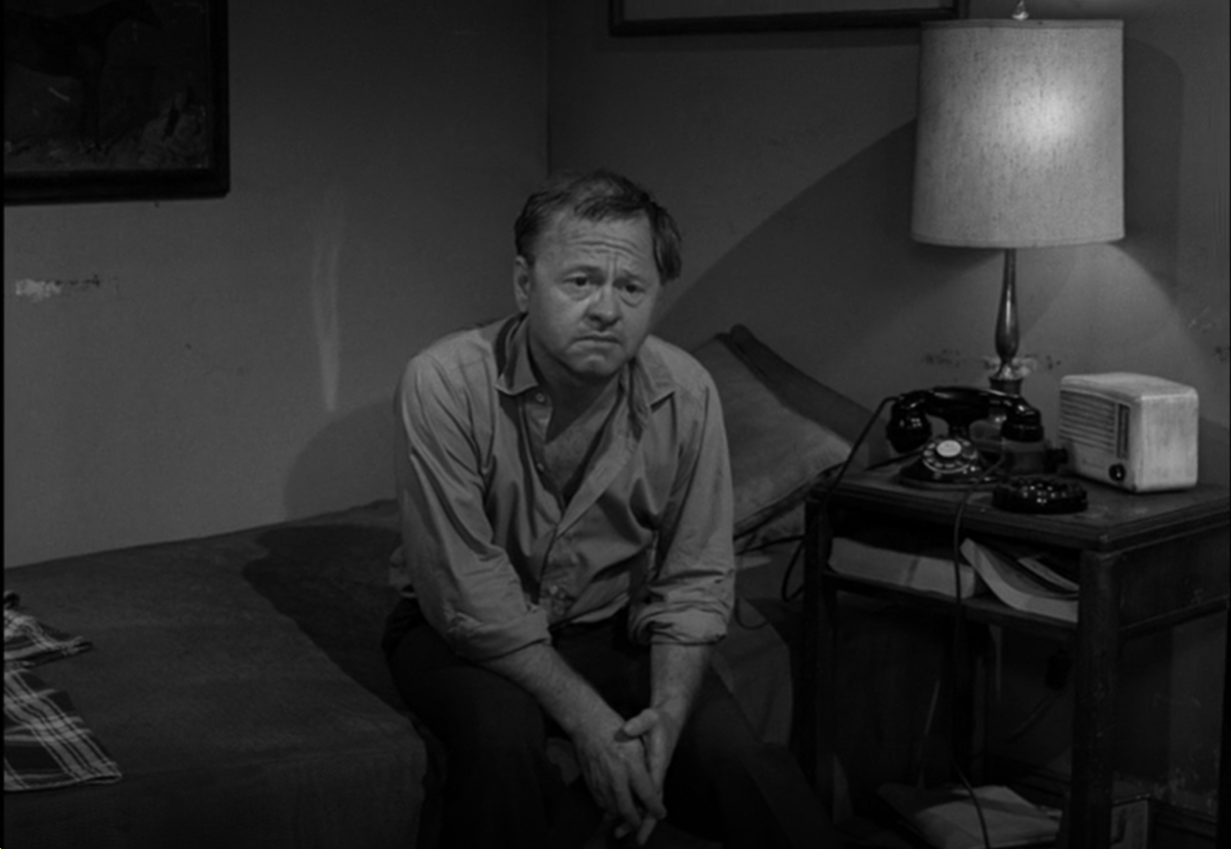
Mickey Rooney as Grady

“The Last Night of a Jockey”
Season Five, Episode 125
Original Air Date: October 25, 1963

Cast:
Grady: Mickey Rooney

Crew:
Writer: Rod Serling
Director: Joseph M. Newman
Producer: William Froug
Director of Photography: George T. Clemens
Production Manager: Ralph W. Nelson
Art Direction: George W. Davis & Malcolm Brown
Film Editor: Thomas W. Scott
Set Decoration: Henry Grace & Robert R. Benton
Assistant Director: Charles Bonniwell, Jr.
Casting: Patricia Rose
Music: stock
Sound: Franklin Milton & Joe Edmondson
Mr. Serling’s Wardrobe: Eagle Clothes
Filmed at MGM Studios

 And Now, Mr. Serling:

“Next on Twilight Zone, a gentleman of myriad talents and a story written especially for him. Mr. Mickey Rooney appears in ‘The Last Night of a Jockey.’ He plays the role of a diminutive little man screaming for help in the bottom of a barrel, and the help he receives is unexpected and quite incredible. On The Twilight Zone, a cast of one: Mr. Mickey Rooney. I hope you’ll be able to be with us.” 

Rod Serling’s Opening Narration: 

“The name is Grady, five-feet short in stockings and boots, a slightly distorted offshoot of a good breed of humans who race horses. He happens to be one of the rotten apples, bruised and yellowed by dealing in dirt, a short man with a short memory who’s forgotten that he’s worked for the sport of kings and helped turn it into a cesspool, used and misused by the two-legged animals who have hung around sporting events since the days of the Colosseum. So this is Grady on his last night as a jockey. Behind him are Hialeah, Hollywood Park and Saratoga. Rounding the far turn and coming up fast on the rail . . . is The Twilight Zone.” 

Summary: 

            In a small, squalid room, with newspapers strewn about the floor, we meet Grady, a man alone. The newspaper headlines tell the story. Grady, a jockey, has been banned from horse racing and his appeal to the racing comission has been struck down. Grady angrily tosses away a newspaper as the telephone rings. It’s a journalist calling to get a word from Grady, and Grady lets him have it, insulting the journalist and blaming him, and other journalists, for his ban from horse racing.

            Grady angrily hangs up the telephone and stumbles to a dresser mirror, gazing at his reflection. He doesn’t like the man who looks back at him and calls him a “chump.” Grady quietly admits that he fixed a couple of races, but he’s a chump because while the men who put him up to it got off rich and clean, the only thing Grady got for his trouble was a few lousy bucks and a ban from the only thing that gave his life meaning.

            Suddenly, Grady hears another voice in the room. He turns around, asking who’s there. The voice laughs at him. Grady checks the closet and the open window, thinking someone is playing a joke. The voice tells Grady that he resides in Grady’s head. Grady, not understanding, repeatedly slaps himself in the forehead, asking the voice if it’s comfortable in there. 

             Grady sees a disembodied image in the dresser mirror, beside that of his own reflection. It looks like him but cleaned-up. The other Grady in the mirror reveals that he knows all of Grady’s thoughts and bitter recollections. When Grady denies having any bitter recollections, his alter-ego reminds him. 1961: Hialeah, suspended for riding infractions. It wasn’t my fault, cries Grady. 1962: Six-month suspension for failing to report a bribe offer. I was framed, says Grady. Finally, a lifetime ban for race fixing and horse doping. I never doped any horses, screams Grady. He angrily smashes the mirror to pieces.

            Grady boasts that a telephone call to Mr. Hannichek will make everything right. His alter-ego urges him to call. Grady telephones and tells the man on the other end that he’s low on money and it’s time for Grady to get what he deserves. The man abruptly ends the call.

            Grady says that it doesn’t matter. He was a big man once and he’ll be a big man again. His alter-ego appears in the surface reflection of a kettle to remind Grady of a time not long ago when Grady had nice clothes and left big tips as compensation for his small size. Grady angrily throws the kettle across the room.

            His alter-ego makes Grady an offer. At this moment, Grady can have anything he wants, anything in the world. Grady says that he wants to be the biggest. He shouts that he wants to be BIG!  

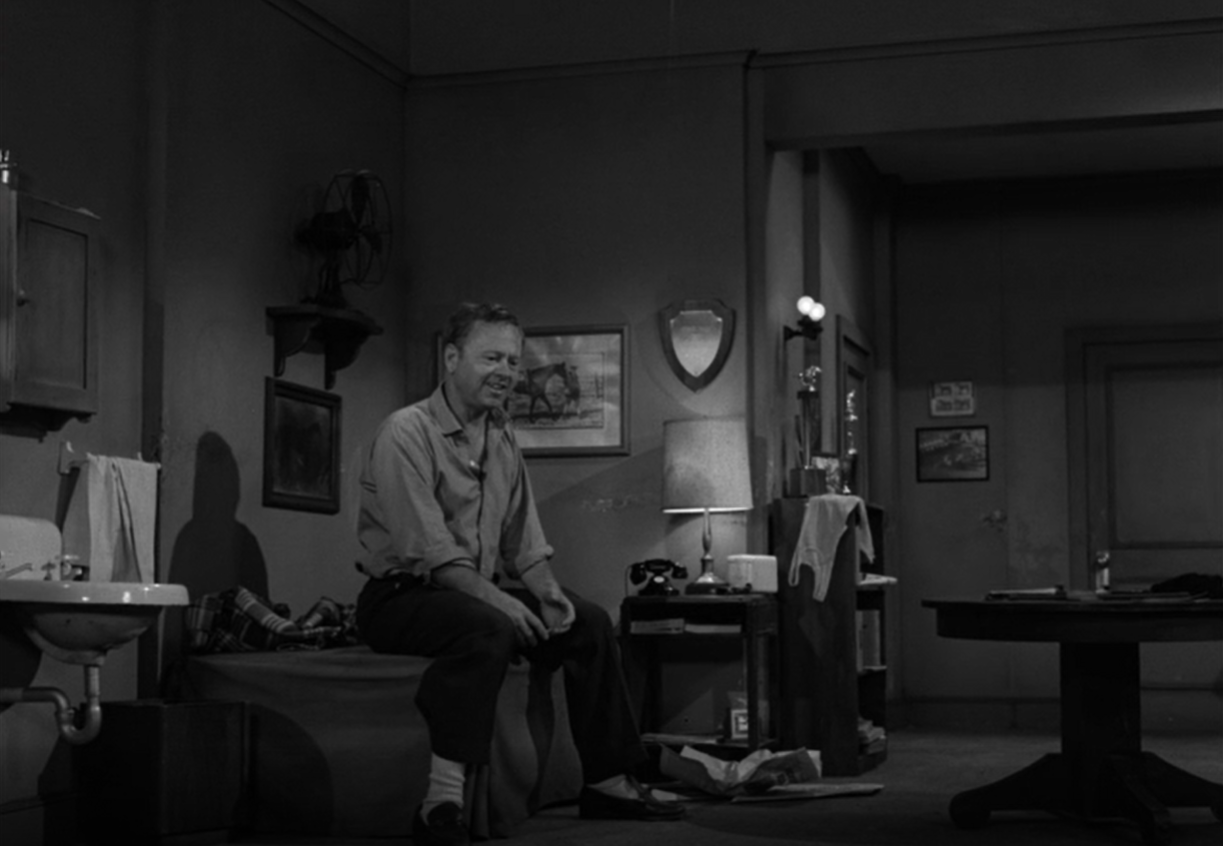
            Later, Grady tries to sleep but is restless with a thunderstorm raging outside. Grady realizes something is wrong, something he can’t quite grasp. He looks down and sees his feet hanging off the end of the bed. Alarmed, Grady sits up and turns on a lamp. Now he knows what’s wrong. He has grown physically, and he has grown a great deal. Grady romps around the room, everything small to his perspective. He must be eight feet tall. His wish has been answered. He is BIG. 

            Grady wonders if he is dreaming. His alter-ego assures him that he is not dreaming. This is his new reality. Grady takes a celebratory drink and calls an old girlfriend, but is angered when she won’t give him the time of day.

            The telephone rings. Grady listens, speaks briefly, hangs up, and then tells his alter-ego that a lawyer from the racing commission is going to call him. His alter-ego tells Grady that people are capable of great heights and terrible lows, and he, the alter-ego, is the final bit of strength that pushes a person one way or the other. He asks Grady if it wouldn’t have been better to have wished to win the Kentucky Derby or to win a clean and honest race. Grady admits that would have been great.

            The telephone rings. The caller is Mr. Newman from the racing commission. He gives Grady good news and Grady is ecstatic, thankful. He hangs up the telephone and mocks his alter-ego. The racing commission has reinstated him, he brags. The laughter of his alter-ego booms with a flash of lighting and a peal of thunder. Grady is now ten feet tall. His head scrapes the ceiling of the room. 

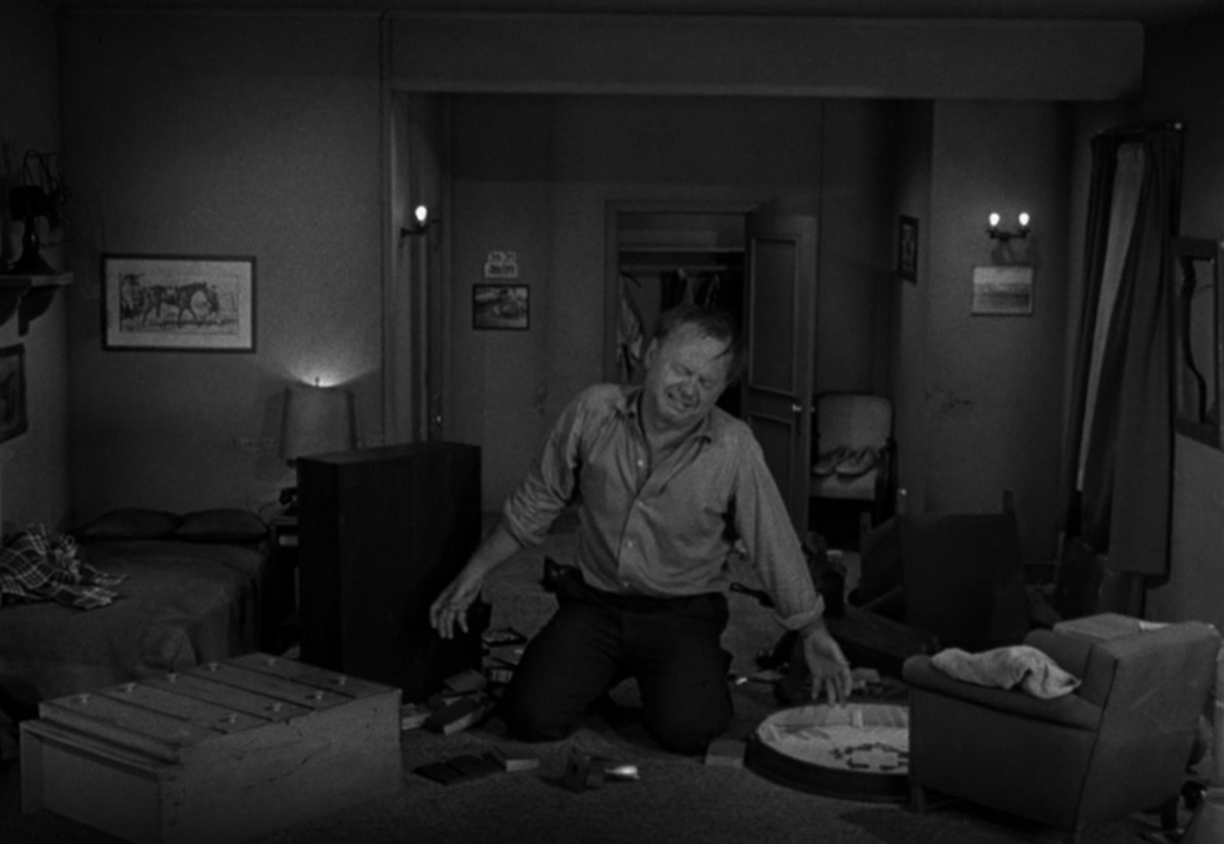
            It hits home like a thunderbolt. Grady is too big to ever race again, too big, in fact, to live any sort of normal life. In a rage, Grady destroys the furniture and begs to be made small again. His alter-ego tells Grady that he’s always been small, and the only time he was big was when he was being honest and unselfish. Then the voice is silent as Grady weeps amid the tattered remains of his tiny room. 

Rod Serling’s Closing Narration:

“The name is Grady, ten feet tall, a slightly distorted offshoot of a good breed of humans who race horses. Unfortunately for Mr. Grady, he learned too late that you don’t measure size with a ruler, you don’t figure height with a yardstick, and you never judge a man by how tall he looks in a mirror. The giant is as he does. You can make a pari-mutuel bet on this, win, place or show, in or out of The Twilight Zone.” 

Commentary: 

            “The Last Night of a Jockey” is the most minimal episode produced on the series. Besides the obligatory appearance and voice of series host Rod Serling, the episode features a single performer, a single voice, and a single set, though this last qualification is a half-truth, since the speculative element of the story required the use of three sets (two of which were almost entirely custom-made) over the three-day filming of the episode in order to display the process of Grady growing larger while everything around him grew smaller. In this way, the episode is a minor marvel of claustrophobic design and Mickey Rooney’s wildly energetic performance is amplified by the increasingly reduced space and elements.

The episode was originally intended to be slightly less minimal as it was to include an additional voice, that of prolific actor Vic Perrin (1916-1989), who was scripted as an unseen landlord who speaks to Grady through the door to Grady’s room. Although this scene was removed from the episode, Perrin remained on the set for the duration of filming in order to provide Mickey Rooney with the lines for Grady’s alter-ego, before these lines were recorded by Rooney for the finished episode. Perrin was a prolific performer who was frequently in-demand for his voice, providing narrations and voice work for radio, documentary films, and amusement park attractions. Perrin probably remains best-known for providing the Control Voice on The Outer Limits. Perrin can be seen in two episodes of The Twilight Zone, "People Are Alike All Over," from the first season, and "Ring-a-Ding Girl," from the fifth season. 

Many viewers of the series connect this episode with Rod Serling’s thematically and structurally similar first season episode, “Nervous Man in a Four Dollar Room.” Although not as minimal as “The Last Night of a Jockey,” the earlier episode concerns a man, Jackie Rhodes (Joe Mantell), trapped by his own fears in a single room with only a telephone to connect him to the outside world. Jackie Rhodes, like Grady in “The Last Night of a Jockey,” also finds himself confronted by his alter-ego, but “Nervous Man in a Four Dollar Room” is a redemptive episode, one in which the principal character undergoes a metaphysical transformation that strengthens and redeems him, whereas Grady is destroyed by his selfish impulses and by his inability to see beyond the scope of his own petty desires. Serling, who wrote “The Last Night of a Jockey” specifically for Mickey Rooney, may also have found inspiration for the episode in “Eddie,” an earlier television triumph for Rooney in which he played a fearful man alone in a room with only a telephone to connect him to the outside world. More on that in a moment.

The thematic changes were likely made simply to distinguish what is essentially a remake of the earlier episode as something different and fresh, though it may also give some insight into where Rod Serling was as a writer after a length of four continuously grueling seasons of the series. In interviews at the time, Serling reiterated that he felt burned out, that he felt like he was repeating himself while also losing perspective on what was good writing and what was bad writing. Serling was always his own harshest critic, and although a viewer can find many examples of Serling recycling ideas, themes, titles, and characters stretching all the way back to the beginning of his television writing career, this is in no way an indication of bad writing on Serling’s part. Earlier in the fifth season Serling wrote what is perhaps his finest script of the season, “In Praise of Pip,” a significant portion of which was recycled from an earlier television drama written by Serling for Kraft Television Theatre. Like all prolific writers, Serling revisited certain thematic ground, but he was such a talented storyteller that everything he wrote possessed some interesting features for the viewer. “The Last Night of a Jockey” is no different in this regard. Despite the somewhat ludicrous nature of the speculative element and the jokey nature of the punchline, Serling’s tightly scripted single character study and Rooney’s emotionally explosive performance lift the episode above the average offering on the series.

Rod Serling, as well as other writers on the series, experimented with minimalism (in terms of character, environment, and, in at least one example, dialogue) throughout the course of the series, often to great effect. This was likely a choice made as much out of financial necessity (The Twilight Zone was never an expensive series) as it was a creative one. Besides “Nervous Man in a Four Dollar Room,” interested viewers may wish to explore such Serling-penned episodes as “Where Is Everybody?” and “King Nine Will Not Return” for variations on the theme of a single character against the elements of The Twilight Zone.

“The Last Night of a Jockey” was not the first, last, or most significant pairing of Rod Serling and Mickey Rooney on television. Earlier, the two combined for a triumphant live production of Ernest Lehman’s “The Comedian” for Playhouse 90 on Valentine’s Day, 1957. Rooney gave a powerful performance as the brash, arrogant, and cruel vaudeville comedian Sammy Hogarth. The actor netted an Emmy Award nomination for his performance and the production earned Rod Serling a third Emmy Award for his outstanding adaptation of Lehman’s novelette from the January, 1952 issue of Cosmopolitan. The television production was such a success that Signet Books released that same year a paperback collection of Lehman’s works titled The Comedian and Other Stories.

Working together on “The Comedian” resulted in a close personal friendship between Rod Serling and Mickey Rooney, but the chance to work again with Serling was not the only draw for Rooney to The Twilight Zone. There was also the opportunity to reunite with producer William “Bill” Froug (1922-2013), recently hired as series producer on The Twilight Zone.

On November 17, 1958, Alcoa Goodyear Theater presented the aforementioned “Eddie,” in which Rooney portrayed a small-time hoodlum who has one night to raise $900 to pay his debts or else face a beating or worse. “Eddie” was a one-man showcase for Rooney, not dissimilar to “The Last Night of a Jockey,” and Rooney delivered what is essentially a monologue on a telephone as the eponymous character attempts to raise money to avoid the consequences of his debts. William Froug was a producer on the series who worked closely with the scriptwriters and the performers. He received the script, originally titled “Sammy,” and, after retitling it and cleansing the script of anti-Semitic elements, immediately thought of Rooney as perfect for the role, certain that Rooney would win an Emmy for his performance. As fate would have it, everyone involved in the production of “Eddie” won an Emmy except Mickey Rooney, who received a nomination but lost to Fred Astaire. Froug won an Emmy for producing, as did Jack Smight for directing, and Alfred Brenner and Ken Hughes for writing.

Froug told the story of his encounter with Rooney at the Emmy Awards ceremony that year. As Froug told it, Rooney was in full Grady mode, drunk in the men’s restroom and pounding on the mirror above the sink in anger at having lost to Fred Astaire. Also losing to Astaire that year was Rod Steiger for Rod Serling’s controversial Playhouse 90 production, “A Town Has Turned to Dust,” which Serling later reworked for the second season Twilight Zone episode, “Dust.” “A Town Has Turned to Dust” also featured future Twilight Zone performers William Shatner and James Gregory, as well as Fay Spain, who later worked with Serling and Rooney on an episode of Rod Serling’s Night Gallery. More on that in a moment.

William Froug initially announced to the press that Mickey Rooney was being brought in to direct an episode of The Twilight Zone, one possibly featuring Rooney’s frequent costar Judy Garland. Rooney made his directorial debut in 1951 with My True Story for Columbia Pictures. He would not get the chance to direct an episode of The Twilight Zone however, nor would Judy Garland appear on the series. Rooney was instead given the star treatment with a tailor-made script by Rod Serling and as individual a showcase as the series could offer. “The Last Night of a Jockey” was the first aired of the episodes produced on the series by William Froug.

William Froug, who is likely best remembered today as a producer on Bewitched and Gilligan’s Island, as well as the author of several books on screenwriting, was brought in as producer on the series after the unexpected departure of producer Bert Granet after only thirteen episodes of the fifth season. Granet left the series for a larger CBS paycheck to rescue a floundering John Houseman series at the network. Froug was a talented producer and writer with a long and successful career in both radio and television who was, by most accounts, a highly likeable man who nevertheless did not seem the best fit for the series.

Froug made decisions which contributed to a downturn in the quality of content during the fifth season, none so consequential as jettisoning several scripts from the show’s regular writers in favor of new writers and new scripts, many of which proved well below the show’s creative standards. Among the scripts sold to Bert Granet to later get the axe from Froug were works by regular Twilight Zone writers Richard Matheson, Charles Beaumont, and Jerry Sohl, as well as a script from veteran radio writer Arch Oboler of the influential Lights Out radio series. Matheson’s script, “The Doll,” was removed from the production schedule due to its nominal similarity to the now-classic episode “Living Doll,” written by Jerry Sohl under the name of Charles Beaumont. Matheson’s script was later printed in the June, 1982 issue of Rod Serling’s The Twilight Zone Magazine, which may have led to it being produced in 1986 for the first season of Steven Spielberg’s Twilight Zone inspired television series Amazing Stories. The star of the episode, John Lithgow, won an Emmy Award for his performance. Jerry Sohl saw two of his scripts cancelled, “Who Am I?” and “Pattern for Doomsday,” both of which were included in Filet of Sohl: The Classic Scripts and Stories of Jerry Sohl, edited by Christopher Conlon and published by BearManor Media in 2003. Charles Beaumont’s unproduced script, “Gentlemen, Be Seated,” based on his story from the April, 1960 issue of Rogue, later appeared in The Twilight Zone Scripts of Charles Beaumont, Volume 1, edited by Roger Anker and published by Gauntlet Press in 2004.  

Froug even saw one of his own scripts, “Many, Many Monkeys,” rejected on the series, likely due to the gruesome nature of the story, which included layers of tissue growing over the eyes of afflicted people, blinding them. The script was later produced for the third season of the first Twilight Zone revival series in 1989.

Rod Serling and Mickey Rooney teamed again in 1972 for “Rare Objects,” a darkly comedic and entertaining offering on the third and final season of Rod Serling’s Night Gallery. Written by Serling and directed by Jeannot Szwarc, “Rare Objects” tells the story of August “Augie” Kolodney, a gangster who comes increasing close to death with each passing attempt on his life by rival gangsters. Augie is also losing the trust of his closest companions, including a girlfriend played by the aforementioned Fay Spain. A backstreet doctor treating a bullet wound from the latest attempt on Augie’s life suggests to the gangster that he contact the mysterious Dr. Glendon, who can offer Augie a way out of his dangerous life.

Dr. Glendon, played by Raymond Massey, proves to be a wealthy and eccentric collector of unique and priceless items who also collects unique people and wishes to add Augie to his collection. Glendon is attracted to Augie since Augie is at the top of his profession, even if that profession is racketeering.

After drugging Augie’s wine, with a drug whose properties also extend Augie’s lifespan, Dr. Glendon leads Augie to a hidden wing of his large and secluded house which contains a row of lavish prison cells. Here, Dr. Glendon displays his collection of unique people, all of whom are thought lost or dead, and all of whom Dr. Glendon has kept alive and imprisoned for many years beyond their natural lifespans. These unique people include Princess Anastasia, Judge Joseph Crater, polar explorer Roald Amundsen, Amelia Earhart, and the prize of Dr. Glendon’s collection, Adolf Hitler, whom Dr. Glendon acquired at enormous costs in South America. 

Rooney as Augie Kolodney, imprisoned

Dr. Glendon, with the help of his trusted manservant Joseph, then places the drugged and weakened Augie into his own private cell to live for a very long time as a unique addition to the doctor’s collection. This is the fulfillment of Glendon’s promise to remove Augie from his dangerous life to live in secluded comfort behind a locked door.

Rod Serling adapted his script to prose as “Collector’s Items,” the original title of the teleplay, for Night Gallery 2 from Bantam Books (1972). Serling’s prose adaptations are always a treat since he typically expands on character and incident in interesting ways. “Collector’s Items” includes interesting variations concerning the unique people imprisoned by Dr. Glendon. For the story, Serling removes Princess Anastasia and Roald Amundsen and adds the infamous fugitive Nazi Martin Bormann as well as Michael Rockefeller.

“The Last Night of a Jockey” never reaches the heights of the best episodes of the series but remains a fascinating single-character portrait with some of Rod Serling’s best writing of the fifth season and an energetic and unforgettable performance by Mickey Rooney. Aided by clever and effective production design and special effects, the episode remains a largely satisfying entry in the uneven fifth season. For those interested, I previously wrote about “The Last Night of a Jockey” (along with several other episodes) in my post on The Twilight Zone’s connections to film noir and in another post on the integral part a telephone plays in many episodes. Thanks for reading!

Grade: B

Next Month: An in-depth look at the September/October, 1983 issue of Rod Serling's The Twilight Zone Magazine, a special issue: Twilight Zone: The Movie. 

Grateful Acknowledgements:

-The Twilight Zone Companion (3rd ed.) by Marc Scott Zicree (Silman-James, 2018)

 -The Twilight Zone: Unlocking the Door to a Television Classic by Martin Grams, Jr. (OTR, 2008)

 -Inside The Twilight Zone by Marc Scott Zicree (CBS DVD/Image Entertainment, 1999)

 -A Critical History of Television’s The Twilight Zone, 1959-1964 by Don Presnell and Marty McGee (McFarland & Co., 1998)

-Rod Serling’s Night Gallery: An After-Hours Tour by Scott Skelton and Jim Benson (Syracuse University Press, 1999)

 -Night Gallery 2 by Rod Serling (Bantam Pathfinder, 1972)

 -William Froug Interview (Part 1 of 2) (Archive of American Television (emmytvlegends.org))

 -The Internet Speculative Fiction Database (isfdb.org)

 -The Internet Movie Database (imdb.com) 

Notes: 

 --Joseph M. Newman also directed the fifth season episodes “In Praise of Pip,” “Black Leather Jackets,” and “The Bewitchin’ Pool.”

 --Mickey Rooney also appeared on the Playhouse 90 production of “The Comedian,” written by Rod Serling from the story by Ernest Lehman, broadcast on February 14, 1957. Rooney was also in the third season episode of Night Gallery titled “Rare Objects,” written by Rod Serling and directed by Jeannot Szwarc. Serling adapted his teleplay, as “Collector’s Items,” for Night Gallery 2 (Bantam Pathfinder, 1972).

--“The Last Night of a Jockey” was adapted as a Twilight Zone Radio Drama starring Bruno Kirby.

 --Rod Serling’s teleplay for “The Last Night of a Jockey” was included in the tenth and final volume of As Timeless as Infinity: The Complete Twilight Zone Scripts of Rod Serling, edited by Tony Albarella (Gauntlet Press, 2012).

 --Although Grady’s first name is never spoken in the episode, it can be seen to be Michael on the decorative plaque in which his alter-ego appears.

 --In the first season episode “Walking Distance,” Martin Sloan (Gig Young) can be heard naming off the families who occupy the houses which line his childhood street, one of whom is named Rooney, a nod by Serling to his good friend.

 --In 1964, as The Twilight Zone was ending, Rod Serling began work on a new anthology series with the ABC network tentatively titled Witches, Warlocks and Werewolves. The project ultimately fell through as Serling and an ABC executive did not see eye-to-eye on the content of the series. The replacement series which ABC ordered was the short-lived sitcom Mickey, starring Mickey Rooney. Rod Serling’s Triple W: Witches, Warlocks and Werewolves was the title of a paperback anthology ghost-edited by science fiction writer Gordon R. Dickson and published by Bantam Books in 1963.

 -JP 

Monday, March 29, 2021

"In Praise of Pip"

Jack Klugman as Max Phillips and Bill Mumy as Young Pip

“In Praise of Pip”
Season Five, Episode 121
Original Air Date: September 27, 1963

Cast:
Max Phillips: Jack Klugman
Mrs. Feeny: Connie Gilchrist
Pvt. Pip: Robert Diamond
Young Pip: Bill Mumy
Moran: S. John Launer 
George Reynold: Russell Horton
Gunman: Kreg Martin
Doctor: Ross Elliott 
Lieutenant: Gerald Gordon 
Surgeon: Stuart Nisbet

Crew:
Writer: Rod Serling 
Director: Joseph M. Newman
Producer: Bert Granet
Director of Photography: George T. Clemens
Production Manager: Ralph W. Nelson
Art Direction: George W. Davis & Walter Holscher 
Film Editor: Thomas W. Scott
Set Decoration: Henry Grace & Robert R. Benton
Assistant Director: Charles Bonniwell, Jr. 
Casting: Patricia Rose
Music: René Garriguenc (composer), Lud Gluskin (conductor)
Sound: Franklin Milton & Philip N. Mitchell 
Mr. Serling’s Wardrobe: Eagle Clothes
Filmed at MGM Studios

Rod Serling’s Opening Narration:

“Submitted for your approval, one Max Phillips, a slightly-the-worse-for-wear maker of book, whose life has been as drab and undistinguished as a bundle of dirty clothes. And, though it’s very late in his day, he has an errant wish that the rest of his life might be sent out to a laundry to come back shiny and clean, this to be a gift of love to a son named Pip. Mr. Max Phillips, Homo sapiens, who is soon to discover that man is not as wise as he thinks – said lesson to be learned in the Twilight Zone.”

Summary:

            Vietnam. A wounded young soldier is carried in on a stretcher. He needs to be moved to a better facility if he hopes to survive his injuries. The soldier’s identification tag reads: Phillips, Pip.

            Thousands of miles away, Max Phillips awakens with a scream. He is in a cheap, one-room apartment. He smiles ruefully at the man in the mirror and takes a drink from a bottle of bourbon kept concealed in a drawer. Max’s landlady, Mrs. Feeny, enters to tidy up the room. She scolds Max on his habits, especially his drinking. Max inquires if a letter arrived in the mail. Mrs. Freeny tells him that nothing arrived that day.

            Max receives a visitor. It is a young man named George, who placed a losing bet on a horserace using money stolen from his place of employment. Max is a bookie and George has come to beg off paying up in fear he will be jailed if he doesn’t return the money.

            Later that night, Max pays a visit to Moran, who employs Max. Moran mentions that Max has been avoiding him, and that Max failed to collect three-hundred dollars from George. Now, Moran tells him, someone will have to go out and bring George back. Max drops an envelope of money on the table and lights a cigarette. Moran’s gunman brings in George, who has been beaten up.

            Max takes a phone call from Mrs. Feeny. She informs him that a telegram arrived from the Army stating that his son, Pip, is seriously wounded and dying in Vietnam. Max is stunned. He walks to the window and looks out onto an amusement park where he used to take Pip. Max is filled with regret for a lifetime of drinking and conning and hustling, when he should have spent more time with his son. It appears as though they’ll never have time together again, and Max will never have the chance to make-up for all the times he left Pip waiting.

            Regret turns to rage. Max picks up the envelope of money and tosses it to George. Max tells George to get out of there, return the money, and keep his nose clean from now on. Moran’s gunman won’t allow George to leave. Max pulls out a knife. The gunman takes a shot and wounds Max, but Max charges and drives the knife into the gunman’s belly. Then Max turns and knocks down Moran. Max and George rush out.

            Max stumbles, wounded, to the gates of the amusement park. The park is closed for the night, dark and deserted. He begs God to let him see Pip one last time. Max slips through the gates and into the amusement park.

            Max sees a boy in the distance. It looks like Pip as a young boy. Max can’t believe his eyes. He follows the boy around the corner. Miraculously, incredibly, it really is Pip, as he was at ten years old. Max hugs and kisses his son but doesn’t understand how Pip could be there or how Pip could be ten years old again. It doesn’t matter, Pip tells him, they have time together and they have the park to themselves. They should make the best of it.

            The amusement park lights up. The rides lumber into motion. Cotton candy and popcorn appear at the concession stands. Max has forgotten about the wound in his side. He and Pip dash off to ride the rides, eat the food, play the games, and enjoy one another’s company.

            An hour passes when, suddenly, Pip runs away. Max, confused and upset, follows Pip into the House of Mirrors. Max chases the boy but cannot catch him in the maze. Max’s wound flares up again and he collapses, exhausted.

            Pip appears in the mirror. Max pours his heart out and tells Pip all the things he regrets about their relationship. Max promises to change his ways, to be a better father, to give up the drinking and the bookmaking so they can spend time together. Pip tells him that their time is almost up. Pip has to leave because he is dying.

            Pip rushes from the House of Mirrors and disappears. Max follows, the wound in his side draining him of life. The amusement park is dark and silent again. Max leans against a post and offers up a bargain to God. Max will gladly give up his life if it means that Pip can live. Max stumbles forward and collapses to the ground, dead.

            On a sunny afternoon sometime later, Pip arrives at the amusement park in the company of Mrs. Feeny and her granddaughter. Pip is limping and using a cane but looks to be on the road to a full recovery. Pip wanders around the crowded park and remembers the good times he had with his father.

Rod Serling’s Closing Narration:

“Very little comment here, save for this small aside: that the ties of flesh are deep and strong, that the capacity to love is a vital, rich, and all-consuming function of the human animal, and that you can find nobility and sacrifice and love wherever you may seek it out; down the block, in the heart, or in the Twilight Zone.”

Commentary:

            “In Praise of Pip” begins the fifth and final season of Twilight Zone on a particularly high note. It features some of Rod Serling’s strongest writing on the series and reunites viewers with two of the show’s most recognizable and enjoyable performers.

 At this late point in the series, writing was often a struggle for Serling, not because he had lost any of his considerable ability, but because the responsibility of producing a high quantity of high quality material took a creative toll on his output. This was a pressure consistently placed on Serling since the first season, when he was contractually obligated to produce eighty percent of the scripts for the series. Although this production arrangement did not extend beyond the first season, Serling continued to produce the vast majority of material for the series. Serling wrote sixteen of the thirty-five scripts for the fifth season.* As comparison, the second-most productive writer of the fifth season, Earl Hamner, Jr., contributed five scripts.

By his own admission, Serling felt creatively and physically exhausted, and it affected the quality of his scripts as well as his ability to distinguish good work from bad. Serling composed his scripts via dictation, not only in an effort to capture the natural cadences of conversation, but also to speed up production. The results, apparent in several episodes of the fifth season, were scripts heavily weighed down by dialogue and largely devoid of substantial dramatic action. In some instances, Serling was able to circumvent this recurring characteristic and produce engaging drama, such as “The Masks” or “The Jeopardy Room.” Other times, the results were less successful, as in “Uncle Simon” or “The Fear.”

            How, then, did Serling create one of his finest scripts, and perhaps the finest episode of the fifth season? The simplest answer is that, creatively exhausted or not, Serling was still a hugely talented writer capable of producing high quality material. If we dig a little deeper, however, we can see the method by which Serling went back to a creative well that produced material earlier in his career, as well as earlier in the series.

            On April 8, 1953, Kraft Television Theatre presented “Next of Kin” by Rod Serling. The contemporary drama concerned the conflict of the Korean War and explored the effect of three missing soldiers on their families and friends back home. The story of a missing soldier named Tommy Phillips is told through the perspective of his father, Max, an alcoholic bookie who recites an oft-repeated promise to his landlady, Mrs. Feeny. Max promises to clean up, to stop drinking, and to leave bookmaking behind in order to spend time with his son once Tommy returns from the war. Max tells Mrs. Feeny that he plans to meet Tommy at the boat. His love for his son pushes Max to spare a young man who cannot pay up on a bet. This lands Max in trouble with Moran, the local crime boss, who is less forgiving of such transgressions. It is while visiting Moran that Max receives a telephone call from Mrs. Feeny. A telegram arrived from the Army reporting Tommy missing in action. Max is stunned. He looks out of the window onto a carnival where he used to take Tommy. Facing the possibility of never seeing his son again, Max is filled with regret for not being a better father.

            If this sounds familiar to viewers of “In Praise of Pip,” it is because Serling recycled this dramatic act, almost verbatim, from his earlier script. It also explains why the fantasy element in “In Praise of Pip” does not appear until halfway through the episode. As it is, the fantasy element is so subtle, and achieved with such a minimum of effects, that one could plausibly suggest that Max is already dead at the time he enters the deserted amusement park. The park then serves as a sort of purgatory in which Max must wrestle with his own mortality, and the mortality of his neglected son, in order to make the necessary sacrifice that will grant him redemption and save Pip. The telltale clue to this possibility is the waxing and waning of the effect of Max’s gunshot wound.

            Serling did not recycle an earlier script simply to take a shortcut or to speed up production. He recognized the dramatic power in the earlier work and decided to take another shot at it a decade later on Twilight Zone. From this earlier springboard, Serling added a second act and a requisite element of fantasy.

            The second act also calls back to earlier Serling scripts, although in a more indirect manner. “In Praise of Pip” contains a number of thematic and symbolic echoes from earlier episodes of Twilight Zone. In some ways, the episode plays out like the inverse of Serling’s early masterpiece, “Walking Distance.” In that first season episode, a man magically returns to a moment in his childhood and receives a new perspective on his unhappy life, largely through the wisdom of a father who, though deceased in the reality of the present, is young and alive in this fantasy past. For purposes of comparison, "Walking Distance" can roughly be summarized as concerning a father who encounters an adult version of his son from the future, whereas "In Praise of Pip" concerns a father encountering a child version of his son from the past. "In Praise of Pip" also contains, albeit briefly, a sequence with a carousel, which may remind viewers of "Walking Distance."

            “In Praise of Pip” also features an ambiguous deal with God. In many of his scripts, Serling writes about God, Death, or the afterlife as someone or something with which one can directly communicate and bargain. This was established as early as the first season episode, “One for the Angels,” in which an old man gives his life for a young girl hovering, much like Pip, between life and death. Jack Klugman’s first appearance on Twilight Zone was in “A Passage for Trumpet,” which concerns a man, guided by an angel, who must contend with his own personal worth as he walks a purgatorial path between life and death. Bill Mumy, young Pip in “In Praise of Pip,” made his first appearance on the series in an episode concerned with much of the same material. “Long Distance Call,” written by Charles Beaumont and William Idelson, sees a father directly call out to the other side in order to save his young son, played by Mumy, from a tragic early death.

            There are also recurring symbols tenuously connecting “In Praise of Pip” to earlier episodes of the series. The mirror as a symbol for interior self-reflection was a key component in two earlier Serling scripts, “Nervous Man in a Four Dollar Room” and “The Mirror.” It was also used as a simple vehicle for suspense in “The Hitch-Hiker” and “Mirror Image.” Serling also recreated the memorable scene of a character crashing into a mirror from the pilot episode, “Where Is Everybody?”

            “In Praise of Pip” feels akin to several film noir-influenced offerings on the series, as well, many of which date from the first season. The grimy, hopeless, and doom-laden atmosphere of the first act is heightened in the second act by the atmospheric setting of the deserted amusement park and by Max’s bleak, but ultimately redemptive, death. These elements are greatly enhanced by George Clemens’s wonderfully expressionistic photography and, especially, by the melancholy, jazz-inflected score from René Garriguenc. Director Joseph M. Newman was no stranger to film noir and related crime dramas. Although he is perhaps best remembered as the director of the science fiction classic, This Island Earth (1955), he also directed such films as 711 Ocean Drive (1950), Lucky Nick Cain (1951), Dangerous Crossing (1953), and The Human Jungle (1954). Newman brought his talent for crime and suspense subjects to The Alfred Hitchcock Hour at roughly the same time he arrived on the fifth season of Twilight Zone.

            None of the preceding is to suggest that “In Praise of Pip” is simply a patchwork quilt of earlier material, but Serling was at his strongest as a dramatist when retracing a narrative path over certain themes and symbols that clearly held personal, rather than artificial, importance to his work.

            The most recognizable aspects from earlier episodes of Twilight Zone are the two central performers in “In Praise of Pip,” Jack Klugman and Bill Mumy. The role of Max Phillips was originally offered to Art Carney, star of the second season episode, “The Night of the Meek.” Carney was unable to accept the role so it went instead to Jack Klugman, a familiar face on Twilight Zone and one of only two actors, the other being Burgess Meredith, to headline four episodes. Both Carney and Klugman date their creative relationships with Rod Serling to the Playhouse 90 drama “The Velvet Alley” (1959). Serling enjoyed working with these actors due to their ability to take Serling’s poetic, expressive dialogue and ground it in the gritty realism of the drama. Klugman, in particular, possessed an almost uncanny ability to elicit genuine pathos from dialogue and situations that, in the hands of a lesser performer, might play as unrealistic, if not ludicrous. The most obvious example in “In Praise of Pip” is the final sequence in which Max strikes a bargain with God to give his life in order to spare Pip. As a contemporary Variety review opined, in an otherwise unfavorable view, Klugman made the material better than it deserved to be. This may be too strong of a take, since it is excellent writing from Serling, but the point remains that Klugman possessed a unique ability to elevate or ground the drama as necessary.

            Klugman also brought a streetwise toughness to the role. Klugman, the son of Russian-Jewish immigrants, grew up in a tough Philadelphia neighborhood and his formative experiences likely played a role in his ability to portray a rough, violent character like Max Phillips. The scene in which Max violently confronts Moran and his gunman is completely believable and serves as a stark transition point for the character and the episode. Before this scene, Max virtually sleepwalked through the drama, lazing about on his bed or the sofa in Moran’s hotel room, seemingly indifferent to what went on around him. From the moment he gets the call informing him that Pip is dying, he becomes an open wound of emotion, and Klugman perfectly steers Max’s progression from rage to joy to regret and finally to the raw anguish of death. It is altogether a masterful performance, and perhaps Klugman’s finest moment on the series.

            The anchoring presence opposite Jack Klugman is Bill Mumy as Young Pip. Mumy is also a memorable repeat performer from the series, primarily remembered for his role as the God-like child Anthony Fremont in the brilliant and disturbing third season episode, “It’s a Good Life.” Here, Mumy assumes a role more in line with his first appearance on the series in the second season episode, “Long Distance Call.” In both episodes, Mumy expertly embodies the vulnerable innocence of youth confronted with the reality of death. Mumy worked exceptionally well with Jack Klugman, allowing Klugman to pick him up, spin him around, and kiss and hug on him, all in a highly naturalistic manner that made the father/son relationship immediately believable. Mumy tells a sweet and touching story in interviews relating that Klugman came up to Mumy and his parents before filming began in order to prepare them for the highly affectionate way in which Klugman prepared to perform the scene with Mumy. 

           The standout performance from the supporting cast in “In Praise of Pip” is that of veteran character actress Connie Gilchrist as Mrs. Feeny, Max’s empathetic landlady who provides a refreshing, motherly aspect to the heavily male drama, and further magnifies the absence of any mention of Pip's mother. The Brooklyn-born Gilchrist (1895-1985) was a versatile performer whose career on screen dates back to 1940. Of particular interest to Vortex readers are Gilchrist’s appearances on The Alfred Hitchcock Hour. Gilchrist appeared in the Charles Beaumont-scripted first season episode, “The Long Silence,” based on the novel Composition for Four Hands by Hilda Lawrence, as well as in the unforgettable second season opener, “A Home Away from Home,” scripted by Robert Bloch and based on his short story from Alfred Hitchcock’s Mystery Magazine. Gilchrist earlier appeared on Alfred Hitchcock Presents in the seventh season episode, “The Door without a Key.”           

            Interiors for “In Praise of Pip” were constructed at MGM and seamlessly blended with the results of external location filming at Pacific Ocean Park in Santa Monica, California. Production secured access for filming at Pacific Ocean Park for two consecutive nights after closing hours. Pacific Ocean Park, an amusement park along the Santa Monica Pier, replaced the earlier attractions of Ocean Park Pier and was designed as a direct competitor to Disneyland in nearby Anaheim. POP opened in July of 1958 and closed in October of 1967, left to fall into disrepair for years afterwards. 

            The House of Mirrors is one of the more memorable and impressive sets created for the series. Bill Mumy recalled the method by which the actors were able to navigate through the mirror maze. Tape was placed on the floor, marking the correct turnings to quickly get through the maze. The viewer can see Mumy glance down to the floor as Young Pip rushes out of the House of Mirrors to disappear into the night. 

            Bill Mumy also recalled the eeriness of filming in the deserted park after hours. Mumy, who resided nearby at the time, was a frequent visitor to the park and found the juxtaposition of the normally crowded park with the dark, deserted atmosphere to be strange and unnerving. This jarring juxtaposition is perfectly captured in the episode in the transition from Max’s nighttime death, lying on the pavement with refuse blowing across his body, to the bright sunshine and the afternoon crowds on a following day. 

            Finally, it would be remiss not to mention the episode’s approach to the military conflict in Vietnam. “In Praise of Pip” is very likely the first depiction of American military casualties in Vietnam on a network television broadcast of a dramatic series. As such, it is an important part of the show’s cultural legacy of confronting contemporary social and political issues, as well as a continued example of Rod Serling’s use of military conflicts to explore broader concerns of the human condition. Thematically related episodes such as “The Purple Testament,” “The Passersby,” and “A Quality of Mercy” retain much of their dramatic power due to their universal theme of human suffering.

Rod Serling, a WWII veteran, became a vocal opponent of the Vietnam War as the United States grew deeply entrenched in that conflict and the war became a mass media event. However, Vietnam was not the location Serling originally chose for the military sequences in “In Praise of Pip.” Originally, Serling chose Laos and wrote the teleplay as such. When Serling submitted the teleplay to script readers at de Forest Research to check against errors and inaccuracies, it was reported back that the International Agreement on the Neutrality of Laos, signed in Geneva in 1962, precluded the presence of the United States military in Laos outside of their station at the American Embassy. In other words, it would be highly inaccurate to suggest a contemporary military conflict in Laos. It was recommended Serling change the setting to South Vietnam, where U.S. forces were fighting in an advisory capacity. Serling made the necessary change.

            Although Serling later became an outspoken critic of America’s involvement in Vietnam, “In Praise of Pip” is not a direct comment on that conflict in the way, for example, that “The Mirror” is a direct comment on the Cuban Revolution. Serling simply needed a believable military situation in order to place Pip in peril. Regardless, it serves as an eerily prophetic work, as U.S. involvement in the region grew into a seemingly endless military engagement that costs thousands of American lives, a price primarily paid by young men like Pip.

              “In Praise of Pip” signaled a remarkably strong beginning to the fifth and final season, setting a standard which, despite occasional peaks of excellence, the increasingly tottering series could not maintain. The episode serves as a reminder that Rod Serling at the pinnacle of his talents was capable of producing work leagues beyond most network television drama, if not much of what was shown in movie theaters. At his best, and he’s near his best with “In Praise of Pip,” Serling could say in twenty-four minutes what many films struggled to say in ninety, and most of the time Serling said it better. Throughout Serling’s career, there were lightning strikes of brilliance, works that perfectly illuminated the vagaries of human experience through flashes of robust drama spoken in Serling’s terse, poetic voice. “In Praise of Pip” earns its place in this long line of triumphs.

In many ways, “In Praise of Pip” is also a refreshing callback to the vintage Serling episodes that established the high standard and unique qualities of the series. It is a wonderful showcase for the talents of two of the most consistently brilliant performers on the series, Jack Klugman and Bill Mumy. Klugman, in particular, has never been better on the series. In “In Praise of Pip,” he carries the weight of the drama on his shoulders, and his performance is a testament to the endurance of the series and its continued ability to fascinate and entrance viewers sixty years later.

Although he produced other excellent material for the final season, nothing to emerge from Serling’s Dictaphone again reached the emotional heights of “In Praise of Pip.” Consider it a final, brilliant, and lasting gift from the creator of the series.

Grade: A

*The thirty-sixth episode, “An Occurrence at Owl Creek Bridge,” is a 1961 (released in 1962) Academy Award-winning French short film, broadcast on Twilight Zone as both a showcase for the film and as a cost-saving measure.

Grateful acknowledgement to:

-The Twilight Zone Companion by Marc Scott Zicree (2nd ed., Silman-James, 1989)

-Commentary by Marc Scott Zicree and Neil Gaiman (The Twilight Zone: The 5th Dimension (DVD Box Set), Image Entertainment, 2014)

-Commentary by Bill Mumy (The Twilight Zone: The 5th Dimension (DVD Box Set), Image Entertainment, 2014)

-Rod Serling: His Life, Work, and Imagination by Nicholas Parisi (University Press of Mississippi, 2018)

-The Twilight Zone: Unlocking the Door to a Television Classic by Martin Grams, Jr. (OTR, 2008)

-The Internet Movie Database (imdb.com)

Notes:

-Jack Klugman also appeared in “A Passage for Trumpet,” “A Game of Pool,” and “Death Ship.”

-Bill Mumy also appeared in “Long Distance Call” and “It’s a Good Life.” Mumy later appeared in a cameo role in Twilight Zone: The Movie (1983), and in “It’s Still a Good Life” on the second revival Twilight Zone series.

-S. John Launer also appeared in “And When the Sky Was Opened” and “The Purple Testament.” His voice can be heard in “Third from the Sun.”

-Russell Horton also appeared in “The Changing of the Guard.”

-Ross Elliott also appeared in “Death Ship.”

-Joseph M. Newman directed three additional episodes of the fifth season, “The Last Night of a Jockey,” “Black Leather Jackets,” and the final broadcast episode, “The Bewitchin’ Pool.”

-“In Praise of Pip” was adapted as a Twilight Zone Radio Drama starring Fred Willard.

-Rod Serling’s teleplay for “In Praise of Pip” was printed in the October, 1982 issue of Rod Serling’s The Twilight Zone Magazine. The printed script contains Serling's original setting of Laos instead of Vietnam. 

 -JP