We’ve
made it a third of the way through our issue-by-issue look at Rod Serling’s The Twilight Zone Magazine. In this series we take a detailed look at
each issue. For our capsule history of the magazine, go here.
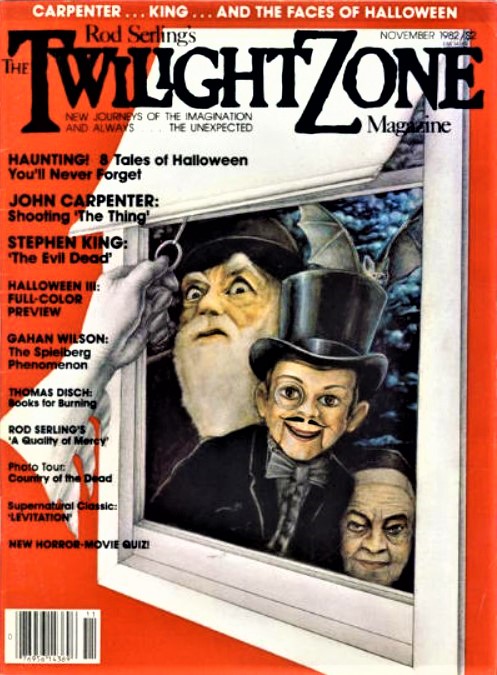
 Volume
2, Number 8 (November, 1982)
Volume
2, Number 8 (November, 1982)
Cover art: Bruce Heapps
TZ
Publications, Inc.
President
& Chairman: S. Edward Orenstein
Secretary/Treasurer:
Sidney Z. Gellman
Executive
Vice-Presidents: Leon Garry, Eric
Protter
Executive
Publisher: S. Edward Orenstein
Publisher:
Leon Garry
Associate
Publisher and Consulting Editor: Carol
Serling
Editorial
Director: Eric Protter
Editor:
T.E.D. Klein
Managing
Editor: Jane Bayer
Assistant
Editor: Robert Sabat
Editorial
Assistant: Judy Linden
Contributing
Editors: Thomas M. Disch, Gahan
Wilson
Design
Director: Michael Monte
Art
Director: Wendy Mansfield
Art
Production: Susan Lindeman, Carol
Sun, Lori Hollander
Typesetting:
Irma Landazuri
Production
Director: Stephen J. Fallon
Controller:
Thomas Schiff
Ass’t
to the Publisher: Penny Layne
Public
Relations Mgr.: Jeffrey Nickora
Accounting
Mgr.: Chris Grossman
Accounting
Ass’t: Annmarie Pistilli
Office
Ass’t: Zuleyma Guevara
Circulation
Director: William D. Smith
Circulation
Mgr.: Carole A. Harley
Circulation
Ass’t: Katherine Lys
Northeastern
Cirulation Manager: Jacqueline Doyle
Eastern
Circ. Mgr.: Hank Rosen
West
Coast Circ. Mgr.: Gary Judy
Advertising
Manager: Rachel Britapaja
Adv.
Production Manager: Marina Despotakis
Advertising
Representatives: Barney O’Hara &
Associates
Contents:
--In the Twilight Zone: “Unmasking time
. . .” by T.E.D. Klein
--Other Dimensions: Screen by Gahan
Wilson
--Other Dimensions: Books by Thomas M.
Disch
--Other Dimensions: The ‘Heroes &
Heavies’ Quiz by Kathleen Murray
--Other Dimensions: War in Fantasyland
by Baird Searles
--Other Dimensions: Etc.
--The Evil Dead (review) by Stephen King
--John Carpenter: Doing His Own Thing
(interview) by James Verniere
--“Hell Is Murky” by John Alfred Taylor
--Required Reading: “Levitation” by
Joseph Payne Brennan
--“The Opening” by Bruce Boston
--TZ Screen Preview: Halloween III by James Verniere
--Country of the Dead by Randy Chisholm
(photos) & John Bensink (text)
--“Night Cry” by Katherine M. Turney
--“The Spook Man” by Al Sarrantonio
--“The Circle” by Lewis Shiner
--“Halloween Girl” by Robert Grant
--“The Screenplay” by Joseph Cromarty
--“The Smell of Cherries” by Jeffrey
Goddin
--Show-by-Show Guide: TV’s Twilight
Zone: Party Twenty by Marc Scott Zicree
--TZ Classic Teleplay: “A Quality of
Mercy” by Rod Serling
--Looking Ahead: In December’s TZ
--In
the Twilight Zone: “Unmasking time . . .” by T.E.D Klein
 |
| T.E.D. Klein |
-Klein
gets straight to the contributor bios in this Halloween-themed issue. Among the
highlights: the return of Gahan Wilson as films reviewer, an essay on The Evil Dead by
Stephen King, an interview with John Carpenter, required reading from Joseph
Payne Brennan, Halloween stories by Al Sarrantonio, Lewis Shiner, and Robert
Grant, a preview of Halloween III, and
a feature on unusual epitaphs. The “Unmasking time” of the title refers to
Klein’s inclusion of photographs of some of the TZ Magazine staff. There are
photos of Klein, publisher Leon Garry, editorial director Eric Protter,
managing editor Jane Bayer, assistant editor Robert Sabat, art department
members Susan Lindeman, Lori Hollander, Michael Monte, Wendy Mansfield, Carol
Sun, and Irma Landazuri, production director Stephen J. Fallon, and advertising
production manager Marina Despotakis.
--Other
Dimensions: Screen by Gahan Wilson
 |
| Poltergeist |
-Feeling
ambitious upon his return to the magazine, Wilson reviews three notable films: E.T.: The Extra Terrestrial (1982), The Thing (1982), and
Poltergeist (1982). Since E.T. and The Thing feature aliens as characters, Wilson expounds upon the pros and cons of
what he terms the “NHL,” or non-human lead, especially as it refers to E.T.
Wilson is enthusiastic in his review of
Steven Spielberg’s film, especially the performances of child actors Henry
Thomas and Drew Barrymore, the special effects from Carlo Rimbaldi, Spielberg’s
direction, and the script by Melissa Mathison, the writer who rewrote Richard
Matheson’s adaptation of George Clayton Johnson’s “Kick the Can” for Twilight
Zone: the Movie (1983). Wilson’s review of John Carpenter’s The
Thing (subject of the TZ Screen Preview
in the July, 1982 issue) is largely positive with particular praise for the
script from Bill Lancaster, Rob Bottin’s special makeup effects, and the
successful updating of the material. Wilson takes issue with the design of the
spaceship upon which the Thing arrives on Earth, feeling that it does not makes
sense for the amorphous physiology of the Thing to be able to pilot such a
vehicle. Fan theories have suggested that the Thing arrived as a stowaway on
the spacecraft, having attacked and absorbed the lifeform onboard. John
Carpenter, the director of The Thing, is
the interview subject in this issue. Finally, Wilson tackles the funhouse spook
film Poltergeist, directed by Tobe
Hooper and produced by Steven Spielberg. Wilson praises the cast but finds
fault with the film’s kitchen-sink approach, throwing everything at the viewer
while taking little time to explain anything. The film’s troubled production is
also briefly touched upon.
--Other
Dimensions: Books by Thomas M. Disch
-Disch
is in acerbic form in this review column as he cuttingly examines four novels.
Disch first takes his critical knife to Mickelsson’s
Ghosts by John Gardner. Disch writes:
“Gardner writes precisely the sort of over-earnest, symbol-laden tome that is
to the college writers’ workshop what the Model A was to Detroit. I can imagine
no one reading Mickelsson’s Ghosts with
pleasure except the more plodding students of Creative Writing, whose faith in
the eventual triumph of the patient imitation of approved models finds in
Gardner a kind of messiah.” Richard A. by
Sol Yurick fares little better under Disch’s critical eye. The prose style is
Disch’s primary point of contention and he offers an excerpt of purple prose as
example. His final judgment: “It’s only paper. Burn it.” Disch also suggests
burning John Shirley’s Cellars, a
horror novel currently gaining new and appreciative readers through a
resurgence of interest in paperback horror novels of the 1980s. Disch is not a
fan, however, and concludes this way: “So it goes, the grue alternating with
the hokum for 295 pages of prose that is eighty-five percent pulp padding and
fifteen percent amplified scream. There is, I will admit, an aesthetic to
screaming, and Shirley’s shriller screams can get to your crystal ware, but
screaming is, as a general rule, less effective on the printed page than in
rock music, where the silly lyrics are blessedly incomprehensible and the beat
goes on. Novels, alas, don’t have a rhythm section to keep them moving – so
when the pages refuse to turn: burn, baby, burn.” The final book under the
knife is Battlefield Earth by L. Ron
Hubbard. Disch characterizes the book as “to other, ordinary dumb books what a
Dyson sphere is to an ordinary lampshade – awesomely much bigger, though not
different in kind.” Disch criticizes the bits of autobiography that Hubbard
includes in the opening of the book, as well as the old-fashioned feel of the
novel. Disch admits, however, that the novel will almost certainly be a
critical and commercial success. A large advertisement for Battlefield
Earth is featured at the end of the
column. Disch included a portion of this review column, the section dealing
with Hubbard’s Battlefield Earth, in
his 2005 essay collection On SF.
--Other
Dimensions: The ‘Heroes & Heavies’ Quiz by Kathleen Murray
-The
quiz this month challenges the reader to match the hero or heroine of horror
movies with the bad guys who terrorize them. Below are the quiz and the answers
for those who wish to take the challenge.
--Other
Dimensions: War in Fantasyland by Baird Searles
Illustration by Jonathan Lewis
 -Searles
(1934-1993) was the proprietor of the now-defunct Science Fiction Shop in
Manhattan as well as a books, films, and technology reviewer for several
science fiction magazines. Here he examines the history of fantasy fandom among
readers and the ways in which this fandom was changed, expanded, and challenged
by the greater emergence of fantasy in films and television, particularly where
it concerns Star Trek fandom. Searles explains how fantasy first
became a publishing category, the birth of fantasy conventions and how film and
television have changed conventions, the different types of fantasy readers,
differences in expectations between readers and viewers, and the ways in which
films and television have influenced books, and vice versa.
-Searles
(1934-1993) was the proprietor of the now-defunct Science Fiction Shop in
Manhattan as well as a books, films, and technology reviewer for several
science fiction magazines. Here he examines the history of fantasy fandom among
readers and the ways in which this fandom was changed, expanded, and challenged
by the greater emergence of fantasy in films and television, particularly where
it concerns Star Trek fandom. Searles explains how fantasy first
became a publishing category, the birth of fantasy conventions and how film and
television have changed conventions, the different types of fantasy readers,
differences in expectations between readers and viewers, and the ways in which
films and television have influenced books, and vice versa.
--Other
Dimensions: Etc.
 -The
miscellany column this month finds the use of the “popular phrase” the
“twilight zone” in a newspaper article from the May 6, 1915 issue of the
Niagara Falls, NY Gazette, an increase in orders for the music examined by Jack
Sullivan in his recently-ended music column, more gargoyle sightings in NYC (right), an
article on a child born “in the twilight zone” when changes in time zones puts
his birthdate at odds with his admittance to the proper school grade, a
limerick by Edward Lear which includes “E.T.,” a frequently-sited article on
the N.A.A.C.P. which contains the term “Twilight Zone,” and a listing of
unusually named cities, towns, and places across the U.S., such as The
Boneyard, Arizona, Midnight, Mississippi, and Skeleton, Oklahoma.
-The
miscellany column this month finds the use of the “popular phrase” the
“twilight zone” in a newspaper article from the May 6, 1915 issue of the
Niagara Falls, NY Gazette, an increase in orders for the music examined by Jack
Sullivan in his recently-ended music column, more gargoyle sightings in NYC (right), an
article on a child born “in the twilight zone” when changes in time zones puts
his birthdate at odds with his admittance to the proper school grade, a
limerick by Edward Lear which includes “E.T.,” a frequently-sited article on
the N.A.A.C.P. which contains the term “Twilight Zone,” and a listing of
unusually named cities, towns, and places across the U.S., such as The
Boneyard, Arizona, Midnight, Mississippi, and Skeleton, Oklahoma.
--‘‘‘The
Evil Dead’ Why you haven’t seen it yet . . . and why you ought to” by Stephen
King
“While on the scene at Cannes, the
author stumbled upon – well, not gold, exactly,
but plenty of great gore.
 -This
is one of the more notable reviews in horror film history. King’s review of
director Sam Raimi’s The Evil Dead resulted from the author having attended a
screening of the film at the Cannes Film Festival where the film screened out
of competition. King’s quote of “the most ferociously original horror film of
the year” was used on the film’s theatrical release poster and other marketing
material. The quote was as follows: “that he has made the most ferociously
original horror film of 1982 seems to me beyond doubt.” King uses the word
“genius” when discussing the film and its director while also acknowledging the
film’s derivative nature and its debt to such films as Night of the Living
Dead and The Exorcist. When King viewed the film at Cannes, it
was still struggling to find theatrical distribution and had only been viewed
at occasional screenings. The film was eventually released simultaneously in
theaters by New Line Cinema and on VHS home video. It has become a classic of
the modern horror film, spawning two sequels, Evil Dead II (1987) and Army of Darkness (1992), a television series, Ash vs Evil
Dead (2015-2018), comic books, toys, and
more. The production of the film has been exhaustively documented in
publications like Fangoria as well as
in supplementary material on the film’s various home video releases. King’s
review is a bit of production history, a bit of introduction to the filmmakers
and performers, a bit of detail about the film’s struggle for distribution, and
a bit of critique.
-This
is one of the more notable reviews in horror film history. King’s review of
director Sam Raimi’s The Evil Dead resulted from the author having attended a
screening of the film at the Cannes Film Festival where the film screened out
of competition. King’s quote of “the most ferociously original horror film of
the year” was used on the film’s theatrical release poster and other marketing
material. The quote was as follows: “that he has made the most ferociously
original horror film of 1982 seems to me beyond doubt.” King uses the word
“genius” when discussing the film and its director while also acknowledging the
film’s derivative nature and its debt to such films as Night of the Living
Dead and The Exorcist. When King viewed the film at Cannes, it
was still struggling to find theatrical distribution and had only been viewed
at occasional screenings. The film was eventually released simultaneously in
theaters by New Line Cinema and on VHS home video. It has become a classic of
the modern horror film, spawning two sequels, Evil Dead II (1987) and Army of Darkness (1992), a television series, Ash vs Evil
Dead (2015-2018), comic books, toys, and
more. The production of the film has been exhaustively documented in
publications like Fangoria as well as
in supplementary material on the film’s various home video releases. King’s
review is a bit of production history, a bit of introduction to the filmmakers
and performers, a bit of detail about the film’s struggle for distribution, and
a bit of critique.
--John
Carpenter: Doing His Own Thing by James Verniere
“With Firestarter still ahead, The
Thing’s director talks about his lifelong love of horror movies, the spate
of films spawned by his Halloween, and
the perils of remaking – or appearing to remake – a cult classic.”
 -James
Verniere provides a concise but detailed account of John Carpenter’s career
before getting into the interview. He begins by asking the director about his
formative years, from an early childhood interest in film and horror to his
university days at the USC film school. Each of Carpenter’s films is then
discussed in turn, from the early film Dark
Star, made for $60,000 while at USC, to
the critically acclaimed but commercially unsuccessful action thriller Assault
on Precinct 13, to the awesomely successful
Halloween, and concluding with
discussions of Escape from New York, The Fog, and the recently completed The Thing. Each film is discussed in the context of Carpenter’s inspiration,
process, and sociological view. Carpenter clarifies his level of participation
in Halloween II, details what viewers
can expect from Halloween III, and provides
his view on the spate of slasher films which arrived in the wake of Halloween’s
success. Carpenter speaks in detail about
The Thing, from the impetus to remake
a classic to his approach in updating the material. The interview concludes
with Carpenter discussing film projects he planned to make. These projects were
either made much later, never made, or were made without Carpenter’s
involvement, including The Philadelphia Experiment (made in 1984 without Carpenter’s involvement), a weird western titled El Diablo (released in 1990 with Carpenter as
co-writer and executive producer), and, most tantalizingly, an adaptation of
Stephen King’s Firestarter, which was
made without Carpenter’s involvement in 1984.
-James
Verniere provides a concise but detailed account of John Carpenter’s career
before getting into the interview. He begins by asking the director about his
formative years, from an early childhood interest in film and horror to his
university days at the USC film school. Each of Carpenter’s films is then
discussed in turn, from the early film Dark
Star, made for $60,000 while at USC, to
the critically acclaimed but commercially unsuccessful action thriller Assault
on Precinct 13, to the awesomely successful
Halloween, and concluding with
discussions of Escape from New York, The Fog, and the recently completed The Thing. Each film is discussed in the context of Carpenter’s inspiration,
process, and sociological view. Carpenter clarifies his level of participation
in Halloween II, details what viewers
can expect from Halloween III, and provides
his view on the spate of slasher films which arrived in the wake of Halloween’s
success. Carpenter speaks in detail about
The Thing, from the impetus to remake
a classic to his approach in updating the material. The interview concludes
with Carpenter discussing film projects he planned to make. These projects were
either made much later, never made, or were made without Carpenter’s
involvement, including The Philadelphia Experiment (made in 1984 without Carpenter’s involvement), a weird western titled El Diablo (released in 1990 with Carpenter as
co-writer and executive producer), and, most tantalizingly, an adaptation of
Stephen King’s Firestarter, which was
made without Carpenter’s involvement in 1984.
--“Hell
Is Murky” by John Alfred Taylor
Illustrated by Steve Byram
“They say it’s nice to have a cult
following. But not this kind of
following. And not this cult.”
 -A
cartoonist recently moved to Los Angeles believes himself the victim of an
insidious cult whose agents stalk him and whose powers extend to altering
reality. When he discovers a notebook belonging to a cult member in his new
home he sets up a fateful meeting with the cult’s leader.
-A
cartoonist recently moved to Los Angeles believes himself the victim of an
insidious cult whose agents stalk him and whose powers extend to altering
reality. When he discovers a notebook belonging to a cult member in his new
home he sets up a fateful meeting with the cult’s leader.
-This
was an excellent and creative story which struck that otherworldly chord which
will appeal to TZ fans. The imagery is David Lynchian in its approach and the
snap ending is capably handled. John Alfred Taylor (b. 1931) previously
appeared in the pages of TZ with the story “When the Cat’s Away . . .” in the
September, 1981 issue. Taylor appeared again with “Like a Black Dandelion” in
the Sept/Oct, 1983 issue and “The Weight of Zero” in the Jan/Feb, 1985 issue. Taylor
is a prolific short fiction writer, mainly of horror and dark fantasy fiction,
the best of which was collected by Ash Tree Press in the 2008 volume Hell Is Murky: Twenty Strange Tales. “Hell Is Murky” was reprinted in the Summer,
1985 issue of Night Cry.
--Required
Reading: “Levitation” by Joseph Payne Brennan
Illustrated by Edward Gorey
“A classic tale in which we learn that
the supernatural world has its own merciless version of Murphy’s Law.”
-A
hypnotist at a country fair challenges a heckler to come on stage and subject
himself to the trick of levitation. When the hypnotist has a heart attack
during the trick, the unconscious, levitating man continues to rise into the
night sky.
-Joseph
Payne Brennan (1918-1990) was the last great name in horror fiction to emerge
from the pages of Weird Tales, selling a handful of stories to the pulp
magazine between 1952 and its demise in 1954. He is a personal favorite of mine
and, though his work can be difficult to find, I highly recommend Brennan to
anyone who enjoys well-told, traditional tales of horror and mystery. Brennan
was also a prolific and award-winning poet, a mystery writer whose stories
appeared regularly in Alfred Hitchcock’s Mystery Magazine, an essayist and expert on the works of H.P.
Lovecraft, and worked for forty years as an acquisitions assistant at Yale’s
Sterling Memorial Library. “Levitation” first appeared in Brennan’s 1959 Arkham
House collection Nine Horrors and a Dream, published in paperback in 1962 with a memorable cover by Richard Powers.
The collection was reprinted in 2019 by Dover. The Edward Gorey illustration
first accompanied the tale with its appearance in the 1968 anthology Hauntings:
Tales of the Supernatural, edited by
Henry Mazzeo. The story was adapted for the first season of Tales from the
Darkside from a script by David Gerrold,
directed by John Harrison, broadcast May 19, 1985. Brennan’s stories “Murder on
the Rocks” and “Goodbye, Dr. Bliss” were adapted for the second season of Boris
Karloff’s Thriller as “The Lethal
Ladies,” scripted by Boris Sobelman, directed by Ida Lupino, broadcast April
16, 1962.
 |
Cover by Kirk Reineret
illustrating "Slime" |
-Nine Horrors and a Dream also included much of Brennan’s best work,
including the unforgettable “Slime,” a 1953 Weird Tales cover story which was likely an inspiration
for the film The Blob (1958), “The
Calamander Chest,” about a beckoning, ghostly finger, “Canavan’s Back Yard,”
about a deadly plot of land and a witch’s curse (Brennan wrote a sequel to the
tale, “Canavan Calling,” in 1985), and “The Mail for Juniper Hill,” a devilish
tale of life beyond death. Much of Brennan’s output was self-published by his
Macabre House imprint under which Brennan also published a Weird Tales-like magazine titled Macabre for nearly twenty years between 1957 and
1976. Along with Nine Horrors and a Dream, Brennan’s most readily available collection is The Shapes of
Midnight (Berkley, 1980; reprinted by
Dover in 2019 minus two tales). The original edition included an introduction
from Stephen King in which King admitted Brennan’s influence on his own work:
“Joseph Payne Brennan is one of the most effective writers in the horror genre,
and he is certainly one of the writers I have patterned my own career upon.”
King appropriated the name of a fictional town in Brennan’s works, Juniper
Hill, for the name of the fictional insane asylum in his own works. The
Shapes of Midnight included such stories
as “The Corpse of Charlie Rull,” a fast-paced, gruesome, and undeservedly
neglected zombie tale, “The Willow Platform,” a tale of ironic revenge in the
style of E.C. Comics, “The Horror at Chilton Castle,” a tale of a vampire
legacy, and the Twilight Zone-esque
“The House on Hazel Street,” in which a woman is drawn into the past through
the power of her memories.
--“The
Opening” by Bruce Boston
Illustrated by Annie Alleman
“They were strangers in the night. And
one of them was very strange.”
 -After
a fight with his wife, a man walks to a hillside in the nighttime where he is
soon joined by an odd-looking man walking an odd-looking dog. The odd-looking
man talks about the stars and the opportunity to voyage to outer space for
anyone willing to take the journey. Later, the man believes the encounter to
have been a dream, until he finds his wife missing.
-After
a fight with his wife, a man walks to a hillside in the nighttime where he is
soon joined by an odd-looking man walking an odd-looking dog. The odd-looking
man talks about the stars and the opportunity to voyage to outer space for
anyone willing to take the journey. Later, the man believes the encounter to
have been a dream, until he finds his wife missing.
-This
was a slight but enjoyable story with a snap ending from Bruce Boston (b.
1943), who is likely the most honored modern speculative poet. His poetry has
won multiple Rhysling, Asimov’s Readers’, and Bram Stoker Awards as well as the
first Grandmaster Award from the Science Fiction Poetry Association. Boston is
equally adept at prose and his stories have appeared in numerous magazines,
large and small press alike. “The Opening” was collected in Skin Trades (1988).
--TZ
Screen Preview: Halloween III by
James Verniere
“This year’s entry in the seasonal
horror sweepstakes combines Celtic magic, microchips, and masks that transform
more than just your looks. James Verniere reports.”
 -Verniere
begins with a potted history of Halloween, the holiday, before moving on to a brief examination of the
first two Halloween films. Halloween III, of course, is remembered as the Halloween
film without the masked killer Michael
Myers. Instead, the plot focuses on the machinations of an evil mask-maker, played to perfection by Dan O'Herlihy, whose products transform and kill those who wear them. The film was initially poorly
received but its reputation has improved in recent years as it has found a new
and appreciative audience. The Halloween franchise was initially intended as an anthology film series, wherein
each film would tell a different story set on Halloween. The popularity of the
Michael Myers character was such that the Halloween films soon settled into a convoluted storyline to keep Myers
terrorizing the town of Haddonfield, Illinois. Though uncredited in the
finished film, Halloween III was
co-scripted by Nigel Kneale, the British scriptwriter best-known for the Quatermass
films and television productions such as The
Stone Tape (1972) and the short-lived
anthology series Beasts. Verniere
gets behind Kneale’s process on scripting the third Halloween film and gets John Carpenter’s input on the
proceedings as well. Finally, first-time director Tommy Lee Wallace, who
previously served under Carpenter as editor and production designer, is briefly
profiled. Wallace went on to direct three episodes of the first revival Twilight
Zone series: “Dreams for Sale,” “Little
Boy Lost,” and “The Leprechaun-Artist,” all from the first season.
-Verniere
begins with a potted history of Halloween, the holiday, before moving on to a brief examination of the
first two Halloween films. Halloween III, of course, is remembered as the Halloween
film without the masked killer Michael
Myers. Instead, the plot focuses on the machinations of an evil mask-maker, played to perfection by Dan O'Herlihy, whose products transform and kill those who wear them. The film was initially poorly
received but its reputation has improved in recent years as it has found a new
and appreciative audience. The Halloween franchise was initially intended as an anthology film series, wherein
each film would tell a different story set on Halloween. The popularity of the
Michael Myers character was such that the Halloween films soon settled into a convoluted storyline to keep Myers
terrorizing the town of Haddonfield, Illinois. Though uncredited in the
finished film, Halloween III was
co-scripted by Nigel Kneale, the British scriptwriter best-known for the Quatermass
films and television productions such as The
Stone Tape (1972) and the short-lived
anthology series Beasts. Verniere
gets behind Kneale’s process on scripting the third Halloween film and gets John Carpenter’s input on the
proceedings as well. Finally, first-time director Tommy Lee Wallace, who
previously served under Carpenter as editor and production designer, is briefly
profiled. Wallace went on to direct three episodes of the first revival Twilight
Zone series: “Dreams for Sale,” “Little
Boy Lost,” and “The Leprechaun-Artist,” all from the first season.
--Country
of the Dead by Randy Chisholm (photos) & John Bensink (text)
“The original ‘silent majority’ – the
dead – may no longer be the majority. And they’re certainly not silent.”
 -John
Bensink, who previously appeared in TZ with the story “Midtown Bodies” in the
August, 1982 issue, takes us through some of the more memorable epitaphs
collected in American Epitaphs, Grave
and Humorous by Charles L. Wallis (Dover,
1979), accompanied by evocative photographs from Chisholm. Wallis’ book was
originally published in 1954 by Oxford University Press under the title Stories
on Stone. Examples include:
-John
Bensink, who previously appeared in TZ with the story “Midtown Bodies” in the
August, 1982 issue, takes us through some of the more memorable epitaphs
collected in American Epitaphs, Grave
and Humorous by Charles L. Wallis (Dover,
1979), accompanied by evocative photographs from Chisholm. Wallis’ book was
originally published in 1954 by Oxford University Press under the title Stories
on Stone. Examples include:
On a marker in Paxton, Massachusetts,
for Sidney Ellis, died 1836, age seven weeks:
He
lived
He
wept
He
smiled
He
groaned
And
died.
On a marker in Westernville, New York,
for William Reese, died 1872, age twenty-one:
This
is what I expected but
Not
so soon.
And more of the like.
--“Night
Cry” by Katherine M. Turney
Illustrated by Lisa Mansolillo
“That yowling cat was keeping her awake.
But what if it wasn’t a cat?”
 -A
woman is kept awake by a sound outside her apartment window which she cannot
identify. The source of the sound establishes itself in an unexpectedly
gruesome way.
-A
woman is kept awake by a sound outside her apartment window which she cannot
identify. The source of the sound establishes itself in an unexpectedly
gruesome way.
-This
short shocker with a nasty ending was the first, and possibly only, published
story by Katherine M. Turney, whom T.E.D. Klein informs us managed movie
theaters in Denver at the time this story was published. The title of the story
was used for TZ Magazine’s sister publication, Night Cry, which
was published from 1984-1987. Turney’s story was reprinted in the premier issue
of Night Cry, accompanied by an
illustration from D.W. Miller.
--“The
Spook Man” by Al Sarrantonio
Illustrated by Kevin Kelly
“His cape was black, his eyes were
hooded. And he was particularly fond of children.”
-A
figure known as the Spook Man arrives in a small town and entices four
monster-loving children to enter his haunted travelling home. The Spook Man’s
home contains all manner of nightmare creatures and he has built his collection
by transforming the children he brings into his home.
-Al
Sarrantonio (b. 1952) appears again in TZ after last month’s “The Silly Stuff.”
“The Spook Man” is prime Sarrantonio, combining the author’s love of Halloween,
traditional images of horror and the macabre, and an engaging prose style to
create a story which is partly nostalgic sweetness and partly an evocation of
the sinister elements of the dark season. It is also a love letter to those of
us who have always enjoyed monsters and horror stories and the like. Sarrantonio
writes often on the subject of Halloween and “The Spook Man” is clearly an
homage to Ray Bradbury’s many writings on the season, particularly in its
poetic prose style. “The Spook Man” will recall Bradbury’s collection The October Country and, especially, his novel Something Wicked This Way Comes. “The Spook Man” was reprinted in the Fall,
1985 issue of Night Cry and collected
in Toybox (1999).
--“The
Circle” by Lewis Shiner
Illustrated by Peter Kuper
“It was the perfect story for Halloween
– and let the reader beware!”
-A
circle of friends gathers every Halloween night to read scary stories. This
Halloween they receive a package from a fringe member of the group who was
recently pushed out of the circle. The package contains a story to be read
aloud. It concerns the group gathered on Halloween night and the act of reading
the tale traps them in a fateful course of events.
-This
was my favorite story in the issue, a simple yet chilling and exceedingly
clever take on themes ranging from the occult, revenge, the tradition of oral
storytelling, and the politics of social groups. The title refers to the term
used to describe a group of friends as well as the effects of reading the
outcast member’s tale. Lewis Shiner (b. 1950) previously appeared in TZ with the
tales “Blood Relations,” in the May, 1981 issue, and “Tommy and the Talking
Dog” in the July, 1982 issue. “The Circle” was Shiner’s final story for TZ
though he appeared later with a story, “Dancers,” in the Summer, 1987 issue of
TZ’s sister mag, Night Cry. “The Circle” was reprinted in two Halloween
themed anthologies: 13 Horrors of Halloween (1983), edited by Isaac
Asimov, Martin H. Greenberg, and Carol-Lynn Rössel Waugh, and October
Dreams (2000), edited by Richard Chizmar
and Robert Morrish. Chizmar co-scripted a 2009 television adaptation of the
story for the short-lived anthology series Fear Itself. The episode was the final in the series and
did not air on network broadcast but was included when the series was collected
on home video. Chizmar was assisted on the script by Johnathon Schaech and the
episode was directed by Eduardo Rodriguez. The story was collected in Shiner’s Collected
Stories (Subterranean Press, 2009).
--“Halloween
Girl” by Robert Grant
Illustrated by Harry Pincus
“It was the season, the holiday, the
night of nights. And come what may, he was going to spend it with her.”
-A
young boy and a young girl bond over their shared love of monsters, horror, and
Halloween. The young girl grows sick and dies, leaving the young boy forlorn.
The boy grudgingly honors the customs of the next Halloween and afterwards
visits the girl’s grave to leave her his bag of trick-or-treat candy. He wakes
the following morning to evidence that she visited him later in the night.
-This
story was a perfect example of a type of tale which is very hard to write, the
gently spooky story. More touching than chilling, the ending of the tale still
manages to satisfy much in the way of Ray Bradbury’s “The Emissary.” Like Lewis
Shiner’s “The Circle,” Grant’s “Halloween Girl” was reprinted in 13 Horrors of Halloween (1983). Grant appeared later in TZ with the story “Where You Lead . . .
I Will Follow” in the October, 1985 issue.
--“The
Screenplay” by Joseph Cromarty
Illustrated by Yvonne Buchanan
“All this talk about werewolves . . .
could Jack be trying to tell him something?”
-Roger
surprises his friend Jack with a visit to discuss ideas for a screenplay. Jack
seems uncomfortable with Roger’s unexpected visit and becomes increasingly
agitated when Roger suggests a story about werewolves. In fact, Roger begins to
believe that Jack may be a werewolf himself and makes a quick exit. Jack
congratulates himself on being an actor as he got Roger to leave before Roger’s
wife arrived at Jack’s place.
-This
humorous story with an ironic ending is courtesy of Joseph Cromarty
(1932-2016), who previously appeared with the Edgar Allan Poe spoof, “Ms. Found
in a Bottle,” in the August, 1982 issue. Cromarty appeared twice more in TZ,
with “The Neighborhood Assassin” and “Words, Words, Words,” both in the
Jan/Feb, 1984 issue.
--“The
Smell of Cherries” by Jeffrey Goddin
Illustrated by Michael Davis
“Something was spooking the night
watchmen – and it wasn’t robbers. It was just . . .
-A
security guard is terrorized by the frightening revenants which haunt a
warehouse property which was once the site of nerve gas testing.
-Goddin
used his personal experience as a security guard to craft this atmospheric
tale. Anyone can imagine the uneasiness which could creep upon you if you were
left at night to guard an abandoned property. Goddin takes this idea to
horrific heights with some disturbing imagery and great moments of tension. Goddin
is a short story writer who was prolific from the late seventies through the early
nineties, publishing horror and science fiction tales in most of the notable
small press magazines, such as Weirdbook,
Eldritch Tales, Fantasy Tales, Deathrealm, and
the like. His stories have been included in Karl Edward Wagner’s The Year’s
Best Horror Stories, including “The Smell
of Cherries,” which appeared in volume XI of the series (1983). The story was also
reprinted in the anthology A Treasury of American Horror Stories (1985) and collected as the title story of a
2012 volume of Goddin’s stories from Gallows Press. Paperback collectors may know Goddin through his two horror novels
published by Leisure Books, both of which remain collectible for their cover
art: The Living Dead (1987) and Blood
of the Wolf (1987).
--Show-By-Show
Guide: TV’s Twilight Zone: Part Twenty by Marc Scott Zicree
-Marc
Scott Zicree continues his guide to the original television series by providing
cast and crew listings, summaries, and Rod Serling’s opening and closing narrations
for the fifth season episodes “Ninety Years Without Slumbering,” “Ring-a-Ding
Girl,” and “You Drive.”
--TZ
Classic Teleplay: “A Quality of Mercy” by Rod Serling
-The
complete shooting script of Rod Serling’s third season tale about a young,
inexperienced, cruel, and overzealous platoon leader who discovers what it
means to see through the eyes of the enemy. The episode was directed by Buzz
Kulik, starring Dean Stockwell and Albert Salmi, originally broadcast December
29, 1961. Go here for our full review of the episode.
--Looking
Ahead: In December’s TZ
-Next
month looks like another great issue. December’s TZ features stories from David
J. Schow, Pamela Sargent, Mort Castle, and L.P. Hartley, the latter being the
subject of an Essential Writers essay by Jack Sullivan. The issue also features
an interview with director Ridley Scott, a preview of the science
fiction/horror film Xtro, a new quiz from William Fulwiler, and the
script for “Living Doll” by Jerry Sohl, which at this time was still solely
credited to Charles Beaumont. See you next month!
-JP


 “This
is William Benteen, who officiates on a disintegrating outpost in space. The
people are a remnant society who left the Earth looking for a millennium, a
place without war, without jeopardy, without fear. And what they found was a
lonely, barren place whose only industry was survival. And this is what they
have done for three decades, survive. Until the memory of the Earth they came
from has become an indistinct and shadowed recollection of another time and
another place. One month ago, a signal from Earth announced that a ship would
be coming to pick them up and take them home. In just a moment we’ll hear more
of that ship, more of that home, and what it takes out of mind and body to
reach it. This is The Twilight Zone.”
“This
is William Benteen, who officiates on a disintegrating outpost in space. The
people are a remnant society who left the Earth looking for a millennium, a
place without war, without jeopardy, without fear. And what they found was a
lonely, barren place whose only industry was survival. And this is what they
have done for three decades, survive. Until the memory of the Earth they came
from has become an indistinct and shadowed recollection of another time and
another place. One month ago, a signal from Earth announced that a ship would
be coming to pick them up and take them home. In just a moment we’ll hear more
of that ship, more of that home, and what it takes out of mind and body to
reach it. This is The Twilight Zone.”
 Dual
suns cast intense heat and perpetual daylight upon a group of weary colonists
on a barren, rocky outpost in space. The colonists are the remnants and the
descendants of the 113 people who arrived on the Pilgrim 1, an exploratory
vessel which set out thirty years earlier to find a human habitat beyond Earth.
Now they struggle to survive in this unforgiving and oppressive environment. On
a rise above a cluster of makeshift shacks is a radio tower where Captain
Benteen, the leader of the colony, oversees a constant monitoring of the radio
channels in the hopes of hearing from a rescue ship from Earth.
Dual
suns cast intense heat and perpetual daylight upon a group of weary colonists
on a barren, rocky outpost in space. The colonists are the remnants and the
descendants of the 113 people who arrived on the Pilgrim 1, an exploratory
vessel which set out thirty years earlier to find a human habitat beyond Earth.
Now they struggle to survive in this unforgiving and oppressive environment. On
a rise above a cluster of makeshift shacks is a radio tower where Captain
Benteen, the leader of the colony, oversees a constant monitoring of the radio
channels in the hopes of hearing from a rescue ship from Earth.


 James Whitmore’s
performance as Captain William Benteen is justly celebrated as the best part of
“On Thursday We Leave for Home.” I rated the performance #6 among the best
performances on the series and it could have rated higher, all the way up to
#1. The most impressive aspect of Whitmore’s performance is that it essentially required
the actor to transition between three different characters, the heroic,
benevolent leader of the colonists, the selfish, controlling zealot, and the tragic figure of a man doomed by
his own stubborn insistence on being a god among men. Whitmore pulls off all
aspects of the performance exceptionally well, particularly the transition from
a hated antagonist to a truly pitiable figure with hands raised in supplication
to the sky. It is one of the most gutting endings on the series and it achieves its effects by eliciting great pity and sympathy for a character most viewers despised five minutes previously. These moments when Rod Serling's best writing found a skilled and motivated performer through which to speak are the reasons why this sixty-plus year old television series remains one of the most watched and discussed programs in the medium's history.
James Whitmore’s
performance as Captain William Benteen is justly celebrated as the best part of
“On Thursday We Leave for Home.” I rated the performance #6 among the best
performances on the series and it could have rated higher, all the way up to
#1. The most impressive aspect of Whitmore’s performance is that it essentially required
the actor to transition between three different characters, the heroic,
benevolent leader of the colonists, the selfish, controlling zealot, and the tragic figure of a man doomed by
his own stubborn insistence on being a god among men. Whitmore pulls off all
aspects of the performance exceptionally well, particularly the transition from
a hated antagonist to a truly pitiable figure with hands raised in supplication
to the sky. It is one of the most gutting endings on the series and it achieves its effects by eliciting great pity and sympathy for a character most viewers despised five minutes previously. These moments when Rod Serling's best writing found a skilled and motivated performer through which to speak are the reasons why this sixty-plus year old television series remains one of the most watched and discussed programs in the medium's history.  The revelation upon a
repeat viewing of “On Thursday We Leave for Home” is the exceptional performance of Tim O’Connor
as Colonel Sloane, the foil to Whitmore’s Captain Benteen. O'Connor portrays Sloane as an affable,
intelligent, caring, and accommodating man whose idea of leadership flies
directly in the face of Benteen’s leadership ideals. O’Connor’s performance
is one of restraint pushed and tested in increasing intervals by
Benteen’s progressive mania of control until Sloane takes decisive action to lead the colonists away from Benteen’s
parasitic influence. It is as masterful a character progression in its way as Whitmore’s Benteen. The viewer waits in vain for the crack in Sloane’s
persona to appear. Even to the end Sloane attempts to do the right thing and
persuade Benteen to board the ship with the others. In this way, Benteen’s fate
becomes one completely of his own making, sealing his tragic arc.
The revelation upon a
repeat viewing of “On Thursday We Leave for Home” is the exceptional performance of Tim O’Connor
as Colonel Sloane, the foil to Whitmore’s Captain Benteen. O'Connor portrays Sloane as an affable,
intelligent, caring, and accommodating man whose idea of leadership flies
directly in the face of Benteen’s leadership ideals. O’Connor’s performance
is one of restraint pushed and tested in increasing intervals by
Benteen’s progressive mania of control until Sloane takes decisive action to lead the colonists away from Benteen’s
parasitic influence. It is as masterful a character progression in its way as Whitmore’s Benteen. The viewer waits in vain for the crack in Sloane’s
persona to appear. Even to the end Sloane attempts to do the right thing and
persuade Benteen to board the ship with the others. In this way, Benteen’s fate
becomes one completely of his own making, sealing his tragic arc.  --Buzz
Kulick directed eight additional episodes of the series, including “King Nine
Will Not Return,” “The Trouble with Templeton,” “Static,” “A Hundred Yards Over
the Rim,” “The Mind and the Matter,” “A Game of Pool,” “A Quality of Mercy,”
and “Jess-Belle.” “On Thursday We Leave for Home” was Kulik’s final episode for the series.
--Buzz
Kulick directed eight additional episodes of the series, including “King Nine
Will Not Return,” “The Trouble with Templeton,” “Static,” “A Hundred Yards Over
the Rim,” “The Mind and the Matter,” “A Game of Pool,” “A Quality of Mercy,”
and “Jess-Belle.” “On Thursday We Leave for Home” was Kulik’s final episode for the series. 


 Volume
2, Number 8 (November, 1982)
Volume
2, Number 8 (November, 1982)


 -Searles
(1934-1993) was the proprietor of the now-defunct Science Fiction Shop in
Manhattan as well as a books, films, and technology reviewer for several
science fiction magazines. Here he examines the history of fantasy fandom among
readers and the ways in which this fandom was changed, expanded, and challenged
by the greater emergence of fantasy in films and television, particularly where
it concerns Star Trek fandom. Searles explains how fantasy first
became a publishing category, the birth of fantasy conventions and how film and
television have changed conventions, the different types of fantasy readers,
differences in expectations between readers and viewers, and the ways in which
films and television have influenced books, and vice versa.
-Searles
(1934-1993) was the proprietor of the now-defunct Science Fiction Shop in
Manhattan as well as a books, films, and technology reviewer for several
science fiction magazines. Here he examines the history of fantasy fandom among
readers and the ways in which this fandom was changed, expanded, and challenged
by the greater emergence of fantasy in films and television, particularly where
it concerns Star Trek fandom. Searles explains how fantasy first
became a publishing category, the birth of fantasy conventions and how film and
television have changed conventions, the different types of fantasy readers,
differences in expectations between readers and viewers, and the ways in which
films and television have influenced books, and vice versa.  -The
miscellany column this month finds the use of the “popular phrase” the
“twilight zone” in a newspaper article from the May 6, 1915 issue of the
Niagara Falls, NY Gazette, an increase in orders for the music examined by Jack
Sullivan in his recently-ended music column, more gargoyle sightings in NYC (right), an
article on a child born “in the twilight zone” when changes in time zones puts
his birthdate at odds with his admittance to the proper school grade, a
limerick by Edward Lear which includes “E.T.,” a frequently-sited article on
the N.A.A.C.P. which contains the term “Twilight Zone,” and a listing of
unusually named cities, towns, and places across the U.S., such as The
Boneyard, Arizona, Midnight, Mississippi, and Skeleton, Oklahoma.
-The
miscellany column this month finds the use of the “popular phrase” the
“twilight zone” in a newspaper article from the May 6, 1915 issue of the
Niagara Falls, NY Gazette, an increase in orders for the music examined by Jack
Sullivan in his recently-ended music column, more gargoyle sightings in NYC (right), an
article on a child born “in the twilight zone” when changes in time zones puts
his birthdate at odds with his admittance to the proper school grade, a
limerick by Edward Lear which includes “E.T.,” a frequently-sited article on
the N.A.A.C.P. which contains the term “Twilight Zone,” and a listing of
unusually named cities, towns, and places across the U.S., such as The
Boneyard, Arizona, Midnight, Mississippi, and Skeleton, Oklahoma.  -This
is one of the more notable reviews in horror film history. King’s review of
director Sam Raimi’s The Evil Dead resulted from the author having attended a
screening of the film at the Cannes Film Festival where the film screened out
of competition. King’s quote of “the most ferociously original horror film of
the year” was used on the film’s theatrical release poster and other marketing
material. The quote was as follows: “that he has made the most ferociously
original horror film of 1982 seems to me beyond doubt.” King uses the word
“genius” when discussing the film and its director while also acknowledging the
film’s derivative nature and its debt to such films as Night of the Living
Dead and The Exorcist. When King viewed the film at Cannes, it
was still struggling to find theatrical distribution and had only been viewed
at occasional screenings. The film was eventually released simultaneously in
theaters by New Line Cinema and on VHS home video. It has become a classic of
the modern horror film, spawning two sequels, Evil Dead II (1987) and Army of Darkness (1992), a television series, Ash vs Evil
Dead (2015-2018), comic books, toys, and
more. The production of the film has been exhaustively documented in
publications like Fangoria as well as
in supplementary material on the film’s various home video releases. King’s
review is a bit of production history, a bit of introduction to the filmmakers
and performers, a bit of detail about the film’s struggle for distribution, and
a bit of critique.
-This
is one of the more notable reviews in horror film history. King’s review of
director Sam Raimi’s The Evil Dead resulted from the author having attended a
screening of the film at the Cannes Film Festival where the film screened out
of competition. King’s quote of “the most ferociously original horror film of
the year” was used on the film’s theatrical release poster and other marketing
material. The quote was as follows: “that he has made the most ferociously
original horror film of 1982 seems to me beyond doubt.” King uses the word
“genius” when discussing the film and its director while also acknowledging the
film’s derivative nature and its debt to such films as Night of the Living
Dead and The Exorcist. When King viewed the film at Cannes, it
was still struggling to find theatrical distribution and had only been viewed
at occasional screenings. The film was eventually released simultaneously in
theaters by New Line Cinema and on VHS home video. It has become a classic of
the modern horror film, spawning two sequels, Evil Dead II (1987) and Army of Darkness (1992), a television series, Ash vs Evil
Dead (2015-2018), comic books, toys, and
more. The production of the film has been exhaustively documented in
publications like Fangoria as well as
in supplementary material on the film’s various home video releases. King’s
review is a bit of production history, a bit of introduction to the filmmakers
and performers, a bit of detail about the film’s struggle for distribution, and
a bit of critique.  -James
Verniere provides a concise but detailed account of John Carpenter’s career
before getting into the interview. He begins by asking the director about his
formative years, from an early childhood interest in film and horror to his
university days at the USC film school. Each of Carpenter’s films is then
discussed in turn, from the early film Dark
Star, made for $60,000 while at USC, to
the critically acclaimed but commercially unsuccessful action thriller Assault
on Precinct 13, to the awesomely successful
Halloween, and concluding with
discussions of Escape from New York, The Fog, and the recently completed The Thing. Each film is discussed in the context of Carpenter’s inspiration,
process, and sociological view. Carpenter clarifies his level of participation
in Halloween II, details what viewers
can expect from Halloween III, and provides
his view on the spate of slasher films which arrived in the wake of Halloween’s
success. Carpenter speaks in detail about
The Thing, from the impetus to remake
a classic to his approach in updating the material. The interview concludes
with Carpenter discussing film projects he planned to make. These projects were
either made much later, never made, or were made without Carpenter’s
involvement, including The Philadelphia Experiment (made in 1984 without Carpenter’s involvement), a weird western titled El Diablo (released in 1990 with Carpenter as
co-writer and executive producer), and, most tantalizingly, an adaptation of
Stephen King’s Firestarter, which was
made without Carpenter’s involvement in 1984.
-James
Verniere provides a concise but detailed account of John Carpenter’s career
before getting into the interview. He begins by asking the director about his
formative years, from an early childhood interest in film and horror to his
university days at the USC film school. Each of Carpenter’s films is then
discussed in turn, from the early film Dark
Star, made for $60,000 while at USC, to
the critically acclaimed but commercially unsuccessful action thriller Assault
on Precinct 13, to the awesomely successful
Halloween, and concluding with
discussions of Escape from New York, The Fog, and the recently completed The Thing. Each film is discussed in the context of Carpenter’s inspiration,
process, and sociological view. Carpenter clarifies his level of participation
in Halloween II, details what viewers
can expect from Halloween III, and provides
his view on the spate of slasher films which arrived in the wake of Halloween’s
success. Carpenter speaks in detail about
The Thing, from the impetus to remake
a classic to his approach in updating the material. The interview concludes
with Carpenter discussing film projects he planned to make. These projects were
either made much later, never made, or were made without Carpenter’s
involvement, including The Philadelphia Experiment (made in 1984 without Carpenter’s involvement), a weird western titled El Diablo (released in 1990 with Carpenter as
co-writer and executive producer), and, most tantalizingly, an adaptation of
Stephen King’s Firestarter, which was
made without Carpenter’s involvement in 1984. -A
cartoonist recently moved to Los Angeles believes himself the victim of an
insidious cult whose agents stalk him and whose powers extend to altering
reality. When he discovers a notebook belonging to a cult member in his new
home he sets up a fateful meeting with the cult’s leader.
-A
cartoonist recently moved to Los Angeles believes himself the victim of an
insidious cult whose agents stalk him and whose powers extend to altering
reality. When he discovers a notebook belonging to a cult member in his new
home he sets up a fateful meeting with the cult’s leader. 

 -After
a fight with his wife, a man walks to a hillside in the nighttime where he is
soon joined by an odd-looking man walking an odd-looking dog. The odd-looking
man talks about the stars and the opportunity to voyage to outer space for
anyone willing to take the journey. Later, the man believes the encounter to
have been a dream, until he finds his wife missing.
-After
a fight with his wife, a man walks to a hillside in the nighttime where he is
soon joined by an odd-looking man walking an odd-looking dog. The odd-looking
man talks about the stars and the opportunity to voyage to outer space for
anyone willing to take the journey. Later, the man believes the encounter to
have been a dream, until he finds his wife missing.  -Verniere
begins with a potted history of Halloween, the holiday, before moving on to a brief examination of the
first two Halloween films. Halloween III, of course, is remembered as the Halloween
film without the masked killer Michael
Myers. Instead, the plot focuses on the machinations of an evil mask-maker, played to perfection by Dan O'Herlihy, whose products transform and kill those who wear them. The film was initially poorly
received but its reputation has improved in recent years as it has found a new
and appreciative audience. The Halloween franchise was initially intended as an anthology film series, wherein
each film would tell a different story set on Halloween. The popularity of the
Michael Myers character was such that the Halloween films soon settled into a convoluted storyline to keep Myers
terrorizing the town of Haddonfield, Illinois. Though uncredited in the
finished film, Halloween III was
co-scripted by Nigel Kneale, the British scriptwriter best-known for the Quatermass
films and television productions such as The
Stone Tape (1972) and the short-lived
anthology series Beasts. Verniere
gets behind Kneale’s process on scripting the third Halloween film and gets John Carpenter’s input on the
proceedings as well. Finally, first-time director Tommy Lee Wallace, who
previously served under Carpenter as editor and production designer, is briefly
profiled. Wallace went on to direct three episodes of the first revival Twilight
Zone series: “Dreams for Sale,” “Little
Boy Lost,” and “The Leprechaun-Artist,” all from the first season.
-Verniere
begins with a potted history of Halloween, the holiday, before moving on to a brief examination of the
first two Halloween films. Halloween III, of course, is remembered as the Halloween
film without the masked killer Michael
Myers. Instead, the plot focuses on the machinations of an evil mask-maker, played to perfection by Dan O'Herlihy, whose products transform and kill those who wear them. The film was initially poorly
received but its reputation has improved in recent years as it has found a new
and appreciative audience. The Halloween franchise was initially intended as an anthology film series, wherein
each film would tell a different story set on Halloween. The popularity of the
Michael Myers character was such that the Halloween films soon settled into a convoluted storyline to keep Myers
terrorizing the town of Haddonfield, Illinois. Though uncredited in the
finished film, Halloween III was
co-scripted by Nigel Kneale, the British scriptwriter best-known for the Quatermass
films and television productions such as The
Stone Tape (1972) and the short-lived
anthology series Beasts. Verniere
gets behind Kneale’s process on scripting the third Halloween film and gets John Carpenter’s input on the
proceedings as well. Finally, first-time director Tommy Lee Wallace, who
previously served under Carpenter as editor and production designer, is briefly
profiled. Wallace went on to direct three episodes of the first revival Twilight
Zone series: “Dreams for Sale,” “Little
Boy Lost,” and “The Leprechaun-Artist,” all from the first season.  -John
Bensink, who previously appeared in TZ with the story “Midtown Bodies” in the
August, 1982 issue, takes us through some of the more memorable epitaphs
collected in American Epitaphs, Grave
and Humorous by Charles L. Wallis (Dover,
1979), accompanied by evocative photographs from Chisholm. Wallis’ book was
originally published in 1954 by Oxford University Press under the title Stories
on Stone. Examples include:
-John
Bensink, who previously appeared in TZ with the story “Midtown Bodies” in the
August, 1982 issue, takes us through some of the more memorable epitaphs
collected in American Epitaphs, Grave
and Humorous by Charles L. Wallis (Dover,
1979), accompanied by evocative photographs from Chisholm. Wallis’ book was
originally published in 1954 by Oxford University Press under the title Stories
on Stone. Examples include:  -A
woman is kept awake by a sound outside her apartment window which she cannot
identify. The source of the sound establishes itself in an unexpectedly
gruesome way.
-A
woman is kept awake by a sound outside her apartment window which she cannot
identify. The source of the sound establishes itself in an unexpectedly
gruesome way. 


