"Elegy"
Season One, Episode 20
Original Air Date: February 19, 1960
Cast:
Jeremy Wickwire: Cecil Kellaway
Captain James Webber: Kevin Hagen
Peter Kirby:
Don Dubbins
Kurt Meyers:
Jeff Morrow
Crew:
Writer:
Charles Beaumont (adapted from his story)
Director:
Douglas Heyes
Producer:
Buck Houghton
Production Manager: Ralph W. Nelson
Director of Photography: George T. Clemens
Art Direction:
George W. Davis and William Ferrari
Set Decoration:
Henry Grace and Budd S. Friend
Assistant Director: Edward Denault
Casting:
Mildred Gusse
Editor:
Joseph Gluck
Sound:
Franklin Milton and Jean Valentino
Music:
Nathan Van Cleave
And Now, Mr. Serling:
“Next week on The Twilight Zone we offer you the
unbelievable along with an explanation. Three men visit a strange new world
with people, cars, houses—the works. But something is wrong on the scene.
Something very abnormal amidst the normal. You’ll see what I mean when next
week we bring you ‘Elegy’ by Charles Beaumont. It stars Cecil Kellaway. Thank
you and good night.”
Rod Serling’s opening narration:
“The time is the day after tomorrow. The place: a far
off corner of the universe. The cast of
characters: three men lost among the stars, three men sharing the common urgency
of all men lost…they’re looking for home. And in a moment they’ll find home,
not a home that is a place to be seen but a strange, unexplainable experience
to be felt.”
Summary:
Two hundred years into the future,
three astronauts land on a strange asteroid because their spacecraft is out of
fuel. The atmosphere of the asteroid is identical to that of Earth. With no
alternative, the men decide to search their new home for supplies.
They immediately notice that
the asteroid seems to be inhabited. They stumble upon a farm house and see a
man taking a break from the day’s work.
They approach but find that he stares back at them with a blank
expression. They enter a town and find more of the same. A group of gamblers
sit motionless around a poker table. Contestants at a beauty pageant stand
frozen upon the stage, staring back at a silent, lifeless audience. The sounds
of a marching band echo through the town square, yet the band stands
immobilized in the lobby of the town hall, prerecorded melodies pouring out of
a hidden speaker. The three men toss forward a stockpile of ideas but can’t
seem to conceive of a rational reason for why everyone is frozen. Even more
alarming is their realization that this place is now their home.
They walk along, looking at
more of the buildings and constructing more theories, when they come to a house
with an elderly, white-haired gentleman sitting on the front porch reading a
newspaper in a rocking chair. They assume they he is frozen like everyone else.
To their amazement they find that he can speak and move quite efficiently. He
tells them that his name is Jeremy Wickwire and politely invites them inside. There
he pours them a drink and explains the mystery. They have arrived at Happy
Glades, a high end mortuary built on a drifting asteroid near the end of the
twentieth century. It’s a place where people can posthumously live out their
dreams for all eternity. Using an “Eternifying Fluid” which prevents the body
from decaying, people can customize how they want to spend eternity. The men
ask Wickwire how he has survived over two hundred years and he informs them that
he is not a man but an android, designed specifically to be the caretaker of
Happy Glades.
Wickwire asks the men where
they would most like to be precisely at that moment. They all agree that they
greatly desire to be on their ship headed home. It’s at this time that they
begin to feel the effects of the Eternifying Fluid that is now coursing through
their veins. They drop to the floor in agony and stare up at Wickwire in
absolute horror, asking him why he would want to kill them. He tells them that
Happy Glades is a peaceful place. A place free from war and destruction and all
of the atrocities created by man. And as long as there are men there will be no
peace.
Cut
to a scene of Jeremy Wickwire inside a spaceship. He is feather-dusting and
keeping things tidy. Seated at the control boards are our three heroes, staring
quietly into forever on their way home.
Rod Serling’s Closing Narration:
“Kirby, Webber and Meyers, three men lost. They shared a common wish, a simple one—they
wanted to be aboard their ship, headed for home. And fate, a laughing fate, a practical
jokester with a smile that stretched across the stars, saw to it that they got
their wish, with just one reservation: the wish came true, but only in the
Twilight Zone.”
Commentary:
“Elegy” marks the second
contribution from Twilight Zone
heavyweight Charles Beaumont. A story swimming with imagination that is
constantly fluctuating between sparkling humor and anxiety-laced dread. I’ll
preface this commentary by saying that “Elegy” was, as far as I can remember,
the first episode of The Twilight Zone
that I ever saw. I watched it in a high school English class. I remember that I
wrote a paper on it, the premise of which was forgotten probably as soon as I
handed it in. But it must have left an impression on me. I remember thinking
that this was the most aesthetically enjoyable fantasy program that I
had ever seen, one that managed to grab my attention immediately by placing the
fantasy in a familiar situation.

Like
many episodes of show, the reason “Elegy” is so vivid is that it’s a reflection
of reality, a slideshow of images that are as familiar as parts of the cultural
fabric of the twentieth century. It’s genuine, shine-polished Norman Rockwell
Americana at its absolute finest--marching bands, beauty pageants and all. Only
it’s horribly flawed. It isn’t the America it appears to be. Beaumont was a
very socially aware writer that seemed to be deeply interested and concerned
with the unspoken weaknesses of the world in which he lived. He was a regular
contributor of social commentary to Playboy and several other magazines and he
often used his fiction as a platform for social critique. Taken at face value,
“Elegy” is a cautionary tale about nuclear annihilation and the inevitable
self-destruction of the human race, not dissimilar from hundreds of post-
apocalyptic science fiction stories from around the same time. But Beaumont’s
cynicism stings more personally than this. There is an underlying current of
unbridled satire in this story, and apparently its target is our own narcissism.
It seems that Beaumont is attempting to show us how we view ourselves and want
others to view us as well. The entire
premise of this episode, the idea that people would build a sprawling
customized cemetery on a drifting asteroid in the middle of outer space, is
absurd, as one of the astronauts points out. But the absurdity exists for a
reason. Beaumont’s trying to draw the viewer’s attention to the fact that most
people value their own self-image enough that even after they die they want to
be put on display for others to see, like a piece of art in a museum.

Misleading
android Jeremy Wickwire is played by the great Cecil Kellaway. It was a smart
choice for Beaumont to leave Wickwire’s intentions ambiguous. He is shrouded in
mystery for the entire episode. Even by the end of it we are still not sure who
he is exactly or what purpose he serves at this strange place, or if this is in
fact an actual mortuary. The audience witnesses Wickwire explaining to the
three befuddled astronauts that he’s an android serving as a caretaker in this
bizarre, wax museum of a mortuary. But this is Wickwire’s explanation, not
Beaumont’s. And the audience is unable to depend on Wickwire’s explanation
because he proves himself to be an unreliable character when he invites these
three astronauts into his home, assuring them that everything is alright and
that they have no cause to worry, and then proceeds to murder them without
provocation, his tone abruptly changing from whimsical, elderly gentleman to a
much darker character. And in the final scene he is back to his smiling,
genteel self, going on about his business in an increasingly unsettling manner.
So the audience is mostly left to form their own opinion about Jeremy Wickwire.
He could be a refined, morally conscious, two hundred year-old android
faithfully trying to protect this very sacred place or he could be an utterly
insane kind of unregulated taxidermist, running wild through his own personal
museum of collectable human beings.
Unlike
Richard Matheson, whose adapted Twilight
Zone scripts usually stuck very closely to his original short stories,
Beaumont often took many liberties with his own source material. It’s curious
that Beaumont would choose “Elegy” as his second script for the series. It had not appeared in any of his three original
short story collections and for the most part hasn’t had an extensive
publishing history. It was originally published in the February, 1953 issue of Imagination but according to close
friend William F. Nolan in his anthology A
Sea of Space it was written several years earlier under the guidance and
influence of Beaumont’s literary mentor, Ray Bradbury. The original story,
while still quite enjoyable, is really more of a sketch than a fully imagined
story and is probably no more than a thousand words. In the original story
there is an entire crew of Astronauts instead of just three, and the tableaux
they witness seem grimmer and more unsettling than the ones that end up on
screen. For instance, one of the men walks into a butcher shop but it’s pitch
dark inside and he has to feel his way around the store, eventually running
into cuts of raw meat, mistaking it for human flesh. Another walks into an
operating room in which a woman lies naked on a table with motionless doctors
and nurses stationed all around her holding scalpels and needles and saws in
their hands. These scenes were no doubt changed because the producers felt they
were too suggestively morbid for primetime television. In Beaumont’s original
script there was a scene where one of the astronauts wandered by a tableau of a
race track, probably inspired by Beaumont’s interest in auto racing. But, as
Marc Scott Zicree points out in The
Twilight Zone Companion, director
Douglas Heyes wanted to scrap this scene because he knew that the cars would
not appear to be frozen in motion, they would simply look like parked cars. Beaumont
was reportedly irritated at this suggestion and reluctantly wrote the beauty
pageant scene in its place.

The biggest technical hang-up with this episode was the fact that real actors
were hired to portray the human statues in the mortuary. No matter how skilled the actor, it is physically impossible for a person to stand totally motionless. To shoot the tableau
scenes director Douglas Heyes knew that he would have to keep the camera moving at all times so
that the viewer would never be able to see the actors moving. For the most part
this is done successfully, but there are several scenes where the actors
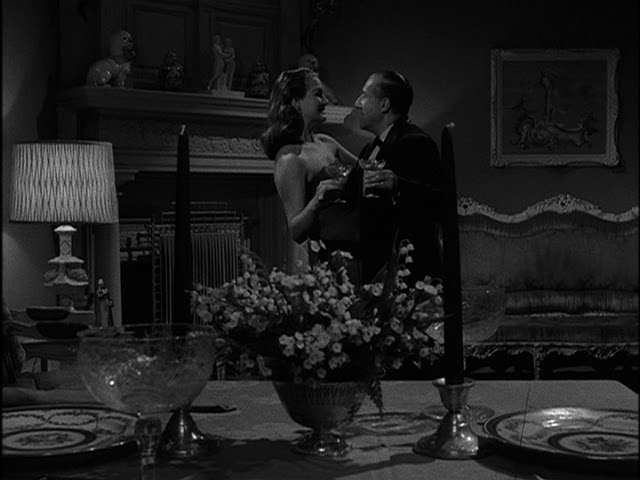
movements are quite noticeable (check out the scene where the couple is slow
dancing to a violin quartet, both of them holding glasses of champagne; the
actors are quite still but the champagne is clearly not. There is also the
lengthy scene in the crowded town hall where several of the actors can be seen
blinking profusely). Again, this isn’t a major blunder and only works against
the episode conceptually. Over time I have found that these nuances are part of
the episode’s charm as they give the impression that Happy Glades is all a
façade, which makes it even more frightening, the same way that no attempt was
made to mask the fact that these men are clearly not in any kind of town at all
but on a Hollywood backlot. Everything
in this place seems quite obviously phony. There is also another interesting
shot where two of the astronauts are seen standing on a bridge. Instead of a
filmed shot Heyes, or possibly film editor Joseph Gluck, inserted a noticeably grainy
still photograph instead. This may have been a technical oversight never
intended to make the final cut.
Although
it has its shortcomings and may not be an episode which will suit everyone’s
tastes, “Elegy” is a highly atmospheric episode with its own kind of charm and
is one of my personal favorites from the first season.
Grade: B
Notes:
--Director Douglas Heyes directed several additional episodes of the series, including the classic episodes "The After Hours," "The Howling Man," "Eye of the Beholder," and "The Invaders." Heyes wrote three episodes of Rod Serling's Night Gallery, "The Dead Man" (based on the story by Fritz Leiber and which Heyes also directed), "The Housekeeper," and "Brenda" (based on the story by Margaret St. Clair), the latter two being written under the pseudonym Matthew Howard.
--“Elegy" was originally published in the
February, 1953 issue of Imagination:
Stories of Science and Fantasy. It was
also published in William F. Nolan’s science fiction anthology A Sea of
Space (Bantam, 1970) as well as The
Twilight Zone: the Original Stories (Greenberg,
Matheson, Waugh, eds. Avon, 1985; MJF,
1997).
--Cecil Kellaway appears in another episode written by
Charles Beaumont, season four’s “Passage on the Lady Anne."
--"Elegy" was adapted into a Twilight Zone
Radio Drama starring Blair Underwood.
--Brian Durant