Showing posts with label William Tuttle. Show all posts

Tuesday, June 15, 2021

"Steel"

"Steel" Kelly (Lee Marvin) and his masked android fighter
Battling Maxo, hours before the big match

"Steel"
Season Five, Episode 122
Original Air Date: October 4, 1963

Cast:
Steel Kelly: Lee Marvin
Pole: Joe Mantell
Nolan: Merritt Bohn
Maxwell: Frank London
Maynard Flash: Chuck Hicks
Battling Maxo: Tipp McClure
Announcer: Jimmy Ames
Maynard Flash's Handler: Robert McCord
Man in Crowd: Larry Barton
Man in Crowd: Slim Bergman
Man in Crowd: Lou Cavalier
Man in Crowd: Bob Peterson
Man in Crowd: Edwin Rochelle

Crew:
Writer: Richard Matheson (based on his story)
Director: Don Weis
Producer: Bert Granet
Director of Photography: George T. Clemens
Production Manager: Ralph W. Nelson
Art Direction: George Davis & Walter Holscher
Film Editor: Thomas W. Scott
Set Decoration: Henry Grace & Robert R. Benton
Assistant Director: Charles Bonniwell, Jr.
Makeup: William Tuttle
Casting: Patricia Rose
Music: Nathan Van Cleave
Sound: Franklin Milton & Philip N. Mitchell
Mr. Serling's Wardrobe: Eagle Clothes
Filmed at MGM Studios

And Now, Mr. Serling:

“Next on Twilight Zone, we dabble into the manly arts with a show called ‘Steel’ written especially for us by Richard Matheson. This one isn’t just for prize fighting buffs because the story is above and beyond anything remotely involving the Marquis of Queensbury. Rather, it’s a tender, touching, and tough analysis of some very bizarre people. Lee Marvin and Joe Mantell take a walk in the Twilight Zone next in ‘Steel.’”


Rod Serling's Opening Narration:

“Sports item, circa 1974. Battling Maxo, B2 heavyweight, accompanied by his manager and handler arrives in Maynard, Kansas for a scheduled six-round bout. Battling Maxo is a robot or, to be exact, an android. Definition: an automaton resembling a human being. Only these automatons have been permitted in the ring since prize-fighting was legally abolished in 1968. This is story of that scheduled six-round bout, more specifically the story of two men shortly to face that remorseless truth: that no law can be passed which will abolish cruelty or desperate need nor, for that matter, blind animal courage. Location for the facing of said truth: a small smoke-filled arena just this side of the Twilight Zone.”

Summary:

August, 1974. The Future.

Two men stumble out of a bus onto a scorching city sidewalk. They wheel between them a masked figure roughly the size of the average man. The figure does not speak, nor does it appear to move on its own. The men find a nearby diner and decide to grab something to eat.

Once inside the men begin to argue. No one in the diner seems to find the masked figure unusual. Their conversation seems to derive from their lack of money. We learn that the masked figure is not a human being but a robot, specifically an android, built to fight other robots in a new spectator sport that has taken the place of boxing. The android, Battling Maxo, is an older model, a B2, and his opponent that night is a B7 and is seemingly more advanced in every way. One of the men, Pole, Maxo’s mechanic, thinks that they should forfeit and return home to avoid the certain destruction of their fighter. Steel, Maxo’s manager, says that they don’t have enough money to return home and that they need the money from the fight to pay for new parts. He believes that Maxo isn’t obsolete yet and that he can win the fight against the newer model.

Later, at the venue, they enter the promotor’s office to see about getting paid. Insecure about Maxo’s age, Steel begins to boast to the uninterested occupants of the office that Maxo was once a celebrated fighter. He also lets it slip that he once won championships himself, under the name “Steel” Kelly, before the sport was outlawed. Nolan, the promotor of the fight, informs them that they will get their money after the fight. He also informs them that they were a last-minute booking because the original fighter couldn’t make it. He normally doesn’t accept fighters as old as Maxo. Already feeling somewhat defeated, Steel thanks him and leaves the room.

Back in the ready room, we see Battling Maxo’s face for the first time. It is primitive in its design but resembles the face of a man convincingly enough. Steel begins to spar with Maxo to test his reflexes when something in the android malfunctions. Pole says that he won’t be able to fix it in time for the fight. Steel thinks for a moment and informs Pole that he will disguise himself as Maxo and fight in his place. No one has actually seen Maxo yet so they will not know the difference. Pole pleads with him to change his mind, claiming that it is far too dangerous, but Steel has made up his mind. He threatens Pole with violence if he does not help him.

9:00pm. Pole wheels Steel to the ring and removes his mask. Loud boos and taunting fill the arena. His opponent, Maynard Flash, is noticeably larger and stares back at him with a calm indifference. Steel does his best to look mechanical. At the sound of the bell, the two begin to fight. Steel is beaten severely and fakes a knockout before the end of the first round.

After Pole wheels him back to the ready room, Steel collapses on the floor. Pole goes to Nolan’s office to get the money but returns with only half of it. He says that Nolan refuses to pay them in full because the fight was too short. Physically and mentally exhausted, Steel looks at Maxo and tells the android not to worry. They will get him new parts and everything will be okay. Maxo stares back at him, calm and motionless, never saying a word.

Rod Serling’s Closing Narration:

“Portrait of a losing side, proof positive that you can’t outpunch machinery. Proof also of something else: that no matter what the future brings, man’s capacity to rise to the occasion will remain unaltered. His potential for tenacity and optimism continues, as always, to outfight, outpoint, and outlive any and all changes made by his society, for which three cheers and a unanimous decision rendered from the Twilight Zone.” 

Commentary:

Writer Richard Matheson begins what is probably his most creatively successful season on The Twilight Zone, delivering this noir-soaked futuristic boxing tale where machines battle one another inside the ring instead of people. Matheson saw four of his scripts made into episodes during the show’s final season with a fifth script, “The Doll,” slated for production. This script was ultimately canned by the show’s final producer, William Froug, when he took over production duties from Bert Granet mid-season. “The Doll” was eventually made into a segment of Steven Spielberg’s anthology series Amazing Stories in 1986 for the show’s first season. It was directed by Phil Joanou and features John Lithgow as a lonely man who becomes lovingly infatuated with a doll that he purchases for his niece, a performance that won Lithgow an Emmy. Matheson’s script was nominated for a Writers Guild of America Award for Outstanding Teleplay in an Anthology series. Ironically, all of his fellow nominees were scripts from the 1980’s Twilight Zone reboot series—Harlan Ellison’s script for "Paladin of the Lost Hour" took home the prize. By this point in Matheson’s career he had made a name for himself as a writer who could produce quality material in a variety of genres relatively quickly. After leaving the show he would enjoy a highly successful career as a novelist and screenwriter and would leave behind a body of work that spans over half a century. But his work on The Twilight Zone remains the most recognizable part of his legacy.

“Steel” is a seamlessly blended hybrid of the film noir boxing tale and of dystopian allegories that warn of the threat of artificial intelligence, two genres that were used multiple times on the show. Boxing had long been a staple of American cinema dating all the way back to the silent era but found its niche in the film noirs of the forties and fifties. Film noir was an ideal vehicle for boxing stories due to its gritty aesthetic and its pervasive elements of fear and desperation that inhabit so many of its characters. Films like Robert Rossen’s Body and Soul (1947), Robert Wise’s The Set-Up (1949), and Mark Robson’s Champion (1949) and The Harder They Fall (1956) are all often cited as some of the best boxing-related movies of the film noir era. Serling’s own masterful dissertation on boxing, Requiem for a Heavyweight, which he penned for Playhouse 90 in 1956 and again in 1962 as a feature-length film—both directed by Ralph Nelson—is also considered one of the best boxing stories of the twentieth century. Serling, a former amateur boxer in the United States Army 11th Airborne Division, was fascinated with the sport and wrote multiple boxing-related scripts throughout his career. Matheson was not a boxer and “Steel” is his only venture into the boxing world but it is flawlessly executed and is one of his best episodes of the show. 

By the time this episode aired in 1963, boxing was entering what would become its golden age, with the advent of television providing more coverage of the sport than ever before. Due to several highly televised fights that resulted in the deaths of boxers like Benny Paret and Davey Moore and the Pope’s declaration of the sport as “barbaric” public debate concerning the violent nature of the sport and the safety of its fighters was at the forefront of the public conscience. Whether it was intentional or not, “Steel” acts almost as a commentary to this debate.

“Steel” also offers somewhat of a nuanced approach to a genre that had, by this point in the show, been all but exhausted. The fear of artificial intelligence, specifically robots and androids, was one of the most frequently used tropes in science fiction at the time, and The Twilight Zone was no exception—there are six episodes featuring sentient machinery in the fifth season alone. The vast majority of mid-twentieth century science fiction concerning artificial intelligence is overwhelmingly cautionary and tends to comment on things like xenophobia, greed, neglect, violence, and the loss of human identity. Matheson touches on several of these themes but doesn’t attempt to force any kind of authoritative commentary on the story and simply allows it to be a story about a man and his fear of becoming irrelevant.

For the most part, there is a clear visual distinction between how the show would portray either robots or androids. Robots were usually clunky bulks of metal that fit together awkwardly in episodes such as “Uncle Simon,” “The Brain Center at Whipple’s” and “The Old Man in the Cave.” Androids, which appeared on the show far more often, were usually just actors who were revealed to be machines at some point during the episode. “The Mighty Casey,” “The Lonely,” “In His Image” and “The Lateness of the Hour” are all examples of this trend which Serling and the producers likely figured would prevent the show from feeling dated to future audiences.


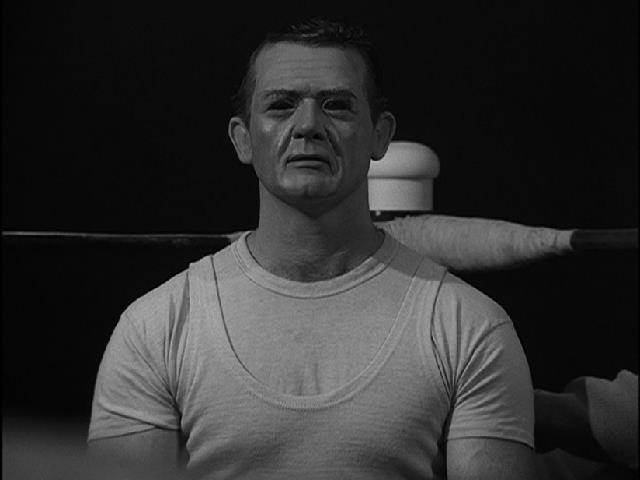
Battling Maxo
Maynard Flash

The androids in “Steel” are unique in that their physical appearance seems to aim somewhere between these two approaches. While they are played by actors Chuck Hicks and Tipp McClure, there is an effort by makeup artist William Tuttle to make them appear less than human, the result of which is quite haunting. The masks the actors wear are made of stretched latex and the eyes are ping pong balls which were painted black with a small hole drilled in the center so they could see. A mention should be made of the terrific performances by both actors in portraying the restricted movements of what are essentially early generation androids.

The Shores of Space
(Bantam, 1957)

Matheson claimed in numerous interviews and essays over the years that this episode was his favorite of the sixteen that he wrote for the show. He first published the short story in the May, 1956 issue of The Magazine of Fantasy and Science Fiction and it later appeared in his collection The Shores of Space (Bantam, 1957). His teleplay is incredibly faithful to his short story and the episode is filmed almost shot for shot from his script. The only significant differences are that the year is changed from 1997 to 1974 and the fight is changed from a ten-round bout to six rounds. Also, in the story, Steel is given a first name, Tim, and there is a very brief mention of a woman he was once in love with. Other than these few exceptions, the two versions are very similar. 

A much less faithful adaptation is the 2011 Dreamworks film Real Steel starring Hugh Jackman and Dakota Goyo. Directed by Shawn Levy and written by John Gatins, Dan Gilroy, and Jeremy Leven, the film contains only the basic idea of fighting robots as a substitution for real, live people while sacrificing the emotional struggle of its main character, the element which made Matheson’s original story so powerful. In the film Jackman plays Charlie Kenton, a former boxer who owns a string of obsolete fighting robots, keeping each until it can no longer fight and then discarding it for a newer one. After learning that his ex-girlfriend has died, he is now the sole guardian to his son, Max, whom he has had no contact with since he was born. An avid boxing fan, Max helps Charlie find an early generation robot which is enhanced with a shadow function allowing the robot to mimic Charlie’s exact moves. So Charlie is once again able to fight but, unlike Steel Kelly, does not have to risk physical annihilation to do so. Max and Charlie pit their underdog robot, named Atom, against increasingly harder opponents until they are unofficially declared the best fighting team in the league. The film ends on a predictably happy note with Charlie realizing that he has the ability to love others as well as himself. While it is fairly clear that the basic premise of fighting robots comes from Matheson’s story, the similarities between the two stories ends there. There is so significant a difference in the film’s plot that Matheson’s opening screen credit reads: “based in part upon the short story ‘Steel’ by Richard Matheson.” The film received mixed reviews with much of the criticism directed at its uneven plot and clichéd, unrealistic ending. The film’s special effects team did receive a lot of positive mentions and was even nominated for an Academy Award for Best Visual Effects. It lost to Martin Scorsese’s Hugo.

Director Don Weis makes his only venture into The Twilight Zone with this episode. Weis began his career at MGM making popular light comedies and musicals such as I Like Melvin (1953), A Slight Case of Larceny (1953), and The Affairs of Dobbie Gills (1953) and was known for being able to produce quality films quickly and under budget. He would continue to make feature-length films throughout his career, which spanned nearly half a century, including a biopic of jazz drummer Gene Krupa, The Story of Gene Krupa (1959), an adaptation of Ira Levin’s play Critic’s Choice (1963), and the World War II film The Longest Hundred Miles (1967). It was in television, however, where Weis made his mark, owing his success to the speed with which he could deliver quality productions. Over several decades he directed episodes of some of the best television series of all time including Wagon Train, The Thin Man, The Jack Benny Program, The Andy Griffith Show, Alfred Hitchcock Presents, Batman, Ironside, Kolchak: The Night Stalker, M.A.S.H., Hawaii Five-O, and Hill Street Blues to list just a fraction of his catalog. His direction in “Steel” is quite impressive. He allows the camera to move naturally through each scene and his still shots are framed well. He also creates the illusion of a crowded arena effectively as there are only a handful of extras present in that particular scene. Considering that at this point in his career he had directed mostly light situational comedies, he captures the seediness of the film noirs of the forties and fifties incredibly well.

This is the second appearance on the show for actor Joe Mantell who gave a great performance as panic-stricken loser Jackie Rhodes in the season two episode “Nervous Man in a Four Dollar Room.” Mantell was a terrific actor who unfortunately did not have as famous a career as his co-star, despite a handful of roles in very famous films. In 1955 he was nominated for an Academy Award for Best Supporting Actor for his role as Ernest Borgnine’s best friend, Angie, in Delbert Mann and Paddy Chayefsky’s smash hit Marty (1955). He played the part of the traveling salesman in the café in Alfred Hitchcock’s The Birds (1963) and was Jack Nicholson’s assistant, Lawrence Walsh, in Roman Polanski’s Chinatown (1974), where he utters to Nicholson the film’s famous final line, “Forget it, Jake. It’s Chinatown.” The film’s sequel, The Two Jakes (1990), was Mantell’s last screen appearance. He also appeared in numerous other early anthology series including Alfred Hitchcock Presents, Climax!, Out There, Inner Sanctum, Suspense, and Lights Out. His performance here is brilliant. As well written and directed as this episode is, it is the chemistry between its two leading stars which steals the show. Mantell gives Pole a seamless mix of angry frustration and genuine concern for Marvin’s troubled, washed up fighter.

Lee Marvin carved out an enormously successful career for himself becoming one of the most recognizable actors of the sixties and seventies. He was known for playing tough, often violent characters similar to the one he plays here. This is Marvin’s second and final appearance on the show, having appeared in the star-studded season three episode “The Grave.” Less than a year after that episode, a western, aired in October of 1961 Marvin and two of his co-stars from the episode, Lee Van Cleef and Strother Martin, appeared as a gang of sadistic criminals in John Ford’s The Man Who Shot Liberty Valance (1962). Considered by many to be one of the best western films ever made, Marvin’s performance as the title character is probably the role most responsible for launching him into the Hollywood A-list for the next few decades. So by the time this episode aired exactly two years after his first appearance on the show he was like more familiar to the audience.

Marvin’s stardom took longer to come to fruition than for many of his contemporaries. After being wounded in action during World War II, Marvin returned to the states and decided to pursue acting, appearing dozens of stage productions throughout the late forties. After being famously thrown out of the Actor’s Studio for screaming profanities at Lee Strasberg he moved to Hollywood and began a career in film and television. During the first fifteen years of his career, Marvin appeared in numerous television series including Suspense, Dragnet, Wagon Train, Route 66, Bonanza, The Virginian, and The Untouchables as well as many live drama anthology series including an Emmy nominated performance on Alcoa Premiere. From 1957 to 1960 Marvin starred as gritty Detective Lieutenant Frank Ballinger on the NBC series M Squad. The creators of Police Squad, the short-lived series that launched the Naked Gun franchise, admitted years later that M Squad was one of the main influences for their show and that Leslie Nielsen’s Detective Frank Drebin was a direct satire of Marvin’s character.

During this time, he also racked up a number of credits playing memorable minor characters in now famous films like The Wild One (1953), The Caine Mutiny (1954), Bad Day at Black Rock (1955), The Killers (1964), and the feature-length adaptation of Serling’s The Rack (1956). Two years after he appeared in “Steel” Marvin won an Academy Award for his dual performance in Elliott Silverstein’s Cat Ballou (1965). After that he left television behind and concentrated solely on film, strengthening his image as an actor who liked playing dark and often controversial characters. Roles in films like The Professionals (1966), The Dirty Dozen (1967), and Point Blank (1967) helped to solidify this image.

His performance here as Steel Kelly is remarkable. A more restrained performance, perhaps, than some of his more well-known characters but this only adds to the level of desperation and insecurity that Steel inhabits. The scene in which he has to speak to the fight promoter inside his small, cramped office is brilliant because Marvin’s speech pattern and facial expressions perfectly convey how clearly uncomfortable and humiliated Steel is. Matheson recalled in several interviews that he was on the set during the rehearsal and filming of this episode and claimed that to help build his character and to prepare for the fight scene, Marvin would walk around the set of the boxing ring, throwing random jabs into the air, and would imitate the sound of the crowd taunting him. Marvin had actually worked with Don Weis several times before on episodes of M Squad and episodes of Schlitz Playhouse and Jane Wyman Presents the Fireside Theatre.

While not as well known as some of the other teleplays Matheson wrote for the show, “Steel” is an incredibly powerful and moving episode about the strength of friendship and the importance of feeling relevant. It is fair to mention that there have been many who see Steel’s decision to step into the ring with an opponent that he most certainly will not defeat and who might very possibly kill him as nothing more than a death wish. This is a valid point and one that only complicates Steel Kelly’s already complex character. Steel is afraid of accepting change because it would mean that he loses who he is as a person. Boxing is all that he knows and Battling Maxo is his last connection to it. He has no money to buy another android and without boxing he is forced to live in a world he no longer recognizes with neither ambition nor purpose. So there is a part of him that probably would rather cease to exist than be obsolete. Pole realizes that fear and self-doubt have crept into every facet of his friend’s world and knows that removing him from their current environment is the only way to make him whole again. However, being a fighter is all Steel knows and as long as either he or Battling Maxo are able to step into the ring he will continue to fight for his place in the world.


Grade: A


Grateful acknowledgment is made to the following:

The Twilight Zone Scripts of Richard Matheson, Vol. 2 edited by Stanley Wiater (Edge Books, 2002)

Richard Matheson on Screen: A History of the Filmed Works by Mathew R. Bradley (MacFarland & Company, 2010)

The Twilight Zone: Unlocking the Door to a Television Classic by Martin Grams, Jr. (OTR, 2008)

The Twilight Zone Companion by Marc Scott Zicree (3rd ed., Silman-James Press, 2018)

Episode commentary by Marc Scott Zicree and Bill Warren, The Twilight Zone: The Complete Series Blu-ray (Image Entertainment, 2016)

Lee Marvin: Point Blank by Dwayne Epstein (Schaffner Press, 2013)

The Internet Movie Database (www.imdb.com)

The Internet Speculative Fiction Database (www.isfdb.org)


Notes:

—Lee Marvin also appeared in the season three episode “The Grave.”

—Joe Mantell appeared in the season two episode “Nervous Man in a Four Dollar Room.” He also appeared in an episode of Serling’s western series, The Loner, in 1966 called “The Trial in Paradise.”

—Chuck Hicks appeared in the season five episode “Ninety Years Without Slumbering.”

—Merritt Bohn appeared in the season one episode “One for the Angels.”

—Frank London appears in the season two episode “A Penny for Your Thoughts.”

—Loyal extra Bob McCord can be spotted here as one of Maynard Flash’s handlers. McCord made dozens of appearances on the show, usually uncredited.

The Magazine of Fantasy
and Science Fiction

May, 1956
Cover art by Ed Emshwiller


—Richard Matheson adapted “Steel” from his short story of the same name which was originally published in the May, 1956 issue of The Magazine of Fantasy and Science Fiction. It later appeared in his collection The Shores of Space (Bantam, 1957) and in The Twilight Zone: The Original Stories (MJF, 1985) edited by Martin H. Greenberg, Matheson, and Charles G. Waugh. It can currently be found in the second volume of his Collected Stories (Edge Books, 2005) and in his collection Duel: Terror Stories (Tor, 2003). In 2011 Tor released the collection Steel and Other Stories, a paperback movie tie-in for the film Real Steel (2011) which was inspired by Matheson’s story.

—Matheson’s adapted teleplay for “Steel” is collected in Richard Matheson’s The Twilight Zone Scripts, Vol. 2 edited by Stanley Wiater (Edge Books, 2002)

—This episode was adapted into a Twilight Zone Radio Drama by Dennis Etchison starring Louis Gossett, Jr.

Real Steel 
(Dreamworks, 2011)

—As previously noted, “Steel” was the inspiration for the 2011 film Real Steel starring Hugh Jackman. The film was written by John Gatins, Dan Gilroy, and Jeremy Leven, and was directed by Shawn Levy. It was executive produced by Stephen Spielberg for DreamWorks Pictures. Matheson’s screen credit reads: “based in part upon the short story ‘Steel’ by Richard Matheson.”

—Former professional welterweight boxer turned stunt performer and Hollywood boxing coach Johnny Indrisano (1906 – 1968) was hired as a fight consultant to make the bout between Lee Marvin and Chuck Hicks seem as realistic as possible. Indrisano’s career as a fighter lasted from 1923 to 1934 and he retired with thirty-seven out of forty-six wins.

—Matheson’s decision to name the boxing promoter Nolan is likely a nod to his close friend, writer William F. Nolan.


—Brian

Tuesday, March 20, 2018

"The Changing of the Guard"

Professor Ellis Fowler (Donald Pleasence) and the
students of the Vermont Rock Springs School for Boys
“The Changing of the Guard”
Season Three, Episode 102
Original Air Date: June 1, 1962

Cast:
Professor Ellis Fowler: Donald Pleasence
Headmaster: Liam Sullivan
Mrs. Landers: Philippa Bevans
Artie Beachcroft: Tom Lowell
Bartlett: Russell Horton
Dickie Weiss: Buddy Hart
Graham: Bob Biheller
Butler: Kevin O’Neal
Boy: Jimmy Baird
Boy: Kevin Jones
Thompson: Darryl Richard
Rice: James Browning
Hudson: Pat Close
Whiting: Dennis Kerlee

Crew:
Writer: Rod Serling (original teleplay)
Director: Robert Ellis Miller
Producer: Buck Houghton
Production Manager: Ralph W. Nelson
Director of Photography: George T. Clemens
Art Direction: George W. Davis and Merril Pye
Set Decoration: Henry Grace and Keogh Gleason
Make Up: William Tuttle
Assistant Director: E. Darrel Hallenbeck
Casting: Robert Walker
Editor: Bill Mosher
Sound: Franklin Milton and Bill Edmondson
Music: Stock
Optical Effects: Pacific Title
Rod Serling’s Wardrobe: Eagles Clothes
Filmed at M.G.M. Studios

And Now, Mr. Serling
“Next week on the Twilight Zone, Mr. Donald Pleasence, visiting us from Broadway, brings his exceptional talents to a very special program. The story of an aging schoolmaster who finds some faith, some hope, and some mending glue for a few shattered dreams. But he finds it in that strange manner unique in the shadow regions of the Twilight Zone. Next week Donald Pleasence stars in “The Changing of the Guard.”

Rod Serling’s Opening Narration:
“Professor Ellis Fowler, a gentle, bookish guide to the young, who is about to discover that life still has certain surprises, and that the campus of the Rock Spring School for Boys lies on a direct path to another institution, commonly referred to as the Twilight Zone.”

Summary:

Professor Ellis Fowler is an aging English teacher at the Vermont Rock Spring School for Boys, a position he has held for over half a century. After saying goodbye to his last class of the fall semester, Professor Fowler is summoned to the headmaster’s office before leaving for the winter break. The headmaster, a young well-to-do man, reluctantly informs the professor that the school’s board of trustees have voted not to renew his contract for the Spring. They feel that someone younger may be more beneficial to the students. Fowler is speechless. 

At home that evening, he flips through old yearbooks, remembering the hundreds of students who have graced his classroom. He wonders how many of his students remember him. He thinks of all the years he spent spouting poetry to bored, indifferent faces and feels foolish. He informs his housekeeper that he is going for a walk and wanders out into the night. After he leaves she discovers an empty gun holster in his desk drawer.


Professor Fowler makes his way to the deserted school campus and finds himself in front of a statue of Horace Mann. He remarks to the statue that he has won no victory for humanity, in reference to the great educator's famous quote. As he raises the barrel of the gun to his temple, Fowler hears class bells ringing. Curious, he walks off to investigate. 

He eventually finds himself back in his classroom, now empty. Before he has a chance to get a hold of his senses he sees a room full of students materialize out of nothing right before his eyes. He recognizes each of them. They are former students from various classes throughout the years, all of which are now dead. Each student tells him of the enormous impact that he had on their lives. The professor is moved to tears.

He returns home in better spirits and tells his housekeeper that he is looking forward to retirement. He has made his mark and is ready to turn the reigns over to someone else. As he settles in for the night he hears Christmas carolers outside his window. He opens the window to find his students gathered on the lawn. They wish him a Merry Christmas and continue on their way. The professor closes the window and smiles, content with the victory he has won for humanity.


Rod Serling’s Closing Narration:
“Professor Ellis Fowler, teacher, who discovered rather belatedly something of his own value. A very small scholastic lesson, from the campus of the Twilight Zone.”


Commentary:

To close out the third season of The Twilight Zone, Rod Serling penned this incredibly warm, moving story that seems to foreshadow many of the events that were to happen in his life in the coming years. While The Twilight Zone always held a dedicated fan base it was never a strong candidate when it came to ratings due likely to the fact that it was a fantasy program. The show lived in constant fear of cancellation and at the end of its third season, after failing to attract a new sponsor after the departure of Liggett and Myers Tobacco Company, it finally found itself off the air. It would cease to broadcast new episodes for the next seven months until it was brought back as a mid-season replacement, unseating the very program that had replaced it. This temporary hiatus would have a lasting impact on the show and its creators. Long-time producer Buck Houghton, faced with the possibility of sudden unemployment, would reluctantly leave the show as would other important figures of the show’s production crew including film editors Bill Mosher and Jason Bernie and assistant director E. Darrel Hallenbeck. As for Serling, the constant grind of writing the bulk of the show’s scripts as well as acting as host and executive producer had taken an enormous creative toll. At the end of the 1961-62 season he accepted a teaching position at his alma mater, Antioch College, in Yellow Springs, Ohio, thousands of miles away from Los Angeles, leaving incoming producer Hebert Hirschman with the task of resurrecting the show largely by himself. So when CBS finally brought The Twilight Zone back in January of 1963 it may have resembled its former self in many ways but it was, without question, a noticeably different show.

I.

Rod Serling’s “The Changing of the Guard”

When first viewing “The Changing of the Guard” the influence of Frank Capra’s It’s a Wonderful Life (1946) is immediately noticeable given its celebration of the common man and the promise that no one goes unnoticed or unloved in life. The fact that this episode, which aired in June, takes place around Christmas is probably not a coincidence but a deliberate nod to Capra’s classic holiday film. It should come as no surprise that Serling would be influenced by a storyteller like Capra for his films possess the same brand of empathy found in much of Serling’s work. Capra believed in humanity and the overlying message found throughout his body of work is simply that every human being has value and therefore has the right to feel valuable. This maxim seems to have greatly appealed to Serling for much of his work concerns the forgotten members of society: the misunderstood alcoholic with a heart of gold, the convict who is unjustly punished, the aging man who has suddenly found himself in an unfamiliar world. Like Capra, Serling seemed to possess a genuine affection for these types of characters and often awarded them a second chance at life as he does for Professor Fowler here. The theme of moral forgiveness appears in many of his Twilight Zone scripts including “A Hundred Yards Over the Rim” “The Night of the Meek” “A Passage for Trumpet” and "In Praise of Pip," all Capra-esque episodes with unlikely heroes similar to Professor Fowler. But his dedication to the downtrodden of the world is found throughout his work from early teleplays like Requiem for a Heavyweight and Old MacDonald Had a Curve to episodes of his western series, The Loner, and even in several of his scripts for Night Gallery—an unapologetically macabre series—including the Emmy-nominated “They’re Tearing Down Tim Riley’s Bar.”

Serling’s empathetic relationship with his lowly protagonists was more than just his preaching of the humanist gospel. Serling was, above anything else, an autobiographical writer. No matter the setting or premise of a story Serling’s personality was always present and many of his heroes were simply extensions of himself. It seems safe to assume that Professor Fowler represents many of Serling’s fears as a writer even though he would later claim that he felt this episode was too sentimental. These fears would only grow as he grew older. In the years after The Twilight Zone, as the counter-culture movement flourished and television began to change, Serling saw the medium that he helped create more or less move on without him. The live dramas of the previous decade were gone, The Loner was canceled after a single season, many of his series ideas went unrealized, Night Gallery turned out to be an unpleasant experience for him, and his career as a screenwriter never quite progressed the way his television career had. In later years he often told interviewers that his work would likely be forgotten and that to simply be remembered as a writer would be sufficient enough. Time has proven him wrong and the fact that he allows Fowler a second chance at happiness in an attempt to remind his fellow man to simply treat one another with dignity and respect is probably the hallmark of his career as a writer, one which earned him six Emmy Awards for writing, a record he holds to this day. Ironically, given his fame as a writer, his epitaph simply reads RODMAN E. SERLING, TEC5 U.S. ARMY, WORLD WAR II in reference to his military rank as Technician 5th Class in the United States Army.

Poetry plays an important role in "The Changing of the Guard." But the poems Serling includes are not chosen at random nor were they poems everyone in a 1960's television audience would necessarily recognize. The first poem mentioned, recited in-full by Donald Pleasence in the first scene of the episode, is from English poet A.E. Housman's (1859-1936) 1896 collection A Shropshire Lad. "Poem XIII," commonly referred to by its opening line, "When I was One and Twenty," recounts a young protagonist's encounter with a presumably older, wiser man at the age of twenty-one who tells him that falling in love has consequences that are not repaired as easily as losing money or material possessions, advice the young protagonist ignores. One year later, now a victim of a broken heart, the speaker regrets his ignorance. Fowler's recitation of the poem to his young students reflects the old sage's advice to the protagonist and the theme of the poem also foreshadows Fowler's heartbreak at having the thing he loves most, teaching, taken away from him. Serling may also have included it in reference to Fowler's students who died young, as many of the poems in A Shropshire Lad pay tribute to English soldiers who lost their lives at a young age. As Fowler recites this to the class, the camera pans slowly across the classroom of boys, some fiddling restlessly, some staring vacantly into thin air, all naive and inexperienced like the protagonist of the poem. Pleasence gives a fantastic rendition of the poem and this ends up being a very powerful moment in the episode. 

The two other poems Serling includes are mentioned during the second classroom scene and are recited by the ghosts of Fowler’s former students. The first is American minister Howard Arnold Walter’s (1883-1918) poem “My Creed,” commonly referred to by its opening line “I Would be True,” first published in 1906. Serling includes the first four lines which are read by Russell Horton who plays a young man who gave his life for the cause of medical research. The poem is a testament to being brave and honest in the face of adversity.

The last poem mentioned is John Donne’s (1572-1631) “No Man is an Island.” First published in 1624 in his collection of religious essays, Devotions upon Emergent Occasions, Donne actually wrote this as part of a much larger essay called Meditation XVII. The short passage that has become so famous is commonly referred to by either its opening phrase, “No man is an island” or its closing phrase, “never send to know for whom the bell tolls; it tolls for thee” often recited as “ask not for whom the bell tolls; it tolls for thee.” It basically suggests that every person is part of a larger fabric of humanity and therefore what effects one person’s life inadvertently effects all of humanity. The second half of the passage is recited here by actor Buddy Hart who plays Dickie Weiss, a Naval officer who was on-board the Arizona and became the first person killed at Pearl Harbor while rescuing his crew mates—Serling’s reference here is perhaps a little over the top but the message still resonates. Audiences at the time might have recognized Hart as he had a reoccurring role on Leave It to Beaver. He later changed his name to Buddy Joe Hooker and went on to enjoy an enormously successful career as a stunt coordinator. This last poem is probably the best known of the three mentioned in the episode and one Serling likely admired.

Much should be said about Donald Pleasence's performance as Professor Ellis Fowler for it is as moving and honest as any the show ever saw. It should be noted that Pleasence was only forty-three at the time. He is not only given the task of convincingly portraying a man who is at least in his late seventies but he must then affectionately charm the audience into liking this old man so that they care about what happens to him. He manages to accomplish both jobs flawlessly. In order to appear physically older, Pleasence wore aging makeup and a facial hair prosthetic designed by MGM makeup artist William Tuttle, whose work is memorably featured in numerous episodes throughout the series. Even with the heavy makeup Pleasence fully realizes the transformation through physical mannerisms, altered speech patterns, and improvisational dialogue. He captures both the joy and gratification Fowler feels as a teacher and the bleakness and despair that washes over him after he is made to feel like his contributions were worthless. 

This was Donald Pleasence’s first appearance on American television. He had already enjoyed success in his native England both on the stage and on the big and small screens. While he was known for being gentle and soft-spoken, Pleasence enjoyed playing malevolent characters. Before being cast as the bookish Professor Fowler, Pleasence had just spent an entire year playing the role of Davies, an incredibly unlikable character, in Harold Pinter’s play The Caregiver, first in London and then on Broadway. The role earned him a Tony Award nomination, the first of four, and he revived the role for a film version, The Guest, in 1963. Pleasence would make a name for himself playing seedy, vicious characters and enjoy a successful and highly prolific career in a variety of mediums. His film roles include The Great Escape (1963), Dr. Crippen (1963), The Greatest Story Ever Told (1965), Fantastic Voyage (1966), Escape to Witch Mountain (1975), Dracula (1979), and Escape from New York (1981). He was well-known among horror fans and appeared in numerous independent films, mostly anthologies, from American International Pictures, Amicus Productions and others including Circus of Horrors (1960), From Beyond the Grave (1974), The Uncanny (1977), and The Monster Club (1981). He appeared in episodes of One Step Beyond, The Outer Limits, and The Ray Bradbury Theatre and was nominated for an Emmy Award for Best Supporting Actor in The Defection of Simas Kudirka in 1978. The two roles he is most known for, however, are Bond villain Ernest Stavro Blofeld in You Only Live Twice (1967) and as Dr. Samuel Loomis in the original Halloween film series. Before becoming an actor Pleasence served as a Flight Lieutenant in the Royal Air Force during World War II and was taken captive by German forces after his plane was shot down over France. He remained a prisoner of war for almost two years before being released. Pleasence died in 1995 at the age of seventy-five.

Making his only contribution to The Twilight Zone is director Robert Ellis Miller. Miller began his career in television directing many episodes of the live drama series of the 1950's as well as of The Donna Reed Show. In the late 1960's he made the transition to directing feature films, mostly romantic comedies, including Sweet November (1968), The Heart is a Lonely Hunter (1968), which was nominated for an Academy Award for Best Picture, and The Buttercup Chain (1970). Ellis does a fine job on "The Changing of the Guard" and he reacts to the performances of the actors really well, as in the aforementioned opening scene in which Pleasence reads the Housman poem. The scene between Fowler and the headmaster is also particularly moving. His most noticeable contribution to the episode, however, is the second classroom scene featuring the ghosts of Fowler's students. To "summon" the ghosts he had an image of the actors sitting at their desks with their heads down gradually appear onscreen. Once in real time, they pick up their heads and look directly at the camera. This is before the audience is made aware of the well-meaning intentions of the ghosts and the effect is appropriately eerie and convincing. 

II.

Rod Serling, Horace Mann, and Education

The idea that Ellis Fowler is, at least to some degree, an extension of Serling’s personality is further solidified by the fact that Serling makes his hero an educator  at a school that prominently displays a statue of education pioneer Horace Mann, a hero of Seling’s and the founder of Serling’s alma mater, Antioch College, where Serling would soon be a faculty member. Education was clearly important to Serling and he had a great admiration for teachers. He spoke fondly of the teachers who had made an impact on him creatively, particularly his public speaking teacher at West Junior High in Binghamton, Helen Foley. The two became lifelong friends and Serling even named the main character from his season one Twilight Zone episode, “Nightmare as a Child,” after Foley.

Before becoming a writer Serling thought he wanted to be a teacher himself. After returning home from World War II, he enrolled in Antioch College in Yellow Springs, Ohio as a physical education major. He soon changed it to language and literature. Serling found that writing offered a therapeutic outlet which helped him process the psychological trauma of combat and allowed him to learn more about himself. Serling saw Antioch as a haven of unrestricted self-expression, a place where he was encouraged to question things he felt were wrong with the world in which he lived. Not long after he began writing Serling became the head of the Antioch Broadcasting System’s radio program where he wrote, directed, and acted in weekly productions. In 1949 he made his first professional sale to the Dr. Christian radio show where his radio play “To Live a Dream” placed second in the annual script writing contest. In many ways Antioch was the place where Rod Serling the writer was born.

While still a student, Serling came to admire the life of the school’s founder, American politician and education reformer, Horace Mann (1796-1859). Mann was one of the first prominent advocates of universal, tax-funded public education. Born into poverty, he went on to graduate valedictorian from Brown University and held positions in the Massachusetts State House of Representatives, the State Senate, and the United States House of Representatives. He was an early advocate of gender equality, state-funded mental health facilities, the separation of church and state, and an outspoken opponent of slavery. Education, however, was always his priority. “A republic,” he said, “cannot long remain ignorant and free, hence the necessity of universal popular education…such education is best provided in schools embracing children of all religious, social, and ethnic backgrounds.” In 1853, Mann became the first president of Antioch College, the first non-sectarian, coeducational college in the United States. During Mann’s six years as president, Antioch became the first college to appoint a female to its faculty--with the same rank and pay as her male coworkers. Mann also kept tuition at a rate affordable for students, something that almost caused the school to close after the Christian Connexion withdrew its funding. The college enrolled students of all races, religions, and financial backgrounds. In his 1859 commencement address Mann delivered the phrase which he would forever be associated with and which Serling includes in “The Changing of the Guard.”

"Be Ashamed to Die Until You Have Won Some Victory for Humanity."

Mann collapsed not long after the ceremony and died a few months later. Today he is considered a pioneering social activist and the father of American public education.

It should come as no surprise that Serling was an admirer of Horace Mann for their principles are very much the same. Serling mentions Mann in his lectures and in several of his teleplays. In an early teleplay for NBC’s Hallmark Hall of Fame titled “Horace Mann’s Miracle” Serling recounts Mann’s struggle to keep Antioch from closing its doors in financial ruin after losing most of its funding. The half-hour drama aired on March 8, 1953. It was directed by Albert McCleery and stars Frank M. Thomas as Mann.

After accepting a faculty position at Antioch in the fall of 1962, Serling told interviewers that his official title would be “writer in residence.” During his brief time at the college from September, 1962 to January, 1963 Serling taught two classes. One was an open enrollment survey course for undergraduates called Mass Media. The other was an evening course called Writing in the Dramatic Form. Enrollment for this course was by invitation only and was intended for graduate students or individuals just beginning their careers as writers. Jeanne Marshall was an aspiring writer at the time and was a student in the evening class. She kept detailed notes of each class period, noting the films they watched, assignments they were given, and Serling’s book and film recommendations. If you are interested, all twenty-three pages of her notes are available on the Rod Serling Memorial Foundation website. While Serling clearly needed a break from The Twilight Zone his choice for in-class viewing material suggested otherwise. Serling screened a variety of episodes of the show throughout the semester including “The Changing of the Guard.” Among the numerous books Marshall lists as recommended by Serling are Joseph Heller’s Catch 22, works by Gore Vidal and Paddy Chayefsky, and The Beardless Warriors by Richard Matheson. It should be noted that several of the students who attended the course, including Marshall, went on to make a career for themselves as writers. Serling even helped future television writer Sue Clauser sell her first two teleplays to Bonanza.

Serling’s trial run as a teacher was short-lived. Not long after he moved to Ohio CBS green lit the fourth season of The Twilight Zone which would debut in January as a mid-season replacement. So in January of 1963 Serling and family moved back to California. However, this was not the last time he would don the educator's hat. Serling began to lecture at college campuses across the country. He held film screenings at the Sherwood Oaks Experimental College in Hollywood where he would often screen episodes of The Twilight Zone. He was also a founding member of the Famous Writers School. In the late 1960’s, Serling took another teaching position, this time at Ithaca College near his home in Ithaca, New York. He is said to have found this job peaceful and rewarding. He continued to teach at Ithaca until his death in 1975.

III.

The End of Season Three

The reason The Twilight Zone went off the air is because Liggett & Myers Tobacco Company, who had sponsored the show since the beginning of the third season, chose not to renew their sponsorship due to CBS’s decision to move the show from its original time-slot of Fridays at 10:00 pm to Wednesdays at 7:30 pm. They did not think the audience would follow them to the earlier time and they were probably correct. The Twilight Zone was too weird to be placed in the middle of the primetime lineup next to westerns and situational comedies. When the show failed to find a new sponsor in time for production to begin on the fourth season they found themselves off the air. But this was not the first time the show had faced cancellation. A similar set of events had occurred at the end of the first season but popular demand managed to keep the show on the air. This time they weren’t so lucky.

Unfortunately, many members of the show’s production crew found themselves at the risk of potential unemployment. Many could not afford to wait it out, so they submitted their resumes elsewhere. The show lost numerous members of its production crew, many of which had been there since the beginning. The biggest blow, however, was the departure of long-time producer Buck Houghton, who was a fundamental part of the show’s success. Unable to wait for a decision from CBS, Houghton accepted a position with Four Star Productions working on The Richard Boone Show at NBC. He had produced 101 episodes of the show, had won the award for Best Produced Series from the Producer’s Guild of America, and had helped create an invaluable piece of television history. 

With so many new faces it’s no surprise that the show looked and felt different going into its fourth season and its seems appropriate that this new season have a different format and a different name—the show dropped the definite “the” from its title and would now be known simply as Twilight Zone.

As for Serling, his time in Yellow Springs was not the rejuvenating getaway he had hoped it would be. Serling had the type of personality that had to remain in motion all the time. If he found himself with downtime he would invent another project for himself. In addition to his two classes at Antioch, while in Yellow Springs Rod was also writing the screenplay for Seven Days in May and writing scripts for Twilight Zone, which were now twice as long. He also had to fly back to Los Angeles periodically to film his onscreen introductions for the show and to meet with producer Herbert Hirschman. He also briefly hosted a movie series on WBNS in Columbus called 10 O’Clock Theatre. So when he returned to Los Angeles in January he was still fatigued and frustrated which would unfortunately affect much of his writing for the show for the remainder of its existence.

IV.

Moving On

Even if The Twilight Zone had ended after just three seasons Serling and company could have walked away from it with a sense of accomplishment. The 102 television episodes they produced in just under three years are some of the finest pieces of drama ever committed to film. “The Changing of the Guard” would have made an appropriate swan song to the series for it unabashedly embraces Serling’s sentimentalism and celebrates the value of human beings. But the show did continue. And despite the uneven quality of the fourth and fifth seasons, some fine episodes were still to come.


Grade: B


Grateful acknowledgement to the following:

As I Knew Him: My Dad, Rod Serling by Anne Serling (Citadel Press, 2013)

The Twilight Zone Companion by Marc Scott Zicree (Second Edition, 1989)

The Twilight Zone: Unlocking the Door to a Television Classic by Martin Grams, Jr. (OTR Publishing, 2008)

Rod Serling Teaches Writing: Jeanne Marshall's Seminar Notes, 1962-63 arranged and annotated by Jeanne Marshall; Rod Serling Memorial Foundation

“The Radio Career of Rod Serling” by Martin Grams, Jr.; Old Time Radio Researchers Group

“Fading into the Twilight Zone?” TV Guide (Summer, 1963); Rod Serling Memorial Foundation


Notes:
Illustration by Jim Harter which accompanied
Anne Serling's adaptation of
"The Changing of the Guard," from
Rod Serling's The Twilight Zone Magazine
--Liam Sullivan also appeared in the season two episode “The Silence.”
--Russell Horton also appeared in the season five episode “In Praise of Pip.”
--Check out the Twilight Zone Radio Drama starring Twilight Zone alumni Orson Bean.
--“The Changing of the Guard” was adapted into a short story by Serling’s daughter Anne Serling which first appeared in the January/February 1985 issue of Rod Serling’s The Twilight Zone Magazine. It was reprinted later that year in two anthologies: The Twilight Zone: The Original Stories, published by MJF Books and edited by Martin H. Greenberg, Richard Matheson, and Charles G. Waugh and Young Ghosts, published by Harper and Row and edited by Isaac Asimov, Greenberg, and Waugh.


--Brian