In
which we take a closer look at each issue. For a history of the magazine, go
here.
Volume
4, Number 2  (May/June,
1984)

Cover
art: Illustration
by Carl Wesley depicting William Shatner
and Gremlin (Nick Cravat) from Richard Matheson’s “Nightmare at 20,000 Feet.”
TZ
Publications, Inc.
Chairman
and Executive Publisher: S. Edward
Orenstein
Contents:
--In The
Twilight Zone: “Paranoia Preferred, But Not Necessary” by T.E.D. Klein
--Other Dimensions: Books by Thomas M.
Disch
--Other Dimensions: Screen by Gahan
Wilson
--Other Dimensions: Nostalgia by Ron
Goulart
--Other Dimensions: Etc.
--Books in Brief by T.E.D. Klein
--TZ Interview: John Sayles by Gerald
Peary
--“Distant Signals” by Andrew Weiner
--“Absent Friends” by John Sladek
--The Universal All-Purpose Fantasy Quiz
by John Morressy
--“Pookas” by Jim Cort
--“End of the Line” by Stanley Wiater
--1984
and Beyond by T.E.D. Klein
--Beyond the Zone: The Way-Out World of “Feggo”
--The Essential Writers: Blood Brothers
by Mike Ashley
--“The Horror-Horn” by E.F. Benson
--“The Watcher” by R.H. Benson
--The
Outer Limits: Monsters Incorporated
by David J. Schow
--TZ Classic Teleplay: “Nightmare at
20,000 Feet” by Richard Matheson
--Matheson Looks at His ‘Nightmare’
--Looking Ahead: Next in TZ
--In
The Twilight Zone: “Paranoia
Preferred, but Not Necessary” by T.E.D. Klein
-Klein
begins his column by highlighting the connecting theme of paranoia that
characterizes the contents of the issue. He recommends Ramsey Campbell’s story
collection Demons by Daylight (1973)
as proof you don’t need a dark and stormy
night to create an atmosphere of horror. Klein next profiles the contributors
to the issue.
-Stanley Wiater, author of the story “End of the Line,” previously won a first story contest judged by Stephen King for a Boston newspaper. The story was later published in Mike Shayne Mystery Magazine. Wiater was a regular contributor to Fangoria magazine at the time and has since produced a substantial amount of biographical and bibliographical material on horror and fantasy writers. Wiater co-authored The Richard Matheson Companion (2008) for Gauntlet Press, released in a mass-market edition the following year as The Twilight and Other Zones: The Dark Worlds of Richard Matheson. Wiater is perhaps best-known for his interview series Dark Dreamers, in which he spoke to such writers as Richard Matheson, Peter Straub, and Harlan Ellison. Jim Cort, who previously appeared in the September 1982 issue with the story “Reaper,” returns with the fantasy story “Pookas,” inspired by the imaginings of his young daughter. The girl’s drawing of the titular characters is included.
-The Benson brothers are profiled by Mike Ashley, who, among his many publications, wrote an excellent biography of Algernon Blackwood titled Starlight Man: The Extraordinary Life of Algernon Blackwood, and the still useful Who’s Who in Horror Fantasy Fiction. Ashley’s latest publication at the time, written with Frank H. Parnell, was Monthly Terrors: An Index to the Weird Fantasy Magazines Published in the United States and Great Britain, which included an index to the first twenty-one issues of Twilight Zone. E.F. Benson’s misogyny is discussed as a prelude to his story “The Horror-Horn,” included in the issue. The youngest Benson, R.H. Benson, is represented with the story “The Watcher.” A story by A.C. Benson is not included, but the supernatural stories of all three brothers have been collected and published in recent editions by Wordsworth, Collins, and the British Library, for which Mike Ashley edited The Outcast and Other Dark Tales by E.F. Benson (2020), a collection of the writer’s lesser-known supernatural stories.
-John Sladek, whose comic science fiction novel Roderick was previewed in the September 1981 issue, and who delivered the horror tale “Ursa Minor” for the December 1983 issue, returns with the satirical science fiction story “Absent Friends.” Andrew Weiner also returns to the magazine, after previously appearing in the June 1983 issue with “Takeover Bid,” with “Distant Signals,” a story that experienced a significant amount of life outside the pages of its initial appearance. John Morressy, a college instructor, who previously contributed the story “Final Version” to the January 1982 issue, provides the game this issue: The Universal All-Purpose Fantasy Quiz. Journalist Gerald Peary, who interviewed filmmaker John Sayles for the issue, is also briefly profiled.
-A selection of macabre poems by Joseph Payne Brennan, taken from his 1981 collection Creep to Death, is included in the issue alongside the atmospheric works of New York photographer Arthur Paxton. Brennan, who began his career writing westerns for the pulps, soon turned his attention to the macabre. He was one of the last great writers for Weird Tales before its demise. Brennan’s sporadically published magazine Macabre did much to hold for weird fiction its small place in American literature between the demise of Weird Tales and the boom in horror publishing that begin in the late 1970s. Brennan wrote monographs on Lovecraft and several collections of horror stories, including Nine Horrors and a Dream (1958), from Arkham House, and The Shapes of Midnight (1980), with an introduction by Stephen King. Brennan also created the memorable occult detective Lucius Leffing. A prolific macabre poet, Brennan’s work in this area was collected across several collections, including Nightmare Need (1964) and As Evening Advances (1978).
-Klein’s column concludes with the offer of a free issue of the magazine. To test a circulation-increasing practice inspired by another publisher, Klein offers to send a free issue to anyone a reader of this issue nominates on an enclosed form.
--Other Dimensions: Books by Thomas M. Disch

--Disch
reviews The Spiritualists by Ruth Brandon, an anecdotal history of the
occult-centered spiritualist movement that began with the young Fox sisters,
Kate and Maggie, who, in 1848 New York, began "communicating" with the dead for
houseguests through a series of deceptions and tricks. The movement quickly
soared in popularity, both domestically and abroad. It became, Disch writes, “a
nineteenth-century craze that mushroomed into a popular, if highly
disorganized, religion – a religion which, as the book scrupulously but often
hilariously documents, has been a non-stop con game from its inception in 1848
to the present day.” Disch lauds the book’s attention to detail, as well its
author’s admirable non-partisan position, and concludes his review by stating
that it “is the perfect book to commend to those who are gluttons for the
miraculous – to readers of Colin Wilson, Brian Inglis, and the National
Enquirer – though, as Brandon shows time
and again, faiths are strong in proportion to their preposterousness.”
-Disch next looks at two anthologies of supernatural fiction: Roald Dahl’s Book of Ghost Stories and Lost Souls: A Collection of English Ghost Stories, edited by Jack Sullivan, a contributor to the magazine with essays on macabre literature and music. Disch lambasts the Dahl anthology, not for its contents but for Dahl’s introduction, filled as it is with contradictions, misogyny, and a general ignorance of the field of supernatural fiction. Disch bitingly states: “If this is the man she was married to, no wonder Patricia Neal got hooked on Anacin.” Dahl states in his introduction that he gathered the material for the book while seeking out ghost stories for a proposed television series that never materialized. Dahl hosted the short-lived anthology series ‘Way Out, which aired immediately before The Twilight Zone on Friday nights during the spring and summer of 1961. Dahl later hosted the first two seasons of the UK anthology series Tales of the Unexpected (1979-1988), several episodes of which were based on his stories.
-Disch held a more favorable view of Jack Sullivan’s Lost Souls, not only for the wider range of its contents but also for the “critical apparatus” Sullivan supplies in the form of introductions, notes, and bibliographies. Sullivan’s anthology was intended as a companion volume to his earlier study Elegant Nightmares: The English Ghost Story from Le Fanu to Blackwood. The frontispiece illustration for Sullivan’s anthology by D.W. Miller is taken from Twilight Zone Magazine and illustrates William Hope Hodgson’s “The Voice of the Night.”
-Disch next reviews Pet Sematary by Stephen King. King’s shadow loomed large over the magazine for most of its run, as he was at the height of his fame and influence at the time. King appeared on the cover of the magazine more times than anyone except Rod Serling. Disch was intrigued by the setup of King’s novel but was equally disappointed by the novel’s denouement, in which a supernaturally reanimated toddler spews obscenities and murders multiple characters. “At his best,” Disch writes, “King has shown himself capable of combining the frissons of the supernatural thriller with the weightier stuff of tragedy, but in the present instance he has decided to sidestep that harder task and just lay on the special effects till he’s spent his budget of potential victims.” Disch desired a subtler, more nuanced sense of the uncanny to illustrate the disturbed condition of extreme grief. Disch concludes: “The blustering denouement King does provide is reassuring to readers precisely to the degree that it’s conventional; it’s King’s way of telling us not to be upset: it was only a ghost story, after all.” Readers who enjoyed King’s novel may be interested in an earlier story along the same lines, which also featured a murderous child and a monstrous feline companion. The story is “The Child” by English author L.A. Lewis. It was published in 1934 in Lewis’ collection Tales of the Grotesque: A Collection of Uneasy Tales. Lewis’ work was resurrected by anthologist Hugh Lamb in the 1970s and later by anthologist Richard Dalby in the 1990s. “The Child” was included in Lamb’s 1973 anthology A Wave of Fear.
-Disch concludes his column with a brief look at two anthologies from the Oxford University Press: The Oxford Book of Dreams, edited by Stephen Brook, “a fascinating compendium of dreams dreamt or invented by an all-star cast of celebrity dreamers and dream interpreters,” and The Oxford Book of Narrative Verse, edited by Iona and Peter Opie.
--Other Dimensions: Screen by Gahan Wilson

-More
Stephen King coverage in the magazine as Wilson reviews director John
Carpenter’s adaptation of King’s novel Christine (pictured), about a 1958 Plymouth Fury imbued with
murderous life. A preview of the film was the cover story for the January 1984
issue. Wilson explores the uneven nature of Carpenter’s output as a director,
but praises Carpenter’s work on Christine. Wilson also praises the film’s special effects, by Roy Arbogast, and
the film’s felicity to the source novel, aided by the presence of producer
Richard Kobritz, who previously brought King’s novel ‘Salem’s Lot to television, and executive producer Kirby
McCauley, King’s literary agent.
-Wilson is less charitable in his review of director Michael Mann’s adaptation of F. Paul Wilson’s novel The Keep, a film that was previewed in the May 1983 issue. Wilson criticizes the changes made from the novel, the poor acting by the usually reliable Ian McKellan, and the unconvincing special effects. Wilson concludes: “All of which goes to show that if you don’t know what you’re doing, you just can’t scare anybody, even with something nastier than Count Dracula, and that if you do know what you’re doing, all you need is an old car.”
--Other Dimensions: Nostalgia by Ron Goulart

“Decade of the big bugs”
-Covering
the fantasy films of the 1950s as he had previously done for those of the
1940s, Goulart writes: “And despite the overt optimism about the wonders of the
atomic age, there was a great deal of ill-concealed concern.” Goulart profiles
the writers, directors, performers, and films that defined the decade for
fantasy filmmaking. Among the brief profiles are those of Ray Bradbury, Richard
Matheson, and director Jacques Tourneur, director of Twilight Zone’s “Night
Call.” Goulart considers Tourneur’s Curse of the Demon (aka Night of the Demon), based
on M.R. James’ “Casting the Runes,” to be among the best fantasy films of the
decade. Other films covered include Robot Monster, Attack of the Fifty-Foot
Woman, The Incredible Shrinking Man (pictured), Them!, The Amazing Colossal Man, It Came
from Outer Space, The Creature from the Black Lagoon (and its sequels), plus several more. For interested readers, the best
book on the subject remains Bill Warren’s Keep Watching the Skies: The 21st
Century Edition, an exhaustive and
opinionated catalog published by McFarland.
--Other Dimensions: Etc.

-The
miscellany column is highlighted by Robert Viagas’ review of the stage
production of Rod Serling’s Requiem
for a Heavyweight, starring John Lithgow
and Richard Dreyfuss. Viagas lauds the performance of Lithgow but found
Dreyfuss detrimentally miscast. The production enjoyed a long run at the Long
Wharf Theater in New Haven, Connecticut before making a brief appearance on
Broadway. Lithgow played the distraught air traveler in Richard Matheson’s
“Nightmare at 20,000 Feet” for Twilight Zone: The Movie. Lithgow won an Emmy Award in 1986 for his
guest appearance on Steven Spielberg’s anthology series Amazing Stories, performing in Richard Matheson’s “The Doll,”
originally written for The Twilight Zone but left unproduced. The column also includes a mini-quiz, two quotes
from recent publications, and an image of a teenaged Rick Baker (pictured), who
made himself up as a doctor from Rod Serling’s “Eye of the Beholder.”
--Books
in Brief by T.E.D. Klein
-Klein’s
book column highlights the recent publications of two reference works on
fantasy literature, the still-useful Guide
to Supernatural Fiction by E.F. Bleiler,
and Modern Fantasy Literature, edited
by Frank N. Magill, a collection of plot synopses from the editor who devised
the Master Plots series. Klein also
highlights H.P. Lovecraft: A Critical Study by Donald R. Burleson, and a lost pulp novelette from 1919 by Clark
Ashton Smith recently republished by Donald M. Grant as As It is Written.
--TZ Interview: John Sayles: From Hoboken to Harlem via Outer Space by Gerald Peary

“He’s blown up giant alligators and made
werewolves howl. Now the boy wonder of Secaucus
and Baby It’s You is bringing the
world its first black alien.”
-The
interview this issue is with the Academy Award-nominated independent filmmaker
John Sayles. At the time of this interview, Sayles was best-known for writing
and directing Return of the Secaucus
7 (1980). Sayles was also well-known as a
scriptwriter. He discusses writing such films as The Howling (1981), Alligator (1980), Battle Beyond the Stars (1980),
and Piranha (1978). Sayles discusses
the successes and failures of the films he’s directed and discusses his
upcoming sociological science fiction film The Brother from Another Planet.
Sayles also discusses the challenges he’s
faced, from both the material and audiences, when exploring perspectives
different from his own, such as his lesbian-themed film Lianna (1983). Finally, Sayles reveals his
relationship with horror and science fiction going back to childhood.
--“Distant Signals” by Andrew Weiner

Illustrations by Carl Wesley
“He was out to revive the bad old days
of television – and he had the gold to do it.”
-A
talent agent is visited by a young man who looks like he stepped out of the
1950s. The young man carries a briefcase filled with gold bars and is looking
for the actor from an old western television series about a cowboy suffering
from amnesia. The series was canceled before the story was completed and the
problematic actor disappeared soon afterwards. The young man wishes to finance
the completion of the series. The agent balks at this but helps the young man
find the actor, who is now an overweight drunk. The young man mysterious cures
the actor of his alcoholism, tracks down the original series creator, now a
successful scriptwriter embarrassed by this early series, and galvanizes all to
complete the series. The result is the best work they have ever done. The young
man is pleased with the finished series and returns with it to his home among
the distant stars.
-“Distant Signals” was adapted in 1985 for the second season of Tales from the Darkside, an anthology series that often drew material from the magazine. The episode was written by Theodore Gershuny, directed by Bill Travis, and starred Darren McGavin, David Margulies, and Lenny von Dohlen. The subject of the television episode was changed from a western to a private detective series. The story has been reprinted several times. It was included in the Tales from the Darkside anthology (1988) edited by Mitchell Galin and Tom Allen. It was also included in Peter Haining’s sampler of television anthology series, The Television Late Night Horror Omnibus (1993). Other notable anthology appearances include The Norton Book of Science Fiction (1993), edited by Ursula K. Le Guin and Brian Atterbery, and Northern Stars: The Anthology of Canadian Science Fiction (1994), edited by David G. Hartwell and Glenn Grant. It was the title story of Weiner’s 1990 collection Distant Signals and Other Stories.
--“Absent Friends” by John Sladek

Illustration by Leslie Sternbergh
“Join Rusty and the space pirates on a
journey into strangeness – and for heaven’s sake, don’t ask what it all means!”
-A
robot relates the horrifying and hilarious tale of being the only survivor of a
doomed spacecraft. He survived the ordeal because, unlike the other passengers,
he did not analyze the situation as it was happening. This satirical story was
included in Sladek’s 1984 collection The
Lunatics of Terra.
--The
Universal All-Purpose Fantasy Quiz by John Morressy
Illustrated by Peter Kuper
“Calling all fantasy fans, Frodophiles,
and sorcery fanatics!”


--“Pookas” by Jim Cort

Illustrations by Andrew Shachat
“Grown-ups, keep out!”
-A
young girl’s father, who is beaten down by the pressures of the daily grind, discovers
passage to a magical nighttime world of fantasy and fun built from the
imagination of the girl.
--“End of the Line” by Stanley Wiater

Illustrated by Randy Jones
“Meet Death face to face – he’s in the
seat across the aisle.”
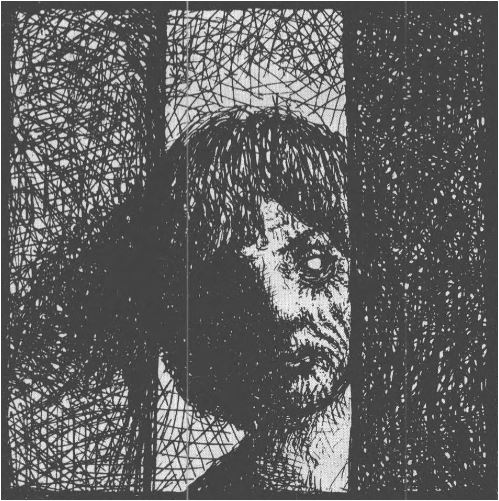
-The
narrator, a subway passenger, is terrified when he sees who he believes to be
the “Subway Slasher” sitting across the aisle. The two passengers are alone in
the car. As his stop approaches, the narrator removes a surgical knife from his
coat and gruesomely stabs the other man to death. The narrator then slips away
unnoticed, revealing himself to be the murderously paranoid “Subway Slasher.”
--1984 and Beyond by T.E.D. Klein

“It’s Orwell’s year, and (surprise!)
we’re still smiling. But if Hollywood’s to be believed, the worst is yet to
come.”
-The
color feature examines the spate of dystopian films from the 1970s and 1980s
that have led to the year 1984, the year depicted in and the title of Orwell’s
disturbing 1948 novel. Klein ranges backwards in time to Metropolis (1927)
and Things to Come (1936) before
focusing on more recent films. He discusses such films as Soylent Green (1973), Wild in the Streets (1968), Logan’s Run (1976), Z.P.G. (1972), Blade
Runner (1982), A Clockwork Orange (1971), Escape from New York (1981), Fahrenheit 451 (1967), Rollerball (1975), The Road Warrior (1982),
Punishment Park (1970), Alphaville
(1965), THX-1138 (1971), The Forbin Project (1970),
and the 1956 film version of 1984. Color
photographs of film scenes accompany the essay.
--Intimations of Mortality by Joseph Payne Brennan

Photography by Arthur Paxton
“A portfolio of poems, tender, bleak,
and doom-haunted, from Brennan’s new collection, Creep to Death – and the photographic images they inspired.”
-Brennan’s
atmospheric poems are enhanced by the eerie photographs of Arthur Paxton. The
poems included are: “Dust,” “Summation,” “Beyond the Night,” “My Nineteenth
Nightmare,” “When Cedar Woods,” “Hell: A Variation,” “Grottos of Horror,”
“Artifice,” “Walk On, My Darling,” “Marsh Moment,” “Winter Dusk,” and “My
Father’s Death.”
--Beyond
the Zone: The Way-Out World of “Feggo”

--The Essential Writers: Blood Brothers by Mike Ashley
 |
| L to R: R.H. Benson, E.F. Benson, A.C. Benson |
“The Bensons were a trio only Victorian
England could have spawned: three bookish bachelors with eccentric tastes and a
particular passion for ghost stories.”
-Mike
Ashley, the noted bibliographer and anthologist, does a superb job with this
profile of the Benson family, a group of intelligent, eccentric, and creative
individuals who made for a highly dysfunctional family. Ashley introduces the
reader to each member of the family, beginning with the patriarch Edward White
Benson, who ascended the ranks of the Church of England to appointment as the
Archbishop of Canterbury. Edward White Benson married his second cousin Mary
(known as Minnie) when he was thirty and she was seventeen. He’d been
infatuated with her since she was eleven. The six children this increasingly
eroded marriage produced were all individualistically brilliant and eccentric. The
oldest, Martin, was thought to be the most promising until he was struck down
at the age of seventeen by a form of cerebral meningitis. Arthur Christopher
(A.C.) came next. He was a lifelong academic who kept a voluminous diary and
suffered debilitating bouts of depression. He wrote supernatural stories for
the amusement of his students. Two daughters came next. Mary (known as Nellie)
was a social worker for women’s causes who died prematurely at the age of
twenty-seven. Margaret (known as Maggie) was a noted amateur Egyptologist who
suffered a mental breakdown when her mother formed an intimate relationship,
after the death of her father, with the daughter a former archbishop. Maggie
attacked her mother with a knife with the intent of murdering her. She was
prevented from doing so and was subsequently institutionalized. Edward Fredric (E.F.)
arrived next. Fred, as he was known to family and friends, became a literary
celebrity at a young age with the publication of his satirical society novel Dodo (1893). He remains
well known for his tales of horror and the supernatural as well as for his
humorous novels chronicling the exploits of Mapp and Lucia. Robert Hugh (R.H.) was the youngest child. R.H.
Benson followed his father into service in the Church of England before
reversing course, after his father’s death, and converting to Roman
Catholicism. All three surviving brothers wrote prodigiously, with a
significant portion of their output centering on tales of the uncanny and
supernatural. Ashley’s profile examines the supernatural fiction of each
brother, its strengths and weaknesses, themes and concerns, and how the
supernatural was approached by each through the lens of their lived
experiences.
-Ashley’s profile is filled with interesting details, such as the friendship between Henry James and the family. It was Edward White Benson who provided James with the kernel of the idea which formed James’ The Turn of the Screw. E.F. Benson lived in the same house, Lamb House in Rye, previously occupied by James. All in all, this was a highly enjoyable piece of literary and social history centered on this fascinating, and tragic, family.
--“The Horror-Horn” by E.F. Benson

Illustrations by Bruce Waldman
“There were things up there on the
mountain – hairy things with almost-human faces, and when winter came, they
grew hungry.”
-While
on winter holiday in the Alps, the narrator’s friend points out to him a news
report that climbers high in the Himalayan Mountains have discovered the tracks
of what appear to be bare human feet. The friend recounts a terrifying tale of
his own experience climbing the Ungeheuerhorn, known locally as the “Horror-Horn,”
which looms outside the windows of their resort. Years ago, while climbing high
upon the mountain with a guide, the friend came upon a hairy, humanoid creature
sunbathing on the edge of the peak. The image of the creature filled the friend
with unnamable loathing. He managed to warn off his guide and quietly slip away
down the mountain without drawing the creature’s attention. On the following
day, the narrator skis across the slopes to a nearby village. He becomes lost
on the mountain on his return journey due to the heavy mists and snow. As the
sun lowers in the sky and night draws on, the narrator becomes frightened of
having to spend the night on the mountain. He becomes more frightened when he
hears an unnatural howling nearby. The mists clear and the narrator sees before
him a beastly humanoid creature with a struggling chamois in its grip. The
female creature mutilates the chamois by pulling off one of its hind legs and
gouging out one of its eyes. The narrator accidentally betrays his presence,
sending the creature after him. He skis rapidly down the slope in fear for his
life as the creature races behind him. The narrator tumbles over a bush and the
creature is quickly upon him. He is saved by the presence of the ice skates
tied to his back. He manages to free one and strike the creature in the head
with the blade. He gets quickly to his feet when he hears another howl nearby
and fears the presence of a second such creature. The narrator skis down the
slope to his hotel and relates his terrifying experience. A group of men search
the mountain on the following day. They find a pool of blood in the snow but no
sign of a body.
-This intense and gruesome story was first published in 1922 in the September number of Hutchinson’s Magazine. It was collected in Benson’s 1923 collection Visible and Invisible. It has been reprinted numerous times in anthologies and collected editions of Benson’s supernatural fiction.
--“The Watcher” by R.H. Benson

Illustration by Bruce Waldman
“The deed was done, and something had
died . . . but something else had awakened.”
-An
elderly priest relates the tale of being a young man of eighteen who, for his
birthday, came into possession of a small pistol. Soon tiring of shooting
targets, the young man decides to shoot and kill an animal. Setting out at
dusk, he fails to shoot a rabbit in a pasture. Moving into the woods, the young
man hears the song of a thrush. He sets his sight on the bird and shoots it. He
tries to see where it fell but instead sees the formation of a hideous, demonic
face in the foliage. The face stares not at the young man but upon the fallen
bird, an evil smile of satisfaction creasing its face. This vision shakes the
young man to his core. The face fades away and the young man runs from the
place, disposing of his pistol and ammunition in a pond. He decides to embrace
a life of spiritual servitude.
-Mike Ashley wrote that the stories of R.H. Benson occasionally “have a power and intensity equal to any tales of the supernatural.” This is believed to be due to R.H. Benson’s strong personal spiritual nature. By contrast, E.F. Benson wrote supernatural stories in a commercial, often formulaic, manner, while A.C. Benson wrote tales for the moral instruction of his students. “The Watcher” is certainly a striking and powerful piece, with an almost hypnotic atmosphere of the uncanny. It was published in 1903 in Benson’s collection The Light Invisible, the first of two collections of uncanny stories, the other being A Mirror of Shalott (1907). It has been reprinted in several anthologies of supernatural fiction, including Jack Sullivan’s Lost Souls. Anthologist Hugh Lamb, responsible for bringing back into print many excellent supernatural stories from the Victorian and Edwardian periods, reprinted Benson’s story in his 1976 anthology Return from the Grave.
--The Outer Limits: Monsters, Incorporated by David J. Schow

“Working on a tight budget and an even
tighter schedule, the special effects team made aliens’ eyes bulge . . . and
the audience’s, too.”
-Schow
continues his fascinating production history of The Outer Limits with
a look at the special effects on the series. The essay focuses on Projects,
Unlimited, a pioneering effects company formed in the late 1950s that worked
extensively with producer/director George Pal before delving into television
work on The Outer Limits. Schow
profiles the directors of the company, Wah Ming Chang and Gene Warren, as well
as makeup artist Fred Phillips, model maker Marcel Delgado, and several other
members of the effects team. Schow details how the team brought to life the
creations of the show’s writers, and how the team worked with other members of
the production, such as director Byron Haskin, who organized much of the
effects work on the series due to his previous experience as head of the makeup
department at Warner Brothers in the 1930s. Schow’s account is filled with
interesting, behind-the-scenes information about the creation of the makeup and
special effects that have contributed enormously to the show’s cultural legacy.
--Show-by-Show Guide: The Outer Limits, Part Three by David J. Schow and Jeffrey Frentzen

“Continuing our seven-part survey of the
series, complete with the words of the celebrated ‘Control Voice.’”
-The
episode guide to the classic series continues with complete cast and crew
listings, Control Voice narrations, and summaries of the following episodes:
“The Mice,” “Controlled Experiment,” “Don’t Open till Doomsday,” “Zzzzz,” “The
Invisibles,” “The Bellero Shield,” and “The Children of Spider County.”
--TZ Classic Teleplay: “Nightmare at 20,000 Feet” by Richard Matheson

“The original television script first
aired on CBS-TV October 11, 1963”
-The
cover feature is Richard Matheson’s script for the classic fifth season episode
starring William Shatner as a terrified airplane passenger, Christine White as
his wife, and Nick Cravat as the menacing Gremlin. I wrote a detailed review of
the episode, examining Matheson’s original short story, its production on the
series, and its many remakes, sequels, and spoofs. You can find that review
here.
--Matheson Looks at His ‘Nightmare’

“The author weighs the merits of the TV
version – and reveals some of the problems in bringing it to the screen.”
-This
brief essay by Matheson provides his thoughts on both the original series
adaptation of his story as well as the updated adaptation for Twilight Zone: The Movie. The original episode remained one of Matheson’s favorites, largely due
to the faithfulness shown to his script, the ingenuity of director Richard
Donner, and, perhaps most of all, the powerful lead performance of William
Shatner (I rated it third best of the series). Matheson had reservations about
the performance of Christine White. Matheson would have liked to see Shatner
and Patricia Breslin reunited from their previous appearance on the series in
“Nick of Time.” Matheson also thought the Gremlin “looked rather like a surly
teddy bear.”
-Matheson states that little of his script for the movie segment was retained by director George Miller. Matheson’s script was shorter and focused on a character in the mold of actor Gregory Peck. George Miller wrote a draft of the script that Matheson intensely disliked. Miller wrote another draft that Matheson liked much better. Matheson thought Miller was the consummate director. He was also impressed with John Lithgow’s performance, and thought the Gremlin looked great. Matheson particularly enjoyed the humor in the segment.
--Looking
Ahead: Next in TZ
-Next
issue features Jack Sullivan’s profile of Shirley Jackson and Jackson’s story
“One Ordinary Day, with Peanuts.” Rod Serling’s teleplay for the first season Twilight Zone episode
“The Hitch-Hiker,” based on the radio play by Lucille Fletcher, is included, as
are stories by Nancy Kress, Steven Millhauser, T.M. Swain, Chet Williamson,
Robert E. Howard, Richard Partlow, and Don Traverso. Features include an
interview with Harrison Ford, coverage of the film version of Stephen King’s Firestarter,
a preview of Star Trek III, including interviews of Leonard Nimoy and
Cathie Shirriff, and the usual columns from Thomas M. Disch, Gahan Wilson, Ron
Goulart, and editor T.E.D. Klein.

Acknowledgments:
The Internet Archive (archive.org)
provided the scan of the magazine. The Internet Speculative Fiction Database
(isfdb.org) provided bibliographic details.
Next in the Vortex: A look at one of the finest episodes of the final
season, Richard Matheson’s “Night Call,” starring Gladys Cooper and directed by
Jacques Tourneur.
-JP