 |
| Agnes Moorehead meets the Invaders |
“The Invaders”
Season Two, Episode 51
Original Air Date: January 27, 1961
Cast:
Woman: Agnes
Moorehead
Astronaut Voice: Douglas Heyes (uncredited)
Crew:
Writer:
Richard Matheson (original teleplay)
Director:
Douglas Heyes
Producer:
Buck Houghton
Associate Producer: Del Reisman
Production Manager: E. Darrell Hallenbeck
Director of Photography: George T. Clemens
Art Direction:
George W. Davis and Philip Barber
Set Decoration:
Henry Grace and H. Web Arrowsmith
Assistant Director: Lindsey Parsons, Jr.
Casting:
Ethel Winant
Editor: Leon
Barsha
Sound:
Franklin Milton and Charles Scheid
Music: Jerry
Goldsmith
And Now, Mr. Serling:
“Next week we bring you a show called ‘The Invaders’
written by Mr. Richard Matheson and in this room you’ll watch Ms. Agnes
Moorehead in a tension-riddled attempt at escape…from a pair of very improbable
housebreakers. This one we recommend to science fiction buffs, fantasy lovers,
or to anyone to grip the edge of his seat and take a twenty-four minute trip
into the realm of terror.”
Rod Serling’s Opening Narration:
“This is one of the out-of-the-way places. The
unvisited places. Bleak. Wasted. Dying. This
is a farmhouse, handmade, crude. A house without electricity or gas. A house
untouched by progress. This is the woman who lives in the house, a woman who’s
been alone for many years. A strong, simple woman whose only problem up until
this moment has been that of acquiring enough food to eat. A woman about to
face terror which is even now coming at her from the Twilight Zone.”
Summary:

An
old woman lives alone in a ramshackle house on a barren stretch of land few
would willingly choose to call home. While washing the dishes one evening, she
hears a loud, piercing noise followed immediately by a crash. After a few
moments she climbs up to the attic to investigate. Upon entering the attic she
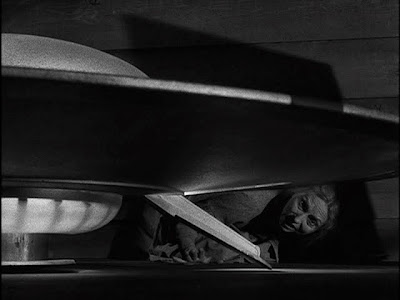
discovers that a small air vessel of some kind has crashed through her roof. The
vessel is round and thin with a diameter of about three feet. The woman
approaches the vessel with caution. As she does so a small drop-door begins to
descend from underneath the ship and a tiny figure emerges. The figure is fully
clothed and his face cannot be seen. Frightened, she kicks the figure through
the attic opening down into the bottom interior of the house and swiftly shuts
the door. She notices a second figure standing on the opposite end of the room.
The figure aims his arm at the woman and fires something at her. She is too big
for the tiny weapon to do any significant harm but its effects are still
painful and she fleas back to the kitchen.
After
she dresses her wounds she begins to look for figure number one. She notices that one of her kitchen knives is
missing. She searches the house in extreme caution. One of the figures emerges
from under a floorboard and plunges the knife into her foot. She screams in
pain. She runs to the kitchen and grabs a hatchet. After having her hand sliced
open while grabbing the makeshift door handle on her bedroom door she enters
into her bedroom and finds one of the tiny figures hiding under a blanket. She
approaches the blanket slowly and grabs the moving mass underneath. She is then
confronted by the second figure shooting at her from the ledge of a nearby
window. She shoves the figure through the window sending it to the ground
below. She wraps the other figure up in the blanket and slams it down on a
table repeatedly as if she were trying to bust the table open with a
sledgehammer. She stops once the figure goes limp.
She
hears noise above her. She climbs up to the attic and approaches the ship, her
fingers gripped around the handle of the hatchet.
She
hears a voice.
“Gresham
is dead,” the voice says. “Incredible
race of giants here. No counter attack,
too powerful! Stay away! Gresham and I are…finished.”
The
woman begins to smash the ship in a violent frenzy until she collapses from
exhaustion. Afterwards, we see the only part of the ship left intake. Printed
in English in large block letters are the words: U.S. Air Force: Space Probe
No. 1.
Rod Serling’s Closing Narration
“These are the invaders: the tiny beings from the tiny
place called Earth, who would take the giant step across the sky to the
question marks that sparkle and beckon from the vastness of the universe only
to be imagined. The invaders, who found
out that a one-way ticket to the stars beyond has the ultimate price tag. And we have just seen it entered into a
ledger that covers all the transactions of the universe, a bill stamped ‘paid
in full,’ and to be found on file…in the Twilight Zone.”
Commentary:
 Never
a program to shy away from a challenge, the second season of The Twilight Zone had already given
audiences Rod Serling’s “Eye of the Beholder,” an episode in which none of the
characters’ faces can be seen until the end of the story. Now the show offered
viewers a story with only one performer who doesn’t utter a single line of dialogue
for the entire twenty-three minutes that she is on screen. Her thoughts and
emotions are conveyed through facial expressions and the use of pantomime,
making it one of the most memorable episodes in the entire Twilight Zone canon.
Never
a program to shy away from a challenge, the second season of The Twilight Zone had already given
audiences Rod Serling’s “Eye of the Beholder,” an episode in which none of the
characters’ faces can be seen until the end of the story. Now the show offered
viewers a story with only one performer who doesn’t utter a single line of dialogue
for the entire twenty-three minutes that she is on screen. Her thoughts and
emotions are conveyed through facial expressions and the use of pantomime,
making it one of the most memorable episodes in the entire Twilight Zone canon.
For
an episode that has scant dialogue and is shot in real time, “The Invaders” feels
surprisingly fast-paced, with tension instilling itself during the first
moments of the episode and not letting up until its denouement. This is one of
only a handful of episodes that breaks the formula of the opening sequence
which usually consisted of a teaser followed by Serling’s appearance on screen.
Here, the audience is given no information before Serling’s introductory
monologue. Instead, Matheson and Serling
grab the viewer’s attention as soon as the title sequence is over with Serling
launching into what may be the single most effective opening line in any
episode of the show:
“This is one of the out-of-the-way places. The unvisited places. Bleak.
Wasted. Dying.”
The
rest of the monologue continues in a similar manner with Serling describing
both the woman and the house in an unflattering fashion. When Matheson first
began writing for the show he didn’t attach an introductory or closing
monologue to any of his scripts believing that Serling preferred to write the
monologues himself. But he found out later that this was not the case and began
to write them himself. It can be assumed that by this point Matheson had begun
scripting his own monologues, for this example in particular resembles
Matheson's prose style even though it was written specifically to be spoken by
Rod Serling. Its effectiveness lies in not only what is being described but the
way in which the words are strung together. Its terse delivery and harsh language
immediately grab the viewer’s attention and gives them a glimpse into the world
of this character.
Matheson had explored the theme of
role reversal between human beings and extraterrestrial life a decade earlier
in his short story “Third from the Sun,” which was adapted by Rod Serling
during season one. In this story the audience is led to believe they are
watching a family escape from an Earth on the brink of a nuclear apocalypse
only to find out by the end of the story that it is an alien family traveling
to Earth. He would also recycle the premise and basic plot structure of
"The Invaders" for his short story “Prey,” which was published in the
April, 1969 issue of Playboy. “Prey”
tells the story of a young woman alone in her apartment with a Zuni fetish doll
that she has purchased for her boyfriend. After only a few paragraphs, the Zuni
doll comes to life after the woman accidentally removes a restricting charm
from around the doll's neck. The doll proceeds to stalk the woman around her
tiny apartment for the remainder of the story trying to kill her. When
interviewed, Matheson said that his original pitch for “The Invaders,” a script
titled "Devil Doll," was much closer to the plot of "Prey"
but that producer Buck Houghton and series creator Rod Serling thought it was
too grim a tale and suggested that he set it on another planet and try to tone
down the violence. “Prey” was later made into a segment of the
made-for-television horror anthology film Trilogy
of Terror (ABC, 1975). This film was intended as the pilot episode for a
possible anthology series but was never picked up by a network. Trilogy of Terror was directed by Dark Shadows creator Dan Curtis based on
three of Matheson's short stories, "The Likeness of Julie,"
"Needle in the Heart," (or "Therese") and
"Prey." All three segments
feature Karen Black in the lead role.
The first two segments were adapted by writer William F. Nolan, a close friend
of Matheson's and frequent collaborator with Dan Curtis, but the “Prey”
segment, titled “Amelia” in the film, was adapted by Matheson, the writer
perhaps sensing something special about the segment as it is undoubtedly the
most fondly remembered portion of the film. Curtis directed a sequel to the
film, Trilogy of Terror II, in 1996 which
includes a sequel to the “Amelia” segment from the first film, picking up right
where the original segment ended. William F. Nolan wrote the screenplay for
this segment.
Calling the shots on “The Invaders” was director Douglas Heyes who had become the show’s good luck
charm when it came to technically challenging episodes such as this one. Unfortunately,
this would be the last episode directed by Heyes. The Twilight Zone never staffed regular directors, writers, or
actors. Everything was freelance, with the producers purchasing the stories
they felt were right for the show and hiring the people they felt were right
for that particular story. Heyes made nine episodes during the first and second
seasons of the show, although his influence can be felt throughout the entire
run of the series. He had an eclectic style that lent itself to the show
remarkably well. If Houghton knew that an episode was going to be challenging
Heyes was usually his first choice.

Something of a renaissance artist, Heyes explored many
avenues of the creative process during his career. In addition to directing he
was also a skilled musician, painter, actor, screenwriter, and novelist. He
began his career at the age of seventeen as a cartoonist for Walt Disney
Studios where he first learned the process of storyboarding. After he left
Disney Heyes worked as a cartoonist on the syndicated comic strip Strange as It Seems from 1946 – 1948.
With the advent of television Heyes turned his talents to writing. Heyes sold
his first script to Arthur Ripley at General
Electric Theatre who saw in the young man an extraordinary talent. He
offered Heyes the chance to direct his own material. With no formal training,
Heyes began his career as a director and was soon writing and directing for
shows like Cheyenne, Maverick, Naked City,
and The Adventures of Rin Tin Tin—for
which he wrote forty-four episodes. During this time he also began a career as
a novelist publishing his first book The
Kiss-Off (Simon and Schuster, 1951) to favorable reviews. Considering his prolific
output as a writer, it seems odd that Heyes never penned any scripts for The Twilight Zone. It is possible that he
intended to eventually return to the show but was never able to.
Heyes’s
second major contribution to the horror/fantasy genre is his work on Boris Karloff’s Thriller. Around the
same time that he made “The Invaders” Heyes had already begun working on
episodes of Thriller at NBC. Although
several different versions of the show’s history have been presented over the
years it is generally agreed upon that Heyes played a significant role in
helping it evolve from a bland imitation of Alfred
Hitchcock Presents to a program of rich gothic horror more in line with the
image of Boris Karloff. Heyes wrote and directed the first genuine horror
episode of the show, “The Purple Room,” for its first season. Later in the
season he directed the episode “The Hungry Glass” which he adapted from the
Robert Bloch story “The Hungry House.” Heyes’s third and final episode was “The
Premature Burial” which he directed and co-adapted with William D. Gordon from
the story by Edgar Allan Poe. Although he was only directly involved in three
episodes Heyes, along with many others most notably producer William Frye,
helped save the show from obscurity and made it a program that is still
enjoyed and discussed today.
After
his work on Thriller and The Twilight Zone, Heyes wrote three
segments of Night Gallery including
both segments of the debut episode “The Dead Man,” which he also directed, and
“The Housekeeper.” He also wrote the segment “Brenda” for the second season of
the show. He continued to publish novels. The
12th of Never was published by Random House in 1963 and The Kill was published by Ballantine
Books in 1985 and was nominated for a Shamus Award for Best Original Paperback.
Today he is probably best remembered for helming the sprawling historical
miniseries Captains and Kings (NBC,
1976)—which features an appearance by Richard Matheson as President James
Garfield—and North and South (ABC,
1985). Much of his writing appeared under the pseudonym Matthew Howard. He died
in 1993 at the age of 73.

In
an interview with Marc Scott Zicree, Heyes said that once he read the script
for “The Invaders” he knew that the set design had to be as simple as possible
to make the audience believe that they were watching a story set on Earth. Nothing
specific to Earth, nor anything overtly foreign, could be used as a set piece. This
is why the woman’s house looks so primitive. All of the set pieces seen inside
the house are the basic tools one would need for survival. Heyes also revealed
that the “invaders” were simply puppets that were manually operated by various
crew members. Heyes and the crew members wore black, long sleeve t-shirts and
were able to maneuver the puppets by placing their hand through an opening on
the back side of the puppet and moving the legs with their fingers. This is why
the spacemen move with such slow, wooden gestures. Over the years the tiny
invaders have been the subject of criticism and ridicule from fans because of
their primitive appearance. However, the story is so good and Moorehead’s
performance so captivating that this is quickly forgotten. Heyes said he based
the spacemen on the Michelin Tire Man. He also revealed that the voice of the
astronaut at the end of the episode was actually his voice.
Jerry
Goldsmith forgoes his usual soft dream-like style to deliver some of the most
memorable music from any episode of the show. No doubt taking a cue from
Bernard Hermann’s famous score for Alfred Hitchcock’s Psycho, which was released the year before, Goldsmith uses mostly
harsh strings and occasional piano arrangements which greatly add to the
unsettling atmosphere in this episode.
And finally, although Matheson
delivers a solid script and both Heyes and Goldsmith help breathe life into it,
this episode more or less belongs to Agnes Moorehead. A veteran character
actress of stage and screen, Moorehead was a well-known name by the time this
episode aired. In the 1930’s she became friends with Orson Welles and
eventually joined his Mercury Theatre Company.
In 1938 she took part in Welles’s famous radio adaptation of H. G.
Welles’s War of the Worlds. After
Welles moved to Hollywood she appeared in several of his films including Citizen Cane (1941) and The Magnificent Ambersons (1942). She
went on to have a wildly successful film career appearing alongside the likes
of Humphrey Bogart, Lauren Bacall, Bette Davis, and Vincent Price. But it was
her role as Endora on Bewitched that
would immortalize her forever (much to her reported irritation).

Heyes
recruited Moorehead for this episode specifically based on her performance in a
one-woman radio adaptation of Lucille Fletcher’s “Sorry, Wrong Number” (1948)
for the show Suspense. He was
impressed by her ability to sustain terror for the entire half hour episode and
figured that she would be a good fit for “The Invaders.” The challenge here of
course is that she had no dialogue to help her move the plot along or develop
her character. As there is little dialogue in this episode most of the story is
told through the actions, mannerisms, and facial expressions of Moorehead’s
character. Years earlier she studied under renowned pantomime artist Marcel
Marceau and her performance here is one of the best the show ever offered. It is
crude and even embarrassing at times but she still manages to be completely
compelling. Her mannerisms are almost primitive and there is one scene where
the woman, exhausted, is seen drooling uncontrollably. It is as authentic as
any performance that one is likely to see on television from this or any other
era.
Although
“The Invaders” has come to be a fan favorite and one of the more recognizable
episodes of the show it should be noted that Richard Matheson was not a fan of
it, although he did praise Moorehead’s performance. He was irritated by the
stilted movements and absurd mannerisms of the tiny invaders. He also thought
the episode moved much slower than his original script. Even so the idea was
unique enough to cement this story in the cosmos of popular culture and make his miniature space invaders immortal.
Grade: A
Grateful acknowledgement to:
“Douglas Heyes: Behind the
Scenes at The Twilight Zone”
interview with Heyes conducted by Ben Herndon. Rod Serling’s The Twilight Zone Magazine (August, 1982) edited by
T.E.D. Klein
This is a Thriller by Alan Warren (McFarland and Company, 1996)
The Twilight Zone Companion, second edition by Marc Scott Zicree (Silman-James Press, 1992)
 |
Original design sketch by director Douglas Heyes
featured in an interview with Heyes in the
Aug, 1982 issue of Rod Serling's The Twilight Zone Magazine |
Notes:
--Agnes Moorehead also appeared in two episodes of Rod Serling's Night Gallery, "Certain Shadows on the Wall," scripted by Serling from a
story by Mary E. Wilkins Freeman, and "Witches' Feast."
--Douglas Heyes directed nine episodes of The Twilight Zone and
was considered by producer Buck Houghton to be the go-to director for
technically challenging episodes. “The Chaser,” “The After Hours,” “The Howling
Man” and "Eye of the Beholder" are among his contributions to the
show. Heyes wrote both segments of the first episode of Rod Serling's Night Gallery, "The Dead Man" (based on the story by Fritz Leiber) which he also directed and "The Housekeeper" which he wrote under the pseudonym Matthew Howard. He also wrote the season two segment "Brenda" (based on the
story by Margaret St. Clair) under this pseudonym.
--"The Invaders" was adapted into a Twilight Zone Radio Drama starring Kathy Garver.
--Brian
 Duvall’s
sympathetic turn as a lonely man who falls in love with a female figure in a
doll’s house has been largely overlooked due to the fact that the episode was
kept out of syndication for many years, which is a terrible shame since it is
one of the more moving performances featured on the series. Duvall’s
performance is at once understated and yet fiercely defiant, lending the
character an aspect of proud dignity which is ultimately rewarded by the
episode’s happy ending. The episode overall is a triumph of acting, writing,
and directing and one of the more underrated masterpieces from the series.
Duvall’s
sympathetic turn as a lonely man who falls in love with a female figure in a
doll’s house has been largely overlooked due to the fact that the episode was
kept out of syndication for many years, which is a terrible shame since it is
one of the more moving performances featured on the series. Duvall’s
performance is at once understated and yet fiercely defiant, lending the
character an aspect of proud dignity which is ultimately rewarded by the
episode’s happy ending. The episode overall is a triumph of acting, writing,
and directing and one of the more underrated masterpieces from the series.