|
| Anne Francis as Marsha White |
"The After Hours"
Season One, Episode 34
Original Air Date: June 10, 1960
Cast:
Marsha White: Anne Francis
Saleswoman: Elizabeth Allen
Elevator Operator: John Conwell
Mr. Armbruster: James Millhollin
Mr. Sloan: Patrick Whyte
Miss Keevers: Nancy Rennick
Crew:
Writer: Rod Serling (original teleplay)
Director: Douglas Heyes
Producer: Buck Houghton
Production Manager: Ralph W. Nelson
Director of Photography: George T. Clemens
Art Direction: George W. Davis and Merrill Pye
Set Decoration: Henry Grace and Keogh Gleason
Assistant Director: Don Klune
Editor: Bill Mosher
Sound: Franklin Milton and Philip Mitchell
Music: Stock
Makeup Effects: William Tuttle
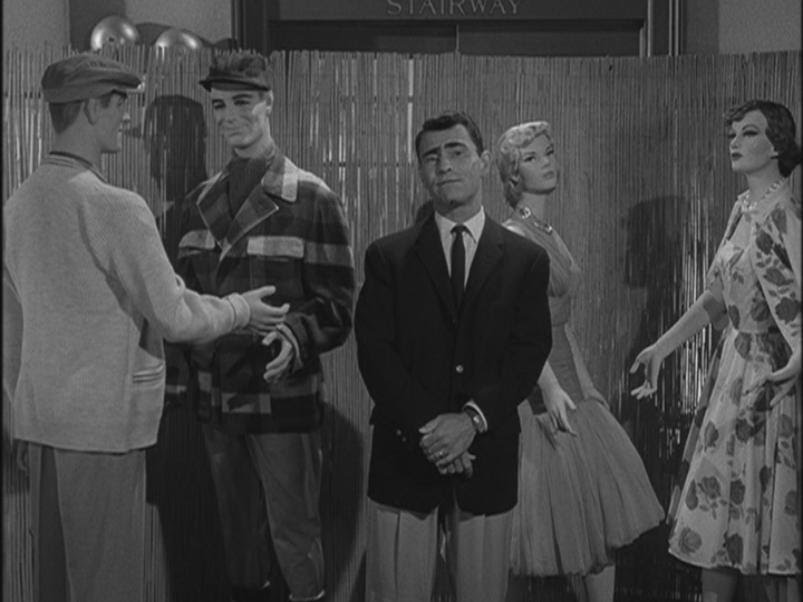
 "Next week you'll see our friends here along with Anne Francis and Elizabeth Allen in one of the strangest stories we've yet presented on The Twilight Zone. It's called 'The After Hours' and concerns the shadowy time when normal people go back to their homes and concurrently what happens to those who perhaps are not quite so normal, or perhaps not quite so human. Intriguing? I think you'll find it so, next week on The Twilight Zone."
Rod Serling's Opening Narration:
"Express elevator to the ninth floor of a department store carrying Miss Marsha White on a most prosaic, ordinary, run-of-the-mill errand.
"Miss Marsha White on the ninth floor, Specialties Department, looking for a gold thimble. The odds are that she'll find it but there are even better odds that she'll find something else because this isn't just a department store. This happens to be. . . The Twilight Zone."
Summary:
 Marsha White is visiting a busy department store. She walks around the first floor looking in display cases but not finding what she wants. Moving to the elevators, Marsha stands with a cluster of shoppers waiting for the next available elevator. Suddenly, the doors to a service elevator a few feet away open and the elevator operator calls out the availability of the carriage. It seems as though only Marsha notices the available elevator. She alone gets in.
Marsha tells the man that she is searching for a gold thimble and the operator informs her that it can be found on the ninth floor, Specialties Department. As they slowly ascend, Marsha comments on the strangeness of the situation, that she should be given a private elevator when all those other shoppers were waiting. The operator tells Marsha that this elevator is strictly an express elevator to the ninth floor.
 When they arrive on the ninth floor, Marsha quickly exits the elevator only to see that the floor appears to be darkened and sparsely filled with empty display cases. She turns to comment to the elevator operator but the man has already closed the elevator doors and left.
Marsha tries to call the elevator back up and soon resigns herself to looking around. It seems to be an abandoned and unused floor until a voice speaks from the darkness. From the shadows emerges a well dressed and attractive saleswoman who offers to help Marsha. Though taken aback by the woman’s sudden appearance, Marsha tells the saleswoman what it is she is looking for and the woman says that they have something in stock which may be just what Marsha wants. The saleswoman leads Marsha to a seemingly empty display case until the woman turns on an interior light and illuminates a single object on display: a gold thimble.
 Though Marsha clearly finds the whole encounter strange she agrees that this gold thimble is exactly what she is looking for and pays cash for the item. As she turns to walk back toward the elevator, Marsha says, "That's odd." To which the saleswoman replies, "What is, Marsha?" Marsha remarks on the strangeness of her experience in the store, the solitary elevator ride, the seemingly empty floor devoted to a single item. Suddenly, Marsha realizes that the saleswoman has called her by name. She calls attention to this, stating that she has not given the woman her name nor has she seen the woman around the store. Marsha, now unnerved as well as annoyed, rushes to the elevator. The saleswoman calls out to her once more before Marsha reaches the elevator. "Miss White? Are you happy?" Marsha looks back at the saleswoman, incredulous that this woman would ask her that question. Marsha replies, "It's none of your business." The saleswoman finds this response both hilarious and unbelievable. The elevator opens at Marsha's approach.
Marsha realizes that the gold thimble she has just purchased is both scratched and dented. The elevator operator lets Marsha off on the third floor, Complaints Department. There, Marsha runs into a problem. When she complains of her encounter on the ninth floor and the purchasing of the gold thimble, both the department manager and the store manager tell Marsha that the store does not have a ninth floor nor does the store carry gold thimbles. Suddenly, Marsha spies the saleswoman that sold her the thimble and she calls out to the lady only to discover that it is a store mannequin with an uncanny resemblance to the woman. Marsha has a near panic attack from this bizarre encounter and is allowed to lie down in the manager's office.
 Marsha falls asleep, the store workers forget about her, and she is accidentally locked in the department store after closing hours. The vast and empty building is terrifying, alive with voices that seem to pursue Marsha as she runs from one end of the store to the other looking for a way out or for someone to help her. The voices, she realizes, are coming from the store mannequins. Marsha runs, always to be confronted by another mannequin at every corner of the store. When one mannequin actually reaches out to her, Marsha panics and, crying, backs into an opening elevator. It is the express elevator to the ninth floor. When the doors open, the mannequin figure of the saleswoman who sold Marsha the gold thimble stands there, immobile. Marsha screams and sinks down to the floor. The saleswoman moves to Marsha’s side to comfort her and leads Marsha out of the elevator, the whole time telling Marsha that she is overreacting and needs to get a hold of herself.
 As the saleswoman leads Marsha through the ninth floor, they pass by several mannequins who, one by one, come to life and climb down from their pedestals. They encircle Marsha. The saleswoman holds Marsha at arm’s length and implores Marsha to think, to concentrate and try to recollect why she is here in the department store. Recollection eventually dawns on Marsha's face and she remembers everything: she is a mannequin and was given a month to leave the store and live among humans as though she were made of flesh and blood. Marsha overstayed her vacation and is returning to the store a day late. The saleswoman is the next mannequin scheduled to get a month long vacation out into the world of humans and Marsha has set her back a day. While the other mannequins follow the departing saleswoman to the elevator, all wishing her a wonderful vacation, Marsha and the elevator operator stay behind. The operator asks Marsha if she enjoyed her vacation and Marsha tells him she had so much fun. She had, in fact, completely forgotten who she really was.
 On the following day, the department manager of the store, the man who helped Marsha with her complaint about the damaged gold thimble, is walking through his department, keeping his workers on task when he passes by a mannequin that causes him to pause and give a double take. It is the mannequin of Marsha White.
Rod Serling's Closing Narration:
"Marsha White, in her normal and natural state, a wooden lady with a painted face who one month out of the year takes on the characteristics of someone as normal and as flesh and blood as you and I. But it makes you wonder, doesn't it? Just how normal are we? Just who are the people we nod our hellos to as we pass on the street? A rather good question to ask, particularly . . . in The Twilight Zone."
Commentary:
 Rod Serling's "The After Hours" stands as a creative high point not only for the first season but for the entire series. Along with a select number of other episodes, "The After Hours" has achieved the status of cultural milestone, the traits and characteristics of its plot and thematic effects recognizable even to those who have never seen the episode. It is a masterpiece of dramatic fantasy, a tightly-written, superbly acted, and frighteningly claustrophobic exercise in urban terror.
Director Douglas Heyes and Director of Photography George T. Clemens expertly utilized a number of interesting camera setups and angles, from a close-up Marsha White (Anne Francis) calling for help from the other side of a frosted glass door to high-mounted shots utilized to display Marsha's panicked run through the empty department store. The set was converted from its previous use as a large newspaper office into the department store set used for the episode. The jarring juxtaposition from a busy shopping day during opening hours to the silent darkness of the store after closing creates an unnerving contrast and creates a startling effect which makes the episode one of the more genuinely frightening produced for the series. Though few viewers have likely ever been locked inside an enormous department store after closing hours, it is not very difficult to image the terror that would grip one in that situation, alone in the darkness without a way out and without knowing your way around. Then there are those voices calling out to you and those mannequin faces watching your every move.
Director Douglas Heyes's previous episodes for the show, "And When the Sky Was Opened" and "Elegy," were more than competent directing jobs but Heyes, beginning with "The After Hours," began to stretch his creative muscles and create some of the most memorable episodes of the series. His directing style is characterized by an intense focus on both character and mood. Heyes likes to move the camera around and often experiments with angles and lighting effects to achieve a desired atmosphere. At the same time, Heyes well knows when to keep the audience's attention off the movement of the camera and focus it upon the performer at a critical junction in the narrative.
Heyes also seemed to be the director called upon to work on technically challenging episodes. Producer Buck Houghton expressed his principle concern for the episode was the effectiveness in how much the mannequin doubles resembled their respective performers. The solution for veteran makeup artist William Tuttle and his longtime assistant Charles Schram was to cast facial molds of the actors, Anne Francis, Elizabeth Allen, and John Conwell, in order to create life-sized plaster head models which could then be painted and mounted upon mannequin bodies. The effect, like most of Tuttle's work for the show, is convincing and frightening. For a full examination of William Tuttle's career, see my commentary on the earlier episode, "Long Live Walter Jameson."
 |
| James Millhollin |
The supporting characters in "The After Hours" are capably handled. Elizabeth Allen is suitably unnerving as the saleswoman and veteran character actor James Millhollin offers some effective comic relief in an otherwise grim episode. His double-take of the mannequin and breaking of the fourth wall (looking directly into the camera) to end the episode are whimsical yet fitting for the odd nature of the play and remains a memorable way to close out the episode.
 The true acting triumph of the show belongs to Anne Francis as Marsha White. The success of the episode hinged on her performance and Francis brings it off in stunning fashion, marking one of the finest performances for the entire series. Some of the finest performances of the series belonged to female performers, such as Inger Stevens in "The Hitch-Hiker," Vera Miles in "Mirror Image," Gladys Cooper in "Nothing in the Dark," Lois Nettleton in "The Midnight Sun," and Agnes Moorehead in "The Invaders," to name only a few. Anne Francis is another prime example of what a talented actress can do with a strong supporting cast, an able crew, and a well-written script. Francis comes off as fierce, independent, and strong, making the effect of her terrified pursuit and subsequent breakdown all the more shocking, increasing the unease in the episode. Douglas Heyes felt that Francis was excellent in the role and undoubtedly improved the episode's quality. Francis often told interviewers that despite her more famous work on the 1956 film Forbidden Planet or the television series Honey West (1965-66) she was often approached by fans to tell her how much they enjoyed "The After Hours." Francis went on to star as the namesake of writer Earl Hamner's excellent fourth season episode, "Jess-Belle."
Rod Serling's script for "The After Hours" is one of his best original teleplays for the series. Serling was well suited to adapt previously existing work and would often improve upon, or at least present an interesting take on, chosen source material. When it came to crafting the original teleplay Serling sometimes found himself (undoubtedly because of his contractual obligation to write 80% of the first season's output) falling back on standard genre tropes which unfortunately garnered calls of plagiarism from other professional genre writers. Serling's script for "The After Hours" was no exception. One of the stories most closely associated with the episode is John Collier's "Evening Primrose" (1940). Other than the fact that both stories take place in a department store and that much of the action takes place after closing hours, the two stories are quite different in plot and resolution. There is no doubt that Serling was familiar with Collier's work and the idea for "The After Hours" may even have germinated in Serling's reading of Collier's story, but Serling took a suitably different approach when crafting his teleplay in order to avoid the plagiarism bug that pursued him throughout his time writing scripts for The Twilight Zone. Author Martin Grams Jr., in his book The Twilight Zone: Unlocking the Door to a Television Classic (OTR, 2008), notes that Serling may have been exposed to the Collier story from its adaptation on the radio show Escape, broadcast November 5, 1947. Serling purchased Robert Presnell, Jr.'s adaptation of Collier's 1940 story "The Chaser" for the first season of The Twilight Zone.
Grams, Jr. also documents Serling's feud with writer Frank Gruber over the similarities between "The After Hours" and Gruber's story "The Thirteenth Floor." Gruber (1904-1969) made his name primarily writing western and detective stories, credited with over 300 stories for 40 different pulps under a variety of names besides his own, including Stephen Acre, Charles K. Boston, and John K. Vedder. Gruber had a script floating around titled "The Thirteenth Floor," which he adapted from his story in the January, 1949 issue of Weird Tales. Gruber submitted the script to Cayuga Productions where it landed in the hands of series producer Buck Houghton. Houghton passed on the script and Serling claimed to have read "very little" of Gruber's script at the time of writing "The After Hours." There are similarities in the scripts which most closely resemble one another in the opening act. These similarities include the setting, a department store, the plot element of a character winding up on a phantom floor, and small similarities such as a shopper purchasing an item that is not currently carried in the store and store employees unable to verify a customer's experience. In Gruber's script the phantom floor is the thirteenth floor, in Serling's it is the ninth floor. The stories diverge considerably beyond these similarities.
 |
Illustration by John Giunta
for Frank Gruber's "The Thirteenth Floor"
Weird Tales (Jan, 1949) |
Gruber's "The Thirteenth Floor" concerns a man who visits a busy department store and manages to secure a solitary ride on elevator 12, operated by a chipper young man. The shopper is deposited on the thirteen floor, which is filled with wares but no shoppers. There he meets only two people, a floorwalker and a saleswoman. The shopper puts in his order and departs. Later, he returns to the store to investigate his experience but is rebuffed by store employees, who inform the shopper that there is no thirteenth floor and that the sale receipt he possesses is ten years old and for an item no longer carried in-store. Before he leaves the shopper again steps onto elevator 12. There, he plummets to his death. It turns out that elevator 12 was closed off ten years ago and the thirteen floor renumbered after a store tragedy. Three workers died on the elevator, the young elevator operator, a floorwalker, and a saleswoman. Gruber's tale is essentially a ghost story and though it certainly shares similarities with "The After Hours," no one would mistake one story for the other. One of Gruber's best-known tales, "The Thirteen Floor" has been translated into several foreign languages and was reprinted in the March, 1955 issue of The Magazine of Fantasy and Science Fiction, as well as in The Boris Karloff Horror Anthology (aka Boris Karloff's Favorite Horror Stories) (1965).
After he failed to sell his script to The Twilight Zone and later viewed Serling's "The After Hours," Gruber became convinced that Serling stole his idea and began spreading the word at social gatherings that Serling was a plagiarist. Serling, obviously feeling the need to defend himself, went so far as to send Gruber the shooting script for "The After Hours," confident that the writer would see the obvious differences in the treatments. Gruber, however, replied to Serling in a ranting letter that both admitted the differences and defended Gruber's claims of plagiarism. After Serling sent one final reply to Gruber the situation seemed to end on its own as Serling heard no more from Gruber. Oddly enough, Serling seems to have been comfortable enough with the end of the Gruber feud to include a tale titled "The Thirteenth Story," concerning a hidden floor, in his 1963 book Rod Serling's The Twilight Zone (Grosset & Dunlap; written in collaboration with Walter B. Gibson). This book was a mixture of original stories and adaptations of Twilight Zone episodes and was marketed as "13 new stories from the supernatural especially written for young people."
Another interesting aspect concerning plagiarism connects "The After Hours" to Charles Beaumont's marvelous fourth season episode "Miniature." Beaumont's episode was initially broadcast on February 21, 1963 and not seen again in syndication* due to a charge of plagiarism levied against the episode by the author of a script submitted for consideration during the fourth season. That script was titled "The Thirteenth Mannequin" and concerned a department store worker who so preferred the company of mannequins to other people that the mannequins come to life. It is a story with a title taken from the Frank Gruber story and a plot nearly lifted from "The After Hours," with a bit of Charles Beaumont's and Jerry Sohl's "The New Exhibit" as well. Needless to say, the suit was thrown out but the damage remained. "Miniature" for many years went unseen after its initial broadcast.
It is a shame that of Serling's scripts that strongly resemble other stories, such as "Nightmare as a Child" (Truman Capote's "Miriam"), "The Silence" (Anton Chekhov's "The Bet"), or "A Thing About Machines" (Richard Matheson's "Mad House"), an issue would be publicly made for an episode that is suitably original in treatment and execution. Suffice it to say that the science fiction and fantasy community of the fifties and sixties was a crowded field full of writers covering the same grounds in terms of theme and plot. It was inevitable that there would be similar stories floating around at the same time. Add in the fact that Rod Serling, a science fiction and fantasy "outsider," was creator and lead writer of a well-regarded and popular television series and it's no surprise that some writers were calling for series credits they did not deserve.
"The After Hours" was remade quite effectively for the second season of the first Twilight Zone revival series. It originally aired on October 18, 1986, directed by Bruce Malmuth, adapted by Rockne S. O'Bannon, and starred Terry Farrell in the role of Marsha Cole. The remake is effective due to the successful updating of the tale to the styles and settings of the eighties. The updating included setting the story in a modern American shopping mall of the style which came into vogue during the late seventies. The episode is one of the creepiest produced for the first revival series and plays upon the body horror aspect of the story with some unnerving and grotesque makeup effects simulating the transformation from mannequin to human and the reverse. Though innovative practical makeup effects reached its zenith during the eighties, the Twilight Zone revival series generally shied away from flashy displays of makeup effects (in contrast to, say, Tales from the Darkside). "The After Hours" is a pleasant exception. It remains one of the darker and more unnerving episodes from the eighties Twilight Zone series and comes recommended.
"The After Hours" stands as a creative high point for the series and justifiably remains one of the most popular episodes of the show. The only element truly lacking from the show's production was a fine original musical score from one of the show's talented composers such as Jerry Goldsmith or Bernard Herrmann. Still, this element does not take away any of the episode's dramatic effects and it remains an enduring and influential work.
*The same fate befell the fifth season episodes "Sounds and Silences," "A Short Drink from a Certain Fountain," and "The Encounter."
Grade: A
--Anne Francis also stars in the fourth season episode, "Jess-Bell."
--Director Douglas Heyes also directed some of the show's most famous episodes, including "The Howling Man," "The Invaders," and "Eye of the Beholder." In addition, Heyes contributed to three episodes of Rod Serling's Night Gallery, writing and directing the first episode, "The Dead Man" (based on the story by Fritz Leiber), and writing two additional episodes, "The Housekeeper" and "Brenda" (based on the story by Margaret St. Clair), both of which were written under the pseudonym Matthew Howard. Heyes re-teamed with actress Elizabeth Allen for a classic episode of Boris Karloff's Thriller titled "The Hungry Glass." That episode also featured Zone performers William Shatner, Russell Johnson, Donna Douglas, Clem Bevans, and Heyes's wife Joanna.
---"The After Hours" was originally broadcast with the rare opening sequence of a woman's open eye slowly closing and the following narration from Rod Serling: "You are about to enter another dimension, a dimension not only of sight and sound but of mind, a journey into a wondrous land of imagination. Next stop, the Twilight Zone."
--"The After Hours" was updated and remade for the first revival Twilight Zone series. It aired on October 18, 1986 as part of the second season. It starred Terry Farrell and was directed by Bruce Malmuth. Writer Rockne S. O'Bannon adapted Rod Serling's original teleplay.
--"The After Hours" was adapted as a The Twilight Zone Radio Drama starring Kim Fields.
--"The After Hours" was adapted as a graphic novel by writer Mark Kneece and artist Rebekah Issacs (Walker & Co., 2008).
--JP