Showing posts with label Jerry McNeely. Show all posts

Monday, September 1, 2025

"The Self-Improvement of Salvadore Ross"


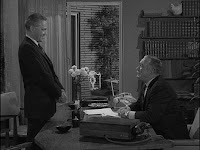
Mr. Maitland (Vaughn Taylor) listens to an offer from Salvadore Ross (Don Gordon)

“The Self-Improvement of Salvadore Ross”
Season Five, Episode 136
Original Air Date:
January 17, 1964

Cast:
Salvadore Ross: Don Gordon
Leah Maitland: Gail Kobe
Mr. Maitland: Vaughn Taylor
Old Man: J. Pat O’Malley
Mr. Halpert: Douglass Dumbrille
Albert: Doug Lambert
Jerry: Seymour Cassel (uncredited)
Nurse:
Kathleen O’Malley (uncredited)


Crew:
Writer: Jerry McNeely (based on the story by Henry Slesar)
Director: Don Siegel
Producer: Bert Granet
Director of Photography: George T. Clemens
Production Manager: Ralph W. Nelson
Art Direction: George W. Davis & Walter Holscher
Film Editor: Richard Heermance, a.c.e.
Set Decoration: Robert R. Benton & Henry Grace
Assistant Director: Charles Bonniwell, Jr.
Casting: Patricia Rose
Music: stock
Sound: Franklin Milton & Philip N. Mitchell
Mr. Serling’s Wardrobe: Eagle Clothes

Filmed at MGM Studios

And Now, Mr. Serling:

“Next time out on The Twilight Zone, an unusual little item from the pen of Jerry McNeely, based on a story by Henry Slesar, and called, intriguingly enough, ‘The Self-Improvement of Salvadore Ross.’ This one poses a question. If you don’t like what you are, how do you go about changing? Don Gordon portrays a man who really goes the route when it comes to some basic changing, and the results are most unexpected.” 

Rod Serling’s Opening Narration:

“Confidential personnel file on Salvadore Ross. Personality: a volatile mixture of fury and frustration. Distinguishing physical characteristic: a badly broken hand which will require emergency treatment at the nearest hospital. Ambition: shows great determination toward self-improvement. Estimate of potential success: a sure bet for a listing in ‘Who’s Who,’ in The Twilight Zone.” 


Summary: 

Salvadore Ross is an uneducated and crude laborer with the single-minded obsession of winning the affection of pretty and refined social worker Leah Maitland. Sal arrives on Leah’s street driving a fancy car he “borrowed” from old Mr. Halpert, for whom Sal occasionally performs odd jobs. Despite Sal’s attempts to impress Leah with the car, she quickly sees through his deception. Leah tells him they are simply too different to be together. Sal, believing her rejection stems from his low social status, vows to win her over. When Leah’s invalid father intervenes on her behalf and Sal insults him, Leah tells Sal she now sees him exactly as her father does. They close the door on Sal and he punches the door in a fit of rage, breaking his hand and landing himself an overnight stay at the hospital.

During his hospital stay, Sal discovers an astonishing ability. He meets an old man afflicted with a cold and jokingly offers to trade his broken hand for the old man’s ailment. To their surprise, the exchange works! The old man wakes up in the night with a painful broken hand, while Sal is left with a cold. When the old man begs to trade back, Sal cruelly refuses, telling him “all deals are final.” Realizing the incredible potential of his new power, Sal decides to improve himself in a big way. He trades old Mr. Halpert years of his life for a million of Halpert’s dollars and possession of Halpert’s luxurious penthouse apartment. He then restores his youth by buying years from the building’s young bellboys and elevator operators. With his youth regained and his wealth assured, Sal sets his sights on Leah once more.

When Sal returns to Leah’s apartment, he’s a changed man on the surface. His speech and appearance have improved, impressing Leah but arousing suspicion in Mr. Maitland. Sal, still arrogant, insults Mr. Maitland’s career and military service. Leah, however, is curious about Sal’s transformation and agrees to a date. At his penthouse, Sal makes a clumsy and aggressive attempt to show Leah affection. When she rejects him, he angrily demands to know what more he could possibly do to please her. Leah’s response is simple and damning: Sal lacks kindness and compassion, qualities that can’t be bought and sold. 

Undeterred, Sal believes his unique power can acquire these qualities. He offers Mr. Maitland $100,000 for his compassion. The next day finds Sal truly transformed. He is kind, caring, and considerate. Leah responds affectionately to this change in him, and they return to her apartment. While Leah is in another room, Sal apologizes to Mr. Maitland and asks for his forgiveness. But Mr. Maitland reminds Sal of their deal. Revealing a pistol from beneath his quilt, he explains that he will never let Sal marry his daughter. Despite Sal’s protests, Mr. Maitland shoots him dead without compassion.

Rod Serling’s Closing Narration:

“The Salvadore Ross program for self-improvement, the all-in-one, sure-fire success course that lets you lick the bully, learn the language, dance the Tango, and anything else you want to do or think you want to do. Money back guarantee. Offer limited to The Twilight Zone.”


Commentary: 

Illustration by Ed Emshwiller

“The Self-Improvement of Salvadore Ross” by Henry Slesar was first published in the May, 1961 issue of The Magazine of Fantasy and Science Fiction. The editorial introduction read: “Salvadore Ross had a driving urge to improve himself, and literally fell into a talent for doing so. The problem then became one of knowing where the stop . . .” In the story, Salvadore Ross is a laborer at a bottling plant who breaks his leg in a work accident. Recovering in the hospital, he discovers an astonishing ability when he trades his broken leg for an old man’s pneumonia. No explanation is given for Sal’s amazing talent. Slesar writes: “He laughed to himself, remembering the swap they had made, and the situation tickled him so much that he didn’t even marvel over the mysterious transaction. He was too pleased.” Leah Maitland is a local beauty Sal has coveted since high school. Realizing his newfound ability might offer a path to Leah’s affections, Sal works on improving his station in life. He trades his hair to the bald bartender Phil for the bar's cash takings that day. Again, the miraculous exchange works. This scene was filmed for the episode, with Ted Jacques in the role of the bartender, renamed Stan, but was left on the cutting room floor. Sal regains a head of hair from a derelict for the price of a bottle and realizes he shouldn’t sell his talent so cheaply. Sal trades a friend his talent at billiards for a meeting with rich, old Mr. Halpert and is on the path to his ironic demise. 

Slesar later adapted his story for CBS Radio Mystery Theater. Retitled “A Bargain in Blood,” the episode aired on June 10, 1974 with Tony Roberts as Salvadore Ross, Evelyn Juster as Ruth Maitland, and Mandel Kramer as Mr. Maitland. Slesar was a staff writer on the radio series and used the opportunity to adapt several of his previously published stories. For more on Henry Slesar’s life and career, see our review of “The Old Man in the Cave.”

 Slesar’s story is an entertaining, breezily written tale, with moments of humor that primarily serve its ironic twist ending. As a result, the characters are only hazily sketched, particularly Leah and Mr. Maitland. Jerry McNeely’s adaptation removes the humor and focuses on the psychological realism of the characters. By creating more nuanced depictions of Sal, Leah, and Mr. Maitland, the episode’s central conflict feels more impactful and heightens the shock ending. 

The aging makeup applied to Don Gordon

The episode has its shortcomings, however. The aging makeup applied to Don Gordon was criticized by series historian Marc Scott Zicree in The Twilight Zone Companion, who likened it to “something out of a high school play.” Another sloppy moment occurs during the hospital sequence, when a prop malfunctions and Gordon pulls the switch cord completely off the light fixture above the old man’s bed. The mysterious origin of Sal’s power to exchange attributes remains unexplained, and McNeely’s script, like that of the previous episode, “The Long Morrow,” suffers from a compressed time frame. This is acutely felt in the scene in which Sal regains his youth during an elevator ride, and especially in the instantaneous change in Leah’s feelings for Sal after his transformation into a compassionate man. Another aspect that challenges logic is the shock ending. It is difficult to accept that Mr. Maitland would resort to murder even when lacking his quality of compassion. This moral leap can feel jarring. 

The episode ultimately succeeds due to its excellent performances and the quality of McNeely’s script, particularly its unflinching depiction of domestic abuse. Don Gordon’s portrayal of Sal is physically and verbally abusive, and the fear etched on the face of Gail Kobe in multiple scenes is a testament to the effectiveness of their performances. This element adds a layer of disturbing realism that is both uncomfortable and impactful. 


via The Hollywood Reporter

Jerry McNeely (1928-2014) was a fascinating figure who successfully straddled two demanding careers in higher education and writing for television. Born in Missouri, McNeely earned his undergraduate degree from Southeast Missouri State University and his master’s from the University of Wisconsin. After Army service in the Korean War, McNeely returned to the University of Wisconsin and earned a PhD in Speech. McNeely joined the faculty at the university in 1956 and earned a full professorship. McNeely remained at the university, producing and directing productions for the Wisconsin Players, until 1975 when he left for California to focus full-time on writing for television.

McNeely began writing for television while teaching at the university, only occasionally traveling to Los Angeles for production meetings. His first work appeared near the end of the live anthology era, with McNeely selling his script “The Starting Match” to Studio One in 1957. The script won McNeely a Writers Guild Award. McNeely frequently collaborated with Norman Felton, a producer on Studio One, who bought McNeely’s scripts for The Man from U.N.C.L.E., The Girl from U.N.C.L.E., and Dr. Kildare. Known for his work on medical and education dramas, McNeely's credits include writing for Marcus Welby, M.D. and Mr. Novak, and creating the series Trauma Center and Lucas Tanner. He also created Owen Marshall, Counselor at Law and the family drama Three for the Road. McNeely was nominated for an Emmy for his teleplay for the biographical TV movie Something for Joey (1977).

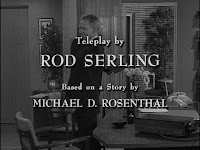
In collaboration with University of Wisconsin student Michael D. Rosenthal, McNeely developed the story for the earlier fifth season episode “A Kind of Stopwatch,” scripted by Rod Serling. Although writing for the series did not spark a lasting friendship between the writers, Serling was intrigued by McNeely’s dual career as an academic. McNeely invited Serling to speak at the University of Wisconsin, which Serling accepted. McNeely later recalled that Serling was something of a celebrity at the time and lectured to a sold out crowd at the Union Theatre on campus. In 1963, Serling was contacted by David Knauf, then-director of the University of Wisconsin’s Center for Film and Television Research. Serling was inspired by Knauf’s suggestion that students could learn from his writings for television, and Serling donated his voluminous papers and manuscripts to the center. 


Don Gordon (1926-2017) was born Donald Guadagno in Los Angeles and later anglicized his name at the suggestion of a fellow actor. Gordon became known for playing tough guys on both sides of the law in numerous films and television series. He was a close friend of Steve McQueen, appearing alongside him in such films as Bullitt (1968), Papillon (1973), and The Towering Inferno (1974). Gordon was nominated for an Emmy in 1963 for his appearance in a two-part episode of The Defenders. Other television appearances include Alfred Hitchcock Presents, The Outer Limits, Voyage to the Bottom of the Sea, and The Invaders. Gordon previously appeared on The Twilight Zone in the first season episode “The Four of Us Are Dying,” in which he was also shot dead by an elderly father in an ironic, shock ending. 


Gail Kobe (1932-2013), born in Michigan as Gabriella Kieliszewski, makes her third and final appearance on the series. Kobe previously appeared in the first season episode “A World of Difference,” and gave an excellent performance in the fourth season opener “In His Image.” Kobe is equally excellent here in her portrayal of a woman torn between a desire for affection and a loyalty to personal convictions. Kobe was a familiar face on 1960s television, appearing in numerous western and detective series, as well as in episodes of Alfred Hitchcock Presents, The Alfred Hitchcock Hour, and The Outer Limits. Kobe moved behind the scenes in the 1970s, serving as producer on a number of daytime drama series. Kobe received an Emmy nomination for producing Guiding Light, and also served as producer on Return to Peyton Place, The Bold and the Beautiful, and The Edge of Night, a series for which Henry Slesar wrote over one hundred episodes.


Boston-born Vaughn Taylor (1911-1983) is a familiar face on the series, here making his fifth and final appearance on The Twilight Zone. Taylor’s most memorable role on the series is perhaps as the “witch man” Teague in Rod Serling’s adaptation of Manly Wade Wellman’s “Still Valley.” Vaughn also appeared in “Time Enough at Last,” “I Sing the Body Electric,” and “The Incredible World of Horace Ford.” Educated at Northeastern University and a certified public accountant, Taylor found his true calling in acting. He struggled early on, working in radio and repertory companies. Taylor landed small but memorable roles in such films as Cat on a Hot Tin Roof (1958) and Psycho (1960). Taylor was a hugely prolific television actor, beginning in the live anthology era. He also appeared on Tales of Tomorrow, Lights Out, Inner Sanctum, Boris Karloff’s Thriller, The Alfred Hitchcock Hour, and The Outer Limits.


J. Pat O’Malley (1904-1985), the British-born actor, appeared in four episodes of the series, most memorably as Old Ben in Charles Beaumont’s “The Fugitive.” O’Malley also appeared in “The Chaser” and “Mr. Garrity and the Graves.” O’Malley is often confused with American actor Pat O’Malley (Patrick H. O’Malley (1890-1966)), who also appeared multiple times on the series. The American O’Malley appeared in “Walking Distance,” “Back There,” and “Static.” Ironically, the American O’Malley’s daughter, Kathleen O’Malley (1924-2019), who often worked with director Don Siegel, appears in the episode as the nurse alongside J. Pat O’Malley. Kathleen O’Malley also appeared in The Alfred Hitchcock Hour episode “The Thirty-First of February,” scripted by Richard Matheson from the novel by Julian Symons.


 Douglass Dumbrille (1889-1974), whose acting career began in the silent era, plays rich, old Mr. Halpert. He was known for his roles as historical figures, often of a villainous nature, in such films as The Ten Commandments (1956), as well as his occasional turns as the comedic foil in slapstick films.


Doug Lambert (1936-1986), a role player in such films as Scorpio (1973), Mooonraker (1979), and The Hunger (1983), plays the young and naïve bellboy Albert.

The episode also includes an appearance by a young, uncredited Seymour Cassel (1935-2019), seen here in aging makeup. Cassel was a staple of independent cinema remembered for his appearances in films by his friend John Cassavetes. He was nominated for an Academy Award for Best Supporting Actor for Cassavetes’ Faces (1969). Cassel also appeared alongside Casavetes in director Don Siegel’s remake of Hemingway’s The Killers (1964), a film that also featured Kathleen O’Malley and Ted Jacques.


Director Don Siegel (1912-1991), previously profiled in our review of “Uncle Simon,” was best-known for directing Invasion of the Body Snatchers (1956) and for his collaborations with Clint Eastwood, including Dirty Harry (1971) and Escape from Alcatraz (1979). Siegel also directed The Shootist (1976), John Wayne’s final film.


While “The Self-Improvement of Salvadore Ross” lacks the enduring qualities of the finest episodes, the excellent performances and the depth of the characters elevate the episode above its relatively minor flaws. Don Gordon, in particular, crafts one of the more repugnant characters on the series, and his brutal demise retains its shock value, ensuring the episode remains a solid, if unremarkable, entry in the uneven fifth season.

Grade: C

Next Time in the Vortex: A look at a dystopian classic from writers Charles Beaumont and John Tomerlin: “Number 12 Looks Just Like You.”

Acknowledgements:

--A Critical History of Television’s The Twilight Zone, 1959-1964 by Don Presnell and Marty McGee (McFarland & Co., 1998)
 
--The Twilight Zone: Unlocking the Door to a Television Classic by Martin Grams, Jr. (OTR, 2008)
 
--The Twilight Zone Companion (3rd ed.) by Marc Scott Zicree (Silman-James, 2018)


--Commentary by Martin Grams, Jr. for "The Self-Improvement of Salvadore Ross" (The Twilight Zone: The 5th Dimension (CBS DVD/Image Entertainment, 2014))
 
--“Jerry McNeely” Television Academy (televisionacademy.com)
 
--“Obituary: Jerry McNeely” by Stephen Bowie (The Classic TV History Blog (classictvhistory.wordpress.com))
 
--“The Self-Improvement of Salvadore Ross” by Henry Slesar (The Magazine of Fantasy and Science Fiction, May, 1961)
 
--The Internet Movie Database (imdb.com)
 
--Wikipedia (Wikipedia.org)


Notes: 

--Henry Slesar’s story first appeared in the May, 1961 issue of The Magazine of Fantasy and Science Fiction.
 
--Jerry McNeely, in collaboration with Michael D. Rosenthal, provided the story for the earlier fifth season episode “A Kind of Stopwatch.”
 
--Don Siegel also directed the earlier fifth season episode “Uncle Simon.”
 
--Don Gordon also appeared in the first season episode “The Four of Us Are Dying.”
 
--Gail Kobe also appeared in the first season episode “A World of Difference,” and the fourth season episode “In His Image.”
 
--Vaughn Taylor also appeared in the first season episode “Time Enough at Last,” the third season episodes “Still Valley” and “I Sing the Body Electric,” and the fourth season episode “The Incredible World of Horace Ford.”
 
--J. Pat O’Malley also appeared in the first season episode “The Chaser,” the third season episode “The Fugitive,” and the later fifth season episode “Mr. Garrity and the Graves.”
 
--“The Self-Improvement of Salvadore Ross” was adapted as a
Twilight Zone Radio Drama starring Luke Perry.

-JP

Friday, December 31, 2021

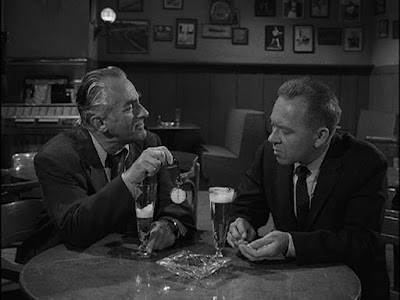
"A Kind of a Stopwatch"


Patrick McNulty (Richard Erdman) receives a gift
from his new friend, Mr. Potts (Leon Belasco)


“A Kind of a Stopwatch”
Season Five, Episode 124
Original Airdate: October 18, 1963


Cast:

Patrick Thomas McNulty: Richard Erdman
Joe: Herbie Faye
Potts: Leon Belasco
Secretary: Doris Singleton
Mr. Cooper: Roy Roberts
Charlie: Richard Wessel
Bar Room Patron: Ken Drake
Attendant: Ray Kellogg
Television Announcer: Sam Balter
Frozen man / Close-up shots of McNulty’s hand: Robert McCord

Crew:

Writer: Rod Serling (teleplay based on an unpublished story idea by Michael D. Rosenthal and Jerry McNeely (uncredited))
Director: John Rich
Producer: Bert Granet
Director of Photography: Robert Pittack, a.s.c.
Production Manager: Ralph W. Nelson
Art Direction: George W. Davis, Walter Holscher
Film Editor: Richard Heermance, a.c.e.
Set Direction: Henry Grance, Robert R. Benton
Assistant Director: Charles Bonniwell, Jr.
Casting: Patricia Rose
Music: Van Cleave
Sound: Franklin Milton, Phillip N. Mitchell
Mr. Serling’s Wardrobe: Eagle Clothes
Filmed at MGM Studios

And Now, Mr. Serling:

“Next time on The Twilight Zone, we probe into the element of time and present a very oddball opus entitled ‘A Kind of a Stopwatch.’ We tell the story of a man, a stopwatch, and an incredible deviation to the norm, said norm being the usual twenty-four-hour day, said deviation involving what happens when a stopwatch is pushed and everything stops, not just time. To titillate and intrigue, ‘A Kind of a Stopwatch.’ Next, on Twilight Zone.

Rod Serling’s Opening Narration:

“Submitted for your approval, or at least your analysis, one Patrick Thomas McNulty, who at age forty-one is the biggest bore on Earth. He holds a ten-year record for the most meaningless words spewed out during a coffee break. And it’s very likely that, as of this moment, he would have gone through life in precisely this manner. A dull, argumentative bigmouth who sets back the art of conversation a thousand years. I say he very likely would have except for something that will soon happen to him. Something that will considerably alter his existence, and ours. Now you think about that now because this is, the Twilight Zone.”

Summary:

Patrick McNulty is an irritating motormouth with a penchant for unrealized ambitions. The world would function better if someone simply gave him a chance to fix it. He is despised by both co-workers and acquaintances but seems mostly unaware of this fact. After continuously avoiding his job duties to pitch irrelevant financial schemes to his boss, he is fired.

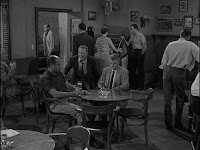
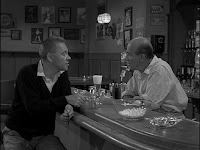
Later, after managing to chase away nearly all of the clientele from his neighborhood bar, McNulty introduces himself to the only person left. Potts, an older man who seems very drunk, gifts McNulty a stopwatch and after a very confusing explanation, gets up and leaves. Joe, the owner of the bar, complains that McNulty repeatedly drives away his customers. As Joe sweeps up for the night, McNulty fiddles with his new gift. Suddenly, Joe freezes. Thinking it’s a gag, McNulty investigates and then looks at the stopwatch. He presses the button and Joe continues sweeping. McNulty presses the button again. Joe’s movements cease. He presses it again and Joe continues. Confused, he decides to leave.

At his apartment later, McNulty continues to test the stopwatch. He clicks the button and his goldfish stops moving. He decides that he simply needs some sleep but when he get ups the next morning he tries it again with the same results. He then walks over to the window and tries the button. Traffic outside stops completely. McNulty now realizes what he has been given.

The next day, McNulty arrives at his old job to show his formers co-workers that he finally has something worthy of their attention. After being told to leave, he clicks the stopwatch and proceeds to rearrange things in the office. Afterwards, McNulty goes to the bar to try to prove his worth but no one takes him seriously there either. He clicks the watch and the world stops. He attempts to give the bar patrons the same treatment he gave his co-workers but his hijinks go mostly unnoticed.

Testing the limits of his new authority, McNulty decides to rob a bank. As he wheels a mountain of cash towards the front door, he loses his grip on the stopwatch and it falls to the ground. He picks it up and clicks it repeatedly but nothing happens. The people in the bank remain frozen. Stunned, he races to the office, and then to the bar, but finds the same situation everywhere he goes. Everyone is silent. Everything is still. The world has simply stopped. Patrick McNulty, the conversationalist, is now the sole inhabitant of a lifeless planet.

Rod Serling’s Closing Narration:

“Mr. Patrick Thomas McNulty, who had a gift of time. He used it and misused it, and now he’s just been handed the bill. Tonight’s tale of motion and McNulty, in the Twilight Zone.”

Commentary:

“A Kind of a Stopwatch” is the fourth episode of the show’s final season and, while an enjoyable one, it is certainly flawed and feels like a bit of a let-down after the three stellar episodes that precede it. It’s premise, already a well-worn narrative of the genre when this episode first aired, is instantly predictable and altogether uninteresting, with a plot that frequently ignores logic. However, because of its well-executed twist ending, it has become one of the more memorable episodes from the show’s final season. It has been spoofed on The Simpsons, Futurama, Johnny Bravo, Wings, and numerous other television programs and its premise was recycled for the debut episode of the 1980’s revival series of The Twilight Zone in the segment “A Little Peace and Quiet.” It is also one of several episodes referenced by Dan Aykroyd and Albert Brooks during the prologue of Twilight Zone: The Movie (1983)—it is, in fact, the episode that Brooks mistakenly insists is an episode of The Outer Limits. It’s an episode that has become an iconic part of the show but its origins went somewhat unknown for decades.

In the early sixties, Michael D. Rosenthal was a student at the University of Wisconsin. One of his professors was a young screenwriter named Jerry McNeely. McNeely sold his first script, “The Staring Match,” to Studio One in 1957 and by the time that “A Kind of a Stopwatch” aired he had seen a dozen or so of his scripts made into episodes of various television series including Dr. Kildare, for which he eventually wrote ten episodes. Unusual for the time, McNeely chose to remain a faculty member in the university’s speech department even though he was achieving success as writer, sending in scripts through the mail and taking the occasional trip to Los Angeles to meet with agents and producers. One day in class Rosenthal pitched McNeely an idea about a stopwatch that could stop time and restart it again with the simple click of a button. Not an earth-shattering premise but one that McNeely thought that he could sell to a television series. So he pitched it to his agent with the insistence that Rosenthal receive the onscreen credit if they were able to land a sale. His agent knew Rod Serling and thought it would be well-received on The Twilight Zone so McNeely wrote a five paragraph synopsis and Bert Granet agreed to buy it for Cayuga Productions.

This is Rosenthal’s only credit as a writer and for many years no one knew exactly who he was. Many assumed it was a pseudonym. Jerry McNeely went on to a successful career in television, writing scripts for numerous television series and later creating the ABC series Owen Marshall, Counselor at Law. He was also nominated for an Emmy for penning the CBS drama Something for Joey in 1977. While McNeely declined screen credit for “A Kind of a Stopwatch,” he did use the interaction to get on the radar of Serling and company who then hired him to adapt the Henry Slesar story “The Self-Improvement of Salvadore Ross” which aired later in the fifth season.

McNeely’s original one-page story, reprinted in full in Martin Grams, Jr.’s The Twilight Zone: Unlocking the Door to a Television Classic (OTR, 2008), differs from the episode in many ways and Serling wrote numerous drafts of the script before arriving at the story that everyone now knows. In McNeely’s version, a man buys a second-hand chronometer from a pawnshop. After discovering that the stopwatch mechanism is broken, he tinkers with it and manages to fix it only to discover that he can stop the flow of time with the click of a button. At first, he uses it to seek petty vengeance on the people who have wronged him in the past. Then he gets the idea of robbing a bank. His plan is to stop time and drive from New York to California, rob a very large, prominent bank, and then drive back to New York and restart time. His reasoning, of course, is that the money can never be traced to him and if it is he can easily prove that he was in New York the entire time. His long trip across an America suspended in time proves to be boring and lonely and he begins to miss civilized conversation. After the robbery proves successful, he decides that he will place himself into a position of political power. However, before he can achieve his goal he drops the stopwatch while time is suspended and it breaks into several dozen pieces.

Serling keeps many elements of McNeely’s treatment but fleshes it out into a full episode, making McNulty a motor mouth and filling the script with clever dialogue. Serling’s greatest achievement here isn’t the twist ending itself, which is both incredibly predictable and also highly reminiscent, both visually and thematically, of season one’s “Time Enough at Last” in which Burgess Meredith plays a bookworm who just wants peace and quiet so he can read and then ends up shattering his bifocals after an atomic bomb wipes out most of humanity. The script’s greatest strength is the abrupt tonal shift from a light, whimsical comedy to something much darker. Although the audience never really hates Patrick McNulty, thanks mostly to Erdman’s performance, they certainly never sympathize with him, at least not until the final few moments of the episode. The sixty seconds or so where the audience witness Erdman's cries to the universe for help are quite moving and leave the audience with a feeling of empathy for a character that exists, for most of the episode, as a comedic punching bag.

The main flaw in Serling’s script is found in the character of Potts and the ambiguous origins of the magical stopwatch. McNeely’s synopsis sees the main character purchase a used stopwatch at a second-hand store, having never seen it before, which is really the perfect origin story. It renders the stopwatch completely anonymous and ignores any explanation about where it came from or how it acquired its magical features. It simply exists. As far as the audience is aware, no other living person knows about it. Serling apparently felt the need to give the stopwatch some kind of an origin so he created Potts, the inebriated man in the bar whom McNulty buys a drink. Often, in stories of a similar likeness, stories where one person is given a magical trinket or such by another person, like the potion in season one’s “The Chaser” or even the genie’s wishes in season two’s “The Man in the Bottle,” the giver of the trinket is clearly aware of the ominous nature of the gift and what can happen to its owner when it is abused. Serling appears to deliberately forgo this trope here as Potts seems to have no knowledge of the stopwatch’s supernatural abilities. He simply says that it is a family heirloom, which makes the plot of the story questionable. Has the stopwatch always had magic powers or is this a new development? And if it has, why doesn’t Potts know about it? Surely, he pressed the button on the stopwatch at least once, just to see if it worked, even if it has been in his possession only a short time. Or if the ability to stop time with the stopwatch is exclusive to McNeely for some reason then what is the reason? On top of all this, Potts utters a string of random, dated references that leave the viewer puzzled as to both their meaning and their purpose in the story.

When McNulty greets his new friend he asks him, “What do you know, what do you say?” Potts responds with three phrases. The first thing he says is “fifty-four forty or fight,” which was a well-known political slogan coined by President James K. Polk while running for office in 1844. It refers to the United States’ dispute with the British over the area of land which now makes up Oregon, Washington, and Idaho. He then says “Damn the torpedoes, full speed ahead,” a very famous military command given by United States Navy Admiral David Farragut in 1864 during the Battle of Mobile Bay in the American Civil War. His final greeting is “It takes a heap of living to make a house a home,” a line taken from the poem “A Heap o’ Livin” (1916) by Edgar A. Guest, a hugely popular American poet during the first half of the century. Potts later references Abner Doubleday, a Union Army Major General during the Civil War who is often credited with having invented baseball.

These references were all at least fifty years old when this episode aired in 1964 and, as far as can be determined given the conversation that follows, are all completely random and contain no insight into who Potts is or where the stopwatch came from. Serling’s intention with these phrases is likely to imply that Potts, who has a very noticeable Russian accent, has immersed himself in American history and culture in order to adjust to his new home. The scene’s ambiguity does give Potts and the stopwatch an added layer of mysticism but, ultimately, something is lost in translation from page to screen. It feels like Serling was a bit uncertain with this character and it only adds to a tapestry of flaws throughout the episode.

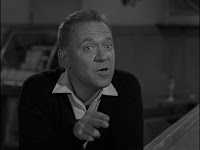
If “A Kind of a Stopwatch” has a saving grace aside from its effective ending, it is the sheer likability of its leading man, Richard Erdman, who gives a brilliant comedic performance as the unfortunate Patrick McNulty. This was Erdman’s only appearance on The Twilight Zone but several years earlier he appeared in the Robert Parrish western Saddle the Wind (1958), for which Serling wrote the screenplay. Erdman was signed to a contract with Warner Brothers while still a teenager and his career as an actor spanned over seven decades. He was often cast in comedic roles as rowdy sailors or awkward outcasts, similar to the role he plays here, although a number of his well-known roles were as serious characters. Probably his most well-known film role was as the American P.O.W. squad leader in Billy Wilder’s masterful World War II film, Stalag 17 (1951). Other notable film roles include Fred Zinnemann’s The Men (1950), Robert Parrish’s Cry Danger (1951), Fritz Lang’s The Blue Gardenia (1953), and the World War II film Tora! Tora! Tora! (1970). The last decade of his career saw a renewed interest from the public when he was cast as elderly college student Leonard in the massively successful television series Community.

His performance here is impressive mostly because of McNulty’s complete and total lack of social awareness but also because he remains in motion for much of the episode, giving an otherwise dull story a continuous surge of energy. McNulty is repeatedly insulted throughout the episode by almost everyone he comes into contact with and the audience is led to believe that he is either totally oblivious to their contempt for him or he simply doesn’t care, a line Erdman tiptoes remarkably well. This causes McNulty to bounce from character to character vying for the attention of anyone who will listen, a device that would tire easily in the hands of a lesser actor but Erdman takes a well-measured approach and even manages to make McNulty sort of likable. According to Erdman, McNulty speaks so quickly and has so much dialogue in this episode that he was still memorizing pages of the script between each take.

The supporting cast here is a mix of fairly recognizable performers from the golden age of television. Herbie Faye, who plays Joe the bartender, appeared as Cpl. Sam Fender on four seasons of The Phil Silvers Show and again on The New Phil Silvers Show. He also appeared in the 1962 film version of Rod Serling’s Requiem for a Heavyweight where he also plays a bartender. Doris Singleton is probably best remembered for her appearances on I Love Lucy and several other Lucille Ball programs. She also had a reoccurring role on My Three Sons. Russian actor Leon Belasco enjoyed a highly prolific career that spanned over half a century. He had small roles in a handful of major films including Casablanca (1942), Holiday Inn (1942), Yankee Doodle Dandy (1942), Son of Ali Baba (1952), and The Art of Love (1965). A lifelong musician, he was often cast as band leaders or solo musicians as well as numerous shop owners, waiters, or hotel attendants. Roy Roberts also had a long career as an actor appearing in many western and war films. His notable film roles include My Darling Clementine (1946), He Walked by Night (1948), House of Wax (1953), and Chinatown (1974). He also had reoccurring roles on several television series including Oh! Suzanna, McHale’s Navy, The Beverly Hillbillies, Petticoat Junction, and Gunsmoke. And, finally, the voice of the television broadcaster here is that of basketball player turned famed sportscaster Sam Balter.

This was the second and final episode of The Twilight Zone for director John Rich. Rich also directed the season two episode “A Most Unusual Camera,” another story that concerns supernatural gadgetry. Rich began his career at the dawn of television directing episodes for many of the live anthology dramas of the time, eventually working his way into episodic television in the late fifties. Today he is remembered for his work on The Dick Van Dyke Show and All in the Family, both of which earned him Primetime Emmy Awards. In the 1980’s he formed a television production company with friend Henry Winkler called, appropriately, Henry Winkler/John Rich Productions where they were executive producers for the CBS series MacGyver. He also directed numerous episodes of Gunsmoke, Bat Masterson, Where’s Raymond?, Gomer Pyle: USMC, The Brady Bunch, and Benson. His brief career as a feature film director includes the Janet Leigh romantic comedy, Wives and Lovers (1963), the Elvis Presley films, Roustabout (1964) and Easy Come, Easy Go (1967), and the slapstick comedy, Boeing, Boeing (1965), with Tony Curtis and Jerry Lewis.

Not counting the sequences of awkward stock footage that appear at various points throughout the episode, Rich’s direction in “A Kind of a Stopwatch” is really quite good. As we discussed in our reviews for several earlier episodes that feature tableau scenes of motionless characters like season one’s “Elegy” and season three’s “Still Valley,” filming someone or something that is suspended in time is incredibly difficult. No human being can appear perfectly still for more than a few seconds so to counteract their involuntary movements directors often keep the camera in constant motion so the audience doesn’t get a glimpse of someone blinking or twitching. Rich accomplishes this exceedingly well here by simply letting Richard Erdman pace relentlessly through several different scenes while his co-stars stand still around him. The problem with solitary objects is that to make them appear suspended in time, for instance to make a baseball appear frozen in mid-air, directors from this period often had to rely on still photography which is immediately noticeable to the audience. Rich does his best to avoid this but CBS likely favored as many stock images as possible as it was cheaper. In one effective shot during the office scene after McNulty breaks the stopwatch, a tissue is seen suspended in mid-air above a trash can while McNulty remains in motion behind it.

A quick mention should be made of Van Cleave's original score here which adds some much-needed atmosphere to the episode. There are two main pieces of music in this episode, one used to emphasis the audience's view of McNulty's character, that he is laughably unlikable, and another, faster piece used during the scenes in which time is suspended. This second piece is clever as its fast, repetitive pace induces a sense of anxiety in the audience that McNulty will somehow be caught during one of his escapades. The payoff for this comes at the end of the episode when McNulty breaks the stopwatch and the music abruptly stops and both the audience and McNulty are plunged into total silence, giving the audience a sense of the world in which McNulty is now doomed to live.

As noted earlier, the premise for “A Kind of a Stopwatch” was recycled for a segment during the premiere episode of the first revival of The Twilight Zone in September, 1985 called “A Little Peace and Quiet.” The only similarity between the two stories is the notion that one person can stop and start time all by themselves. There is also a visual similarity because both shows feature scenes with actors frozen in place and a lot of creative camera work to make it seem genuine. Also, like the original episode, the ending is an abrupt switch from situational comedy to a genuinely bleak aftermath. Aside from these similarities, the two stories are very different and neither Serling, Rosenthal, nor McNeely receive any on-screen credit nor is the original episode referenced in the later episode at all. Instead, sole writing credit goes to James Crocker, who would later write an updated version of the Charles Beaumont classic “Shadow Play” for the revival’s second season.

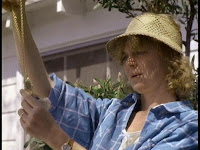
Melinda Dillon and the magic
amulet in "A Little Peace and
Quiet"

In the newer version, directed by the great Wes Craven, Melinda Dillon plays Penny, a housewife and mom of four small children who has grown weary and frustrated at the constant grind of daily life with her loud, needy family. While working in her garden one day she finds a box buried in the ground. Inside the box she finds a gold amulet. Without really questioning how it got there she decides to wear the amulet around her neck. Later that day, she is having an argument with her husband and, out of frustration, yells at him to be quiet. He freezes. Frantic, she tells him to start talking again. He resumes his rant. She tries this several more times with and without the amulet around her neck and discovers that while wearing it she can stop time and start it back up whenever she wants. She immediately uses this to her advantage. She eats breakfast by herself, avoids crowds while shopping, and avoids other annoyances like screaming children and a nagging husband who snores. Throughout the episode she also ignores several news segments warning of possible nuclear warfare with the Soviet Union. At one point, she is even solicited by a nonprofit antiwar group at her front door. She ignores them and uses the opportunity to freeze time and move their immobile bodies away from her house. The comedic tone of the episode changes abruptly when a radio broadcast announces that the Soviets have launched missiles into United States airspace. Nuclear war has been declared and people have only minutes left. Panicked, she freezes time, realizing that she may never see her family again. She walks outside into chaos frozen in time. Hundreds of people are in the streets trying to get to safety. The camera pans up into the night sky—over a movie theatre marquee bearing the titles Fail Safe and Dr. Strangelove—to see a nuclear warhead just a few hundred feet above the ground.

Like the original series episode, the 1985 story has its drawbacks but it also offers a fresh take on a familiar theme. In this episode, Crocker simply flips the situational formula Serling created in the original, a motor mouth who annoys people, to make the hero more sympathetic to the audience and, in turn, cause the ending to feel all the more tragic. Amplifying the tragic ending is the fact that, unlike McNulty, who is unable to cause time to move forward again as a result of his own greed, Penny has to choose between living totally alone, or restarting time and perishing with her loved ones. Add to this the fact that the horrific events have nothing to do with her or the amulet, although Crocker does try hard to make the audience believe that this is somehow the result of her ignoring the repeated signs of impending nuclear warfare throughout the episode. The switch from a stopwatch, which has a very distinct, visible and audible mechanism that lets the audience know when the magic happens, to an amulet necklace, which has no such indicator, is a bit of a let-down. But for the most part, the updated version is pretty good. Melinda Dillon gives a great performance and Craven’s direction is solid the entire way through. There are two large crowd shots with hundreds of extras frozen in place, one a tracking shot at ground level and one on a crane, that are both really impressive. The episode also taps into very real cold war fears that permeated political culture at the time.

While it has become a recognizable episode of the show, “A Kind of a Stopwatch” is not without its flaws or its critics. Limited by a predictable premise, questionable plot elements, awkward stock footage, and a noticeable resemblance to several previous episodes of the show, it simply isn’t strong enough to surprise an audience this far into the show’s run. However, witty dialogue, an impressive balance of tone, and a great performance from its leading man make this episode worthy of at least a viewing or two.

Grade: C

Grateful acknowledgment is made to the following:

The Twilight Zone: Unlocking the Door to a Television Classic by Martin Grams, Jr. (OTR, 2008)

"A Kind of a Stopwatch" episode commentary by Martin Grams, Jr., The Twilight Zone: The Complete Series Blu-ray (Image Entertainment, 2016)

The Internet Movie Database

Washington State Archives

United States Naval Institute

Notes:

--John Rich also directed the season two episode “A Most Unusual Camera.”
--Jerry McNeely also wrote the teleplay for the season five episode “The Self-Improvement of Salvadore Ross,” adapted from a short story by Henry Slesar.
--The debut episode of the 1980’s revival of The Twilight Zone features a segment called “A Little Peace and Quiet” which is loosely inspired by “A Kind of a Stopwatch” although none of the original writers are credited. Instead, sole screen credit goes to James Crocker. It was directed by Wes Craven and stars Melinda Dillon.
--“A Kind of a Stopwatch” was adapted into a Twilight Zone Radio Drama (2002) by writer Dennis Etchison. It stars Lou Diamond Phillips as Patrick McNulty.
--“A Kind of a Stopwatch” is one of several episodes referenced by Dan Aykroyd and Albert Brooks during the prologue of Twilight Zone: The Movie (1983), along with the season one episodes “Time Enough at Last” and “The After Hours.”
--The script for this episode went through so many drafts that two separate versions of it appear in As Timeless as Infinity: The Complete Twilight Zone Scripts of Rod Serling, Vol. Three (Gauntlet Press, 2006; edited by Tony Albarella). The title on both scripts is “A Kind of Stopwatch.”

-Brian