Friday, November 11, 2016

Veterans Day

Spend Veterans Day in The Twilight Zone with this guide to the episodes concerning war and political conflict. To all the brave men and women who have served: Thank you for your service. 

A passenger on an ocean liner during World War II gets the uneasy feeling that the ship is doomed in Rod Serling's eerie thriller, "Judgment Night"


A WWI pilot who fled a chance at heroism is given an opportunity for redemption in Richard Matheson's time travel fantasy "The Last Flight."


A war-weary lieutenant is given the terrible gift of foresight in Rod Serling's melancholy fantasy "The Purple Testament."


A WWII pilot is transported into a nightmare in Rod Serling's unnerving episode, "King Nine Will Not Return."


Two survivors from opposing sides of a world-ending war try and find hope among the ashes in Montgomery Pittman's tense and touching episode "Two."


Two survivors of the Civil War meet at an eerie crossroads in Rod Serling's haunting and dream-like episode "The Passersby."


The sadistic commander of a concentration camp during WWII gets his comeuppance in Rod Serling's frightening revenge tale "Deaths-head Revisited."


Confederate soldiers receive a lesson in war and witchcraft in Rod Serling's adaptation of Manly Wade Wellman's "Still Valley."


A brash young lieutenant is made to understand the value of human life in Rod Serling's affecting WWII fantasy "A Quality of Mercy."


A U.S. naval destroyer intercepts a ghostly signal in Rod Serling's first offering of the fourth season, "The Thirty Fathom Grave."


A regretful father offers the ultimate sacrifice when his son is wounded in Vietnam in Rod Serling's heartbreaking drama, "In Praise of Pip." 

Tuesday, November 8, 2016

"A Quality of Mercy"

Albert Salmi and Dean Stockwell
“A Quality of Mercy”
Season Three, Episode 80
Original Air Date: December 29, 1961

Cast:
Lt. Katell/Lt. Yamuri: Dean Stockwell
Sgt. Causarano: Albert Salmi
Watkins: Rayford Barnes
Hanachek: Ralph Voltrian
Hansen: Leonard Nimoy
Sgt. Yamazaki: Dale Ishimoto
Japanese Captain: J.H. Fujikawa

Crew:
Writer: Rod Serling (based on an idea by Sam Rolfe)
Director: Buzz Kulik
Producer: Buck Houghton
Production Manager: Ralph W. Nelson
Director of Photography: George T. Clemens
Art Direction: George W. Davis, Phil Barber
Set Decoration: H. Web Arrowsmith
Assistant Director: E. Darrell Hallenbeck
Casting: Stalmaster-Lister
Editor: Jason H. Bernie
Sound: Franklin Milton and Bill Edmondson
Music: Stock

And Now, Mr. Serling:
“Next week Mr. Dean Stockwell makes his journey into the Twilight Zone, playing the role of a platoon lieutenant on Corregidor during the last few hours of World War Two. What happens to him provides the basis of a weird and yet we think haunting excursion into the shadowland of imagination. On the Twilight Zone next week Mr. Dean Stockwell stars in ‘The Quality of Mercy.’” *
*In his preview narration Rod Serling clearly states the title of the episode as “The Quality of Mercy” rather than “A Quality of Mercy,” the latter of which is the title of the play as displayed during its broadcast. The Shakespeare quote from which Serling borrows the title begins “The quality of mercy. .  .”

Rod Serling’s Opening Narration:

“It’s August, 1945, the last grimy pages of a dirty, torn book of war. The place is the Philippine Islands. The men are what’s left of a platoon of American infantry, whose dulled and tired eyes set deep in dulled and tired faces can now look toward a miracle; that moment when the nightmare appears to be coming to an end. But they’ve got one more battle to fight and in a moment we’ll observe that battle. August, 1945, Philippine Islands. But in reality it’s high noon in the Twilight Zone.”

Summary:
            It is August 6, 1945, and on the island of Corregidor in Manila Bay a group of war-weary American infantrymen are positioned on a ridge overlooking a cave in which some two dozen sick and wounded Japanese soldiers are holed-up. The American infantry is observing for a mortar company that is attempting to force the Japanese soldiers into surrender by use of explosives. It is not going well. The war is all but decided in favor of the Allied Forces and still this group of Japanese soldiers refuses to give up. The infantrymen fervently hope they will not be called upon to storm the cave on foot and risk senseless bloodshed.

            Lieutenant Katell soon arrives to take control of the situation. Katell is young, clearly inexperienced, and overly eager to prove his worth as a commanding officer through the unnecessary killing of the Japanese soldiers trapped in the cave. Katell is unsympathetic to the weariness of the other American soldiers and quickly puts together a plan to storm the cave and kill the Japanese soldiers despite the protestations from the infantrymen. His bloodthirst and foolish eagerness borders on lunacy at this point in the conflict, and Sargent Causarano informs Katell that they could easily bypass any conflict with the Japanese soldiers in the cave without it affecting the outcome of the war in the least way. Katell does not care to hear about avoiding conflict with the Japanese. He is going to treat this day as though it were the first day of the war.
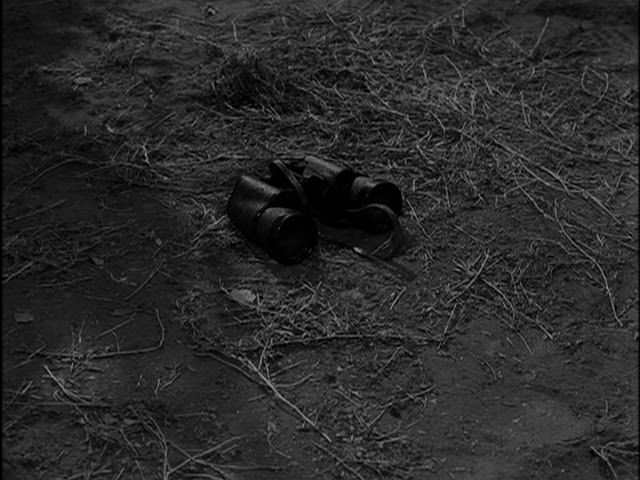
            Katell drops his binoculars. A subtle change is felt and he stoops to retrieve them. Katell discovers that it is now daytime and he is surrounded by Japanese soldiers. What Katell cannot see is that he too is a Japanese soldier by all appearances. He panics and takes off running toward an open area near the mouth of a cave. Gunfire halts his progress and he hides behind a rock. He sees an American firing at him from the entrance of the cave.
            Katell is told that he is Lieutenant Yamuri and that it is May 4, 1942. The Japanese are preparing to storm the cave and overtake the group of wounded Americans that have taken refuge there. The commanding officer believes
Katell/Yamuri has lost his nerve when the young lieutenant attempts to dissuade the captain from attacking the weakened Americans trapped in the cave. The captain tells Katell/Yamuri the same thing Katell told the American soldiers. There will be no mercy.
          Again, Katell/Yamuri drops his binoculars and finds himself back in 1945 with the American company. The company receives word that the Americans have dropped an atomic bomb on Hiroshima. There is now no need to attack the Japanese soldiers in the cave, much to Katell’s relief in light of his newfound perspective.        

Rod Serling’s Closing Narration:
“‘The quality of mercy is not strain’d. It droppeth as the gentle rain from heaven upon the place beneath. It blesseth him that gives and him that takes.’ Shakespeare, Merchant of Venice. But applicable to any moment in time, any group of soldiery, to any nation on the face of the Earth. Or, as in this case, to the Twilight Zone.”

Commentary:

            It is obvious to regular viewers of the series that Rod Serling found the theme of war well suited to exploring the particular type of moral allegory he found appealing as a writer. Stories of war were a constant and integral part of the series and the theme was explored in a wide range of efforts from the Civil War (“Still Valley,” “The Passersby”) to tales of futuristic warfare (“Two”). Though other writers for the series dabbled in war themes (Richard Matheson’s “The Last Flight” and Montgomery Pittman’s “Two”), the vast majority of war episodes were penned by Serling. The Second World War in particular was the conflict of most concern, being fresh in the minds of both the viewing audience and the show’s creators, many of whom found themselves thrust into military service at the time of the conflict.
            “A Quality of Mercy” is the second Rod Serling episode to explore the Pacific Theater of the Second World War and, more specifically, to examine the emotional and physical toll war takes from a soldier. The first season episode “The Purple Testament” was another Serling offering with a similar setting and theme which was boosted by a haunting performance from William Reynolds as a lieutenant that can foresee the deaths of other soldiers by way of a ghostly light which illuminates their faces shortly before death.  With “A Quality of Mercy,” Serling is exploring much of the same ground in a new and interesting way, one which connects his efforts in this mode all the way back to his 1958 play “The Time Element.”  
            “A Quality of Mercy” is boosted by an excellent cast, especially in the form of Albert Salmi as the war-weary Sargent Causarano who desires nothing more than to see the end of the conflict, and Dean Stockwell as the brash young lieutenant. Salmi is the avatar for Serling himself in the episode. Serling was a strong supporter of the war effort while still in high school and immediately enlisted upon graduating, going against the advice of one of his teachers. It would quickly become apparent to his commanding officers that Serling was too sensitive a person to be considered a “good” soldier (i.e. a soldier that could put his emotions away long enough to kill without thought of the action).
            Serling spent three years in the 11th Airborne Division of the Army, from 1943 until his discharge in 1946. Serling took up the hobby of boxing while training in Georgia as part of the 511th Parachute Infantry. His company headed to the Pacific Theater aboard the U.S.S. Pike in 1944. Serling saw combat in November of that year not as a paratrooper but as a member of light infantry. Serling was transferred to the demolition platoon of the 511th due in part to his commanding officer’s belief that Serling’s temperament was unfit to make a good soldier. It was while serving in this capacity that Serling experienced the horrifying accidental death of a close friend when a supply crate fell upon the unaware soldier. It was an incident which clearly illustrated to Serling the absurd and senseless nature of a death in war.  
            Despite the image of Serling as an unsuitable soldier, he was twice wounded before deploying to Tagaytay Ridge in 1945 to march on Manila. After a month, the Americans reclaimed the city and began a celebration with local inhabitants. It was during one such celebration that the celebrants came under fire from Japanese artillery which Serling braved in order to save a performer. Serling’s cumulative actions while serving would yield him the Purple Heart, Bronze Star, and Philippine Liberation Medal by the time of his discharge in 1946.  
            Serling clearly related to both the William Reynolds character from “The Purple Testament” and the Albert Slami character in “A Quality of Mercy” in that both characters are emotional and weary soldiers that paint a completely opposite image from the largely propaganda-based image of a trigger happy, cigar chewing American soldier of the time. Serling’s soldiers are sensitive, intelligent, and possess individual personalities. An air of doom surrounds all of Serling’s war episodes, undoubtedly influenced by Serling’s own harrowing experiences during the war. It is interesting to note as well that both of the aforementioned episodes are stories of transition, and not only from life to death or from war to peace. They are stories about internal transitions and transformations in which one is forced to see within another and experience the world through another's eyes. The war was a time of ultimate transformation for Serling, from a child into a man, from innocence to experience, and it signaled the death of childhood in many ways. When Serling came home from war, his father, Stanley, was gone, dead of a heart attack in 1945. Once opportunity his stint in the armed forces did afford is the opportunity to get an education. Serling enrolled in Antioch College in Yellow Springs, Ohio on the G.I. Bill and, after briefly studying for a career in physical education, refocused his attentions on writing and literature. Serling had written since an early age and wrote dramatic material for the Armed Forces Radio Network during the war. 
            Albert Salmi, here portraying Sargent Causarano, has become a recognizable face from the series, having previously appeared as a murderous cowboy in Rod Serling’s adaptation of George Clayton Johnson’s “Execution” from the first season. Salmi would also have a meaty role as a ruthless and jaded business tycoon in the fourth season episode “Of Late I Think of Cliffordville,” Rod Serling’s adaptation of Malcolm Jameson’s short story “Blind Alley.” Salmi began acting on stage, making it to Broadway by the mid-50s, and would establish himself as one of the more prolific character actors of his generation. Salmi suffered from alcoholism and clinical depression and tragically killed his estranged wife before turning the gun on himself in 1990 at the age of 62.
            Of course, the star of the episode is Dean Stockwell, well-known to science fiction fans as Al Calavicci from Quantum Leap (1989-1993), an engaging time-travel series which owes much to The Twilight Zone in general and episodes such as “A Quality of Mercy” in particular. A Hollywood native, Stockwell has been acting since he was a child on contract to MGM. For many years he retained a youthful appearance which leant itself to his portrayals of inexperienced characters which find themselves in over their heads. Earlier in 1961, Stockwell starred as just such a character in one of the finer offerings of Alfred Hitchcock Presents, the sixth season episode “The Landlady,” scripted by Robert Bloch from the story by Roald Dahl and directed by Hitchcock himself.
            Ironically, Stockwell was initially considered for the lead role in “The Purple Testament” and was forced to bow out due to a scheduling conflict. Producer Buck Houghton and Serling thought highly enough of Stockwell to bring him back for “A Quality of Mercy,” an episode very similar in tone and content. In the latter episode, however, Stockwell would be required to play an entirely different type of character from William Reynold’s emotionally weary lieutenant. Stockwell brought an effective verisimilitude to his portrayal of the inexperienced, brash young lieutenant eager to prove his worth by inflicting pain and death. The story is almost too big for the constricted time frame of the episode and both Salmi and Stockwell are forced to established believable characterizations in a very short amount of time.
            A greater challenge to Stockwell was to portray a Japanese soldier, which he accomplishes with surprising sensitivity due in part to the subtle yet effective makeup which completes his transformation. Stockwell’s character goes back in time through a non-mechanized mode of time travel (similar to that seen previously in the Civil War-era episode “Back There”) to May 4, 1942, the day before the Battle of Corregidor, a battle which allowed the Japanese to take control of the island in order to have access to the harbor at Manila Bay. The purpose of Stockwell’s trip is, of course, to allow the bigoted American lieutenant to experience a situation not only from the other side of the conflict but one which elicits an emotional response within him. By displaying passion to save American lives he learns the lesson that all life, even in war, is of value. Serling was never one to shy away from a controversial topic and this episode much have struck a chord with audiences of the time.
            Having learned his lesson, the lieutenant is brought back to August 6, 1945 and news that the Americans have dropped an atomic bomb on the Japanese city of Hiroshima, effectively ending any need of further engagement with Japanese soldiers. America would drop another atomic bomb, this time on the city of Nagasaki, on August 9. The Japanese surrendered six days later. It is interesting that Serling chose to have the decision of whether or not to attack the helpless Japanese soldiers taken out of the lieutenant’s hands. Though it is clear he has a newfound outlook on life after his time travel experience, it would perhaps have been more impactful for the lieutenant to call off the attack rather than be saved by the deus ex machina ending Serling chose to cap the episode. The unusual choice doesn’t spoil the effectiveness of the episode, however.
            One aspect of the episode that is highly effective is the setting, a lush jungle that is convincingly vast in scope. According to multiple sources, the jungle set on “A Quality of Mercy” was filmed at the Hal Roach Studios in Culver City, California. The studio was torn down just a couple years after the filming of the episode. Roach was a producer from New York who moved to Hollywood in 1912 and used an inheritance to begin a film production company during the silent era. Roach became famous as the producer of the Laurel and Hardy and The Little Rascals series of films.
            Sam Rolfe, who provided Rod Serling with the idea for “A Quality of Mercy,” was an accomplished screenwriter beginning in the early 1950s who soon moved into television, co-creating the long running western Have Gun-Will Travel (1957-1963) and contributing both conceptually and in actual script production for the first season of The Man from U.N.C.L.E. (1964-1968).
            It has been suggested in some writings that “A Quality of Mercy” was the basis for “Time Out,” the first segment of Twilight Zone: The Movie. The segment was directed by John Landis and concerns a racist (Vic Morrow) who is sent back in time to experience the plight of the oppressed in areas such as Nazi Germany, the American South, and Vietnam. Although the two segments contain similarities, there is no evidence that Landis, who scripted “Time Out,” was directly influenced by “A Quality of Mercy.” No credit to Rolfe is given in the film and it is the only segment of the film which is not a direct remake of an episode of the original series. As is well documented, Vic Morrow, along with two child actors, was killed while filming “Time Out.” The scene was to show the racist character save two Vietnamese children and thus redeem himself. An explosive special effect ignited a close-flying helicopter which then spun out of control and crashed down into the water on top of Morrow and the children, killing all three. The accident resulted in a prolonged trial which eventually exonerated John Landis from any wrongdoing. Landis used a more downbeat ending from existing footage which changes the tone of the segment.
            In all, “A Quality of Mercy” may be the finest war episode produced on the series, with its sensitive script, strong cast, and excellent sets, it remains a reminder that the show still had some gas left in the tank when it came to producing original and engaging content. It would be remiss to not mention Leonard Nimoy’s part in the episode. Nimoy is seen here in an early role as Hansen, the radio operator, who is given a single line of dialogue. Nimoy will forever be famous for his portrayal of science officer Spock on the original series of Star Trek (1966-1969).

Grade: B

Grateful acknowledgement is made to Military.com for information on Rod Serling's military career. 

Thanks also to authors Marc Scott Zicree and Martin Grams, Jr. for the information on the connection to the Hal Roach Studios. 

Notes:

-“A Quality of Mercy” was directed by Buzz Kulik, who also directed d 8 additional episodes, including “A Hundred Yards Over the Rim” and “A Game of Pool.”

-Albert Salmi also appeared in the first season episode “Execution” and in the fourth season episode “Of Late I Think of Cliffordville.” He appeared in the episode of Rod Serling's Night Gallery titled "The Waiting Room."

-J.H. Fujikawa also appeared in the third season episode “To Serve Man.”

-Dean Stockwell also appears in an episode of Rod Serling's Night Gallery titled "Whisper."

-Leonard Nimoy also appears in an episode of Rod Serling's Night Gallery titled "She'll Be Company for You." 

-“A Quality of Mercy” was adapted as a Twilight Zone Radio Drama starring Robert Knepper.

-The title is taken from William Shakespeare's 1599 play The Merchant of Venice. The quote can be found beginning on line 184 of Act IV, scene i. The dialogue is delivered by the heroine of the play, Portia. 

--Jordan Prejean          


Monday, October 31, 2016

The Twilight Zone Vortex 2016 Halloween Countdown #1: "Nightmare at 20,000 Feet"

The Twilight Zone excelled in telling tales of terror, exploring the darkest aspects of human existence in myriad ways. To celebrate the Halloween season, we’re counting down the 31 most frightening and unsettling moments from The Twilight Zone, one for each day of October. We’ll be revisiting some of the episodes we’ve already covered and looking ahead to episodes from the final three seasons of the series.                                                                                                                                    -JP

Happy Halloween! Here's our top moment of terror from the series!


#1 - There’s Something on the Wing, from “Nightmare at 20,000 Feet,” season five, episode 123
Written by Richard Matheson, directed by Richard Donner, starring William Shatner, Christine White, Nick Cravat

The most frightening and unsettling moment of The Twilight Zone occurs in Richard Matheson’s fifth season masterpiece, “Nightmare at 20,000 Feet,” which finds William Shatner playing Bob Wilson, an air passenger recovering from a mental breakdown who has the misfortune of witnessing a gremlin tampering with an engine on the airplane. Of course, no one believes there really is a gremlin on the wing of the airplane and Wilson is forced to take desperate measures to ensure the safety of the passengers. Over and again, the series presented stories in which individuals are isolated due to their experience of a preternatural event and “Nightmare at 20,000 Feet” is perhaps the finest example of this type of episode. The dynamic which propels the story forward is similar that found in “Living Doll.” It is the psychological element which contrasts the manner in which other characters perceive Wilson’s mental state against what is actually happening. Also like “Living Doll,” Matheson includes the character of a wife (missing from Matheson’s original short story) who seems to exist in the episode only to look incredulous at each passing moment. To the credit of actress Christine White, she uses very expressive body language to convey the dilemma in which she finds herself. William Shatner’s performance may well be the finest ever showcased on the series. Because of the extreme nature of the character, it is a performance easily parodied, and the episode itself has served as comedic fodder for countless films and television series. William Tuttle’s makeup design has lost some of its effectiveness yet remains an iconic image from the series. The camera work of director Richard Donner and director of photography Robert W. Pittack is exceptional here, especially the framing shot capturing the horrified expressions on the faces of Wilson’s wife and others crowded in the aisle after Wilson opens the emergency exit. The episode is crowned with a clever ending that finds Wilson, in a rare moment for the series, breaking the fourth wall and speaking directly to the audience. 

Trivia:
           
-Matheson’s original story appeared in the paperback anthology Alone by Night: Tales of Unlimited Horror (Ballantine, Jan, 1962). Matheson placed a second story in the anthology, “The Likeness of Julie,” under the pseudonym Logan Swanson. “The Likeness of Julie” was later adapted by Matheson’s friend William F. Nolan as the first of three segments in Dan Curtis’s 1975 horror anthology television film Trilogy of Terror. Alone by Night was edited by Michael and Don Congdon, the latter of whom was Matheson’s literary agent.
           
-“Nightmare at 20,000 Feet” was reimagined for the 1983 feature film Twilight Zone: The Movie, written by Richard Matheson (with additional material by George Miller), directed by George Miller, starring John Lithgow.
           
-“Nightmare at 20,000 Feet” is perhaps the most parodied of any episode of the series. A long list of instances of parody can be found on the episode’s Wikipedia page.

-If that’s not enough spooky Twilight Zone for you, here are a few more unsettling episodes we really enjoy which just missed out on the countdown. 

“Where is Everybody?”
“The Sixteen Millimeter Shrine”
“The Monsters are Due on Maple Street”
“A World of Difference”
“Shadow Play”
“Deaths-head Revisited”
“Spur of the Moment”

Sunday, October 30, 2016

The Twilight Zone Vortex 2016 Halloween Countdown #2: "Living Doll"

The Twilight Zone excelled in telling tales of terror, exploring the darkest aspects of human existence in myriad ways. To celebrate the Halloween season, we’re counting down the 31 most frightening and unsettling moments from The Twilight Zone, one for each day of October. We’ll be revisiting some of the episodes we’ve already covered and looking ahead to episodes from the final three seasons of the series. -JP


#2 - Talky Tina Kills, from “Living Doll,” season five, episode 126
Written by Jerry Sohl (credited to Charles Beaumont), directed by Richard C. Sarafian, starring Telly Savalas, Mary LaRoche, Tracy Stratford, June Foray (voice of Talky Tina)

“Living Doll” is the pinnacle of the type of grim fantasy story the series frequently turned to during its final season. Though tales of terrible dolls were prominent by the time “Living Doll” was broadcast, Jerry Sohl’s story of an abusive, insecure man’s feelings of inferiority mirrored by a malevolent doll set the standard for many subsequent efforts. The devastating and effective measure used by Sohl is that each seemingly rational action taken by Erich Streator (Telly Savalas) to rid himself of the terrible toy appears to his wife as an irrational act of deliberate hate toward his stepdaughter. The series was always interested in using fantasy to examine marriage ("Nick of Time," “A Piano in the House," “Young Man’s Fancy,” etc.) but here Sohl takes it a step further by placing a child at the center of the conflict. The child seems not malicious in the least, leading the viewer to assume that the malevolent doll responds from some unconscious element of the child’s will or psyche. Even though the toy masquerades as a protector, it is clear that it is either a purely malign influence which happens by chance to have landed in the lives of this divided family or it is a supernatural reflection of the marital and familial strife within the household. 

Such conjecture is largely left unexplored in the twenty-six minute play, which only succeeds in making the episode stronger. It presents itself as a simple story and yet can be interpreted and explored in many ways. Perhaps the episode functions best as the simple story of supernatural persecution it presents itself to be, although many elements of the episode remain disturbingly ambiguous, such as the fact that Erich Streator, though certainly an awful husband and stepfather, is surely undeserving of such a horrible fate. Streator's most appalling actions all center around the doll, leading to a bit of a paradox in that Streator is punished by the doll for the escalating behavior caused by the doll. Sohl seems to hint that it was never simply about punishing Streator when the doll threatens the mother at the close of the episode. The addition of Bernard Herrmann’s exceptional score ensures “Living Doll” a very high place among the most memorable episodes of the series.  

Trivia:
           
-This is one of three episodes ghost-written by Jerry Sohl and credited to Charles Beaumont. Sohl wrote the scripts to help Beaumont honor his writing commitments to the series while Beaumont was suffering debilitating health problems.
           
-Talky Tina was a modified version of the Vogue Doll Company’s Brikette line of dolls. It was modeled on Mattel’s Chatty Cathy line of dolls which could speak a set of phrases when a string on the doll’s back was pulled. June Foray, who voiced Talky Tina, was also the original voice of the Chatty Cathy dolls. 

Saturday, October 29, 2016

The Twilight Zone Vortex 2016 Halloween Countdown #3: "The Howling Man"

The Twilight Zone excelled in telling tales of terror, exploring the darkest aspects of human existence in myriad ways. To celebrate the Halloween season, we’re counting down the 31 most frightening and unsettling moments from The Twilight Zone, one for each day of October. We’ll be revisiting some of the episodes we’ve already covered and looking ahead to episodes from the final three seasons of the series. -JP                                                                                                                               

#3 - The Devil is Released, from “The Howling Man,” season two, episode 41
Written by Charles Beaumont, directed by Douglas Heyes, starring H.M. Wynant, John Carradine, Robin Hughes

“The Howling Man” is writer Charles Beaumont’s masterpiece, a well-designed, expertly directed, character driven tale that manages to encompass themes characteristic of the series while feeling entirely different from any other episode. Beaumont’s story of a lost traveler who unwittingly unleashes the Devil from a remote monastery and ushers in the horrors of the Second World War is as close to a traditional tale of Gothic horror as the series ever came. Everything about the episode is unusual and compelling. Its unique narrative structure sees H.M. Wynant, in convincing aging makeup, tell the story in flashback, cleverly placing it within the oral folk tradition to which it is an homage. The episode is drenched in a Gothic atmosphere typical of 19th century supernatural literature, complete with a raging thunderstorm in a remote quarter of Eastern Europe. The episode also features three compelling performances from H.M. Wynant as the doubting traveler, John Carradine in a wonderfully over-the-top performance as the elderly leader of the monastic order, and Robin Hughes, whose devilish features are expertly used to create ambiguity as to the true nature of the imprisoned man. Of course, the episode also features a fantastic monster, revealed in a flourish of special effects shots, and a unique circular narrative structure which sees the monster released yet again at the close of the episode. Director Douglas Heyes’s camera seems never to sit still and the viewer is subjected to a number of tilting, turning, off-center camera shots which effectively mirror not only the mindset of the confused, disoriented protagonist but also the dreamlike nature of the narrative itself. In all, “The Howling Man" is a suspenseful, technically challenging episode that remains a high mark of the entire series.

Trivia:
           
-Beaumont’s original short story was rejected for publication in Playboy magazine, a publication which at the time was paying Beaumont a sizable retainer for first refusal rights to his fiction. Beaumont sold the story to the rival men’s magazine Rouge, which published the story in its November, 1959 issue. Harlan Ellison, a personal friend of Beaumont, was an assistant fiction editor at Rouge and was excited to publish the exceptional story. However, Beaumont could not publish the story under his own name for a rival publication and Ellison devised a pseudonym based loosely on Beaumont’s surname. The story was published under the name C.B. Lovehill. A more detailed account is given by Ellison in Charles Beaumont: Selected Stories (Dark Harvest, 1988, reprinted in paperback as The Howling Man, Tor, 1992).  

Read our full review of “The Howling Man” here.  

Friday, October 28, 2016

The Twilight Zone Vortex 2016 Halloween Countdown #4: "The Masks"

The Twilight Zone excelled in telling tales of terror, exploring the darkest aspects of human existence in myriad ways. To celebrate the Halloween season, we’re counting down the 31 most frightening and unsettling moments from The Twilight Zone, one for each day of October. We’ll be revisiting some of the episodes we’ve already covered and looking ahead to episodes from the final three seasons of the series. -JP


#4 - The Masks are Removed, from “The Masks,” season five, episode 145
Written by Rod Serling, directed by Ida Lupino, starring Robert Keith, Milton Selzer, Virginia Gregg, Brooke Hayward, Alan Sues

“The Masks” is not only Rod Serling’s last great script for the series but stands in the absolute top rank of the series entire. It is an episode whose fable-like quality seems never to age and it remains a wonderfully macabre, fantastically directed and acted episode which contains all the hallmarks of the finest of the series. Within an evocative, isolated set, Serling presents us with the story of a wealthy, dying old man who, in his final attempt to expose their ugly traits, subjects the members of his greedy family to a bit of Cajun magic when he forces them to wear grotesque festival masks until the hour of midnight if they ever hope to get their hands on his money. The old man himself wears the death mask visage of a skull. “The Masks” is a dialogue-heavy episode as Serling had fallen to dictating his late season episodes with a result that was a naturally talky style. While most of these late episodes suffered under the weight of all the dialogue, “The Masks” seems stronger for it. The dialogue adds weight and tension to the characters and events, and benefits from being delivered by a marvelous group of actors. The dialogue also possesses a natural progression, beginning as a series of exchanges shrouded in double talk only to descend into direct, focused attacks of a confrontational nature as the night wears on. Director Ida Lupino keeps the camera pulled in close in a series of tight framing shots that constricts the setting just as the masks constrict the family members beginning to break beneath the strain of the passing hours. The episode also features William Tuttle’s exceptional makeup designs in the both the masks themselves (sculpted by Tuttle's colleague Charles Shram) and in the physical transformations they produce. Even the subtle use of sound is highly effective as the viewer can hear the muted sounds of a Mardi Gras celebration outside the enclosed setting. In all, “The Masks” is a flawlessly executed work of imaginative dark fantasy which manages to combine elements of fable, Southern Gothic, and Serling’s inimitable moralistic style to create an enduring masterpiece. It is a perfect episode for first time viewer of the program as well an episode that rewards repeat viewings.

Trivia:
           
-Director Ida Lupino is in the distinctive position of being the only performer of an episode (season one’s “The Sixteen Millimeter Shrine”) to also direct an episode. Lupino is also the only female director of an episode on the series. 

Thursday, October 27, 2016

The Twilight Zone Vortex 2016 Halloween Countdown #5: "The Dummy"

The Twilight Zone excelled in telling tales of terror, exploring the darkest aspects of human existence in myriad ways. To celebrate the Halloween season, we’re counting down the 31 most frightening and unsettling moments from The Twilight Zone, one for each day of October. We’ll be revisiting some of the episodes we’ve already covered and looking ahead to episodes from the final three seasons of the series. -JP

We move into our top 5 most frightening moments!


#5 - Willy Takes Over, from “The Dummy,” season three, episode 98
Written by Rod Serling, directed by Abner Biberman, starring Cliff Robertson

Rod Serling’s “The Dummy” is a highly effective horror story inspired by a frequently used motif: the relationship between a ventriloquist and his dummy. Before sound film and the advent of television, live performance was a preferred form of entertainment. Among live performers, ventriloquists were a popular attraction. Writers were quick to capitalize on the inherent creepiness of a person throwing their voice to imbue a wise-cracking wooden dummy with life. Serling’s take on the theme follows an established formula: the tortured performer who believes his dummy is alive and malevolent. What elevates “The Dummy” above other stories of its type is the manic performance of Cliff Robertson, the disorienting, dreamlike camera work of director Abner Biberman and photographer George T. Clemens, and the harrowing final sequence. Serling was influenced by the final segment of the 1945 horror anthology film Dead of Night, from Britain’s Ealing Studio. In this segment Michael Redgrave stars as a man who believes his dummy, Hugo, is trying to take over his mind and body. Serling takes this concept a step further and delivers one of the most disturbing endings in the entire series as Willy, the dummy, assumes human form and Jerry, the ventriloquist, is transformed into a wooden dummy. The effect is startling as makeup transforms actor George Murdock into Willy and a dummy was created bearing a caricature of Cliff Robertson’s face. The reveal of the horrible switch is another moment of uniformly excellent camera work in the episode, which perfectly captures the grimy nightclub world of stage lights, cocktails, and cigarette smoke.

Trivia:
           
-“The Ventriloquist," or "The Ventriloquist’s Dummy,” segment of Dead of Night was itself inspired by two sources: the 1929 film The Great Gabbo, starring Eric von Stroheim, based on Ben Hecht’s 1928 short story “The Rival Dummy,” and Gerald Kersh’s 1939 short story “The Extraordinarily Horrible Dummy.” Read our full review of Dead of Night here.
           
-Both the original Willy dummy (created in the 1940s by puppeteer Revello Petee) and the Cliff Robertson dummy created for the episode are housed in magician David Copperfield’s private collection known as the International Museum and Library of the Conjuring Arts.  

Wednesday, October 26, 2016

The Twilight Zone Vortex 2016 Halloween Countdown #6: "It's a Good Life"

The Twilight Zone excelled in telling tales of terror, exploring the darkest aspects of human existence in myriad ways. To celebrate the Halloween season, we’re counting down the 31 most frightening and unsettling moments from The Twilight Zone, one for each day of October. We’ll be revisiting some of the episodes we’ve already covered and looking ahead to episodes from the final three seasons of the series. -JP


#6 - Jack in the Box, from “It’s a Good Life,” season three, episode 73
Written by Rod Serling (from the Jerome Bixby story), directed by James Sheldon, starring Bill Mumy, John Larch, Cloris Leachman, Don Keefer, Alice Frost

Rod Serling’s adaptation of Jerome Bixby’s disturbing short story is filled with unsettling moments, none more so than when Dan Hollis (Don Keefer), reinforced with liquor, decides to take a stand against the omnipotent child monster Anthony Freemont (Bill Mumy) during one of the most tension-filled birthday party ever presented on television. Hollis is betting on help from the final small group of townspeople Anthony has allowed to live in a closed off world, which includes Anthony’s own parents and his psychologically lobotomized Aunt Amy. Hollis quickly realizes, to his horror, that there will be no help from the others. Anthony’s reign of terror has completely negated any chance that someone will step up and attempt to kill the monstrous child. In a horrible instant, the viewer can see the moment of decision go against Hollis in the faces of the others. Hollis’s reward for his attempted uprising is to be transformed into a grotesque jack in the box, mockingly topped with a conical birthday hat. “It’s a Good Life” is a masterpiece of tension and terror. Bill Mumy is resplendently terrifying in his iconic role as Anthony but everyone in the episode is undeniably convincing. In a fantastic adaptation by Serling, he removed all of Anthony’s inner monologues from the story and focused the narrative on those around Anthony. These terrified people quickly become stand-ins for the viewer and we can easily visualize ourselves trapped in that nightmare world. The interesting philosophical question which arises from the episode is whether Anthony was born a monster or whether he was unable to properly mature psychologically and emotionally because of his terrible power. Whatever the case, “It’s a Good Life” remains one of the most potently terrifying moments from the series and an enduring piece of American television.

Trivia:

-Jerome Bixby’s original short story, properly titled “It’s a Good Life,” was first published in Star Science Fiction Stories No. 2 (Ballantine, 1953), edited by Frederick Pohl.
           
-A sequel to “It’s a Good Life” was produced for the third incarnation of the series, which aired on UPN from 2002-2003, titled “It’s Still a Good Life,” starring Bill Mumy as an adult Anthony Freemont and Mumy’s daughter Liliana Mumy portraying Anthony’s daughter Audrey Freemont.

Read our full coverage of “It’s a Good Life” here.

Tuesday, October 25, 2016

The Twilight Zone Vortex 2016 Halloween Countdown #7: "The Hitch-Hiker"

The Twilight Zone excelled in telling tales of terror, exploring the darkest aspects of human existence in myriad ways. To celebrate the Halloween season, we’re counting down the 31 most frightening and unsettling moments from The Twilight Zone, one for each day of October. We’ll be revisiting some of the episodes we’ve already covered and looking ahead to episodes from the final three seasons of the series. -JP


#7 - Going My Way? from “The Hitch-Hiker,” season one, episode 16
Written by Rod Serling (from the radio play by Lucille Fletcher), directed by Alvin Ganzer, starring Inger Stevens, Leonard Strong, Adam Williams

Rod Serling’s adaptation of Lucille Fletcher’s radio play is an engaging and atmospheric episode propelled by Inger Steven’s excellent performance as a woman on the run from a ghostly hitchhiker. Serling changed very little in his adaptation other than the gender of the protagonist. The role was originated on radio by Orson Welles and Serling chose to make the character a young woman whom he named after his daughter Anne (Nan was his daughter's nickname). The episode is cleverly structured, with the narrative leaving hints along the way as to Nan’s fate. Everything in the episode progresses in a manner reflecting Nan’s growing panic. The photography begins quite unobtrusively and slowly becomes more frantic with several subjective shots, giving the viewer a glimpse from Nan’s eyes. As the setting moves from day to night, so too does the increasing pitch of tension until Nan becomes completely unraveled. The episode is also surprising heavy on action, including a nerve-wracking scene in which Nan barely escapes an oncoming train when her car stalls on the railroad tracks. Another curious aspect of the story is the off-duty sailor to who hitches a ride with Nan. The traditional form of this story would follow the sailor and function on the twist ending that the sailor had hitched a ride with a ghost. Lucille Fletcher decided instead on following the ghost to see where he/she ended up. It is an interesting variation that gives the story more depth once the viewer has learned the ending. Leonard Strong gives a memorable performance as the ghostly hitchhiker refraining from any ghoulish action to instead remain a character whose intentions are shrouded in calm yet persistent behavior. The final sequence in which Nan calls home to discover the truth of her fate remains one of the most atmospherically staged and spooky moments from the series.

Trivia:

-Composer and frequent Twilight Zone contributor Bernard Herrmann was married to Lucille Fletcher at the time Fletcher wrote “The Hitch-Hiker.” Herrmann provided a memorable score for the radio play, portions of which were reused for the Twilight Zone adaptation.
           
-Alfred Hitchcock attempted to purchase the rights to adapt “The Hitch-Hiker” for his television series but Fletcher declined the offer. She later sold the rights to Rod Serling’s Cayuga Productions for the exact same amount previously offered by Hitchcock.
           
-Atlas Comics (now known as Marvel Comics) produced an unauthorized adaptation of Fletcher’s story for Marvel Tales #107 (June, 1952), titled “Going My Way?” In it, the character of the hitchhiker is portrayed as a grinning skeleton in a top hat, dispelling any mystery as to the ending of the story. The story was adapted by Stan Lee and illustrated by Bernard Krigstein.

Read our full coverage of “The Hitch-Hiker” here.

Monday, October 24, 2016

The Twilight Zone Vortex 2016 Halloween Countdown #8: "The After Hours"

The Twilight Zone excelled in telling tales of terror, exploring the darkest aspects of human existence in myriad ways. To celebrate the Halloween season, we’re counting down the 31 most frightening and unsettling moments from The Twilight Zone, one for each day of October. We’ll be revisiting some of the episodes we’ve already covered and looking ahead to episodes from the final three seasons of the series. -JP


#8 - Voices in the Dark, from “The After Hours,” season one, episode 34
Written by Rod Serling, directed by Douglas Heyes, starring Anne Francis, Elizabeth Allen, John Conwell

Rod Serling’s “The After Hours” still retains its power to frighten the viewer. This is chiefly due to the excellent use of setting, as being locked inside an empty department store after closing hours is something every viewer can clearly imagine. It is the feeling of being lost, alone, afraid, disoriented, with the added horror of life-like mannequins looming over every darkened aisle from high pedestals. And when those mannequins begin to speak, to move, one can easily imagine their own level of terror and helplessness. Though the episode is seen largely through the eyes of an unreliable character, Serling is not content to present a one-dimensional thriller or even the type of psychological horror story he favored in which a young woman slowly loses her mind under the strain of a supernatural element. Instead, Serling gives us perhaps his most bizarre fantasy of the series, in which department store mannequins assume living, breathing form for a limited period of time in order to experience life as do those they watch in the store every day. The episode is director Douglas Heyes’s earliest masterpiece on the series and contains many of the hallmarks of Rod Serling’s classic episodes: a young woman in danger, an isolated, atmospheric set, a strong central performance, and a technically challenging element, in this case the mannequin forms of the principle actors created by chief MGM makeup artist William Tuttle and Tuttle’s colleague Charles Schram. After a first season spent searching for a unifying theme among the show’s output, “The After Hours” heralds the arrival of the show’s principle identity: serious, character-based dark fantasy with a strong psychological element.

Trivia:

-MGM makeup artist William Tuttle, with the assistance of Charles Schram, sculpted life masks from the faces of Anne Francis and Elizabeth Allen in order to create their mannequin counterparts for the episode. These life masks are housed alongside a number of Tuttle’s other creations for the film and television industries in the Hugh M. Hefner Moving Image Archive at the University of Southern California.

Read our full coverage of “The After Hours” here.

Sunday, October 23, 2016

The Twilight Zone Vortex 2016 Halloween Countdown #9: "The Invaders"

The Twilight Zone excelled in telling tales of terror, exploring the darkest aspects of human existence in myriad ways. To celebrate the Halloween season, we’re counting down the 31 most frightening and unsettling moments from The Twilight Zone, one for each day of October. We’ll be revisiting some of the episodes we’ve already covered and looking ahead to episodes from the final three seasons of the series. -JP


#9 - The Small Assassins, from “The Invaders,” season two, episode 51
Written by Richard Matheson, directed by Douglas Heyes, starring Agnes Moorehead

Richard Matheson’s “The Invaders” is a masterpiece of understatement, design, and, despite Matheson’s own opinions to the contrary, pacing. More importantly, it is an episode that is not defined by its masterful twist ending, but rather by the culmination of elements which mark it as one of the defining moments of the series. Initially, it is an experimental episode, in which perhaps the most famous actress of the golden age of radio drama is cast in a role in which she utters not a single word. It is also a spellbinding thriller which is built around a fundamental premise and triumphs through innovation and design. The production crew which worked on the episode is impressive, perhaps more so than any other episode, and each creative member is working at the peak of their powers. Matheson, still wary of adapting his previously published works, turns in perhaps his finest original script for the series, which, due to a lack of dialogue, allowed for a remarkable versatility in interpretation. Director Douglas Heyes is responsible for more memorable episodes of the series than any other director and was producer Buck Hougton’s primary choice to helm technically challenging episodes. Heyes keeps the camera panning through the small set, stopping at intervals to focus on the tortured and frightened face of his actress. Composer Jerry Goldsmith provides perhaps the finest musical composition of the series with a steady, rhythmic string arrangement full of nervous energy. The special effects are pulled off convincingly and the invaders are wisely kept mostly in shadow. Of course, the entire episode depends on the performance of Agnes Moorehead and she turns in one of the most astounding performances of the series; that of a simple (and perhaps simple-minded), frightened woman battling for her life against something she doesn’t understand, acted entirely in an almost animal-like pantomime. Then there is that twist ending, which still manages to surprise first-time viewers of the episode. It is masterfully accomplished due mainly to the fact that the setting of the episode is shrouded in ambiguity. Quite simply, everything in the episode works to perfection and the result is a terrifying and timeless half hour of television.

Trivia:

-Richard Matheson revisited the basic story elements of “The Invaders” a few years later when he published his short story, “Prey,” about a young woman who is terrorized in her apartment by a Zuni fetish doll intent on killing her. The story is regarded as one of Matheson’s finest efforts. It was first published in April, 1969 issue of Playboy and immortalized in another memorable television moment when Matheson adapted the story for the third and final segment of Dan Curtis’s 1975 television horror anthology film Trilogy of Terror. The film contained two additional segments based on Matheson stories which were adapted by Matheson’s friend and fellow writer William F. Nolan.

Read our full coverage of “The Invaders” here.