Monday, February 25, 2013

"Eye of the Beholder" ("The Private World of Darkness")

The face of Miss Janet Tyler, patient in room 307
“Eye of the Beholder” (“The Private World of Darkness”)
Season Two, Episode 42
Original Air Date: November 11, 1960

 Cast:
Janet Tyler (under bandages): Maxine Stuart
Janet Tyler (revealed): Donna Douglas
Doctor: William D. Gordon
Janet’s Nurse: Jennifer Howard
Walter Smith: Edson Stroll
Nurse #2: Joanna Heyes
Leader: George Keymas

 Crew:
Writer: Rod Serling (original teleplay)
Director: Douglas Heyes
Producer: Buck Houghton
Associate Producer: Del Reisman
Production Manager: Ralph W. Nelson and Darrell Hallenbeck
Director of Photography: George T. Clemens
Art Direction: George W. Davis and Philip Barber
Set Decoration: Henry Grace and H. Web Arrowsmith
Assistant Director: Henry Weinberger
Casting: Ethel Winant
Editor: Leon Barsha
Sound: Franklin Milton and Charles Scheid
Music: Bernard Hermann
Makeup: William Tuttle 

And Now, Mr. Serling:
“Next week you’ll see these bandages unwrapped.  And you’ll get a good, close look at the face beneath them.  It’s an excursion into the odd and into the very, very different.  Our play is called “The Eyes of the Beholder” and it comes recommended.  I hope we’ll see you next week on The Twilight Zone.  Thank you, and goodnight."

Rod Serling’s Opening Narration:
“Suspended in time and space for a moment, your introduction to Miss Janet Tyler, who lives in a very private world of darkness, a universe whose dimensions are the size, thickness, length of a swath of bandages that cover her face.  In a moment we’ll go back into this room and also in a moment we’ll look under those bandages, keeping in mind, of course, that we’re not to be surprised by what we see, because this isn’t just a hospital, and this patient, 307, is not just a woman.  This happens to be the Twilight Zone, and Miss Janet Tyler, with you, is about to enter it."

Summary:
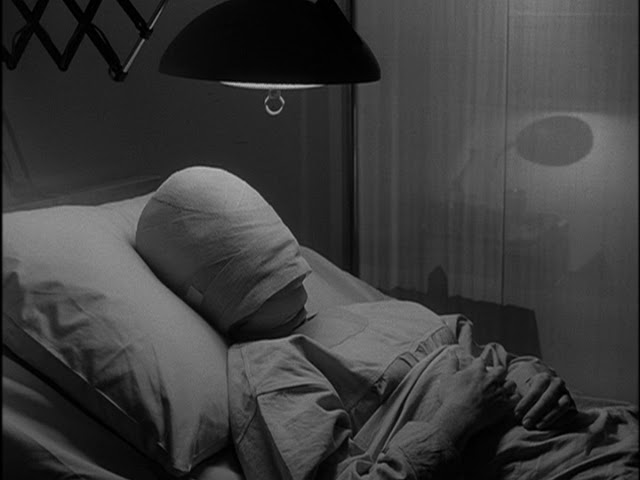
Miss Janet Tyler sits alone in a shadow-draped hospital room staring off into the black nothingness that has become her existence. Miss Tyler has not left her hospital room in what seems like a lifetime. She hasn’t seen a blade of grass, felt the afternoon sun upon her skin, or stared up into a night sky filled with stars in so long that she has practically forgotten that all of these things are possible. Layers of thick bandages cover her face, keeping her isolated in her own private world of darkness.
                In a moment the secret of her torment is revealed: Miss Tyler was born with a severely disfigured face and has been placed in the state-run hospital in hopes of having massive reconstructive surgery. As a result of the procedure Miss Tyler’s face will remain under the bandages until the end of the story and as for the hospital staff, their likenesses will also remain a mystery. Their faces will remain cloaked in shadows or hidden behind various objects and will be revealed at the same time as Miss Tyler’s.
                Miss Tyler desperately desires a solution to her problem.  This is her eleventh treatment, the maximum number allowed by the state. If it proves a failure then she will be sent to a state-mandated segregation camp for people with similar deformities.  She tells the doctor that if the treatment has failed again then she wants to be exterminated. She does not desire to live in a segregation camp. The doctor informs her that while this practice is not totally unheard of he doubts that her request will be granted.
                Miss Tyler’s doctor is not unsympathetic to her dilemma.  He finds himself torn between being a law-abiding citizen of the state and a humanitarian of science. While talking with Miss Tyler’s nurse he says that he simply doesn’t understand why a person who looks different must live in isolation and alienation. The nurse warns him that his words sound dangerously like treason. 
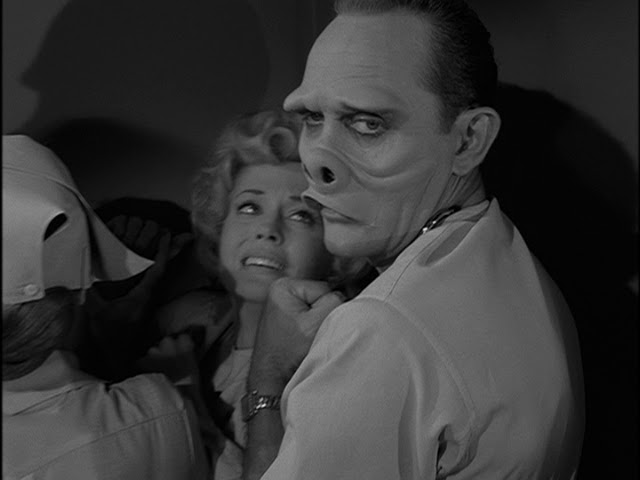
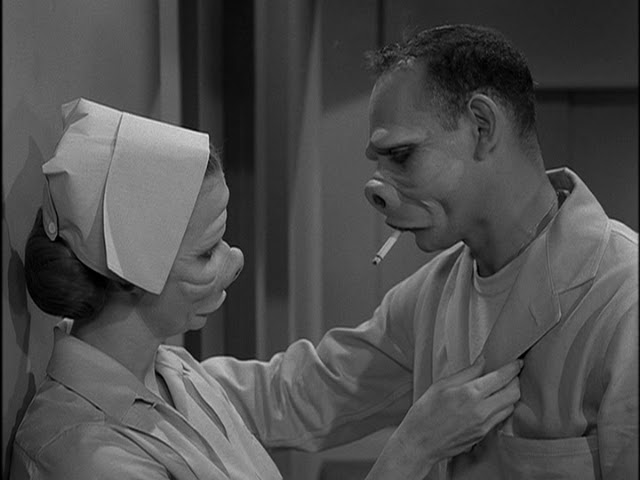
                Back in room 307, Miss Tyler pleads for the bandages to be removed. The doctor finally agrees to remove them. Layer by layer, the bandages are lifted. As the final layer is removed screams fill the room. Underneath the bandages is a young woman with full head of blonde hair, penetrating eyes, and a soft face. We get a glimpse of the hospital staff: they all have grotesque pig-like faces with snarling snouts and deep, sunken eyes.  Miss Tyler needs no mirror to understand her situation. The operation has failed. She panics. She jumps out of her chair and runs screaming down the hallway. On large television monitors placed throughout the hospital a fiery political figure referred to as “The Leader” speaks of a superior race that can only function properly if everyone is made of the same formula. 
                Miss Tyler runs into a room and finds a man waiting there. He lacks the snout and the sunken, dead eyes that the rest of the hospital staff possess. Instead he looks more like her. She recoils in horror and with nowhere left to go, sinks down into a corner and covers her eyes. The doctor enters the room. He informs Miss Tyler that the man’s name is Walter and he is a representative of the segregation camp where she is going to live.  Walter tells her that she no longer needs to be ashamed of her appearance, no longer needs to hide her face from the rest of the world. Where she is going there will be people who look just as she does. He takes her hands and gently leads her out of the room. She begins to relax and the two of them stroll, hand in hand, slowly down the hallway, past the crowd of onlookers, toward a new beginning.


Rod Serling’s Closing Narration:
“Now the questions that come to mind.  Where is this place and when is it?  What kind of a world where ugliness is the norm and beauty the deviation from that norm? You want an answer? The answer is: it doesn’t make any difference.  Because the old saying happens to be true. Beauty is in the eye of the beholder.  In this year or a hundred years hence, on this planet or wherever there is human life, perhaps out among the stars, beauty is in the eye of the beholder.  Lesson to be learned…in The Twilight Zone." 

Commentary:
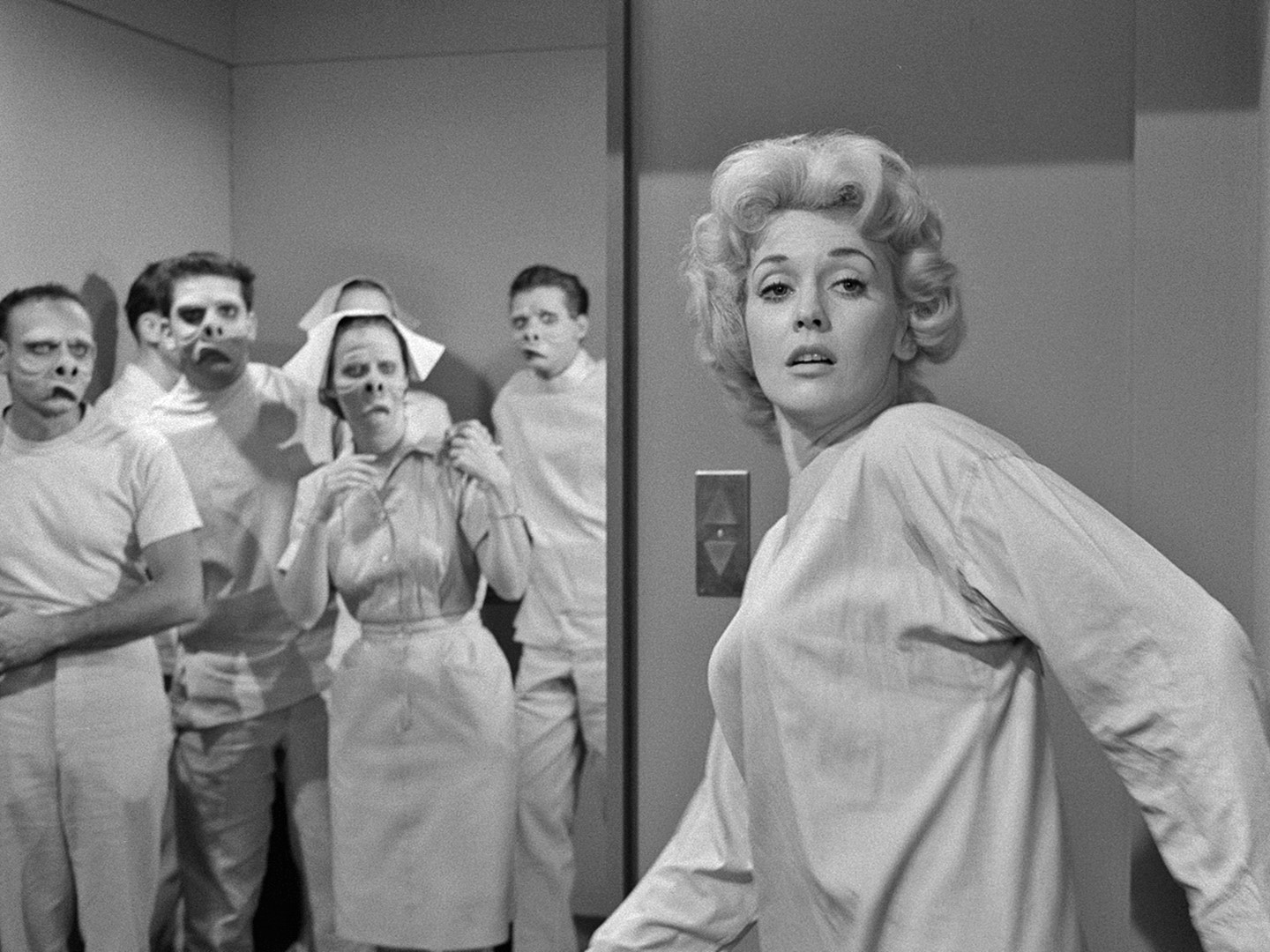
Following on the heels of Charles Beaumont's “The Howling Man,” The Twilight Zone continued its incredible creative streak with Rod Serling’s “Eye of the Beholder.” One of the most widely recognized episodes of the series, “Eye of the Beholder” is the signature episode of director Douglas Heyes and makeup artist William Tuttle. There is not a missed note in the entire episode and every aspect of it is of the highest possible quality that the show had to offer.
                When Buck Houghton first received this script he was reportedly terrified at trying to pull off a twenty-four minute episode where the audience does not get to see any of the character’s faces until the very end. His first choice to direct such an arduously technical episode was Douglas Heyes. In order to keep the viewers from immediately suspecting that something is wrong (i.e. “Hey, why aren’t they showing anyone’s face?”) Heyes keeps the action constantly moving, not in a frenetic way but there is always motion of either the actors or the camera. For instance, in the scene where the doctor walks from the shadows into the light and begins to look directly at the camera his face is briefly hidden behind a nurse, who is standing right in front of him at precisely the right moment, before he turns his back to the audience. The dark and shadowy atmosphere of the set played a large role in hiding the character’s faces. In other episodes this may seem like an intrusion that the audience would pick up on immediately but as this story exists in a world not of our own, the dark, grim set doesn’t seem entirely out of place. The audience doesn’t notice the character’s images being withheld from them because for a large chunk of the episode the camera is centered on Janet Tyler. The sequence of the unveiling is particularly impressive as it is shot from Tyler’s point of view so the audience gets to experience the bandages being lifted, layer by layer, from her face. To accomplish this Heyes had director of photography George T. Clemens place the camera inside a fish tank and had the bandages wrapped tightly around the outside of the tank. It’s an unusual technique and an effective one.

                As much as "Eye of the Beholder" depended upon effective portrayal of character by the actors and the filming ingenuity of director Douglas Heyes and photographer George Clemens, so too did the makeup play a crucial role in the believably and effectiveness of the episode. Makeup artist William Tuttle, then head of the MGM makeup department and the show's go-to technician, rose to the challenge and delivered arguably the show's most recognizable makeup effect.
                For The Twilight Zone, Tuttle was typically asked to create a single makeup ("Nightmare at 20,000 Feet, “ "Hocus Pocus and Frisby") or a handful of effects ("The After Hours," "The Masks") but for "Eye of the Beholder" Tuttle was faced with having to apply his grotesque makeup design on a dozen actors or actresses. Though time was not a problem, production manager Ralph W. Nelson was able to secure a longer preparation time for "Eye of the Beholder," expense would become an issue during the initial stages of developing the makeup. Director Douglas Heyes immediately recognized this problem and approached Tuttle about developing a more streamlined, and thus more cost efficient, method of achieving the makeup effects. Tuttle's typical method of developing his makeup was to take a plaster cast of the all the actors’ faces upon which the makeup would need to be applied. This is a highly efficient way to develop a makeup which perfectly fits the features of individual actors’ faces and is most often used to create a unique makeup which can be molded to the needs and capabilities of the show and the actors. Tuttle would use this method to great effect four years later, working with director George Pal, writer Charles Beaumont, and actor Tony Randall, for 7 Faces of Dr. Lao, for which he would win a special Academy Award (an annual Academy Award for special effects makeup, under the umbrella of "Best Makeup and Hairstyling" would not come into existence until 1981). Fortunately, such an individualized method for the makeup design would not be needed for "Eye of the Beholder" since the purpose of the method, and the theme of the entire episode, was uniformity. Still, Heyes wanted the actors’ natural features to somewhat show through the makeup and also for the actors to be able to perform comfortably through the makeup once their appearances are revealed onscreen and spoken dialogue is required.

  
                The solution was found in foam rubber latex appliances which could be applied to the actors’ faces in a uniform manner. Forming a cast of each of the twelve actors’ faces was out of the question and Tuttle only formed three casts upon which to mold the appliances. Upon careful observation these three designs can be seen in the final cut of the episode to be two "male" models and one "female" model, though at one point in the show an actress is seen to be wearing a "male" model of the makeup, undoubtedly to distort the perception of the viewer, something director Heyes and photographer George Clemens were constantly trying to do on "Eye of the Beholder."
                Heyes had experience with art direction and animation prior to his career as a director and worked hands on in developing the makeup effects alongside Tuttle, on both a design and crafting level. Tuttle had recently created the terrifying Morlocks for George Pal's The Time Machine (1960) and a lot of that makeup design made it into "Eye of the Beholder." It was Heyes who suggested that Tuttle use the leftover appliances from The Time Machine to develop something similar for the grotesque effects needed for "Eye of the Beholder." The differences in the two "male" models of the makeup are two-fold. The first is the brow piece. The first model, the one worn by William Gordon as the Doctor, included a much accentuated brow piece, applied thinly at the hairline and gaining thickness above the eyes, creating a jutting bone structure above the eyebrows. The second design, worn by the male nurses, did not feature as pronounced a brow. One nostril on each of the pig-shaped noses applied to the actors flared chiefly in one direction. This varied between the two "male" designs. The "female" design was more streamlined with a more upturned nose that did not extended out from the face as much as the counterpart designs and featured virtually no brow piece though two layers of makeup, for consistency, can be discerned on the foreheads of the actresses.
                Tuttle had previous experience in creating a makeup intended to unify a design while working under former MGM head of makeup Jack Dawn. Dawn's most memorable makeup was featured in MGM's 1939 Technicolor musical The Wizard of Oz. That film featured several grotesque makeups, some with a unifying theme. Dawn was also an innovator in crafting appliance makeup pieces, no doubt from his experience on The Wizard of Oz, a film plagued by problems in cost and time.
                The final interesting aspect of the makeup was that actress Maxine Stuart, Janet Tyler under the bandages, recalls having a plaster cast made of her face. This was used to create a gauze bandage appliance that could be slipped over Stuart's face like a mask instead of wrapping the actress anew each day of shooting. Not only would the latter method be time consuming and very uncomfortable for the actress but would also lend itself to an aesthetic inconsistency. Tuttle crafted a foam rubber mask from the mold of Stuart's face which would then be wrapped in gauze for ease of application. Stuart’s chin and neck were wrapped in gauze each day of shooting since they were not covered by the appliance. When watching the episode, the viewer can easily see where the appliance ends above Stuart's chin.
                In all, the makeup for "Eye of the Beholder" was one of the most challenging yet rewarding and successful in the entire run of the show. The makeup has been re-imagined by artists and sculptors for posters, prints, magazines, toys, and figures in a seemingly endless stream since the original airing of the episode and has undoubtedly become one those indelible images which has lived on as an identifying factor in The Twilight Zone's cultural heritage.

                In addition to the technical challenges that this episode offered, Douglas Heyes also knew that the story would be carried largely by the voices of the actors because it is all the audience has with which to associate themselves. As he told Marc Scott Zicree, author of The Twilight Zone Companion (1982), to cast this episode he had the actors audition with his back to them so that he would hear what the audience would hear. He felt that the voices should be sympathetic both to sway the audience from deciphering the twist but also so that they would form an emotional connection to the characters. In contrast, he felt that Miss Tyler's voice should be fairly coarse and textured, one that displayed a depth of character. The result of this unusual casting process was a stellar cast with a leading lady that basically carried most of the episode herself. A former radio actress, Maxine Stuart’s performance here is exceptional considering she must make the audience sympathize with Janet Tyler without using any facial expressions. This was an enormous responsibility because the story hinges on how much the audience cares for Tyler, how much they want to see the treatment turn out a successful one. If they do not sympathize with her then the entire episode falls apart. Stuart accomplishes this brilliantly with simple voice intonations and hand gestures, remaining melancholy but hopeful for most of her performance but exploding into a helpless rage when the script calls for it.  Equally as important to Stuart’s performance as Janet Tyler is that of the Doctor played William D. Gordon. Since the Doctor is emotionally torn between his humanitarianism and his obligation as a state employee this has to be reflected in the actor’s voice.  Gordon accomplishes this convincingly and the scene in which he discusses his thoughts with the head nurse is one of the most poignant in the episode.
                The final major cast member of the episode is Donna Douglas who portrays Janet Tyler after the bandages have been removed.  While Maxine Stuart was an ideal choice to voice the faceless Tyler, the producers felt that Janet Tyler should be breathtakingly beautiful in comparison to the grotesque image of the pig people. Stuart plays Tyler up until the removal of the bandages but once they are taken off Douglas takes over as Tyler for the remainder of the episode. Douglas has only a few lines after the bandages have been removed. There are contradictory accounts as to whose voice is heard when Douglas speaks. Stuart recorded a voiceover to sync her voice to Douglas’s facial movements so that the audience would not suspect that two different actresses were playing the same role. According to Stuart it is her voice that is used in the final cut of the episode. Heyes and Douglas, however, both contest that Douglas was on the set during the entire production and learned Stuart’s intonations well enough to recite her few lines believably and that it is her voice that is heard in the last scene of the episode. Either way both performances are convincing and important to the story.

                For those who have seen this episode in syndication you might have seen the version entitled “The Private World of Darkness.” Serling’s original title was “Eye of the Beholder” and its meaning was the basic moral lesson to be taken from the story. When it first aired on CBS on November 11, 1960 it ran under this title. Shortly after, however, Serling and Cayuga Productions received a letter from Stuart Reynolds, a television producer for General Electric Theater which ran on CBS from 1953 to 1962, stating that in October of 1953 General Electric Theater aired an episode written by Hannah Grad Goodman titled “The Eye of the Beholder.” Reynolds was now trying to market this production as an educational film to be used in schools and in a roundabout way he threatened to sue Serling if he did not change the name of his Twilight Zone episode.  Not wanting to pick an unneeded fight Serling and the producers decided to change to the name. When the episode was next broadcast in 1962 it bore the name “The Private World of Darkness.” Since then it has been released commercially under both names but usually the syndicated version runs under the title “The Private World of Darkness” simply because when it first aired in syndication it bore this name. Regardless, most people know it under the name that Serling originally intended.
                As mentioned this is one of the signature episodes of the series. Whenever there is a reference to The Twilight Zone this is one of a handful of episodes that is mentioned. As for the filmmakers, both Rod Serling and Douglas Heyes both consider this one of their best efforts on the program.  Serling would later recycle this same theme on Night Gallery in the episode “The Different Ones” where a deformed teenage boy is sent by a totalitarian society concerned with conformity to live on another planet. When he arrives he discovers that it is to be an exchange as a creature from this new planet, a seemingly attractive human man, is being sent to Earth. To the teenager’s surprise the people from his new home look much like he does and all is well. It was also remade almost verbatim for the UPN revival series in 2003. The producers of this series choose not to change anything and both the concept and script and many of the camera shots are duplicated as well as they can be. The end product is simply a diluted version of the original. This episode has also been spoofed on Saturday Night Live and The Simpsons and many other programs. Serling hit upon a theme here that is often spoken of but rarely put into images as clearly as this episode. And thanks to remarkable casting, Douglas Heyes’s painstakingly choreographed camera work, and William Tuttle’s uniquely grotesque artistry, this episode is still a very recognizable stamp on the face of American popular culture.

Grade: A+

Grateful acknowledgment is made to:

The Twilight Zone Companion, Second Edition by Marc Scott Zicree (Silman-James Press, 1992)

The Twilight Zone: Unlocking the Door to a Television Classic by Martin Grams, Jr. (OTR Publishing, 2008)

"Douglas Heyes: Behind the Scenes at The Twilight Zone" by Ben Herndon. Rod Serling's The Twilight Zone Magazine (August, 1982)


Original design sketch by director Douglas Heyes
for makeup applied to actor William Gordon
featured in an interview with Heyes in the
Aug, 1982 issue of Rod Serling's The Twilight Zone Magazine

 Notes: 
--William D. Gordon also appeared in an earlier Season Two episode “Nervous Man in a Four Dollar Room” which was also written by Serling and directed by Douglas Heyes.
--Douglas Heyes was the director responsible for some of the most memorable episodes of the series, including "The After Hours," "The Howling Man" and "The Invaders." Heyes wrote and directed the first segment of Rod Serling's Night Gallery, "The Dead Man" (based on the story by Fritz Leiber), and wrote two additional segments, "The Housekeeper" and "Brenda" (based on the story by Margaret St. Clair) under the pseudonym Matthew Howard. Soon after the broadcast of "Eye of the Beholder," Heyes would re-team with actress Donna Douglas for "The Hungry Glass," a classic episode of Boris Karloff's Thriller, which originally aired on January 3, 1961. "The Hungry Glass" was an episode loaded with Zone actors/actresses and also featured William Shatner ("Nick of Time," "Nightmare at 20,000 Feet"), Russell Johnson ("Execution," "Back There"), Elizabeth Allen ("The After Hours"), and Clem Bevans ("Hocus-Pocus and Frisby"). "The Hungry Glass" also starred Heyes's wife Joanna Heyes, who here plays the receptionist nurse under William Tuttle's makeup. Douglas Heyes directed two additional episodes of Thriller, including the excellent first season episode "The Purple Room," which featured Patricia Barry ("The Chaser," "I Dream of Genie," and "It's a Good Life" segment from Twilight Zone: The Movie).
--George Keymas also appeared in an episode of Rod Serling's Night Gallery titled "Green Fingers."
--Donna Douglas also appeared in an episode of Rod Serling's Night Gallery titled "Last Rites for a Dead Druid."
--Edson Stroll also appeared in season three's "The Trade-Ins."
--"Eye of the Beholder" was adapted as a Twilight Zone Radio Drama starring Virginia Williams. 
 --While this episode looks remarkable in high definition in many ways the high resolution may not do it justice as there are several scenes in which the actors faces can be seen quite clearly wearing no makeup.


Up Next: Another masterpiece from the best television program of all time, this one written by Richard Matheson.  Join us next time when we review “Nick of Time,” starring William Shatner.

--JP and BD 

Thursday, January 31, 2013

"The Howling Man"

The Howling Man (Robin Hughes) pleads for his freedom with
stranded traveler David Ellington (H.M. Wynant)
"The Howling Man"
Season Two, Episode 41
Original Air Date: November 4, 1960

Cast:
David Ellington: H.M. Wynant
Brother Jerome: John Carradine
The Howling Man: Robin Hughes
Brother Christophorus: Frederic Ledebur
Housekeeper: Ezelle Poule

Crew:
Writer: Charles Beaumont (based on his story)
Director: Douglas Heyes
Producer: Buck Houghton
Associate Producer: Del Reisman
Production Managers: Ralph W. Nelson and Sidney Van Keuren
Director of Photography: George T. Clemens
Art Direction: George W. Davis and Phil Barber
Set Decoration: Henry Grace and H. Web Arrowsmith
Assistant Director: Darrell Hallenbeck
Casting: Ethel Winant
Sound: Franklin Milton and Charles Scheid
Music: Stock
Makeup: MGM Makeup Department (William Tuttle, supervisor)

And Now, Mr. Serling:
"Down this hall is a very strange individual locked in a room. He's known by various names and by various forms and next week on The Twilight Zone you'll be close to the elbow of the people who let him out. Our story is called 'The Howling Man' by Mr. Charles Beaumont. It's designed for the young in heart but strong in nerve. I hope we'll see you next week along with 'The Howling Man.' Thank you and good night."

 Rod Serling's Opening Narration:

"The prostrate form of Mr. David Ellington, scholar, seeker of truth, and, regrettably, finder of truth. A man who will shortly arise from his exhaustion to confront a problem that has tormented mankind since the beginning of time. A man who knocked on a door seeking sanctuary and found instead the outer edges of The Twilight Zone."


Summary:
            "It's an incredible story. I of all people know this. And you won't believe me. No, not at first. But I'm going to tell you the whole thing. Then you will believe because you must. You must believe."
So begins David Ellington's story of how, after the first World War, he became lost in a storm during a walking tour of central Europe. Coming upon a remote hermitage, he begs entry and is allowed to see Brother Jerome, the leader of an order of monks who reside in the hermitage. Ellington is alarmed when he hears strange howling sounds from somewhere within the hermitage. When confronted by Brother Jerome, Ellington explains his situation and asks for shelter and food. Jerome firmly tells him that the brotherhood cannot help him and Ellington will have to leave the hermitage immediately. Shocked by Jerome's lack of empathy, Ellington slowly makes his leave but is unable to reach the door before collapsing unconscious upon the floor.
            Upon waking, Ellington again hears the strange howling and tracks the sound to a small cell with a barred door. Within the cell is a young, thin, bearded man who begs Ellington for help in releasing him. The prisoner tells Ellington that Brother Jerome and the others in the hermitage are insane and have imprisoned him here against his will. Ellington tells the prisoner that he will speak to Brother Jerome and this only sends the prisoner into panic. "Jerome," says the prisoner, "is the maddest one of all."

            When Ellington confronts Brother Jerome, the old monk attempts to convince Ellington that he has not seen or spoken to a man at all. The howling which Ellington hears again and again Brother Jerome pretends not to hear at all. It is only when Ellington threatens to involve the authorities in the matter that Jerome relents and tells Ellington the truth. The man in the cell is the Devil, himself!
            Ellington is reluctant to believe the incredible story but tells Jerome that he does believe. Jerome sees through the lie and attempts to explain to Ellington how he and the brotherhood came to be the wardens of the Devil. The herding staff which all the members of the order carry represent "truth," which is, in Jerome's words, the greatest weapon against the Devil. It is but a meager wooden staff which holds closed the door of the Devil's cell. Jerome pursued the Devil across the world and finally managed to trap him. Ellington again tells Jerome that he believes. This time, unfortunately, Jerome believes him.

            Later in the night, Ellington leaves his room against Jerome's orders by stealing the key to the locked bedroom door from the neck of the sleeping Brother Christophus. Ellington rushes to the prison cell to free the man within. In a moment before he frees the prisoner, Ellington notices that it is only a thin piece of wood, the staff of truth, which holds the door closed. It is something which can easily be removed by the prisoner. It is the last questioning moment that Ellington will have and to remove the staff seems to be a difficult act. Once the staff is removed, Ellington learns the terrible truth. The man in the cell really is the Devil and he quickly escapes from the hermitage.
            Years later, after the second World War and the Korean War and the development of new weapons of mass destruction, Ellington manages to recapture the Devil. He keeps the prisoner locked in a room in his home, barred only by a small wooden staff. He plans on transporting the Devil back to Brother Jerome at the hermitage. It is not to be. Though the whole tale has been a tale of warning to Elllington's housekeeper, whom he leaves in charge of his home while he is off making arrangements to move the Devil back to Brother Jerome, the housekeeper, upon hearing the howling from behind the closed door, cannot resist removing the staff once Ellington has left. The door opens to darkness but we know what waits there in the dark.

 Rod Serling's Closing Narration:
"Ancient folk saying: 'You can catch the Devil but you can't hold him long.' Ask Brother Jerome. Ask David Ellington. They know, and they'll go on knowing to the end of their days and beyond, in The Twilight Zone."

 Commentary:

           “A man was in the cell. On all fours, circling like a beast, his head thrown back, a man. The moonlight showed his face. It cannot be described – not, at least, by me. A man past death might look like this, a victim of the Inquisition rack, the stake, the pincers: not a human in the third decade of the twentieth century, surely. I had never seen such suffering within two eyes, such lost, mad suffering. Naked, he crawled about the dirt, cried, leaped up to his feet and clawed the hard stone walls in fury.
            Then he saw me.”

                                    -“The Howling Man” by Charles Beaumont 

            With "The Howling Man," The Twilight Zone ventured directly into Gothic horror in bravura style, complete with an old European abbey, a thunderous storm, a lost traveler, and a confrontation with the ultimate enemy of mankind. "The Howling Man" succeeds on every level, from the script, direction, photography, and casting to the makeup and set design. Even the stock music, which includes pieces from regular series contributors Jerry Goldsmith and Bernard Herrmann, is used effectively. Its imagery makes it one of the most recognizable episodes of the series, with its unusual atmosphere, a memorable monster, and its frequent broadcasts in The Twilight Zone syndication packages. The episode remains one of the crowning achievements not only of the second season but of the entire series. It is a triumph for writer Charles Beaumont and director Douglas Heyes, and definitively displayed, with its early second season broadcast, that Rod Serling's series was capable of producing engaging fantasy on television that held appeal across a range of viewer demographics. The episode is not flawless but it is one of a handful of episodes that maintain the show's unique cultural identity, familiar as it is even among those who have never seen the episode.
            The genesis of the episode begins with Charles Beaumont's original short story, published in the November, 1959 issue of Rogue, a men's magazine (one of many that appeared in the wake of Hugh Hefner's Playboy) that was fortunate enough to briefly have as its editors a pair of talented American writers who specialized in speculative fiction, Harlan Ellison and Frank M. Robinson. The story was later reprinted in Beaumont’s collection Night Ride and Other Journeys (Bantam, 1960). The story has become a classic of its type, its influence boosted by its adaptation on The Twilight Zone. It has often been reprinted and served as the title story of Beaumont's career retrospective, Charles Beaumont: Selected Stories, when that limited edition volume was published in paperback as The Howling Man by Tor Books in 1992. It is a core work in Beaumont's relatively small but highly influential body of work.
            At the time the story was published, Beaumont was on a monthly retainer from Playboy for first refusal rights to his fiction. Ray Russell, a fringe member of the group of writers who coalesced around Beaumont, was the fiction editor of Playboy at the time. Beaumont was also writing nostalgic essays for Playboy, many of which were written in collaboration with Twilight Zone writers Jerry Sohl and OCee Ritch and later collected in Remember, Remember? (Macmillan, 1963).                 
           Because of his close association with Playboy, Beaumont was strongly discouraged from submitting his work to competing periodicals if he hoped to continue to sell to Hefner's high-paying magazine. Beaumont resorted to using pseudonyms to place his work with other periodicals. Beaumont had already sold several nonfiction pieces to Rogue, including personality profiles under the uniform title, "Rogue of Distinction" (a series Beaumont shepherded from 1956-1959), and articles on automobile racing (in collaboration with William F. Nolan), all written without a byline or under the pseudonym Michael Phillips. "The Howling Man" was first submitted to Playboy but the magazine turned it down (Hefner allegedly didn't care for the story). Beaumont took the story from the Chicago offices of Playboy to the nearby offices of Rogue in Evanston, Illinois. Fiction editor Harlan Ellison (recently discharged from the Army and well into his professional writing career) knew the Beaumont story was a gem and published it in the November, 1959 issue of Rogue under the pseudonym "C.B. Lovehill," a play on Beaumont's name. Other Beaumont stories appeared in Rogue under the Lovehill pseudonym. The December, 1960 issue saw the Lovehill byline on a story titled "Dead, You Know," and, some months earlier, in the April, 1960 issue of Rogue, another story appeared by Lovehill, the short fantasy "Gentlemen, Be Seated." Beaumont later adapted this story into a teleplay for the fifth season of The Twilight Zone before William Froug, the show's final producer, shelved it. The script can be read in The Twilight Zone Scripts of Charles Beaumont, Volume One, edited by Roger Anker (Gauntlet Press, 2004).
            Though the original plot of "The Howling Man" short story is retained for the adaptation on The Twilight Zone, the differences between the two versions are numerous. Generally speaking, Beaumont, and the production crew, improved upon the short story with nearly every change incorporated into the adaptation. There are subtle changes, such as Father Jerome in the story becoming Brother Jerome in the episode. The shepherding staffs which the inhabitants of the hermitage carry do not exist in the story. The door to the prisoner's cell is therefore kept closed using a simple lock and not the "staff of truth," the one barrier the Devil cannot pass. Beaumont's original script described the members of the hermitage as carrying large crosses but director Douglas Heyes was against using this because he did not think it wise to use a distinctly religious symbol for fear of a backlash among viewers. The image of the staff was substituted for the cross. The sounds of the Howling Man are referred to as screams in the short story. Due to the nature of the literary medium, a reader need not dwell on the specific nature of the sound as that aspect is left purely to the reader's imagination. The Howling Man is, in fact, seen howling, or screaming, in the short story and director Douglas Heyes wisely avoided showing Robin Hughes making the howling noises in the episode as this would have not only been incredibly difficult to convincingly execute, but would certainly have destroyed the carefully built tension and atmosphere. 
            Other changes are more significant. As originally written, the true nature of the prisoner in the cell is more ambiguous. Beaumont chose to reveal the Devil only as a single cloven hoof descending over the abbey wall as the Devil makes his escape. Even with this approach it is never clear, even at the end of the story, whether Ellington has truly released the Devil upon the world or simply been the victim of strong suggestion by the religious fanatics that live in the abbey. It is, however, suggested that Ellington did indeed release the Devil as what follows is World War II and all the horrors resultant of that terrible conflict. The ending of the short story, equally ambiguous, concludes with Ellington receiving a postcard from Brother Christophorus which reads: "Rest now, my son. We have him back with us again." Elllington, as filmed for The Twilight Zone, becomes obsessed with recapturing the Devil and getting him back to Brother Jerome and accomplishes the feat himself.
            For The Twilight Zone, Beaumont wanted, with the appearance and escape of the Devil, to retain the original story's version. He wanted the glimpse of a cloven hoof descending over the wall and the look upon Ellington's face to be confirmation enough for the audience. Douglas Heyes felt this was not enough and disliked the ambiguous nature of the ending. Heyes began his career while still a teenager working as an artist for Walt Disney Studios. The visual artist within knew that they needed to show and not merely suggest what the entire episode built toward. The result was a literal transformation of actor Robin Hughes into the archetypal image of the Devil using makeup and photographic techniques. The result has split many viewers, some of whom do not like the literal transformation. Though most viewers agree, including us here in the Vortex, that a transformation needed to happen and not simply be suggested, some writers have criticized the makeup as too literal and unimaginative. It's really a pointless argument as the entire episode is filmed and acted in an exaggerated manner and if the viewer accepts John Carradine's wonderful, yet over-the-top, performance as the staff wielding, white bearded, bass-toned Brother Jerome, then the viewer should accept the literal version of the Devil.


            Though the makeup is a bit pedestrian (in concept if not execution), the transformation of Robin Hughes into the Devil is one of the finest technical achievements of the series. Though Douglas Heyes has been interviewed on the subject more than once, his version of the design and genesis of the effect varied. In an early interview with Marc Scott Zicree, conducted in the late 1970s, while Zicree was researching his pioneering book, The Twilight Zone Companion (1982), Heyes does not credit any major film source for the technique, though it is obvious to those well-versed in the genre which films the director and his crew borrowed from. Heyes would amend his statements on the effects for "The Howling Man" in later interviews and would rightly credit the two films from which the techniques were derived, 1931's Dr. Jekyll and Mr. Hyde from Paramount (starring Fredric March, directed by Rouben Mamoulian, with makeup by Wally Westmore and cinematography by Karl Struss) and 1935's Werewolf of London from Universal Studios (starring Henry Hull, directed by Stuart Walker, with makeup by Jack Pierce and photographic effects by John P. Fulton). Heyes does make two small errors when he further states that Dr. Jekyll's transformation into Mr. Hyde (in the 1931 film version) was a stationary, lap dissolve technique in the mold of Universal's The Wolf Man from 1941 (it was not), and that Henry Hull walks up a staircase for his transformation in 1935's Werewolf of London (he begins by descending a staircase but the transformation occurs while the actor walks through a garden, concealed and then revealed by a line a trees). Heyes does not take credit for the idea to use these specific techniques, however, and credits the achievement to photographer George T. Clemens and makeup supervisor William Tuttle.
            The transformation effects in the episode were achieved two-fold. The first part of the transformation occurs immediately after Ellington has released the Devil from his cell. A distinct physical change comes across the facial features of actor Robin Hughes. This effect was achieved using the same method that changed Kevin McCarthy from a young man to an old man in a matter of seconds in Beaumont's first season episode, "Long Live Walter Jameson." This is a process by which makeup is applied to the actor is a specific hue and color filters are used to first conceal and then reveal the makeup. In this case, red makeup was applied to Hughes's face. A red filter over the camera concealed the makeup until the transformation was scripted to happen. The red filter was then removed and replaced with a green filter, thus revealing the red makeup in a dark hue and giving the illusion of a transformation. This also allowed the actor to be in motion at the time of the transformation and did not require the technique of a stationary lap dissolve with photographic editing to be used. The color filter process, which is only effective in black-and-white cinematography, was perfected by makeup artist Wally Westmore, photographer Karl Struss, and director Rouben Mamoulian for the aforementioned 1931 horror classic Dr. Jekyll and Mr. Hyde. The transformation of Fredric March (co-winner of a Best Actor Academy Award for his performance in the film) from Dr. Jekyll to Mr. Hyde is still one of the most impressive transformations and makeups in the history of film.
            The second portion of the transformation was a technique taken from another horror film of the 1930s, a production from the preeminent horror film studio, Universal Studios, and their first foray into lycanthropy, the 1935 film Werewolf of London. The film featured a minimal werewolf makeup designed by head of the Universal makeup department Jack Pierce. The reason for the minimal makeup design is often erroneously given as the fact that actor Henry Hull was not a willing participant for heavy makeup and Jack Pierce was forced to alter his vision for the werewolf, not unveiling his full version for another six years, in 1941, with The Wolf Man starring Lon Chaney, Jr. In truth, Hull was more than willing to undergo heavy makeup and often used his own makeup designs to turn himself into Edgar Allan Poe or Mark Twain for a stage production or a film. The true reason the werewolf makeup is minimal in Werewolf of London is that Hull's character was supposed to be recognized by the other characters in the film when he was in werewolf form and Pierce's heavy makeup would have made that recognition all but impossible. 
            Werewolf of London displayed an innovative transformation sequence designed by Academy Award-winning special effects photographer John P. Fulton. Henry Hull began his first transformation into a werewolf as he exited his home and began to make his way to his private laboratory across a garden. The transformation occurred as the actor's image was first concealed and then revealed as he moved across a line of trees. It was achieved by photographing the actor in progressing stages of makeup while walking the same path and using the same camera speed for multiple takes. The effect was completed by editing the footage together to create the appearance of one continuous take, thus creating the transformation. Director Heyes and photographer George T. Clemens did the same thing for "The Howling Man." Actor Robin Hughes walked down the abbey corridor behind a line of pillars, first concealed and then revealed. Heyes and Clemens's version is much faster and cleanly edited but they had nearly thirty years to perfect the process. John P. Fulton, a two-time Academy Award winner, also created the astounding photographic effects for Universal's The Invisible Man series of films. Jack Pierce created numerous makeups for Universal in the 1930s and 1940s, including Boris Karloff's makeup for Frankenstein and The Mummy, and Lon Chaney, Jr.'s makeup for the aforementioned The Wolf Man. Pierce was unceremoniously fired by Universal in the late 1940's and replaced with Bud Westmoore as head of the makeup department. This was primarily because Pierce held on to the technique of using outmoded methods of makeup appliance and displayed a general reluctance to use innovations such as foam rubber appliances. Still, it is telling that when it came time to recreate the makeup effects achieved by Lon Chaney, Sr. in films such as The Hunchback of Notre Dame (1923) and The Phantom of the Opera (1925) for the biopic Man of a Thousand Faces (1957), the foam rubber appliances from the Universal Makeup Department were in no way as effective as Chaney's makeups of over thirty years earlier. 
            One final note on the makeup. William Tuttle's aging makeup on actor H.M. Wynant was exceptional. Though Tuttle will always be remembered for his grotesque makeups for episodes of The Twilight Zone ("Eye of the Beholder," "Nightmare at 20,000 Feet," "The Masks," etc.) and his Academy Award winning makeup for The 7 Faces of Dr. Lao, Tuttle was also very skilled in subtle makeups and his work on aging H.M. Wynant is a notable example.
            Douglas Heyes appears to be the director that producer Buck Houghton preferred during the show's first two seasons for episodes which required more than the usual technical requirements. Heyes would direct some of the show's most impressive, technically challenging episodes, including "The After Hours," "Eye of the Beholder," "The Invaders," and "The Howling Man." Heyes and photographer George T. Clemens decided to use expressionistic camera work for the episode and the effects are impressive. From the beginning sequence, in which the camera zooms out of the window, through the pounding storm, and backwards in time for a rain-drenched exterior view of the partially ruined abbey (a miniature), the camera never seems to stand still or take a straight angle for the entire episode. It is especially frenetic in the early portion of the episode as Heyes attempts to use the camera to convey the disoriented mindset of H.M. Wynant's character, David Ellington, who arrives sick and weak at the door to the hermitage.
            Another effect which was integral to the show's success was the sound of the howling. Though Heyes and the crew decided on the sound of a traditional wolf or dog howl, the process for selecting the sound was apparently a dilemma. The prolific writer William F. Nolan, a close friend to Charles Beaumont, accompanied Beaumont to the set of "The Howling Man" during filming. Nolan relates the story to author Marc Scott Zicree of the crew spending a great amount of time listening to recordings of different screams and howls, trying to settle on the proper sound. The sound settled upon is certainly generic but it seems inconceivable that any sound would have sufficed when the readers of the original story could simply rely on their imagination to conjure the proper sound. In its adaptation, it was a difficult effect to achieve and, as noted before, Heyes wisely chose not to show Robin Hughes actually making the howling sound.         
            As with any episode with a small cast (for “The Howling Man,” only five principle characters and four speaking parts), the casting was very important to the success of the show. Heyes had previously worked with John Carradine and knew that the actor's range could extend from extremely reserved to extremely broad. Carradine was a Shakspearian trained actor and placed most of the his acting income into a largely unsuccessful Shakespeare company that traveled around America bringing the Bard to the masses. Heyes gave Carradine the go-ahead to let loose with the character of Brother Jerome and Carradine turns in a commanding performance, moving from reserved, holy-father figure to raving religious fanatic and back again. It has become one of the most memorable and recognizable performances in the show's entire run. Though Carradine starred in several highly regarded American films, such as director John Ford's films Stagecoach (1939), The Grapes of Wrath (1940), and The Man Who Shot Liberty Valance (1962) (for which he would be typecast as a rugged, western type and thereafter find dozens of roles in western films and television series), and racked up some 340 film and television credits, he is best-remembered by horror and science fiction fans for his roles in Universal's horror films of the 1940's, including Captive Wild Woman (1943), The Invisible Man's Revenge (1944), The Mummy's Ghost (1944), and memorable turns as Dracula in House of Frankenstein (1944) and House of Dracula (1945). Carradine also turned up as Dracula in the camp western/horror film Billy the Kid vs. Dracula (1966). He was also a familiar face in the Poverty Row horror films from the 1940's, finding roles in Revenge of the Zombies (1943), Voodoo Man (1944), Return of the Ape Man (1944), and as the title character in director Edgar G. Ulmer's Bluebeard (1944). Carradine was also all over television from the mediums earliest days right up until the end of his career. His genre television credits include episodes of Lights Out, Suspense, Thriller, The Alfred Hitchcock Hour, The Munsters, Lost in Space, Rod Serling's Night Gallery, and the 1980's The Twilight Zone revival for the episode "Still Life." In 1953, he appeared in a segment of The Kate Smith Hour titled "The Hound of Heaven," opposite James Dean. The segment was written by Earl Hamner, Jr. and was an early treatment of the writer's Twilight Zone episode "The Hunt." John Carradine died in Milan on November 27, 1988.
            H.M. Wyant was born on February 12, 1927. He began acting at age 19, and has amassed over 140 film and television credits in his long career. Wynant began in television and worked virtually nonstop on numerous series before getting occasional roles in films in the late 1960's, finding a memorable part in Conquest of the Planet of the Apes (1972). His genre credits include Alfred Hitchcock Presents, Alcoa Presents: One Step Beyond, Thriller, and Batman.
             Robin Hughes, the Howling Man, was born in Buenos Aires in 1920 and died in Hollywood in 1989. He worked until the early 1970's in both film and television. Genre credits include The Mole People (1956), The Thing That Couldn't Die (1958), and on television in Boris Karloff's Thriller and Alcoa Presents: One Step Beyond.
            "The Howling Man" remains one of the finest episodes produced for The Twilight Zone. It displays a range of exceptional and innovative technical effects and shows the care and attention with which the talented crew afforded scripts and productions they considered worthy of such preparation and careful execution. It also displays the thematic range attainable on the series, from far flung science fiction to Gothic horror, and remains arguably the most famous show to emerge from the typewriter of Charles Beaumont, the series writer that created some of the most unique and innovative scripts of the series and whose career was sadly cut short from the early onset of a mentally debilitating disease.

Grade: A+

Grateful acknowledgement is made to the following for information contained in the commentary:

-The Work of Charles Beaumont, An Annotated Bibliography and Guide by William F. Nolan (2nd edition, Borgo Press, 1990)

-The Twilight Zone Companion by Marc Scott Zicree (2nd edition, 1989)

-Marc Scott Zicree interview with Douglas Heyes (included as a commentary track on "The Howling Man" on the Definitive Edition DVD of The Twilight Zone, season 2)

-"The Howling Man" by Charles Beaumont (The Howling Man, Tor, 1992)

-Harlan Ellison's introduction to "The Howling Man" by Charles Beaumont (The Howling Man, Tor, 1992)

-The Internet Speculative Fiction Database (isfdb.org)

 Notes:
--Charles Beaumont originally published the short story “The Howling Man” in the November, 1959 issue of Rogue under the pseudonym C.B. Lovehill. It has been reprinted in the author's collection Night Ride and Other Journeys (Bantam, 1960) and Charles Beaumont: Selected Stories (Dark Harvest, 1988), titled The Howling Man in paperback (Tor Books, 1992), a career retrospective edited by Roger Anker.
-Director Douglas Heyes also directed several classic episodes of the series, including "The After Hours," "Eye of the Beholder" and "The Invaders." Heyes wrote and directed the first segment of Rod Serling's Night Gallery, "The Dead Man" (based on the Fritz Leiber story), and also wrote the segments "The Housekeeper" and "Brenda" (based on the story by Margaret St. Clair) under the pseudonym Matthew Howard.
-John Carradine appeared in an episode of Rod Serling's Night Gallery titled "Big Surprise."
-"The Howling Man" was adapted as a Twilight Zone Radio Drama by Dennis Etchison, starring Fred Willard. 
-H.M. Wynant also appeared in two Twilight Zone Radio Drama episodes, "The Trade-Ins" and "Deaths-Head Revisited."

-JP