Monday, January 14, 2013

"A Thing About Machines"

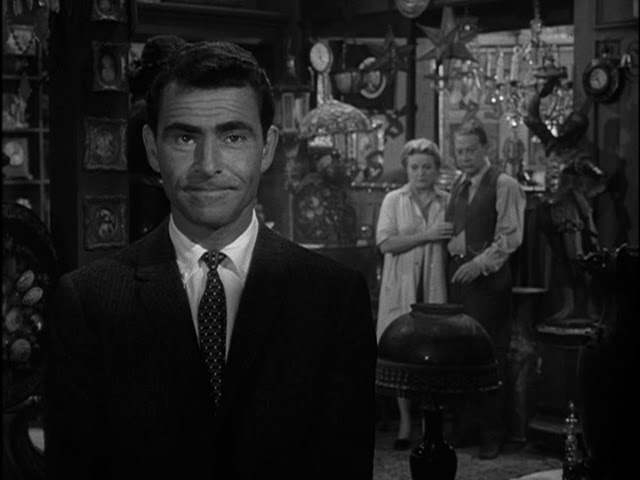
Richard Haydn as the bitter Barlett Finchley.
"A Thing About Machines"
Season Two, Episode 40
Original Air Date: October 28, 1960

Cast:
Bartlett Finchley: Richard Haydn
Edith (the secretary): Barbara Stuart
TV Repairman: Barney Phillips
Intern: Jay Overholts
Policeman: Henry Beckman
Girl on TV: Margarita Cordova

Crew:
Writer: Rod Serling (original teleplay)
Director: David Orrick McDearmon
Producer: Buck Houghton
Associate Producer: Del Reisman
Production Manager: Sidney S. Van Keuren
Director of Photography: George T. Clemens
Art Direction: George W. Davis and Phil Barber
Set Decoration: Henry Grace and H. Web Arrowsmith
Assistant Direction: Darrell Hallenbeck
Casting: Ethel Winant
Editor: Leon Barsha
Sound: Franklin Milton and Charles Scheid
Music: Stock

And Now, Mr. Serling:
"These are familiar items, I'm sure. Television set, electric razor, clock, typewriter, the normal, everyday accouterment that are part and parcel of twentieth century progress. But next week you'll see them under different circumstances and in a totally dissimilar guise. They'll be machines, but they'll also be monsters. Our story is called 'A Thing About Machines' and it'll be here waiting for you in The Twilight Zone."

Rod Serling's Opening Narration:
"This is Mr. Bartlett Finchley, age forty-eight, a practicing sophisticate who writes very special and very precious things for gourmet magazines and the like. He's a bachelor and a recluse with few friends, only devotees and adherents to the cause of tart sophistry. He has no interests save whatever current annoyances he can put his mind to. He has no purpose to his life except the formulation of day-to-day opportunities to vent his wrath on mechanical contrivances of an age he abhors. In short, Mr. Bartlett Finchley is a malcontent, born either too late or too early in the century and who in just a moment will enter a realm where muscles and the will to fight back are not limited to human beings. Next stop for Mr. Bartlett Finchley. . . The Twilight Zone."

Summary:
            The opening scene immediately establishes what the remainder of the episode repeatedly hammers home: Bartlett Finchley, a wealthy, reclusive bachelor whose occupation involves regular commentary on culture, is an unrepentant snob prone to sudden bursts of violent anger. Finchley exchanges barbed witticisms with the television repairman, a familiar figure in the large, solitary home as Finchley repeatedly assaults his television when it does not work according to the standards he has set for the electrical and mechanical appliances in his home. After the television repairman has left, Finchley smashes a tolling clock with a fireplace poker to drive the point home.
            Finchley's next human encounter, this time with his personal secretary (who promptly quits on him after suffering one too many of his insults), reveals Finchley's true dilemma. Not only has Finchley possessed a lifelong inability to effectively use machines, he now believes the machines have gained sentient life and are conspiring not only to malfunction but to cause him bodily harm. 
            Finchley's typewriter writes on its own: GET OUT OF HERE FINCHLEY. His television displays a dancing woman alone on a stage who looks straight at him and utters the same threatening message. In a panic Finchley attempts to call old friends from his little black book. None, however, have time for the curmudgeon. Blaming the telephone itself for this embarrassment, Finchley tears it from the wall. That does not, however, stop the phone from working. A voice on the other end screams at him to get out. The sound of police sirens outside calls Finchley to the end of his driveway where a policeman and a crowd have gathered because Finchley's car has rolled itself out into the street, almost hitting passersby. It seems Finchley's car, too, has been causing trouble as only a few days before the car's steering wheel turned itself in Finchley's hands as he was pulling the vehicle into the driveway and a headlight was broken as a result. It hit Finchley where it hurts most, his wallet. After resolving the issue of the car, all-the-while spewing insults and threats to the people gathered near his home, Finchley decides the only logical thing to do is to drink himself to sleep.
            He awakens hours later. Rising groggily and going upstairs to his bedroom, Finchley is greeted with a frightening adversary, his electric razor has gained life of its own and begins attacking him. The razor chases Finchley downstairs and out of the house where the car takes its turn tormenting the man, chasing him up the street and through backyards where it eventually knocks Finchley into a swimming pool and drowns him. When the ambulance and the police arrive to retrieve the dead man, they wonder why Finchley's body stayed on the bottom of the pool instead of floating up. It seems as though something were holding him down.

Rod Serling's Closing Narration:
"Yes, it could be. It could just be that Mr. Bartlett Finchley succumbed from a heart attack and a set of delusions. It could just be that he was tormented by an imagination as sharp as his wit and as pointed as his dislikes. But as perceived by those attending, this is one explanation that has left the premises with the deceased. Look for it filed under M for machines, in the Twilight Zone."

Commentary:


"In that one brief, fragmentary moment that lay between life and death he saw the headlights of the car blinking down at him through the water and he heard the engine let out a deep roar like some triumphant shout."
           -"A Thing About Machines" by Rod Serling, More Stories from the Twilight Zone (1961)

            Author Marc Scott Zicree, in The Twilight Zone Companion, was short and sharp in his review of "A Thing About Machines": "Although the concept of 'A Thing About Machines' is a clever one and some of the effects are fun (who couldn't help but love the image of an electric shaver slithering down a flight of stairs?), neither the writing, direction, nor performances are able to give the show any real vitality." 
            Zicree is right on the money.
            The problems with the episode are many but fortunately for series creator Rod Serling, this one appears to be an anomaly among his work for the series, particularly during the early seasons. If fault can be made of Rod Serling's style of drama, it is that his scripts can be overly "talky," as exemplified by "A Thing About Machines." The problem is that the incessant talking, after the first scene, does little to move the plot forward other than to pad out the time limit required for a half-hour show. For a show like The Twilight Zone, a show that thrived on the fable-like quality of its scripts, the script for "A Thing About Machines" is especially threadbare and struggles to remain interesting for more than ten minutes. As Zicree states, the main interest in the episode after the first few minutes are the effects of the machines coming to life to attack Finchley, and these are reasonably well done. Unfortunately, on the higher resolution of today's home videos, the fish line attached to the electric razor can clearly be seen holding the razor upright and pulling it down the stairs.
            Also, the characters are one-dimensional and the viewer doesn't like Finchley. Unlike some of Serling's other so-called "hopeful loser" characters, Finchley starts unlikable and doesn’t change or transform from his trip into the Twilight Zone other than to go from living to dead. It renders the episode not only thin on plot but also thin on character and asks the viewer to remain tuned in to this drama for the sole reason of seeing what everyone knows is coming all along: the machines kill Finchley. Few if any viewers can relate to Finchley nor is there any semblance of humanity about the man to elicit viewer sympathy. If anything, we want to see Finchley hurt and punished. Unlike other episodes which generate a similar response in the viewer, think "Death's-head Revisited" or "What You Need,"the effect simply doesn't come off and the viewer is left feeling bored with the whole thing.
            Serling didn't even feel it necessary to tack on one of his twist endings, which even by this point in the show’s history had become a defining characteristic of the series. The one truly unnerving effect in the episode is Margarita Cordova dancing on the television and stopping to look straight out at Finchley and tell him to "get out of here." It is an effectively bizarre choice and the one truly imaginative spot in an otherwise predictable episode.
            It is interesting to note that this episode resembles a story written by another of the show's contributing writers, Richard Matheson. Matheson published a story titled "Mad House" about an aspiring writer/college professor who is victimized by steadily progressing and nearly uncontrollable bouts of rage that not only cost him his job and destroy his marriage but imbue the everyday objects in his home with a malevolence aimed at destroying him. In Matheson's story, not only do machines attempt to inflict pain (instead of a typewriter typing out a threatening message, there is a grisly scene of a typewriter shredding the character's fingers with its metal keys), but so do simple, inanimate objects, including a pencil that breaks and stabs and a deadly straight razor (similar to the electric one in Serling's script) that ends the character's life in a gut-wrenching moment of pain, regret, and helplessness. Matheson's story had seen three printings before Serling brought his vision of killer household machines to the show. "Mad House" was originally published in the January/February, 1953 issue of Fantastic. It was reprinted twice, in Matheson's first hardcover book, Born of Man and Woman (Chamberlain Press, March, 1954) and the abridged paperback reprint of the same collection, Third from the Sun (Bantam, February, 1955). Though Serling certainly took his vision in a different direction for the show it is reasonable to assume that Serling had at least read the Matheson story if not consciously borrowed the germ of the story altogether. The genius and horror of the Matheson story is that the malevolent objects are not the scorned avengers of Serling's version but are products of the character's own rage and negative energy. The resulting death is that of being consumed by one's own hatred for oneself.
            The only other interesting aspect of the episode is an ending which confused some viewers upon initial telecast. As written, Finchley is knocked into the swimming pool and the car enters the pool on top of Finchley to hold him down until he is drowned. As filmed, it is a tad confusing as the viewer never sees the car enter the pool after knocking Finchley in. It simply stops on the edge. A subtle hint is given when Finchley's body is found and the water is shown to be pouring out of the car as though it had recently been submerged. Perhaps it was a bit too subtle and probably a bit too clever on top of the already predictable drama beforehand.
            Though author Marc Scott Zicree bemoans the direction of the episode, it must be said that David Orrick McDearmon was basically attempting to spin straw into gold with this assignment. The director turned in two other fine episodes for the show, the previous season’s "Execution" and the following season two episode "Back There." British born actor Richard Haydn plays it so that Finchley never seems to have a moment when he lets that high cultured, snobbish exterior down, even in moments when he is alone and in fear of his life. Hadyn’s fussy mannerisms found early success on radio and later became a fixture in anthology television, appearing in Playhouse 90, Lux Playhouse, and G.E. True Theater, as well as finding roles in popular television shows Burke's Law, The Dick Van Dyke Show, Man from U.N.C.L.E., Bewitched, and Bonanza. He found occasional supporting roles in impressive films ranging from Disney's Alice in Wonderland (1951), voicing the Caterpillar, to Mutiny on the Bounty (1962) and The Sound of Music (1965). He sat in the director's chair for three features in the late 1940s and early 1950s, including the Bing Crosby vehicle Mr. Music (1950). Hadyn died on April 25, 1985.
            Barbara Stuart is refreshing as the working woman who's finally had enough of Finchley's condescending remarks. The talented character actress amassed over a hundred television credits from the early 1950s until 2004. Her other genre credits include appearances on One Step Beyond and Batman. She died on May 15, 2011.
                 The one familiar face in the cast is that of Barney Phillips as the television repairman. Phillips appeared in four episodes of The Twilight Zone and "A Thing About Machines" is certainly the worst of the lot. He also appeared in the first season's "The Purple Testament,"season four's excellent "Miniature," and, most memorably, in the second season fan favorite "Will the Real Martian Please Stand Up?" as an alien moonlighting as a short order cook in a remote diner and revealing himself by displaying a third eye on his forehead.
            In all, it seems that "A Thing About Machines" got the short end from the start. The stock music cues are uninspired and unremarkable except for the fact that they are used as predictably suits the episode. Like all of producer Buck Houghton's episodes, its looks great and the wonderful MGM backlot is in fine form. The episode, however, lacks complexity or the simple moral quality of Serling's best scripts. Serling's creative muscles were likely being stretched too thin by the enormous amount of material he was obligated to provide for the show. Fortunately, Serling amassed an extremely talented supporting crew of writers for the first season (Richard Matheson and Charles Beaumont) and would add another to the stable in George Clayton Johnson, soon to make his script writing debut in season two's "A Penny for Your Thoughts" after previously selling two short stories that Serling adapted into season one’s "The Four of Us Are Dying" and "Execution." Of course, Serling was far too talented a writer to produce disposable fodder for the show with any regularity and he would turn in one of his finest efforts with "Eye of the Beholder" just two episodes later.

Grade: D

Notes:
-Director David Orrick McDearmon also directed season one's "Execution" and season two's "Back There."
-Actor Barney Phillips also appeared in season one's "The Purple Testament," season two's "Will the Real Martian Please Stand Up?" and season four's "Miniature."
-Henry Beckman appeared in Rod Serling's "They're Tearing Down Tim Riley's Bar" for Night Gallery.
-"A Thing about Machines" was adapted as a The Twilight Radio Drama starring Mike Starr.
-Rod Serling adapted his teleplay into a short story for More Stories from the Twilight Zone (Bantam Pathfinder, April, 1961).

-JP

Sunday, January 6, 2013

"Nervous Man in a Four Dollar Room"

Joe Mantell as nervous man Jackie Rhodes

“Nervous Man in a Four Dollar Room”
Season Two, Episode 39
Original Air Date: October 14, 1960

Cast:
Jackie Rhodes: Joe Mantell
George: William D. Gordon

Crew:
Writer: Rod Serling (original teleplay)
Director: Douglas Heyes
Producer: Buck Houghton
Associate Producer: Del Reisman
Production Manager: Ralph W. Nelson
Director of Photography: George T. Clemens
Art Direction: George W. Davis and Phil Barber
Set Decoration: Henry Grace and H. Web Arrowsmith
Assistant Director: Darrell Hallenbeck
Casting: Ethel Winant
Editor: Bill Mosher
Sound: Franklin Milton and Charles Scheid
Music: Jerry Goldsmith

And Now, Mr. Serling:

“Next week we take you into this eight-by-eight hotel room and we watch a penny-ante crook make a decision.  You better ask the room clerk the number of this room and then come on up.  Mr. Joe Mantell is the ‘Nervous Man in the Four Dollar Room.’  That’s the Twilight Zone, next week, and we’ll be waiting for you.  Thank you and good night.”

Rod Serling’s Opening Narration: 

“This is Mr. Jackie Rhodes, age thirty-four.  And where some men leave a mark of their lives as a record of their fragmentary existence on Earth—this man leaves a blot.  A dirty, discolored blemish to document a cheap and undistinguished sojourn amongst his betters.  What you are about to watch in this room is a strange mortal combat between a man and himself.  For in just a moment Mr. Jackie Rhodes, whose life has been given over to fighting adversaries, will find his most formidable opponent in a cheap hotel room that is in reality the outskirts…of the Twilight Zone.”


Summary:

           Incessant nail-biter and would-be crook Jackie Rhodes sits in a squalid hotel room biding his time until his next big job. The night is long and smothered with heat. Finally, Rhodes receives a phone call from a man named George who has been giving him various jobs for quick cash. But this isn’t another small-time nickel and dime job George has in mind for Jackie Rhodes. Tonight George wants him to murder a bothersome bar owner whom George considers a liability. Rhodes knows he is no murderer and is bound to be caught if he goes through with it. He pleads with George but his gangster friend simply won’t hear it. Rhodes reluctantly hangs up the phone. 


           An hour or so later George stops by Rhodes’s hotel room. Rhodes again tries to persuade George into giving the job to someone else. An angry George explains to Rhodes that the reason he is going to do this job is because everyone knows he is not qualified to do it so no one will suspect him. He hands Rhodes a gun and tells him that the job better be finished the next time they speak.
                Panic sets in. He knows he can’t do the job but he also knows he has nowhere to run. And if he doesn’t kill this man then he will be the one who gets killed. Rhodes catches a glimpse of himself in the mirror. Remarkably, his mirror image begins to talk back to him. Frightened, and fearing that he might be losing his mind, Rhodes tries to escape his reflection. But he cannot escape himself for he finds his reflection in mirrors in the bathroom and in the closet.  His reflection tells him that he is tired of struggling and always listening to everyone else and never himself. He wants a better life for himself and he wants it to start now. The real Rhodes is dumbfounded and the two argue late into the night.
Early the next morning George drops by. He knows the bar owner is still alive. Rhodes looks up at George and instantly a change can be seen in his expression. He punches George in the face and throws him out of his room. Then he calls the front desk and tells them that Mr. John Rhodes is checking out.

 Rod Serling’s Closing Narration: 

“Exit Mr. John Rhodes, formerly a reflection in the mirror, a fragment of someone else’s conscience, a wishful thinker made out of glass, but now made out of flesh and on his way to join the company of men. Mr. John Rhodes, with one foot through the door and one foot out …of the Twilight Zone.”

 Commentary:

           Though clumsy at times, “Nervous Man in a Four Dollar Room” is an archetypal Rod Serling story full of the compassion that runs throughout much of his work. Jackie Rhodes is a loser with a capital L, a character that would hang himself with every piece of rope given to him. But somewhere in his personality is something that makes him a likable and sympathetic character. He is the kind of character that Serling loved to grant a second chance. As many fans and critics have pointed out this episode bears a strong resemblance to the season five episode “The Last Night of a Jockey” also written by Serling.  In this later episode Mickey Rooney plays an aging horse jockey named Grady who has recently been banned from the sport due to horse doping allegations. Disgusted with himself and angry at the world he sits alone in a dirty hotel room drinking himself into a state of oblivion and self-denial. In the midst of his drunken state he hears a voice (Rooney’s voiceover). The voice informs him that it is there to grant him a single wish. Grady informs the voice that he wants to be big. When he wakes up later in the night he suddenly finds that he is a ten-foot tall giant of a man. Immediately after this he receives an offer to come back to race as a jockey again. He is overjoyed until he realizes that he can no longer race because of his size. He proceeds to rip his hotel room apart. Role credits.  Aside from their similarities the juxtaposition of these two episodes is an example of the main thematic element that runs through the majority of Serling’s episodes. The outcome of a character’s journey into the Twilight Zone depends entirely on the character’s view of humanity. While Jackie Rhodes may be a crook there is still something in him that makes him a basically decent person. And the audience recognizes this in his reluctance to murder the bar owner. So he walks away from the Twilight Zone unscathed and with a renewed outlook on life. But Grady cares exclusively for himself and the audience is given evidence of this in virtually everything he does. He takes no responsibility nor does he show any remorse for his crimes thus the Twilight Zone defeats him. Of course this theme can be found in episodes written by any of the show’s regular writers but it is most prominent in Serling’s work.
                The heroes of this episode are leading man Joe Mantell and director Douglas Heyes. This is the first of two appearances by Mantell who also has a role in Season Five’s “Steel.” He had a knack for playing nervous, fumbling characters and here he breathes life into an otherwise stale protagonist. Jackie Rhodes’s personality spills out onto the screen via the naturally spastic mannerisms of Mantell. His anxiety is genuine and the audience sees this in the inflection of his voice and his frantic, disheveled physical appearance. If there is a down side to his performance it’s his portrayal of the “other” Jackie Rhodes, the confident Jackie that wants to take control of his life again. He turns in a believable enough performance but in contrast to the nervous Jackie it comes off as slightly predictable, but this is a minor flaw and Mantell is still the most enjoyable thing about this episode. Mantell first garnered attention in Hollywood when he starred alongside Ernest Borgnine in Marty (1955) for which he was nominated for an Academy Award for Best Supporting Actor. Years later he would star alongside Jack Nicholson in Chinatown (1974). On the small screen he appeared in episodes of Inner Sanctum, Lights Out, One Step Beyond and Alfred Hitchcock Presents. 
                For his first episode of Season Two director Douglas
Heyes flexes his creative muscle for a script that would be an enormous challenge for most directors given that the entire episode takes place in one room. To emphasize Rhodes’s cramped living quarters there are several crane shots shown from directly above the room including the shot for Serling’s intro in which his image is superimposed over video footage. For the scenes which feature mirror images of Jackie Rhodes’s alter ego Heyes choose not to use split screen and instead used rear projections screens for Mantell to play off. To accomplish this Heyes shot all of the footage of Mantell’s mirror image first. So when it came time to shoot the footage of Mantell speaking directly to his alter-ego, all of the mirrors seen in the hotel room were actually rear projection screens with pre-recorded footage playing back on them. So when the viewer sees Mantell speaking to his other self in the mirror they are seeing exactly what was filmed and not footage spliced in later. This allowed both Heyes and Mantell more freedom to move about the set and is aesthetically more pleasing for the viewer. For the alter-ego footage an uncredited actor was brought in to play the meek Rhodes in order to give Mantell a sense of timing. The person assigned this thankless task was actor and director Brian Hutton who later went on to direct Where Eagles Dare (1968) and Kelley's Heroes (1970). Heyes went on to direct five episodes during the show’s second season including “The Howling Man,” “Eye of the Beholder” and “The Invaders,” all three of which are among the best known episodes of the program, particularly for their unusual direction and skillful camera work.
                While the theme here is classic Serling the story isn’t quite up to par with some of his other episodes. The idea is interesting but at times the story feels stagnant and the dialogue repetitive. It’s unique enough to grab the viewer’s attention but ultimately it feels as if it’s stretched too thin over a half-hour segment. 


Grade: C

Grateful acknowledgement is made to:

"Douglas Heyes: Behind the Scenes at The Twilight Zone" Interview with Heyes conducted by Ben Herndon. Rod Serling's The Twilight Zone Magazine (August, 1982) edited by T.E.D. Klein 


 Notes:
--Joe Mantell also appears in the season five episode “Steel.”
 --William D. Gordon appears as the Doctor in another season two episode directed by Douglas Heyes, “Eye of the Beholder.”
--Director Douglas Heyes was also at the helm for the classic episodes "The After Hours," "The Howling Man," "Eye of the Beholder," and "The Invaders." Heyes wrote and directed the first episode of Rod Serling's Night Gallery, "The Dead Man" (based on the story by Fritz Leiber), as well as scripting the second segment of that first episode, "The Housekeeper" under the pseudonym Matthew Howard. Under the Howard name, Heyes also scripted the episode "Brenda," based on the story Margaret St. Clair. 
--"Nervous Man in a Four Dollar Room" was adapted as a Twilight Zone Radio Drama starring Adam Baldwin. 
 --There is a moment in this episode that is eerily similar to the famous scene in Taxi Driver (1976) when Rhodes first encounters his mirror image and utters the lines “Are you talkin’ to me?”


 --Brian

Sunday, December 30, 2012

Jack Klugman (1922 - 2012)

Jack Klugman (1922 - 2012)
It’s hard to imagine The Twilight Zone without Jack Klugman. The prolific character actor, known for his ability at portraying the twentieth century everyman, died on Christmas Eve at the age of 90. Klugman enjoyed a rare kind of success as an actor and during his lifetime he remained a sought-after performer on television, in film and on the stage. Klugman’s low key, approachable personality lent itself wonderfully to the misfit characters he so often portrayed.  

Jack Klugman and Jonathan Winters in
"A Game of Pool"
He and Serling first worked together in 1959 in Serling’s heavily autobiographical Playhouse 90 production of "The Velvet Alley." So when it came time to cast someone as hopeless vagabond Joey Crown in the season one episode “A Passage for Trumpet” Serling turned to Klugman and actually postponed the initial production date of the episode in order to work around Klugman’s schedule. His next appearance on the show was as angry young pool hustler Jesse Cartiff in the season three classic “A Game of Pool” in which he starred alongside Jonathan Winters.  His third episode of the program was season four’s “Death Ship” in which he played a militant Airforce captain leading a crew of three men whose spacecraft has crashed on a bizarre planet. Klugman’s character here is an atypical one for him and he confessed in interviews years later that this was his least favorite episode out of the four he appeared in. Nevertheless his performance is great and I have always considered the episode to be a vastly underrated one. His fourth and final episode was Serling’s “In Praise of Pip” for Season Five in which he played a washed-up gangster whose son is dying in a military hospital in Vietnam. In all, he played the lead in four episodes of the program, a record he holds with Burgess Meredith. Klugman also appeared in Serling's adaptation of Whit Masterson's novel The Yellow Canary in 1963. It was directed by Twilight Zone veteran Buzz Kulik.

Jack Klugman and Tony Randall on
the set of The Odd Couple
Outside of The Twilight Zone Klugman enjoyed a highly prolific career. In 1957 Sidney Lumet cast him as Juror #5 in Reginald Rose’s 12 Angry Men and in 1962 he appeared with Jack Lemmon in Days of Wine and Roses. He was a regular fixture on anthology programs and in the live dramas of the 1950’s including a critically praised 1955 televised adaptation of Robert E. Sherwood’s play The Petrified Forest for Producer’s Showcase where he starred alongside Humphrey Bogart, Henry Fonda, Lauren Bacall and Jack Warden. He put in four appearances on The United States Steel Hour and Studio One in Hollywood and five appearances on Kraft Theatre where he also directed an episode.  His other television credits during this time include appearances on Alfred Hitchcock Presents, Inner Sanctum, Gunsmoke, Suspicion, The Untouchables, Naked City, Kraft Suspense Theatre, The Fugitive and The Defenders to name just a few. From 1964-65 Klugman was given a shot at his own show when he starred as Alan Harris in the NBC half-hour comedy Harris Against the World. Unfortunately, the show was cancelled after only thirteen episodes. From 1970-1975, however, he achieved pop culture immortality as Tony Randall’s unrefined roommate in the television adaptation of Neil Simon’s The Odd Couple. Klugman had already played the role of Oscar Madison in 1965 when he replaced original cast member Walter Matthau in the Broadway production. At the end of the show’s run in 1975 Klugman stepped from one iconic television program into another when he took the role of crime-solving medical examiner Dr. R. Quincy in Quincy, M.E. The show ran from 1976–1983.  After Quincy Klugman continued to appear regularly on television and on the stage. In 1989 Klugman, a lifelong smoker, had to have part of his larynx removed as a result of throat cancer.  This left him with a raspy, harsh voice but despite this setback he continued to act regularly for the next decade or so until his health forced him to retire. He was one of the last great living icons from television’s golden age and his passing marks the end of an era and the end of a long and remarkable career.

Monday, November 26, 2012

''The Man in the Bottle''

Luther Adler, Vivi Janiss and Joseph Ruskin
“The Man in the Bottle”
Season Two, Episode 38
Original Air Date: October 6, 1960

Cast:
Arthur Castle: Luther Adler
Edna Castle: Vivi Janiss
Genie: Joseph Ruskin
Mrs. Gumley: Lisa Golm
IRS Agent: Olan Soule

Crew:
Writer: Rod Serling (original teleplay)
Director: Don Medford
Producer: Buck Houghton
Associate Producer: Del Reisman
Production Manager: Ralph W. Nelson
Director of Photography: George T. Clemens
Art Direction: George W. Davis and Phil Barber
Set Decoration: Henry Grace and H. Web Arrowsmith
Assistant Director: Darrell Hallenbeck
Casting: Ethel Winant
Editor: Leon Barsha 
Sound: Franklin Milton and Charles Scheid
Music: Stock

And Now, Mr. Serling:
“Inside this curio shop, next week, from amidst this old school rococo and some fuzzy moth-eaten antiquary, will emerge a bottle—this one.  And from it will step a genie to give Mr. Luther Adler four wishes.  But he’ll discover, as will all of you, that there’s an economics to magic, a high cost of living.  Next week, a most intriguing tale, ‘The Man in the Bottle.’ Thank you and good night.”

Rod Serling’s Opening Narration:
“Mr. and Mrs. Arthur Castle, gentle and infinitely patient people, whose lives have been a hope chest with a rusty lock and a lost set of keys.  But in just a moment that hope chest will be opened, and an improbable phantom will try to bedeck the drabness of these two people’s failure-laden lives…with the gold and precious stones of fulfillment.  Mr. and Mrs. Arthur Castle, standing on the outskirts and about to enter the Twilight Zone.”

Summary:
Arthur Castle and his loving wife Edna are the owners and sole operators of their very own ramshackle antique store which has been one step away from bankruptcy nearly since its inception.  While attempting to balance this month’s bills a customer enters the store and approaches the counter where Mr. Castle sits brooding over his expenses.  She sheepishly takes what looks like a wine bottle from her purse and places it on the counter.  Mrs. Gumley, the customer, then proceeds to tell Castle that it’s a valuable heirloom that has been in here family for generations.  Castle recognizes the bottle as an ordinary wine bottle and realizes immediately that she is lying.  But he feels sorry for the poor woman who is forced to beg for money.  He gives her a dollar for it and she thanks him and leaves.  His wife enters the room and reminds him that he barely has enough money for himself and that he cannot lend it out to people just because he feels sorry for them.
                In the midst of their argument the bottle falls to the floor and breaks.  From the broken pieces a thick smoke emerges and within minutes a strange man is standing before them.  He claims to be a magic genie who will grant them four wishes.  Not convinced, Arthur tells him to fix the broken glass in his display case to test the genie’s supposed abilities.  Right before his eyes the glass mends itself.  Convinced of the genie’s power Arthur then wishes for one million dollars.  Sure enough, an abundance of American dollar bills begin to fall from the ceiling and accumulate on the floor.  Feeling generous they decide to share their good fortune with the people of the neighborhood by giving away some of the money.  Later in the evening they are visited by a representative from the Internal Revenue Service who tells them that they must pay a tax on their recently acquired one million dollars.  After taxes they realize that all they will be left with is five dollars.  Trying to outsmart the genie this time Arthur wishes for something that he thinks is foolproof.  He tells the genie that he wants to be the ruler of a contemporary foreign country who cannot be voted out of office.  The genie grants his wish and Arthur finds himself in an underground bunker in Germany at the end of World War Two.  The genie has turned him into Adolf Hitler, who is now facing either suicide or his inevitable capture and death by execution.  He then wishes for everything to be just as it was before he met the genie.  Miraculously he is transported back to his shop with his wife who has no memory of the genie or the wishes.  The bottle lies broken at his feet.  Suddenly, his life doesn’t seem so bleak.  He then throws the remnants of the broken bottle into the trash.

Rod Serling’s Closing Narration:
“A word to the wise now to the garbage collectors of the world, to the curio seekers, to the antique buffs, to everyone who would try to coax out a miracle from unlikely places.  Check that bottle you’re taking back for a two-cent deposit.  The genie you save might be you own.  Case in point:  Mr. and Mrs. Arthur Castle, fresh from the briefest of trips…into the Twilight Zone.”

Commentary:


Arthur Castle gets his wish
The second episode of The Twilight Zone’s sophomore season unfortunately comes off as stiff and predictable and is one of the few sore spots in an otherwise wildly impressive run.  It’s Serling’s take on the avarice of the talisman, of trying to alter preordained fate with empty wishing.  This theme is one made famous by W. W. Jacobs’ short story “The Monkey’s Paw.”  Since its original publication in 1901 “The Monkey’s Paw” has been anthologized hundreds of times and is possibly the single most imitated story in the history of the horror genre.  Jacobs based his story in part on the Asian folk tale “Aladdin and the Magic Lamp” found in Arabian Nights in which an impoverished youth is granted wishes from a mysterious genie who resides in an oil lamp.  “The Man in the Bottle” is basically a hybrid of both of these tales although it relies more on Jacobs’ story and follows its structure almost exactly.  In fact, the only change Serling made to the setup is that this genie offers a generous four wishes instead of the usual three.  Why Serling chose to make this change is uncertain for it does nothing to enhance either the setup or the outcome.  Serling makes no misgivings about the fact that this story is a retelling of Jacob’s story for, as I mentioned, “The Monkey’s Paw” is a story that has been adapted or retold so many times that it almost seems unnecessary to even credit it as source material.  However, because Serling is retelling a story that the audience already knows and changing it only enough to call it his own (and watering it down a bit for television) the episode comes off as drab and uninspired.  What I do find interesting about this episode is Joseph Ruskin’s take on the genie.  His flamboyant dress and playful personality make the genie a more approachable character which for my money makes him a substantially more frightening villain. This episode also showcases some clever direction from Twilight Zone veteran Don Medford.  The majority of the episode is shot entirely inside the tiny antique store and features several dolly shots and crane angles that could only have been created by a seasoned director.   There are also several innovative special effects sequences found throughout the episode (the reverse shot of the bottle coming back together at the end is particularly impressive.).
                But even with its redeeming qualities, at the end of the day this episode’s lack of enthusiasm and originality leaves the viewer with very little desire for a second viewing.

Grade: D

Notes:
Earl E. Mayan illustration for
"The Man in the Bottle" from
"Rod Serling's Twilight Zone Revisited"
(Grosset & Dunlap, 1964)
--Joseph Ruskin is also the voice the Kanamit in the Season Three episode “To Serve Man.” He appeared in Rod Serling's "The Messiah on Mott Street" for Night Gallery. 
--Vivi Janiss also appears in Season One’s “The Fever.”
--"The Man in the Bottle" was adapted as a Twilight Zone Radio Drama starring Ed Begley, Jr.  
-- It was also adapted into a short story by Walter B. Gibson for Rod Serling's Twilight Zone Revisited (Grosset & Dunlap, 1964).

--Brian Durant