Friday, February 3, 2012

"Mirror Image"


Naomi Stevens and Vera Miles, with her mirror image

"Mirror Image"
Season One, Episode 21
Original Air Date: February 26, 1960

Cast:
Millicent Barnes: Vera Miles
Paul Grinstead: Martin Milner
Ticket Taker: Joe Hamilton
Female Attendant: Naomi Stevens
Husband: Ferris Taylor
Wife: Terese Lyon
Bus Driver: Edwin Rand

Crew:
Writer: Rod Serling (original teleplay)
Director: John Brahm
Producer: Buck Houghton
Production Manager: Ralph W. Nelson
Director of Photography: George T. Clemens
Art Direction: George W. Davis and William Ferrari
Set Decoration: Henry Grace and Budd S. Friend
Assistant Director: Edward Denault
Casting: Mildred Gusse
Editor: Bill Mosher
Sound: Franklin Milton and Jean Valentino
Music: Stock

And Now, Mr. Serling:
"Next week I try to sell an argument to the effect that I'm not at my best when writing scripts for women. Miss Vera Miles takes my side in a most unusual and unique story we call 'Mirror Image.' I hope to see you next week, you in your living room, and Miss Vera Miles and the rest of us in The Twilight Zone."

Rod Serling's Opening Narration:
"Millicent Barnes, age twenty-five, young woman waiting for a bus on a rainy November night. Not a very imaginative type is Miss Barnes, not given to undue anxiety or fears, or for that matter even the most temporal flights of fancy. Like most young career women, she has a generic classification as a, quote, girl with a head on her shoulders, end of quote. All of which is mentioned now because in just a moment the head on Miss Barnes's shoulders will be put to a test. Circumstances will assault her sense of reality and a chain of nightmares will put her sanity on a block. Millicent Barnes, who in one minute will wonder if she's going mad."

Summary:
Vera Miles with Martin Milner (as Paul Grinstead)
            When Millicent Barnes inquires about the estimated time of arrival for her bus she is greeted with hostility from the ticket manager. The hostility, it seems, stems from the fact that Millicent has apparently come up to inquire about the bus several times and that her impatience has worn thin the patience of the ticker manager. Funny thing is, this is the first time that she has approached him with an inquiry. Confused, and wanting to avoid an argument, Millicent decides to return to her seat on the waiting bench but not before she eyes a suitcase in the luggage check area behind the ticket desk. Eyeing her own suitcase beside the bench, it becomes apparent that something about the suitcase behind the ticket desk has intrigued her and Millicent cannot help but inquire about it. The exasperated ticket manager asks if Millicent is playing some sort of game, as the suitcase behind the desk is, in fact, her suitcase. She checked it in earlier. Millicent laughs and tells the ticket manager that, although it looks like her suitcase, it isn't her own because her suitcase is beside the bench. Yet, when Millicent turns to indicate her own suitcase, it is no longer there. Now beginning to become frightened, Millicent reluctantly returns to her seat.
            Slowly realizing that something is amiss, Millicent walks into the restroom. Staring into the mirror, Millicent attempts to pull herself together. The female attendant notices Millicent's agitation and inquires if everything is okay. Millicent, obviously beginning to lose some control of her emotions, nearly explodes at the woman, telling her that everything is fine, though it is obvious that Millicent is beginning to wonder herself if this is true. The attendant makes a throwaway comment about how Millicent had come into the restroom earlier and this sets Millicent off. She vehemently states that she has not been in the restroom before and makes a comment about something being wrong with the people in the station. The attendant attempts to calm Millicent down to little effect, especially when Millicent opens the door to exit the restroom and sees, reflected in the mirror, herself sitting in the waiting area outside the restroom. Millicent quickly shuts the door again, terrified at the sight. The female attendant, alarmed by Millicent's behavior, again tries to comfort the young woman but to no avail. A moment later, Millicent throws open the restroom door, ready to confront whoever, or whatever, is there waiting for her. Alas, there is nothing but the empty bench.
            Millicent converses with an older couple, the only others in the waiting area, about the possible appearance of someone else in the station but is met with a bewildered and unhelpful response. Despondent, Millicent returns to her own part of the waiting area and, lost in thought, is startled by the appearance of a young man. Shaking rain from his clothes, the man introduces himself as Paul Grinstead. As the young man sits down, obviously looking for some light conversation, he is bombarded with Millicent's story of strange disappearances and reappearances. He is, quite understandably, taken aback by the outlandish story and the sudden and frightening way in which Millicent tells it. Grinstead attempts to rationalize the situation for Millicent but the attempt to settle the young woman fails. When the bus they have both been waiting for arrives, Millicent is only too happy to quickly get out of the station. Ginstead helps her with her bags and follows her out. Outside, Millicent is greeted with a nasty surprise. Looking up into a window on the bus, Millicent flees in terror back inside the station. She has glimpsed her doppelganger already seated on the bus, looking out of the window and wearing a malevolent grin.
             Inside the station, Millicent faints and Grinstead decides to stay behind and help care for her. The female attendant, on her way out of the station, makes a comment of pity toward Grinstead about Millicent but also makes a not-so-subtle comment that perhaps Millicent's problem stems from something wrong with her mind. Millicent wakes up shortly thereafter. She tells Grinstead of a theory she has formed about what is happening to her, a theory stemming from something she read in the past. The theory is based on the existence of parallel planes of existence, twin realities, in which each person has a counterpart in the next world. These twin worlds, Millicent says, sometimes converge and an individual's counterpart may cross over into the other world. That twin is malevolent and possesses the instinct to take over and wipe out the other's existence. Grinstead, wearing an expression of dismay and disbelief, insists that there is a more reasonable explanation but Millicent, wearing a dazed and nearly unresponsive expression, seems not to hear him. Telling Millicent that he will call a friend in a nearby town to come and pick them up with his car, Grinstead walks to the ticket manager's counter. The ticket manager has overhead the conversation and lets it be known that he thinks Millicent is afflicted with a psychosis. Grinstead reveals that he has no friend in a nearby town but only told Millicent that so she would come quietly when the men in white coats arrive. Grinstead then calls the police.
            Millicent suddenly gets up and storms into the restroom, intent on badgering her deadly double out of hiding. Grinstead manages to get her out of the restroom and leads her outside where the police promptly arrive and, after a short struggle, take Millicent away, presumably to a mental health facility. Grinstead, obviously upset, reenters the bus station and decides to sleep away the long wait until the next bus arrives. He places his suitcase beside the bench and goes for a drink from the water fountain. When he looks up again, his suitcase is gone. He catches a glimpse of a man rushing out of the station. Grinstead calls out and takes off in pursuit. He chases the man through the parking lot and toward the street, only stopping when he catches a glimpse of the stranger's face as the man throws a backward look. Grinstead sees his own face looking back at him in the moonlight and then loses sight of the stranger altogether, left standing in the parking lot calling out in fear and confusion.

Rod Serling's Closing Narration:
"Obscure metaphysical explanation to cover a phenomenon, reasons dredged out of the shadows to explain away that which cannot be explained. Call it parallel planes or just insanity. Whatever it is, you'll find it in The Twilight Zone."

Commentary:

"There, seated where she had been a short time before, Millicent saw the mirrored image of a girl who was her identical twin. Either that, or Millicent had become someone else and was looking back at her old self of ten minutes before." 

                 -"The Mirror Image" by Rod Serling and Walter B. Gibson (Rod Serling's Twilight Zone Revisited, 1964)

            "The Twilight Zone" refers to an area which exists outside our normal perceptions of reality and, once entered, can effectively change an individual by attacking and altering the senses which balance a rational state of mind. Stories told on The Twilight Zone can essentially be divided into two groups: the light, or benign, and the dark, or malevolent. "Mirror Image" is an episode of the latter type, an intimately disturbing drama which straddles the line between the psychological and the supernatural and challenges our perceptions not only of this world but of possible worlds beyond. The episode concerns what the Germans label "doppelganger," or double-goer, an apparition or double of a living person. It is what Scottish author John Keir Cross referred to as "the other passenger," a theme which has probably most effectively been presented in a popular work in Edgar Allan Poe's 1839 tale "William Wilson." 
             "Mirror Image" retains its power to unsettle the viewer because we have likely all had those subtly strange experiences which temporarily disorient us. Have you ever experienced a particularly strong sense of deja vu? Or have you ever thought you saw someone you know only to see on second look that it isn't who you thought it to be?  Have you ever spoken to a person in a familiar way before realizing it isn't who you thought it was? Have you ever been mistaken for someone else by someone who is certain they've met you before or seen you somewhere you've never been? We have all likely experienced some slightly unsettling event of a similar nature and it is upon this type of experience, when one is left to briefly question their memory and their senses, that "Mirror Image" gains its power. 
             The idea for the story has its genesis in an episode from Rod Serling's life. Serling was in an airport and noticed a suitcase which looked identical to his own. To Serling's surprise, the man who came to retrieve the suitcase looked, from the backside, very much like Serling himself. Though the man turned out to look nothing like Serling once Serling got a look at the man's face, it ignited an idea in the writer's mind. What if the man turned out to look exactly like himself? Serling thought. What if that man boarded the plane in his place and went home to his family? The disturbing possibilities Serling batted around in his mind later materialized as "Mirror Image." As indicated in his preview narration for the episode, Serling challenged himself to write a showcase for an actress and changed the location from the bustle of an airport to the loneliness of a nearly-deserted bus station in the middle of a rainy night. 
            The episode is a wonderfully moody chiller and one of a handful that I like to show to those who have seen little or none of the series. It possesses an intimately disturbing quality that is exceptionally suited to the supernatural thriller, along with strong acting and direction, and a suitably shocking ending that always seems to get a reaction from a first-time viewer. It is also an episode that is somewhat forgotten and underappreciated. 
            Although the writers and the brilliant scripts they produced are the functioning heart of the series, the best episodes always had one or more strong actors and a strong director behind the camera. "Mirror Image" is no exception. Vera Miles, who will certainly be remembered for her associations with director Alfred Hitchcock, turns in an exceptional performance. It is, along with Inger Stevens in "The Hitch-Hiker" and Anne Francis in "The After Hours,one of the strongest female performances of the first season, and perhaps of the entire series. Miles manages the difficult task of lending the character of Millicent Barnes both a strength and a vulnerability so that when she eventually descends into a place from which she cannot return, mentally and physically, the viewer is not only convinced but completely invested in her fate. Although Rod Serling indicates that he was challenged to write a script for an actress, the first season of the series is an excellent showcase for psychological and supernatural dramas centered around women who alone must face an invading force or recover some essential memory which will forever alter them. Rod Serling's "The Hitch-Hiker," "Mirror Image," "Nightmare as a Child," and "The After Hours" are all first season episodes of this type and all of them, even the least of the quartet, "Nightmare as a Child," are powerful examinations of vulnerable characters slipping precariously into that netherworld from which they return fundamentally changed in character and fate. 
              A former Miss Kansas, 1948, Vera Miles previously contributed to anthology television by starring in the memorable first episode of Alfred Hitchcock Presents, "Revenge" (October 2, 1955). Based on a story by Samuel Blas, originally published in Colliers Weekly for January 11, 1947, it tells of a husband who kills a man in an attempt to avenge an attack on his wife, played by Miles, only to discover that his wife's psyche has been completely shattered and she has led him to target a random, innocent person. A year later Miles costarred with Henry Fonda in The Wrong Man (directed by Alfred Hitchcock), with James Stewart in The Man Who Shot Liberty Valance, and with John Wayne in The Searchers. Initially pegged by Hitchcock to star in the 1958 film Vertigo, Miles was sidelined from the project after becoming pregnant, much to the ire of Hitchcock who replaced Miles with Kim Novak. Miles would reunite with Hitchcock for her role as Lila Crane in Psycho (1960). The image of Miles descending into the basement and discovering the mummified corpse of Mrs. Bates is instantly recognizable to moviegoers. She appeared in the same role for 1983's Psycho II. Miles would also appear in two episodes of The Alfred Hitchcock Hour, season one's "Don't Look Behind You" (1962) and season three's "Death Scene" (1965).
            Actor Martin Milner, who would find television fame on Route 66, Adam-12, and Swiss Family Robinson, turns in a suitably muted performance as the level-headed young traveler who is victimized in the memorable twist ending. The image of Milner's double looking back over his shoulder, grinning madly, is one which lingers in the viewer's mind. 
            What more can be said of director John Brahm's talents that has not been said in previous posts? A major contributor to the series, and its most prolific director, he turned many good episodes into great ones. With "Mirror Image," he was handed a script with a single, simple setting and managed to turn in one of his finest directing jobs of the first season. Given the single set, Brahm uses it to his advantage, bringing the viewer into an immediately claustrophobic situation and making them endure the developing nightmare with subtle camera effects, muted lighting, and an inconspicuous style of photography that perfectly frames the increasingly aggressive supernatural element of the episode against the benign reality of its setting. Of the utmost importance for Brahm was to keep the episode from falling into unintentional comedy. The effects had to be convincing and, along with Vera Miles's fine performance, the episode manages to pull it off brilliantly. It is a fine directing job and in the hands of a lesser talent the episode certainly could have been laughable in places.
            The Twilight Zone is at its most effective when dealing with the elements of paranoia and psychological torment. This type of episode became The Twilight Zone's calling card and most recognizable subject matter. These episodes usually consists of one or more people put into a situation where a real, or sometimes imagined, threat is recognized and confronted with terrible results. The episodes which isolate a single character in the recognition and confrontation of the threat, like the character of Millicent Barnes in "Mirror Image," are the most effective.  "Mirror Image" joins other notable episodes of this ilk, such as "A World of Difference," "Shadow Play," and "Perchance to Dream," to name a few. The episode that it most resembles, however, is "The Hitch-Hiker," also from the first season. It is interesting to watch both episodes together to compare and contrast what works for and against each. Though "Mirror Image" borrows much from "The Hitch-Hiker," there is enough difference and originality for both episodes to stand very well on their own. Both episodes have a strong female lead menaced by a supernatural force that only they perceive. Both episodes also feature seemingly noble male characters that are stubbornly level-headed and eventually abandon their female counterparts. "The Hitch-Hiker" is stronger in plot and resolution but "Mirror Image" is stronger in its effect and atmosphere, that potent mix of terror and disorientation. 
               By this point in the first season, Serling managed to focus his talents on tight plotting, strong characterization, and fluid construction. He would, however, occasionally overwrite and the only major issue with "Mirror Image" is in the heavy-handed rationalization provided through Millicent Barnes's monologue once she awakens from her fainting spell. It feels a bit like an exposition dump, brow-beating the audience with an obvious, and unnecessary, explanation of the supernatural occurrence. The episode functions just fine without the theorizing on parallel planes and malevolent doppelgangers. It seems to me that any reasonable viewer can intuit the cause or that it should simply be left to the imagination. This is a small qualm and it doesn't take much away from the episode. One interesting aspect that is not directly stated through dialogue is the idea that planes between realities are thinnest at way stations and places of travel. It was brilliant on Serling's part, whether consciously done or not, to set the story in a bus station. Places like bus stations, airports, train stations, ports, or even hospitals often served on the series as places where the walls between worlds are thinnest.  
          "Mirror Image" remains a highlight of a rich first season, one that is ripe for rediscovery, and a perfect episode to entice new viewers to the show.

Grade: B

Notes:
-John Brahm directed 11 additional episodes of The Twilight Zone, including "Time Enough At Last," "The Four of Us Are Dying," and "Shadow Play."
-“Mirror Image” was adapted into a short story (as "The Mirror Image") by Walter B. Gibson for Rod Serling’s Twilight Zone Revisited (Grosset & Dunlap, 1964). 
-"Mirror Image" was adapted as a Twilight Zone Radio Drama by Dennis Etchison, starring Morgan Brittany and Frank John Hughes.
-"Mirror Image" was the final episode filmed before a first season hiatus in order to secure further sponsorship.  

-JP

Friday, January 27, 2012

Rod Serling's The Twilight Zone Magazine


The first issue (April, 1981)
Cover art by Jim Warren
            Although Rod Serling sold his share of television syndication rights for The Twilight Zone to CBS at the end of the show's original run (a decision instantly regretted, as the series experienced a remarkably successful afterlife in syndication), Serling retained an equal share of marketing and merchandizing rights to the series, rights which passed on to Serling's widow upon his death in 1975. Early in 1980, Carol Serling was approached with an offer to participate in a publishing venture, a fiction and media magazine bearing her late husband's name as well as that of his most famous creation. At the editorial helm would be T.E.D. Klein, a native New Yorker and former high school English teacher and story editor for Paramount Pictures who was an authority on, as well as a noted writer of, horror and supernatural fiction. Klein completed his undergraduate work at Brown University in Lovecraft's Providence and wrote, as a graduate student at Columbia, the career-setting novella, "The Events at Poroth Farm." The story was published in a fanzine in 1972, reprinted a year later in Richard Davis's The Year's Best Horror Stories, and nearly nabbed Klein a World Fantasy Award at the first World Fantasy Convention held in Providence in 1975. Later, Klein expanded the tale for his only published novel-length work to date, The Ceremonies (1984). Impressed with the concept for the magazine, as well as the list of potential contributors, and eager to keep the flame of her late husband's creative legacy burning, Carol Serling agreed to terms allowing Rod Serling's name and The Twilight Zone to appear on the magazine, with the stipulation that Serling's name appear before The Twilight Zone on each issue. This was agreed to and, with The Twilight Zone licensed as necessary from Viacom, the parent company of CBS, Rod Serling's The Twilight Zone Magazine was created. Carol Serling took an active role in the magazine, serving as Associate Publisher and Consulting Editor while also providing an essay, "A Personal Message: An Invitation to Re-enter The Twilight Zone," for the first issue, and an occasional essay, "A Note from the Publisher" (or "Publisher's Note"), for subsequent issues. Serling was also actively involved in the magazine's content, offering rare and unseen works from Rod Serling's files and guiding the magazine's annual short story contest, which paid cash prizes and published the winning stories of previously unpublished writers. 

            With Carol Serling's active involvement, and the accompanying use of Rod Serling's name and likeness, the publication arrived full circle from that which was originally envisioned during the initial stages of the magazine's conception. Rod Serling's The Twilight Zone Magazine was conceived by editor, anthologist, and literary agent Kirby McCauley (1941-2014), best-known for compiling quality horror fiction anthologies during a lean time for the field, as well as representing some of the most notable names in fantasy, science fiction, and horror, including Stephen King, Ramsey Campbell, George R.R. Martin, and Karl Edward Wagner. McCauley envisioned a fantasy/horror magazine with the branding of a well-known figure in the field, in the manner that Alfred Hitchcock's Mystery Magazine and Isaac Asimov's Science Fiction Magazine served the fields of mystery and science fiction, respectively. McCauley shared the idea with his friend and client, T.E.D. Klein, who was immediately receptive to the notion of a quality, professional horror and fantasy magazine, something that had largely been absent from the field since the demise of Weird Tales in 1954. They developed a proposal for the potential magazine, without a notable figure yet attached, and shopped it around to gauge interest. This first stage in the magazine's development occurred while Rod Serling was still alive, although Serling was not directly approached. The effort ultimately proved fruitless and the venture was temporarily shelved. In the meantime, McCauley and Klein settled for collaborating on a paperback anthology of horror stories for Berkley Medallion, Beyond Midnight (pictured; cover art by Vincent Di Fate), released in November of 1976. McCauley selected the stories and Klein wrote the accompanying notes on the authors. McCauley was a busy anthologist in the finals years of the 1970s while also steadily building up an impressive roster of clients during the calm preceding an oncoming tidal wave of horror in publishing. McCauley compiled Night Chills in 1975 for Avon, the World Fantasy Award-winning Frights for St. Martin's Press in 1976, and the decade-defining Dark Forces for Viking in 1980, another World Fantasy Award winner. 

            Three things subsequently occurred that ultimately pushed the magazine to fruition. First, the initial rumblings of the oncoming boom in horror publishing arrived in the forms of Stephen King, Peter Straub, John Saul, Anne Rice, and V.C. Andrews in America, and James Herbert, Graham Masterton, and Ramsey Campbell in the UK, widening the market for publications specializing in dark fiction. Each of these authors, among dozens more, later appeared in the pages of Rod Serling's The Twilight Zone Magazine. The second thing that occurred was the recognition of Rod Serling as a figure around which the magazine could be marketed. Unfortunately, Serling passed away in June of 1975, which meant that the venture would now require the cooperation of Serling's widow, Carol Serling, to form the partnership necessary to structure the magazine around Rod Serling and The Twilight Zone. Both McCauley and Klein were fans of The Twilight Zone, particularly its talented stable of writers, and understood the viability of Serling's name and image when considering the vast amount of material, ranging from books to comics to commercials to documentaries, that made Serling, even after his death, a figure whom many Americans readily associated with the strange and the supernatural. An immediate example arrived in the form of a paperback anthology from Bantam Books, Rod Serling's Other Worlds, published in March of 1978, three years after Serling's death, and containing an impressive list of contributors representing the cream of the science fiction, fantasy, and horror fields. As T.E.D. Klein later wrote in his introduction to a 1986 omnibus edition of Rod Serling's Stories from The Twilight Zone: "Rod Serling-who died, age fifty, in 1975-is surely one of the most familiar figures in the annals of broadcasting, and was the possessor of one of the screen's most distinctive voices: a sometimes wry, sometimes somber voice that, even today, is instantly recognizable." 

           The final occurrence was that a receptive publisher to approach with the idea for the magazine was recognized in Montcalm Publishing, the company that issued, among other publications, the men's magazine Gallery, which, beginning around 1975, became a fertile market for horror and fantasy fiction, featuring stories by George R.R. Martin, Ray Bradbury, Robert Bloch, and Orson Scott Card. Kirby McCauley was able to place several stories in the pages of Gallery for his most notable client, Stephen King, with "The Man Who Loved Flowers" (1977), "The Crate" (1979), adapted by King for Creepshow (1982), and "The Monkey," which received the deluxe treatment as a bound, removable insert for the November, 1980 issue (pictured; artist unknown). With the promise of McCauley's impressive roster of clients and T.E.D. Klein's knowledge and confidence in the concept, the magazine secured the financial backing from Montcalm Publishing necessary to begin the path to publication. Retaining copyright under TZ Publications, Inc., the first issue arrived mid-spring, cover dated April, 1981 and boasted an incredible list of contributors along with a talented staff who ensured that the magazine was among the most attractively designed, inside and out, on the newsstand. The first issue, which featured a cover by Jim Warren, a profile of Rod Serling, an interview with Stephen King by Charles L. Grant, the first installment in Marc Scott Zicree's guide to the original series, and fiction from Harlan Ellison, Joyce Carol Oates, George R.R. Martin, Ramsey Campbell, and Robert Sheckley, set a remarkably high standard for the magazine. The duties of a fulltime literary agent did not allow for Kirby McCauley to take a position on the magazine's staff, but his influence was felt nonetheless, as the magazine consistently featured contributions from McCauley's clients. McCauley's influence and Klein's editorship resulted in the magazine's ascendant position on the rising tide of the largest horror boom ever experienced in American publishing. Although the magazine, like its television inspiration, was most often considered in terms of science fiction, which it occasionally featured, it dabbled primarily in fantasy, ranging from light and humorous to darkest dread. 

                The magazine continued for an additional sixty issues across eight years, spawned a digest-sized companion publication (Night Cry), went through multiple schedule changes and three additional editors, and quietly closed out with a June, 1989 issue that displayed the same high standards as that established during the magazine's earliest issues. In the years between, Rod Serling's The Twilight Zone Magazine set a new standard for genre magazine publishing and offered one of the most dependable markets for established and aspiring writers of horror and dark fantasy fiction, publishing new work by the giants of the field as well as work by up-and-coming and unknown writers, many of whom went on to highly successful careers. The magazine also published stories by classic writers in danger of falling into obscurity, and featured editorials on virtually every subject encompassed by the classic and contemporary fields of horror, fantasy, and science fiction. 

                Rod Serling's The Twilight Zone Magazine published virtually every important speculative fiction writer of its era. Some (but not nearly all) of the writers to see their fiction published in the magazine include: Stephen King, Richard Matheson, Charles Beaumont, George Clayton Johnson, Robert Bloch, Harlan Ellison, David Morrell, Joe R. Lansdale, Roald Dahl, Joyce Carol Oates, Dan Simmons, Graham Masterton, Spider Robinson, Robert Sheckley, Charles L. Grant, Richard Christian Matheson, Anne Rice, Fritz Leiber, Peter Straub, Steve Rasnic Tem, Robert Silverberg, Roger Zelazny, Joe Haldeman, Tanith Lee, George R.R. Martin, David J. Schow, Dean Koontz, Lisa Tuttle, John Skipp, Lewis Shiner, and Melissa Mia Hall. The fiction and articles were illustrated by a talented array of artists, making the publication as visually appealing as it was imaginatively engaging. The magazine also published several teleplays, treatments, and short stories by Rod Serling, as well as the work of past masters such as M.R. James, J. Sheridan LeFanu, Arthur Machen, L.P. Hartley, William Hope Hodgson, and Shirley Jackson. Each issue also typically featured one or more interviews with leading writers and filmmakers. 

The editorial work for the magazine was superb, as well. Contributions included essays on literary history by Mike Ashley, Jack Sullivan, and T.E.D. Klein, film reviews by Gahan Wilson, Robert Martin, and James Verniere, film and cultural history by Bill Warren and Ron Goulart, book reviews by Theodore Sturgeon, Robert Silverberg, Thomas M. Disch, Ed Bryant, and E.F. Bleiler, interviews conducted by Charles L. Grant, Douglas Winter, Stanley Wiater, and Lisa Tuttle, and television episode guides written by Marc Scott Zicree (The Twilight Zone), David J. Schow (The Outer Limits), and J. Michael Straczynski (Rod Serling's Night Gallery). The magazine was an excellent showcase for documenting the production of Twilight Zone: The Movie (1983), and the success of the magazine was a strong factor when CBS decided to revive The Twilight Zone for television in 1985. The magazine offered an ideal platform for promoting the new incarnation of The Twilight Zone, shared the work of many of the show's writers in its pages, and inspired much of the feel of the revival series with its melding of the boundary pushing excesses of the eighties and the existential nightmares of the original series. Stories published in the magazine served as source material for other anthology television series, as well, such as Tales from the Darkside and Amazing Stories.
 
June, 1982 issue with Richard Matheson's "The Doll"
Cover art by Malcolm McNeill
A significant aspect of the magazine was the publication of little-seen, forgotten, or lost material related to the original Twilight Zone series. Nearly every issue printed a complete teleplay for an original series episode, with the first two years being devoted almost exclusively to the teleplays of Rod Serling. In later issues, the magazine printed story treatments and teleplays that were rejected or unproduced. This included George Clayton Johnson's short story "Sea Change," published in the October, 1981 issue, about a sailor whose hand is cut off in an accident and from whose disembodied hand grows a malevolent doppelganger intent on destroying its counterpart. Johnson originally sold the story to The Twilight Zone but was subsequently asked to buy the story back on the grounds that its subject matter, especially the cutting off of the hand, was beyond the acceptable limits of the show (the series sponsor, a food manufacturer, did not want the audience to be put off from consuming its products). Another interesting item was Richard Matheson's teleplay, "The Doll." Shelved by the show's final producer, due to a perception that it made one too many "doll" episodes between Charles Beaumont's fourth season episode "Miniature" and Jerry Sohl's fifth season episode "Living Doll," Matheson's teleplay was published in the June, 1982 issue of the magazine, directly leading to its appearance on Steven Spielberg's Amazing Stories for May 4, 1986. John Lithgow (who turned in a memorable performance in Twilight Zone: The Movie) won an Emmy Award for his performance in the episode.

T.E.D. Klein relinquished editorial duties on Rod Serling's The Twilight Zone Magazine with the July/August, 1985 issue, in order to pursue the life of a full-time fiction writer. Michael Blaine stepped in as editor, concluding his run with the August, 1986 issue. Managing editor and frequent contributor Robin Bromley edited a transitional issue, October, 1986, before Tappan King assumed the editorship for the remainder of the magazine's run. Alan Rodgers was an associate editor on the magazine who later assumed the editorship of the magazine's sister publication Night Cry after T.E.D. Klein departed the position in 1985.

Each editor, and their accompanying staffs, favored a slightly different style for the magazine, though, in truth, the magazine noticeably varied little from the structure established in the earliest issues. T.E.D. Klein tailored much of the contents to feature the titan horror novelists of the era (King, Straub, Koontz, Saul, etc.) as well as to explore the classic period of supernatural fiction (roughly the 1890s through the pulps) by featuring authors such as Arthur Machen, L.P. Hartley, H.P. Lovecraft, and Shirley Jackson. Klein also kept an eye firmly on the magazine's namesake, giving author Marc Scott Zicree space to compile his episode guide (later expanded into The Twilight Zone Companion (1982), featuring teleplays from the series, and including retrospective essays from original series writers, such as George Clayton Johnson's "Writing for the Twilight Zone."

            Micheal Blaine maintained and expanded the show-by-show guides (Night Gallery, The Outer Limits, 'Way Out), spearheaded coverage of the revival Twilight Zone series, maintained an active letter column, and continued to focus attention on essays, commentaries, and reviews. Added attention was placed on current film and television programs, resulting in a move away from painted covers in favor of photographic images, a less-than-pleasing characteristic that first cropped up under Klein's watch, largely stemming from the magazine's coverage of Twilight Zone: The Movie. The photographic covers were wisely never extended beyond a few consecutive issues. 
The final issue (June, 1989);
cover art by Gottfried Helnwein

            Tappan King's editorship saw the return of painted covers (the magazine never looked better than it did in its final three years) and offered a pleasingly off-beat style characterized by pithy yet fascinating communications on an array of outré topics. Focus sharpened on original fiction (King's editorship saw perhaps the finest flowering of fiction in the magazine) and community, with more space allotted to the letter column and frequent communications from an active and chatty editor. King re-focused much of the magazine's content on the original series of The Twilight Zone, as well, including the excellent final issue, which was a moving tribute to series writer Charles Beaumont, the group of writers that coalesced around him, and to the lost and nostalgic era in which the original series was created. 
    
Cover art by Rosie Mackiewicz
In 1984, a new digest-sized magazine appeared on newsstands, announcing itself with a startling image of a screaming face breaking free from a doll's head. TZ Special #1 appeared as a heading, below that: Night Cry: 20 Tales of Heartstopping Terror from Rod Serling's the Twilight Zone Magazine. This special publication consisted of editor T.E.D. Klein's selection of the best short stories to appear in Rod Serling's Twilight Zone Magazine over the previous three years. It wasn't the first time Klein put together an all-fiction special issue. Klein compiled Great Stories from Rod Serling's The Twilight Zone Magazine, a projected annual volume which ran only a single year (it was released in December, 1982 as a 1983 annual). Klein's new fiction digest magazine soon shortened its title to simply Night Cry and continued as a quarterly periodical that published reprints from Twilight Zone Magazine as well as new fiction from some of the brightest talents in dark fantasy. Whereas the fiction in Rod Serling's The Twilight Zone Magazine encompassed a broad spectrum of horror, fantasy, and science fiction, Night Cry devoted itself exclusively to horror and dark fantasy. Beginning with the Summer, 1985 issue, Night Cry saw an additional ten issues published, concluding with the Fall, 1987 issue. The magazine was edited by T.E.D. Klein until the Winter, 1985 issue when Alan Rodgers took over editorial duties until the magazine's end. "From the editors of Rod Serling's the Twilight Zone Magazine" appeared as a heading on every issue of Night Cry. Artists J.K. Potter and Harry O. Morris, along with a handful of others, provided memorable covers and interior art for the magazine.

Rod Serling's The Twilight Zone Magazine: 

1981- April, May, June, July, Aug, Sept, Oct, Nov, Dec

1982- Jan, Feb, March, Apr, May, June, July, Aug, Sept, Oct, Nov, Dec

1983- Jan/Feb, Mar/Apr, May/Jun, July/Aug, Sept/Oct, Nov/Dec (+ Annual)

1984- Jan/Feb, Mar/Apr, May/Jun, July/Aug, Sept/Oct, Nov/Dec

1985- Jan/Feb, Mar/Apr, May/Jun, July/Aug, Sept/Oct, Nov/Dec

1986- Feb, Apr, June, Aug, Oct, Dec

1987- Feb, Apr, June, Aug, Oct, Dec

1988- Feb, Apr, June, Aug, Oct, Dec

1989- Feb, Apr, Jun

Night Cry: 

1984- TZ Special #1: Night Cry

1985- Summer, Fall, Winter

1986- Spring, Summer, Fall, Winter

1987- Spring, Summer, Fall

-We've begun an annotated guide to Rod Serling's The Twilight Zone Magazine, complete with story reviews, artwork, publication information, and trivia. Go here to follow along.

-Also visit our post detailing the history and displaying a cover gallery of Night Cry.

Grateful acknowledgement to:

-The Internet Speculative Fiction Database (isfdb.org)

-Eating the Fantastic podcast episode 65 by Scott Edelman (an interview with T.E.D. Klein)

-JP

Sunday, January 22, 2012

"Elegy"

A long way from home.

"Elegy"
Season One, Episode 20
Original Air Date: February 19, 1960
                                               
Cast:
Jeremy Wickwire: Cecil Kellaway
Captain James Webber: Kevin Hagen
Peter Kirby: Don Dubbins
Kurt Meyers: Jeff Morrow

Crew:
Writer: Charles Beaumont (adapted from his story)
Director: Douglas Heyes
Producer: Buck Houghton
Production Manager: Ralph W. Nelson
Director of Photography: George T. Clemens
Art Direction: George W. Davis and William Ferrari
Set Decoration: Henry Grace and Budd S. Friend
Assistant Director: Edward Denault
Casting: Mildred Gusse
Editor: Joseph Gluck
Sound: Franklin Milton and Jean Valentino
Music: Nathan Van Cleave

And Now, Mr. Serling:
“Next week on The Twilight Zone we offer you the unbelievable along with an explanation. Three men visit a strange new world with people, cars, houses—the works. But something is wrong on the scene. Something very abnormal amidst the normal. You’ll see what I mean when next week we bring you ‘Elegy’ by Charles Beaumont. It stars Cecil Kellaway. Thank you and good night.”

Rod Serling’s opening narration:
“The time is the day after tomorrow. The place: a far off corner of the universe.  The cast of characters: three men lost among the stars, three men sharing the common urgency of all men lost…they’re looking for home. And in a moment they’ll find home, not a home that is a place to be seen but a strange, unexplainable experience to be felt.”

Summary:
         Two hundred years into the future, three astronauts land on a strange asteroid because their spacecraft is out of fuel. The atmosphere of the asteroid is identical to that of Earth. With no alternative, the men decide to search their new home for supplies.
         They immediately notice that the asteroid seems to be inhabited. They stumble upon a farm house and see a man taking a break from the day’s work.  They approach but find that he stares back at them with a blank expression. They enter a town and find more of the same. A group of gamblers sit motionless around a poker table. Contestants at a beauty pageant stand frozen upon the stage, staring back at a silent, lifeless audience. The sounds of a marching band echo through the town square, yet the band stands immobilized in the lobby of the town hall, prerecorded melodies pouring out of a hidden speaker. The three men toss forward a stockpile of ideas but can’t seem to conceive of a rational reason for why everyone is frozen. Even more alarming is their realization that this place is now their home.
         They walk along, looking at more of the buildings and constructing more theories, when they come to a house with an elderly, white-haired gentleman sitting on the front porch reading a newspaper in a rocking chair. They assume they he is frozen like everyone else. To their amazement they find that he can speak and move quite efficiently. He tells them that his name is Jeremy Wickwire and politely invites them inside. There he pours them a drink and explains the mystery. They have arrived at Happy Glades, a high end mortuary built on a drifting asteroid near the end of the twentieth century. It’s a place where people can posthumously live out their dreams for all eternity. Using an “Eternifying Fluid” which prevents the body from decaying, people can customize how they want to spend eternity. The men ask Wickwire how he has survived over two hundred years and he informs them that he is not a man but an android, designed specifically to be the caretaker of Happy Glades. 
        Wickwire asks the men where they would most like to be precisely at that moment. They all agree that they greatly desire to be on their ship headed home. It’s at this time that they begin to feel the effects of the Eternifying Fluid that is now coursing through their veins. They drop to the floor in agony and stare up at Wickwire in absolute horror, asking him why he would want to kill them. He tells them that Happy Glades is a peaceful place. A place free from war and destruction and all of the atrocities created by man. And as long as there are men there will be no peace.
Cut to a scene of Jeremy Wickwire inside a spaceship. He is feather-dusting and keeping things tidy. Seated at the control boards are our three heroes, staring quietly into forever on their way home.

Rod Serling’s Closing Narration:
“Kirby, Webber and Meyers, three men lost.  They shared a common wish, a simple one—they wanted to be aboard their ship, headed for home.  And fate, a laughing fate, a practical jokester with a smile that stretched across the stars, saw to it that they got their wish, with just one reservation: the wish came true, but only in the Twilight Zone.”

Commentary:
       “Elegy” marks the second contribution from Twilight Zone heavyweight Charles Beaumont. A story swimming with imagination that is constantly fluctuating between sparkling humor and anxiety-laced dread. I’ll preface this commentary by saying that “Elegy” was, as far as I can remember, the first episode of The Twilight Zone that I ever saw. I watched it in a high school English class. I remember that I wrote a paper on it, the premise of which was forgotten probably as soon as I handed it in. But it must have left an impression on me. I remember thinking that this was the most aesthetically enjoyable fantasy program that I had ever seen, one that managed to grab my attention immediately by placing the fantasy in a familiar situation.
Like many episodes of show, the reason “Elegy” is so vivid is that it’s a reflection of reality, a slideshow of images that are as familiar as parts of the cultural fabric of the twentieth century. It’s genuine, shine-polished Norman Rockwell Americana at its absolute finest--marching bands, beauty pageants and all. Only it’s horribly flawed. It isn’t the America it appears to be. Beaumont was a very socially aware writer that seemed to be deeply interested and concerned with the unspoken weaknesses of the world in which he lived. He was a regular contributor of social commentary to Playboy and several other magazines and he often used his fiction as a platform for social critique. Taken at face value, “Elegy” is a cautionary tale about nuclear annihilation and the inevitable self-destruction of the human race, not dissimilar from hundreds of post- apocalyptic science fiction stories from around the same time. But Beaumont’s cynicism stings more personally than this. There is an underlying current of unbridled satire in this story, and apparently its target is our own narcissism. It seems that Beaumont is attempting to show us how we view ourselves and want others to view us as well.  The entire premise of this episode, the idea that people would build a sprawling customized cemetery on a drifting asteroid in the middle of outer space, is absurd, as one of the astronauts points out. But the absurdity exists for a reason. Beaumont’s trying to draw the viewer’s attention to the fact that most people value their own self-image enough that even after they die they want to be put on display for others to see, like a piece of art in a museum.
Misleading android Jeremy Wickwire is played by the great Cecil Kellaway. It was a smart choice for Beaumont to leave Wickwire’s intentions ambiguous. He is shrouded in mystery for the entire episode. Even by the end of it we are still not sure who he is exactly or what purpose he serves at this strange place, or if this is in fact an actual mortuary. The audience witnesses Wickwire explaining to the three befuddled astronauts that he’s an android serving as a caretaker in this bizarre, wax museum of a mortuary. But this is Wickwire’s explanation, not Beaumont’s. And the audience is unable to depend on Wickwire’s explanation because he proves himself to be an unreliable character when he invites these three astronauts into his home, assuring them that everything is alright and that they have no cause to worry, and then proceeds to murder them without provocation, his tone abruptly changing from whimsical, elderly gentleman to a much darker character. And in the final scene he is back to his smiling, genteel self, going on about his business in an increasingly unsettling manner. So the audience is mostly left to form their own opinion about Jeremy Wickwire. He could be a refined, morally conscious, two hundred year-old android faithfully trying to protect this very sacred place or he could be an utterly insane kind of unregulated taxidermist, running wild through his own personal museum of collectable human beings.
Unlike Richard Matheson, whose adapted Twilight Zone scripts usually stuck very closely to his original short stories, Beaumont often took many liberties with his own source material. It’s curious that Beaumont would choose “Elegy” as his second script for the series.  It had not appeared in any of his three original short story collections and for the most part hasn’t had an extensive publishing history. It was originally published in the February, 1953 issue of Imagination but according to close friend William F. Nolan in his anthology A Sea of Space it was written several years earlier under the guidance and influence of Beaumont’s literary mentor, Ray Bradbury. The original story, while still quite enjoyable, is really more of a sketch than a fully imagined story and is probably no more than a thousand words. In the original story there is an entire crew of Astronauts instead of just three, and the tableaux they witness seem grimmer and more unsettling than the ones that end up on screen. For instance, one of the men walks into a butcher shop but it’s pitch dark inside and he has to feel his way around the store, eventually running into cuts of raw meat, mistaking it for human flesh. Another walks into an operating room in which a woman lies naked on a table with motionless doctors and nurses stationed all around her holding scalpels and needles and saws in their hands. These scenes were no doubt changed because the producers felt they were too suggestively morbid for primetime television. In Beaumont’s original script there was a scene where one of the astronauts wandered by a tableau of a race track, probably inspired by Beaumont’s interest in auto racing. But, as Marc Scott Zicree points out in The Twilight Zone Companion, director Douglas Heyes wanted to scrap this scene because he knew that the cars would not appear to be frozen in motion, they would simply look like parked cars. Beaumont was reportedly irritated at this suggestion and reluctantly wrote the beauty pageant scene in its place.
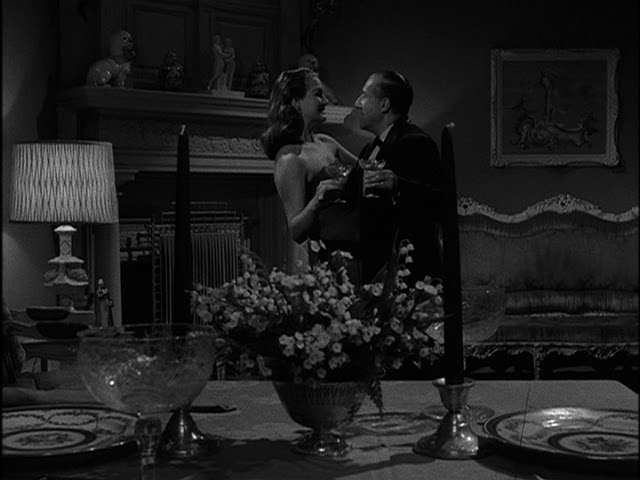
The biggest technical hang-up with this episode was the fact that real actors were hired to portray the human statues in the mortuary. No matter how skilled the actor, it is physically impossible for a person to stand totally motionless. To shoot the tableau scenes director Douglas Heyes knew that he would have to keep the camera moving at all times so that the viewer would never be able to see the actors moving. For the most part this is done successfully, but there are several scenes where the actors movements are quite noticeable (check out the scene where the couple is slow dancing to a violin quartet, both of them holding glasses of champagne; the actors are quite still but the champagne is clearly not. There is also the lengthy scene in the crowded town hall where several of the actors can be seen blinking profusely). Again, this isn’t a major blunder and only works against the episode conceptually. Over time I have found that these nuances are part of the episode’s charm as they give the impression that Happy Glades is all a façade, which makes it even more frightening, the same way that no attempt was made to mask the fact that these men are clearly not in any kind of town at all but on a Hollywood backlot.  Everything in this place seems quite obviously phony. There is also another interesting shot where two of the astronauts are seen standing on a bridge. Instead of a filmed shot Heyes, or possibly film editor Joseph Gluck, inserted a noticeably grainy still photograph instead. This may have been a technical oversight never intended to make the final cut.
Although it has its shortcomings and may not be an episode which will suit everyone’s tastes, “Elegy” is a highly atmospheric episode with its own kind of charm and is one of my personal favorites from the first season.

Grade: B

Notes:
--Director Douglas Heyes directed several additional episodes of the series, including the classic episodes "The After Hours," "The Howling Man," "Eye of the Beholder," and "The Invaders." Heyes wrote three episodes of Rod Serling's Night Gallery, "The Dead Man" (based on the story by Fritz Leiber and which Heyes also directed), "The Housekeeper," and "Brenda" (based on the story by Margaret St. Clair), the latter two being written under the pseudonym Matthew Howard.
--“Elegy" was originally published in the February, 1953 issue of Imagination: Stories of Science and Fantasy. It was also published in William F. Nolan’s science fiction anthology A Sea of Space (Bantam, 1970) as well as The Twilight Zone: the Original Stories (Greenberg, Matheson, Waugh, eds.  Avon, 1985; MJF, 1997).
--Cecil Kellaway appears in another episode written by Charles Beaumont, season four’s “Passage on the Lady Anne."
--"Elegy" was adapted into a Twilight Zone Radio Drama starring Blair Underwood.


--Brian Durant