|
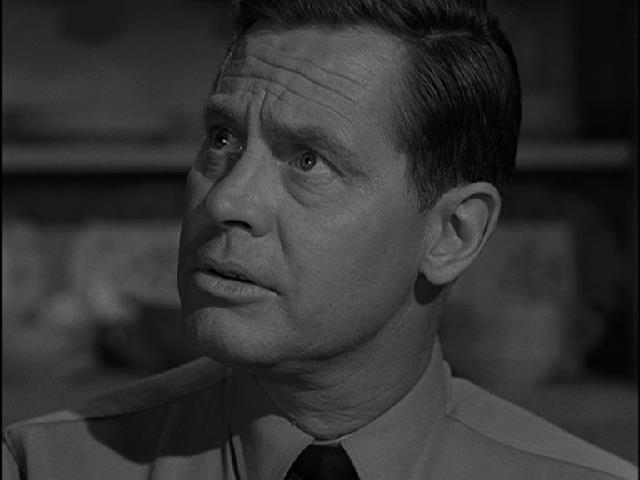
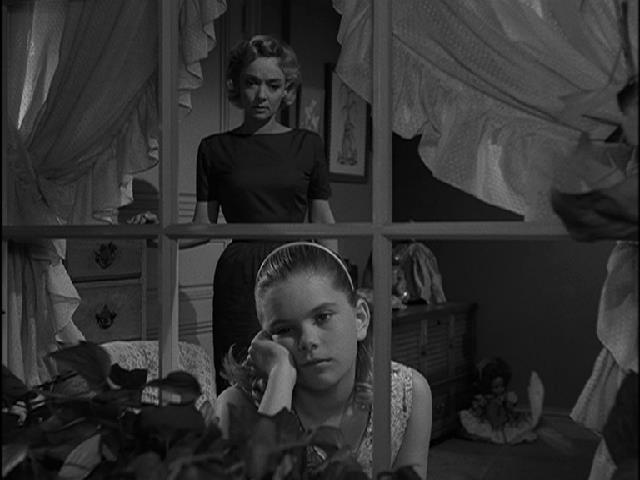
| Ann Jillian as the telepathic girl Ilse and Irene Dailey as the stern Miss Frank |
“Mute”
Season Four, Episode 107
Original
Air Date: January 31, 1963
Cast:
Cora
Wheeler: Barbara Baxley
Harry
Wheeler: Frank Overton
Miss
Frank: Irene Dailey
Ilse:
Ann Jillian
Frau
Werner: Eva Soreny (Éva Szörényi)
Holger
Nielsen: Robert Boon
Fran
Nielsen: Claudia Bryar
Tom
Poulter: Percy Helton
Karl
Werner: Oscar Beregi (Jr.)
Crew:
Writer:
Richard Matheson (based on his story)
Director:
Stuart Rosenberg
Producer:
Herbert Hirschman
Director
of Photography: Robert Pittack
Production
Manager: Ralph W. Nelson
Associate
Producer: Murray Golden
Assistant
to the Producer: John Conwell
Music:
Fred Steiner
Art
Direction: George W. Davis &
Edward Cartagno
Film
Editor: Eda Warren, A.C.E.
Set
Decoration: Henry Grace & Don
Greenwood, Jr.
Assistant
Director: Ray de Camp
Sound:
Franklin Milton & Joe Edmondson
Rod
Serling’s Wardrobe: Eagle Clothes
Filmed
at MGM Studios
And Now, Mr. Serling:
“The talented
author Richard Matheson pays a return visit to Twilight Zone with a story
called ‘Mute.’ It provides an exceptional challenge to the acting talents of
Barbara Baxley, Frank Overton, and an unusual twelve-year-old by the name of
Ann Jillian.”
 Rod Serling’s Opening Narration:
“What you’re
witnessing is the curtain-raiser to a most extraordinary play; to wit, the
signing of a pact, the commencement of a project. The play itself will be
performed almost entirely offstage. The final scenes are to be enacted a decade
hence and with a different cast. The main character of these final scenes is
Ilse, the daughter of Professor and Mrs. Nielsen, age two. At the moment she
lies sleeping in her crib, unaware of the singular drama in which she is to be involved.
Ten years from this moment, Ilse Nielsen is to know the desolating terror of
living simultaneously in the world – and in the Twilight Zone.”
Summary:
The story begins in 1953 in Düsseldorf, Germany where four couples (all parents of small children) form a pact to begin a psychological experiment. Believing human
beings to have natural telepathic abilities, which have been dulled through
centuries of verbal language usage, the families formulate a plan to isolate
their children and train them to develop their inborn telepathic skills. One
family, the Nielsons, including a daughter named Ilse, are leaving Germany to
return to the United States. This causes some anxiety for the
Werners, a closely allied family who are to stay in Germany.
The
story moves forward a decade to a point in which the isolated lives of the
Nielsons in German Corners, Pennsylvania are tragically disrupted by a deadly
house fire in which both Mr. and Mrs. Nielson perish. Ilse, now twelve years
old, is miraculously found unharmed outside the house by Tom Poulter, a local
volunteer firefighter. The local sheriff, Harry Wheeler, attempts to
communicate with the girl but she refuses to speak. The sheriff takes the young
girl home where his wife, Cora, instantly forms an intense protective bond with
the child, fueled by the lingering grief over the drowning death of her own daughter
some time before.
The
Wheelers cannot understand why Ilse, a powerful telepath, refuses to speak.
They begin to darkly speculate on what may have happened to the girl whilst in
the care of her eccentric parents, who refused to assimilate into the local
community. Harry Wheeler does his duty and attempts to find relatives with
which he can place the girl. He uses the return addresses on the Nielsons’s
mail to send out letters apprising the recipients of the situation. Unbeknownst
to Wheeler, Cora destroys the letters.
Meanwhile,
Ilse is struggling in this new world of spoken language. Her isolated
upbringing and telepathic development have made spoken language both a dulling
sensation upon the brain and an assault upon the senses. She fights against
Cora’s attempts to make her speak. After weeks of not hearing anything in
response to his letters, Harry Wheeler makes the fateful decision to enroll
Ilse at the local school, the commencement of a “normal” life for the girl. This
results in the appearance of Miss Frank, the local schoolteacher. Miss Frank, a
stern woman whose father attempted to develop her into a medium as a child,
believes in the power of personal will to overcome the overriding influence of a
negative environment. With the aid of her class, Miss Frank berates and
antagonizes Ilse in an attempt to break her will and force her to speak and
behave as a normal child.
Arriving
in German Corners at this time is Mr. and Mrs. Werner, who, having not heard
from the Nielsens in an unusually long time, have traveled to the United States
to investigate. They connect with Harry Wheeler who takes them to his home to
await Ilse’s return from school. The Werners realize that they are too late in
arriving and that the Wheelers have unknowingly corrupted Ilse’s telepathic
abilities by the girl’s forced assimilation into the local community.
The
suspicions of the Werners are confirmed when Ilse arrives home from school
completely broken of her remarkable abilities. An unconvincing happy ending
ensues in which it is suggested that Ilse will be happier now that she is free
from the influence of her parents and ensconced in the loving home of the
Wheelers.
Rod Serling’s Closing Narration:
“It has been
noted in a book of proven wisdom that perfect love casteth out fear. While it’s
unlikely that this observation was meant to include that specific fear which
follows the loss of extrasensory perception, the principle remains, as always,
beautifully intact. Case in point, that of Ilse Nielsen, former resident of the
Twilight Zone.”
Commentary:
“It
was the sound.
Like endless club strokes across his
vivid mind, it pulsed and throbbed into him in an endless, garbled din. He
sensed it was communication of a sort but it hurt his ears and chained
awareness and locked incoming thoughts behind dense, impassable walls.
Sometimes, in an infrequent moment
of silence he would sense a fissure in the walls and, for that fleeting moment,
catch hold of fragments – like and animal snatching scraps of food before the
trap jaws clash together.”
-“Mute” by Richard Matheson
 |
| Barbara Baxley and Irene Dailey |
The immediate and lingering effects of “Mute” are those of its
conflicted resolution. Most viewers are unlikely to be attuned to writer
Richard Matheson’s proclamation, spoken by Frau Werner (Éva Szörényi) and reiterated by the
author in an interview with editor Stanley Wiater, for Richard Matheson’s The Twilight Zone Scripts, Volume Two, that
Ilse, the young telepathic girl who has been rudely stripped of her
extraordinary abilities through forced assimilation by well-meaning caretakers,
is in a better place at the end of her ordeal now that she is a “normal” child
in the home of loving, if obtuse, adoptive parents. Prime among the
reasons this resolution rings hollow is that the viewer is told, not shown, that
Ilse’s birth parents were unloving. As such, the characterization of her
parents as single-minded scientists who provide everything for their daughter
except affection and warmth is not convincingly argued. There is also the
notion of telepathy itself. Whether one views such an ability as a gift or a
curse, and it has been convincingly portrayed as both in speculative fiction,
the viewer likely sees such an ability as something which should not be
destroyed for the cause of a subjective view of normality.
However large this flawed
resolution appears to the viewer, “Mute” possesses moments of engaging drama
which compel less from the strength of the narrative than from the convictions
of the observations, particularly in what the events display about Americanism,
assimilation, outsider syndrome, and the nature of grief.
 |
Original illustration for
"Lover, When You're Near Me"
by Ed Emshwiller
Galaxy Science Fiction, May, 1952 |
The extraordinary abilities which author
Charles Fort, in his 1932 book on the subject, labeled “wild talents”* has long
formed rich grain for the SF mill. Telepathy, and related abilities such as
telekinesis (moving objects by mental concentration), pyrokinesis (igniting
fire by mental concentration), and precognition (foretelling the future), have
fascinated SF writers and readers alike since at least the late 19th
and early 20th centuries. Early examples include American writer
Edward Bellamy’s 1889 story, “To Whom This May Come,” about an adventurer who
discovers an island of telepathic natives who have long discarded spoken
language. The English occultist and writer Aleister Crowley used the concept of
telepathy to nightmarish effect in his 1913 tale “The Testament of Magdalen
Blair,” in which a telepathic woman experiences the moment-by-moment terror and
agony of her husband’s slow death and descent into an afterlife far different
from the heavenly promises of religious faith. Some critics consider the tale
the most disturbing in the English language.
Richard
Matheson first explored the subject of telepathy with “Lover, When You’re Near
Me,” a 1952 story in which an alien planet serves as a harrowing trap for the Earth
men sent there when they are preyed upon by a native female servant with strong
telepathic abilities and even stronger desires. Later works by Matheson in a
similar vein include the 1963 story, “Girl of My Dreams,” in which a petty
crook exploits his girlfriend’s precognitive abilities, A Stir of Echoes, Matheson’s 1958 novel in which a suburbanite is
hypnotized at a house party, thereby unlocking his ability to sense the
presence haunting his home, and Hell
House, Matheson’s 1971 modern classic in which a small group of psychics
and sensitives investigate the Belasco House, the “Mount Everest of haunted
houses.”
By
the middle of the 1970s, Matheson embarked on a serious exploration of
metaphysical topics, resulting in a pair of novels, Bid Time Return (aka Somewhere
in Time) (1975), a World Fantasy Award-winning novel about a terminally ill
man who mentally wills his way backwards in time to connect with a beautiful
actress from a century earlier, and What
Dreams May Come (1978), which explores the afterlife through the
perspective of a family tragedy and a love which transcends death. Similar
thematic explorations flavor many of Matheson’s subsequent novels and culminate
in his manifesto on the metaphysical, The
Path: A New Look at Reality (1993).
Telepathy
and related abilities were occasionally explored on The Twilight Zone though seldom in so clinical a way as in “Mute,”
which in many ways resembles the frequently used narrative theme of the “wild
child,” in which a feral, or aboriginal, child is introduced into “civilized”
society. The most notable example of this is Rudyard Kipling’s The Jungle Book. Typically, themes of
extrasensory perception were used on the series for morality plays (“What You
Need”), humor (“The Prime Mover”), or ghostly thrills (“Twenty-Two”).
As speculative fiction
moved from the external to the internal, with the emergence of writers who
desired to explore the varieties of interpersonal relationships and the variegated
perspectives of the self, writers found telepathy and related abilities to be
useful lenses through which these topics could be explored, resulting in some
of the finest SF literature of the 20th century. Examples include
John Wyndham’s 1955 novel The Chrysalids,
about an intolerant fundamentalist society which arises from
post-apocalyptic wreckage to practice a form of eugenics which discriminates
against those with telepathic “mutations,” Philip K. Dick’s Ubik (1969), in which psychics are
utilized in corporate espionage, Daphne du Maurier’s 1970 novella “Don’t Look
Now,” in which a pair of elderly psychics unwittingly set in motion a tragedy
which befalls a bereaved couple who have recently lost their young daughter,
Robert Silverberg’s influential 1972 novel Dying
Inside, about a telepath who slowly loses his inborn ability while also
losing a semblance of personal identity, and John Farris’s bestseller The Fury (1976), which combines a
startling tale of psychic twins with the exploits of the espionage thriller. These
wild talents also prominently feature in the works of Stephen King, who counts
both Matheson and Farris as influences. Themes of telepathy and other outré
abilities have further permeated speculative fiction to a saturation point,
resulting in scores of related novels, stories, comic books, and films too numerous
to list.
 |
| Cover art by Richard Powers |
The original short
story “Mute” was published in the 1962 paperback anthology The Fiend in You from Ballantine Books, edited by Matheson’s close
friend and fellow Twilight Zone writer
Charles Beaumont. The Fiend in You, an
anthology of exceptionally high quality which has unfortunately never been
reprinted, served as much as a showcase for the Southern California Group as
for its thematic goal as stated in Beaumont’s introduction: to shrug off the
Gothic archetypes of horror fiction, which are no longer frightening, and push
the genre toward psychological horror, as exemplified by the works of Robert
Bloch, Fritz Leiber, and the writers of The
Twilight Zone. Matheson held the distinction of having two stories in the
anthology, one at each end of the book. Other authors to appear in the
anthology include George Clayton Johnson, Henry Slesar, Ray Bradbury, Stanley
Ellin, Charles E. Fritch, William F. Nolan, and several more. The importance of
this little-known anthology has been unremarked upon through the years but it
remains a key turning point away from the external horrors of the Gothic toward
the inward horrors seen through the perspective of psychological disorder.
Matheson,
typically faithful to himself when adapting his works, changed several elements
when adapting his original short story into a teleplay for The Twilight Zone. Some of these changes, such as the gender of the
telepathic child, changed from the boy Paal in the story to the girl Ilse in
the episode, came at the behest of the production, who perhaps believed that a female
child would elicit more sympathy from the audience. This change necessitated
another in that the Wheelers lost their son David in the story but their
daughter Sally in the episode. Another gender change occurred in the case of
Miss Frank’s tale of her troubled upbringing. In the original story, Miss
Frank’s father died and her mother became obsessed with communicating with him
in the great beyond to the point of forcing mediumship upon her young daughter.
In the episode, it is changed so that Miss Frank’s father is the parent who
forces mediumship upon her. Other changes came as necessary to the change from
print to film. Matheson’s original story is told mostly in flashback while the
episode favors a more traditional linear approach. Unfortunately, the
saccharine and unconvincing happy ending is not a product of the episode but is
lifted nearly whole from the original short story.
It
is worth noting that Matheson was sincere with the ending to “Mute,” while also
acknowledging its overall ineffectiveness. This lack of effectiveness is
largely due to the unsympathetic characters in the drama. Harry Wheeler
comes across as cold and aloof, simply wishing to be unburdened of the child.
Cora Wheeler is largely a pathetic figure, imperceptive and unable to provide
the sort of care Ilse truly needs. Miss Frank is purely a villain, placed into
the story simply to antagonize. The only sympathetic character is the
telepathic child. In the original short story, Matheson gives ample space to
displaying the child’s perspective during assaults by the well-meaning
Wheelers. Speech to the child is described as like “knife strokes across the
weave of consciousness,” and Cora’s attempts to verbally communicate are
related thus from the child’s perspective: “He knew there was only love in her
but the sound would destroy him. It would chain his thoughts – like putting
shackles on the wind.” From the reader’s/viewer’s perspective, the end of the
drama feels more as though the child has been defeated rather than freed from a
mental affliction. It is this tonally depressive quality which mars the smooth transition of the sunny resolution.
The
adaptation does allow Matheson to expand and better explain some aspects of the
short story. The episode gives a clear explanation of how the Nielsens came to
settle in German Corners (an inheritance). It also allows Matheson to expand
the abilities of the telepathic child, as Ilse is able to perform feats such as
sensing when a phone is going to ring moments before it does so, and entering
the minds of those several rooms away, which were not known to be abilities of
the boy Paal from the original story. Oddly enough, a scene near the final act
of the drama seems lifted directly from Ray Bradbury’s third season episode “I
Sing the Body Electric,” going so far as to use the same town square set and to
replicate the narrative action of an upset young girl running from a house
toward the town square only to be pursued by a mother figure who saves the girl
from being run down in traffic.
Both the original story and the episode
approach timely themes of isolation, alienation, and assimilation which remain divisive
topics in American society today. Chief among these themes is the effects of outsider
syndrome (the feeling of not belonging experienced by those who differ from the
common characteristics of a population) and the pressure to assimilate,
particularly in relation to those seen as different or foreign in their
thoughts, actions, or heredity. The German Professor Werner is mocked by the
first townsperson he comes into contact with, and the self-isolating nature of
the Nielsens is repeatedly spoken of in condescending terms by the characters
in the story. This intolerant attitude is focused in the character of Miss
Frank, the spinster schoolteacher whose troubled upbringing has colored all her
subsequent thoughts about teaching, discipline, and assimilation. The tragedy
of the play is that Miss Frank and the Wheelers truly believe their destructive
actions are in the best interest of the child, and remain at the end of the
story completely unaware of the beauty they have destroyed for the sake of
plainness.

Barbara Baxley (1923-1990) is top-billed
as Cora Wheeler, the grieving mother who clings to the orphaned child Ilse as a
second chance for motherhood. Baxley appeared in Rod Serling’s early teleplay
for Kraft Theatre, “The Twilight
Rounds” (1953), a progenitor of his celebrated teleplay, “Requiem for a Heavyweight.”
Baxley also appeared in such genre television programs as Inner Sanctum, Climax!, One Step Beyond, Alfred Hitchcock Presents (in Ray Bradbury's fourth season episode, "Design for Loving," based on his 1949 story, "Marionettes, Inc."), and
‘Way Out, which briefly ran before The Twilight Zone’s broadcast time
during the second season. In the very Twilight
Zone-esque ‘Way Out episode “The
Overnight Case,” written by Nicholas Pryor, Baxley plays a woman who cannot
awaken from a recurrent nightmare, supported in the play by fellow Twilight Zone performers Martin Balsam
and Kevin McCarthy. Baxley was a staple of the Broadway stage during the 1960s
and 1970s, during which time she began to receive notable roles in such films
as Nashville (1975) and Norma Rae (1979). Baxley returned to The Twilight Zone in 1986 when she
appeared in the revival series segment, “Profile in Silver.” Her final film
role was for the 1990 horror film sequel The
Exorcist III.
 Versatile character actor Frank Overton (1918-1967) plays Sheriff Harry Wheeler, a rather unfeeling character who is far removed from Overton's performance as Martin Sloan's (Gig Young) father in Rod Serling's moving first season episode "Walking Distance." Overton perfected his craft on the New York stages before moving into film and television in the early 1950s. Overton played another memorable sheriff in the 1962 film To Kill a Mockingbird and appeared on such genre television programs as Boris Karloff's Thriller, One Step Beyond, 'Way Out, The Alfred Hitchcock Hour, The Invaders, and in his final television role, the Star Trek episode "This Side of Paradise," from a story by Twilight Zone writer Jerry Sohl.
 The “unusual twelve-year-old” of Rod
Serling’s preview narration is actress Ann Jillian (b. 1950), whose name is
misspelled (as “Ann Jilliann”) in the closing credits. Born Ann Nauseda,
Jillian began her career in television on such series as Leave it to Beaver before appearing in Walt Disney’s Babes in Toyland (1961). Numerous
television roles followed. Jillian found a spark of career renewal with the
1980s sitcom It’s a Living, playing Cassie Cranston, which resulted in Jillian gaining notoriety as
a sex symbol. Jillian briefly had her own sitcom for the 13-episode series Ann Jillian later in the decade. Jillian
retired from acting at the turn of the century with her last credit in 2000 for
an episode of Walker, Texas Ranger.
The “unusual twelve-year-old” of Rod
Serling’s preview narration is actress Ann Jillian (b. 1950), whose name is
misspelled (as “Ann Jilliann”) in the closing credits. Born Ann Nauseda,
Jillian began her career in television on such series as Leave it to Beaver before appearing in Walt Disney’s Babes in Toyland (1961). Numerous
television roles followed. Jillian found a spark of career renewal with the
1980s sitcom It’s a Living, playing Cassie Cranston, which resulted in Jillian gaining notoriety as
a sex symbol. Jillian briefly had her own sitcom for the 13-episode series Ann Jillian later in the decade. Jillian
retired from acting at the turn of the century with her last credit in 2000 for
an episode of Walker, Texas Ranger.
The cast is rounded out by three talented performers.
Irene Dailey (1920-2008) portrays Miss Frank. Dailey manages to imbue a rather
one-note villain with a semblance of complexity and subtle shading. Dailey, a
native New Yorker and the sister of actor Dan Dailey, is another product of the
New York stages, appearing in several Broadway productions throughout her
career. Dailey found her niche playing immoral or villainous characters in soap
operas such as The Edge of Night and Another World, the latter for which she
won an Emmy Award. The Hungarian actor Oscar Beregi, Jr. (1918-1976) (billed simply as Oscar
Beregi), portrayed Professor Werner. Beregi is likely a familiar face to regular Twilight Zone viewers, having previously played a criminal
mastermind who suffers an ironic fate in the second season episode, “The Rip
Van Winkle Caper,” and a Nazi fugitive who receives a dose of supernatural
justice in the third season episode, “Deaths-Head Revisited.” Those interested
in information about Beregi’s long career are directed to our commentaries on
those episodes. Portraying Frau Werner is Hungarian actress Éva Szörényi (1917-2009), born Lersch Elvira and billed as Eva Soreny. An award-winning performer of the Hungarian National Theatre, Szörényi was a prolific performer in Hungarian films in the late 1930s and 1940s. She began appearing on American television in 1957, garnering roles on such programs as Perry Mason, Kraft Suspense Theatre, and The Wild, Wild West, among others. Her last role was for the 2001 film An American Rhapsody.
The
final notable component of “Mute” is the varied and sensitive score from
composer Fred Steiner (1923-2011). Steiner scored several Twilight Zone episodes, including excellent scores for “King Nine
Will Not Return” and “The Passersby,” but his contributions to the series are
largely overshadowed by the contributions of other composers on the series. Steiner
provided music, often uncredited, for dozens of films and television series,
including Star Trek, Perry Mason, and
such low-budget genre offerings as Teenagers
from Outer Space (1959), Robinson
Crusoe on Mars (1964), Night of the
Living Dead (1968), and Kingdom of
the Spiders (1977). Steiner began his professional career scoring radio
programs such as Suspense. Steiner’s
father, also a musician, performed in Nathan Van Cleave’s orchestra. Van
Cleave, whose music is familiar to Twilight
Zone fans from such episodes as “The Midnight Sun,” “I Sing the Body
Electric,” “Jess-Belle,” and others, was a prominent influence on the young
musician. Steiner provided uncredited music for such memorable films as Return of the Jedi, Star Trek: The Motion
Picture, and Airplane!
“Mute,”
like much of the fourth season’s offerings, is an engaging though flawed
episode which sacrifices sympathetic characterizations and narrative consistency to
explore timely themes of social alienation as well as broader themes of
metaphysics and the ways in which these themes may logically be thought to
intrude upon everyday life. It can definitely be recommended
for all viewers though said viewers will likely be divided about returning to
“Mute” for additional viewings.
Grade:
C
*In Matheson’s original short story he
gives a small indication of Fort’s influence when Harry Wheeler and Tom Poulter
find the mock-Fortean book The Unknown Mind amid
the ruins of the Nielson’s burned house.
Grateful Acknowledgement is made for information found in the following:
-Richard Matheson's The Twilight Zone Scripts, Volume Two, edited by Stanley Wiater (Gauntlet Press, 2002)
-The Guide to Supernatural Fiction by E.F. Bleiler (Kent State University Press, 1983)
-The Internet Movie Database (imdb.org)
Notes:
--“Mute,”
the original short story, was initially published in the 1962 anthology The Fiend in You, edited
by Charles Beaumont (Ballantine Books). It has been reprinted in Matheson’s
collections Shock II (1964), Collected
Stories (1989), Button, Button:
Uncanny Stories (2008), and The Best
of Richard Matheson (2017). Matheson’s
teleplay for “Mute” was published in Richard Matheson’s The Twilight Zone
Scripts, Volume Two, edited by Stanley
Wiater (2002).
--Stuart
Rosenberg also directed the first season episode “I Shot an Arrow into the
Air.”
--Barbara
Baxley also appeared in the first Twilight Zone revival series segment,
“Profile in Silver.”
--Frank
Overton also appeared in the first season episode “Walking Distance.”
--Robert
Boon also appeared in the third season episode, “Deaths-Head Revisited.”
--Claudia
Bryar also appeared in the first Twilight Zone revival series segment “Welcome
to Winfield.”
--Percy
Helton also appeared in the fifth season episode, “Mr. Garrity and the Graves.”
--Oscar
Beregi (Jr.) also appeared in the second season episode “The Rip Van Winkle
Caper” and the third season episode “Deaths-Head Revisited.”
--The
episode also features Bill Erwin in an uncredited role. Erwin appeared in such
additional episodes as “Mr. Denton on Doomsday,” “Walking Distance,” and “Will
the Real Martian Please Stand Up?” as well as the Twilight Zone Radio Drama production of “Ninety Years Without Slumbering.”
--Fred
Seiner also composed and/or conducted music for the episodes “King Nine Will
Not Return,” “A Hundred Yards Over the Rim,” “The Passersby,” “Miniature,” “I
Dream of Genie,” and “The Bard.”
--“Mute”
was adapted as a Twilight Zone Radio
Drama starring Wade Williams.
-JP

 Sources generally agree that John
Huston’s 1941 film The Maltese Falcon, the
third cinematic adaptation of Dashiell Hammett’s 1930 novel, was the first
major Film Noir. Sources differ on the end of Film Noir’s classic era. A
frequently cited end date is 1960 and the release of Alfred Hitchcock’s Psycho, based on Robert Bloch’s 1959
novel. Hitchcock borrowed elements from Film Noir (black-and-white cinematography, a
murder mystery, a woman on the run, the grizzled private eye), as he had for such previous films as Strangers on a Train (1951) and The Wrong Man (1956), and delivered a
shocking psycho-sexual nightmare which heralded the arrival of a more daring and
ferocious type of film thriller. One of the most transitional works in the
history of cinema, Psycho was an
enormous influence on subsequent crime and suspense films, not to mention literature and illustrative arts. A year before Psycho was released to theaters, The Twilight Zone premiered on American
television.
Sources generally agree that John
Huston’s 1941 film The Maltese Falcon, the
third cinematic adaptation of Dashiell Hammett’s 1930 novel, was the first
major Film Noir. Sources differ on the end of Film Noir’s classic era. A
frequently cited end date is 1960 and the release of Alfred Hitchcock’s Psycho, based on Robert Bloch’s 1959
novel. Hitchcock borrowed elements from Film Noir (black-and-white cinematography, a
murder mystery, a woman on the run, the grizzled private eye), as he had for such previous films as Strangers on a Train (1951) and The Wrong Man (1956), and delivered a
shocking psycho-sexual nightmare which heralded the arrival of a more daring and
ferocious type of film thriller. One of the most transitional works in the
history of cinema, Psycho was an
enormous influence on subsequent crime and suspense films, not to mention literature and illustrative arts. A year before Psycho was released to theaters, The Twilight Zone premiered on American
television.  Perhaps the most important element on The Twilight Zone was the writers. Series creator Rod Serling, always creatively concerned with the
losers, the dreamers, and the doomed, was naturally at the forefront of the Noir influence on the series, but he also recruited writers who were
sensitive to the literary style from which the cinematic genre was born. Richard
Matheson began his career as a novelist with the James M. Cain-inspired effort Someone Is Bleeding (1953) while Charles
Beaumont and John Tomerlin collaborated (as Keith Grantland) on a novel, Run From the Hunter (1957), which bore
the influence of David Goodis’s 1946 novel Dark
Passage, which likely inspired the man-on-the-run television series The Fugitive (1963-1967). Meanwhile, a
young writer named George Clayton Johnson arrived in Hollywood fresh off the
sale of a film treatment which became the popular, Noir-influenced heist film Ocean’s 11 (1960). These
writers were responsible for the show’s most overtly Noir-influenced
output.
Perhaps the most important element on The Twilight Zone was the writers. Series creator Rod Serling, always creatively concerned with the
losers, the dreamers, and the doomed, was naturally at the forefront of the Noir influence on the series, but he also recruited writers who were
sensitive to the literary style from which the cinematic genre was born. Richard
Matheson began his career as a novelist with the James M. Cain-inspired effort Someone Is Bleeding (1953) while Charles
Beaumont and John Tomerlin collaborated (as Keith Grantland) on a novel, Run From the Hunter (1957), which bore
the influence of David Goodis’s 1946 novel Dark
Passage, which likely inspired the man-on-the-run television series The Fugitive (1963-1967). Meanwhile, a
young writer named George Clayton Johnson arrived in Hollywood fresh off the
sale of a film treatment which became the popular, Noir-influenced heist film Ocean’s 11 (1960). These
writers were responsible for the show’s most overtly Noir-influenced
output.  For
his series debut writer Charles Beaumont adapted his story from the October, 1958 issue of Playboy into a tense thriller concerning Edward Hall (Richard Conte), a man with a
heart condition whose overactive imagination has turned his dreaming state deadly.
Hall’s recurring nightmare centers on a carnival roller coaster and the beautiful
but dangerous Maya the Cat Girl. Conte, who built a career
playing gangsters in films such as Under
the Gun (1951) and The Big Combo (1955)
is given the unenviable task of acting manic for half an hour yet pulls it off
brilliantly. Throw in a psychiatrist (John Larch), a seedy carnival, and a femme fatale in the form of Canadian actress Suzanne
Lloyd (in an unforgettable performance as the alluring yet psychopathic Maya
the Cat Girl) and “Perchance to Dream” wears its Noir influence on its sleeve. The
knockout punch is the weird musical score from Nathan Van Cleave and director
Robert Florey’s twisted camera work, which combine to perfectly illuminate Edward Hall’s deteriorating mental state. “Perchance to Dream” is an underrated
episode overall but for those interested in the influence of Film Noir on the
series it is essential viewing.
For
his series debut writer Charles Beaumont adapted his story from the October, 1958 issue of Playboy into a tense thriller concerning Edward Hall (Richard Conte), a man with a
heart condition whose overactive imagination has turned his dreaming state deadly.
Hall’s recurring nightmare centers on a carnival roller coaster and the beautiful
but dangerous Maya the Cat Girl. Conte, who built a career
playing gangsters in films such as Under
the Gun (1951) and The Big Combo (1955)
is given the unenviable task of acting manic for half an hour yet pulls it off
brilliantly. Throw in a psychiatrist (John Larch), a seedy carnival, and a femme fatale in the form of Canadian actress Suzanne
Lloyd (in an unforgettable performance as the alluring yet psychopathic Maya
the Cat Girl) and “Perchance to Dream” wears its Noir influence on its sleeve. The
knockout punch is the weird musical score from Nathan Van Cleave and director
Robert Florey’s twisted camera work, which combine to perfectly illuminate Edward Hall’s deteriorating mental state. “Perchance to Dream” is an underrated
episode overall but for those interested in the influence of Film Noir on the
series it is essential viewing. 
 This most overtly Film Noir-influenced episode is a Rod Serling adaptation of an unpublished story by George Clayton Johnson
about a criminal named Arch Hammer who can change his appearance at will. The
tough dialogue is straight out of a paperback novel and the players are Film Noir standbys: the conman, the gangster, the jazz musician, the washed up
boxer, the lonely nightclub singer. The episode’s strength is in the production
design and photography, including a dazzling floating neon sequence. It remains a memorable debut for George Clayton Johnson on the
series, whose jazzy writing was perfectly filtered through Rod Serling’s
remarkable gifts for characterization and dialogue. Johnson’s story was later
published in the October, 1961 issue of Rogue.
This most overtly Film Noir-influenced episode is a Rod Serling adaptation of an unpublished story by George Clayton Johnson
about a criminal named Arch Hammer who can change his appearance at will. The
tough dialogue is straight out of a paperback novel and the players are Film Noir standbys: the conman, the gangster, the jazz musician, the washed up
boxer, the lonely nightclub singer. The episode’s strength is in the production
design and photography, including a dazzling floating neon sequence. It remains a memorable debut for George Clayton Johnson on the
series, whose jazzy writing was perfectly filtered through Rod Serling’s
remarkable gifts for characterization and dialogue. Johnson’s story was later
published in the October, 1961 issue of Rogue.
 Professional boxing is unquestionably the
sport of choice in Film Noir. In films such as Body
and Soul (1947), The Set-Up (1949), and Champion (1949), boxing is viewed
through the lens of loyalty, honor, criminality, and consequence. Rod Serling’s
writing career was launched into the stratosphere with his Playhouse 90 effort “Requiem for a Heavyweight” (1956), about a washed up boxer trying for a second chance in life, and he
returns here to tackle the sport through a lens of fantasy. The result is a heartbreaking meditation on faith and forgiveness
performed by a groundbreaking group of African American performers who broke through the color lines of American television. It remains one of Serling’s
most underrated efforts on the series and comes highly recommended.
Professional boxing is unquestionably the
sport of choice in Film Noir. In films such as Body
and Soul (1947), The Set-Up (1949), and Champion (1949), boxing is viewed
through the lens of loyalty, honor, criminality, and consequence. Rod Serling’s
writing career was launched into the stratosphere with his Playhouse 90 effort “Requiem for a Heavyweight” (1956), about a washed up boxer trying for a second chance in life, and he
returns here to tackle the sport through a lens of fantasy. The result is a heartbreaking meditation on faith and forgiveness
performed by a groundbreaking group of African American performers who broke through the color lines of American television. It remains one of Serling’s
most underrated efforts on the series and comes highly recommended. Director Douglas Heyes was up to the
challenge for this technically challenging two-man play showcasing Rod Serling’s
concerns with the doomed and the redeemed. It is another example of Serling’s
ability to combine the crime drama with fantasy as Joe Mantell plays a cowardly
small-time crook who comes face-to-face with the hidden self beneath the
surface. William D. Gordon, later to play the lead doctor in Serling’s
masterpiece, “Eye of the Beholder,” is suitably slimy as an antagonistic thug. Though
clearly influenced by Film Noir, Serling’s redemptive ending is unique in a typically nihilistic genre.
Director Douglas Heyes was up to the
challenge for this technically challenging two-man play showcasing Rod Serling’s
concerns with the doomed and the redeemed. It is another example of Serling’s
ability to combine the crime drama with fantasy as Joe Mantell plays a cowardly
small-time crook who comes face-to-face with the hidden self beneath the
surface. William D. Gordon, later to play the lead doctor in Serling’s
masterpiece, “Eye of the Beholder,” is suitably slimy as an antagonistic thug. Though
clearly influenced by Film Noir, Serling’s redemptive ending is unique in a typically nihilistic genre.

 Functioning almost as a darkly humorous remake
of George Clayton Johnson’s “The Four of Us Are Dying,” “Dead Man’s Shoes”
finds bum Nate Bledsoe (Warren Stevens) steal a pair of shoes off a murdered
gangster who’s been dumped in an alley. A game of switched identities ensues as
Bledsoe becomes the murdered man as long as he wears the shoes. Warren Stevens’s
deadpan acting style perfectly complements Montgomery Pittman’s direction as
does the jazz-inflected cues from the stock music. The supporting cast is rounded out by
Richard Devon as a long-faced mobster and the statuesque Joan Marshall as the
dead gangster’s girl. “Dead Man’s Shoes” was remade, as the
entertaining “Dead Woman’s Shoes,” for the first revival Twilight Zone series in 1985.
Functioning almost as a darkly humorous remake
of George Clayton Johnson’s “The Four of Us Are Dying,” “Dead Man’s Shoes”
finds bum Nate Bledsoe (Warren Stevens) steal a pair of shoes off a murdered
gangster who’s been dumped in an alley. A game of switched identities ensues as
Bledsoe becomes the murdered man as long as he wears the shoes. Warren Stevens’s
deadpan acting style perfectly complements Montgomery Pittman’s direction as
does the jazz-inflected cues from the stock music. The supporting cast is rounded out by
Richard Devon as a long-faced mobster and the statuesque Joan Marshall as the
dead gangster’s girl. “Dead Man’s Shoes” was remade, as the
entertaining “Dead Woman’s Shoes,” for the first revival Twilight Zone series in 1985.


 As Film Noir moved into the fifties so did
the genre’s preoccupation with the Cold War. “The Jeopardy Room” combines Rod
Serling’s talent for social commentary and characterization while also
remaining an entertaining espionage thriller. Serling cuts the fat off the
typical spy tale and gets right to a game of cat and mouse staged between two motel rooms. If
the narrative jumps logic in a few spots it is suited to the type of pulp novel on screen Serling and company were trying to achieve. Although this episode
is sometimes dismissed as a tale better suited to Alfred Hitchcock Presents, it is
unmistakably the work of Rod Serling and displays the range of the series.
Director Richard Donner was the last great director to arrive on the series and
here shows his skill in staging a violent and paranoid thriller. Donner
embraces the staged quality of the script with some innovative camera work which keeps the dialogue-heavy action moving forward. The episode also benefits from the presence of Martin Landau, one of the finest actors of
his generation, and John Van Dreelen in a pleasingly over-the-top performance
as the villainous Commissar Vassiloff.
As Film Noir moved into the fifties so did
the genre’s preoccupation with the Cold War. “The Jeopardy Room” combines Rod
Serling’s talent for social commentary and characterization while also
remaining an entertaining espionage thriller. Serling cuts the fat off the
typical spy tale and gets right to a game of cat and mouse staged between two motel rooms. If
the narrative jumps logic in a few spots it is suited to the type of pulp novel on screen Serling and company were trying to achieve. Although this episode
is sometimes dismissed as a tale better suited to Alfred Hitchcock Presents, it is
unmistakably the work of Rod Serling and displays the range of the series.
Director Richard Donner was the last great director to arrive on the series and
here shows his skill in staging a violent and paranoid thriller. Donner
embraces the staged quality of the script with some innovative camera work which keeps the dialogue-heavy action moving forward. The episode also benefits from the presence of Martin Landau, one of the finest actors of
his generation, and John Van Dreelen in a pleasingly over-the-top performance
as the villainous Commissar Vassiloff.