Friday, July 5, 2013

"A Most Unusual Camera"


"A Most Unusual Camera"
Season Two, Episode 46
Original Air Date: December 16, 1960

Cast:
Chester Dietrich: Fred Clark
Paula Dietrich: Jean Carson
Woodward: Adam Williams
Pierre the Waiter: Marcel Hillaire

 Crew:
Writer: Rod Serling (original teleplay)
Director: John Rich
Producer: Buck Houghton
Associate Producer: Del Reisman
Director of Photography: George T. Clemens
Art Direction: George W. Davis and Philip Barber
Set Decoration: Henry Grace and H. Web Arrowsmith
Assistant Director: Darrell Hallenbeck
Casting: Ethel Winant
Editor: Bill Mosher
Sound: Franklin Milton and Charles Scheid
Music: Stock

And Now, Mr. Serling:
            "In this $28 a day hotel suite live three human being who have larceny firmly from their toes to where they part their hair. Amongst the loot of one evening's caper is this camera, which they soon discover has the most unique properties. It takes pictures of the future. Stick around for the development next week, on The Twilight Zone."

 Rod Serling's Opening Narration:
            "A most unimposing addition to the flotsam and jetsam that it came with, hardly worth mentioning really because a camera's a camera, some expensive, some purchasable at five-and-dime stores. But this camera, this one's unusual, because in just a moment we'll watch it inject itself in the destinies of three people. It happens to be a fact that the pictures that it takes can only be developed in The Twilight Zone."

 Summary:
            Chester Dietrich and his wife Paula are small time thieves that have just knocked over a curio shop, coming away with nothing more than a bunch of cheap junk erroneously reported in the local newspaper as priceless valuables. There is one item, however, that soon grabs their attention, an antique camera with markings in an unfamiliar language. Though appearing to be nothing more than a gimmick device, it is soon revealed that the camera has the uncanny ability to reveal events in the very near future.
            One picture shows Paula's brother, Woodward, when it seems impossible that he could be anywhere nearby as he is currently serving a prison sentence. Yet, five minutes later, Woodward appears in the hotel room doorway, having broken out of prison and tracked down the couple. 
            Once Chester figures out the unusual ability of the camera, he initially wants to offer it to the pubic to be put to good use. Paula and Woodward are against this idea, wanting instead to devise a way to make the camera pay off. It is not until Woodward turns the television to a channel broadcasting horse racing that Chester hits upon the idea of using the camera to make a killing at the racetrack, quickly dumping his idea of using the camera for the good of all people.
            The three crooks head to the racetrack in time to catch the final six races for the day with the foolproof idea of taking a picture of the winner's board before the race begins, thus revealing the completed winner's board using the camera's future revealing pictures. They bet high and win large on all six races and return to their hotel room loaded with cash.
            Pierre, the hotel's french waiter, arrives at their room to deliver champagne and is curious about the camera. He picks it up and translates the unfamiliar language written on the camera, presumably French, as: "ten to an owner." Realizing what this means, they rush Pierre from the room and scramble to remember how many pictures they've already taken and arrive at the answer of eight, two before the races and six at the track.
            There is a disagreement over what the do with the final two pictures, culminating in Chester and Woodward getting into a physical confrontation over the camera and accidentally taking a picture. When it develops, it shows Paula screaming. Chester, convinced that Paula is screaming because Woodward is trying to hurt him, and Woodward, convinced that Paula is screaming because Chester is trying to hurt him, get into a fight. As Chester pulls a knife, the two men move toward the open high-rise window in a struggle and go tumbling out and down to their deaths in the courtyard below. Paula screams (as first revealed in the picture) and is initially broken up about the death of her husband and her brother until she sees all the cash that is left behind. She quickly changes her tune, takes a picture of their dead bodies "simply for posterity," and then proceeds to gather up the loot.
            It's not hers for long, however, as Pierre shows up soon after to clean her out, having found out for himself that Paula and her cohorts are wanted by the police, who will be even more interested once the bodies of Chester and Woodward are discovered below. Pierre takes a look at the final picture and tells Paula that there are more than two bodies shown in the picture. Paula rushes to the window to see, trips on an electrical cord, and goes diving out of the window to her death. Pierre walks to the window and again looks at the picture, counting not two or three but four bodies. He, too, falls from the window, though his fall is kept off screen. The unusual camera, dropped by Pierre before he fell, lies on the floor and awaits its next owner. 

Rod Serling's Closing Narration:
            "Object known as a camera, vintage uncertain, origin unknown. But for the greedy, the avaricious, the fleet of foot, who can run a four minute mile so long as they're chasing a fast buck, it makes believe that it's an ally, but it isn't at all. It's a beckoning come-on for a quick walk around the block, in the Twilight Zone." 

Commentary:
            It is easy to label "A Most Unusual Camera" another "filler" episode largely dictated by Rod Serling's workload, which required him not only to function as a showrunner for the series (long before that label found wide use) but also to write the vast majority of the Twilight Zone's output. In a way it is another of Serling's quickly thrown together episodes and is in no way comparable to the writer's greatest work on the show, hanging as it does on an well-worn plot device, strung along on two cheap sets, with cliche characters playing on a shallow theme using overworked dialogue. It is easy to forget that such masterpieces of the series as "The Howling Man" and "Eye of the Beholder," episodes with great technical challenges, were filmed in three days. With that tight of a regular schedule, it is no wonder that occasionally the show would toss off an episode quickly and cheaply. It would be a mistake, obviously, to lump "A Most Unusual Camera" in with Serling's more consciously dramatic efforts when it is clearly more along the lines of Serling's over-the-top comedies, putting it in the same camp with such clunkers as "Mr. Dingle, the Strong," "Hocus-Pocus and Frisby," and "The Mind and the Matter."
            "A Most Unusal Camera" is better than the latter three episodes listed above and multiple viewings reveal it to be a minor success among the dreaded failures that are the Twilight Zone's attempts at broad comedy. It is surely one of the most heavily syndicated episodes and is apparently still enjoyed by a vast majority of the show's fans. The minor success of the episode lies not in Serling's flimsy, yet witty, script but in the performances of the four principle actors. More on them in a moment.
            When looking at the broadcast positioning of "A Most Unusual Camera," it is interesting to note that it was not pushed back toward the end of the second season but instead kept very close in broadcast time to an episode it resembles in more ways than one, "The Man in the Bottle." Both episodes are, in their respective ways, indebted to W.W. Jacobs' seminal 1902 weird story, "The Monkey's Paw." Both stories concern a curio shop, the want or need of money, a struggling couple, and, most importantly, a device, a genie's lamp and an antique camera, respectively, which seems at first to provide salvation only to turn hopes and wishes blackly back upon the owner. The major difference in the two episodes, and the reason why "A Most Unusual Camera" is a minor success and "The Man in the Bottle" is a general failure, is that Serling got the tone completely wrong the first time, attempting to make "The Man in the Bottle" a serious chiller when it only succeeds in coming off as unintentionally funny. This is due both to the audience's familiarity with the Jacobs story (which has nearly become foklore) and to the over-the-top nature of the wish fulfillment. With "A Most Unusual Camera," Serling realized the comedic potential not only of his script but of the principle actors and director John Rich, all of whom spent most, if not all, of their careers producing comedy for film and television.
            Another interesting trend to note is the number of Zone episodes which play upon a single object or device, enchanted or otherwise, affecting the characters or the situations the characters find themselves in. By count of our genre guide to the series, a whopping 19 episodes dealt with this theme. That's tied with time travel as most episodes under a single story theme. These episodes range from some of the best of the show to some of the absolute worst and the range and variety of the objects is notable, from a lost WWII fighter plane in "King Nine Will Not Return,"  a time machine in "Execution," a fortune telling napkin dispenser in "Nick of Time," a voice recorder in "A World of His Own,"  a coin in "A Penny for Your Thoughts," a tin can in "Kick the Can," lucky charms in "The Jungle," a strange book in "To Serve Man," mannequins in "The After Hours," a doll's house in "Miniature," a crashed spacecraft in "Death Ship," Mardi Gras masks in "The Masks," a child's toy doll in "Living Doll," a child's toy telephone in "Long Distance Call," an antique radio in "Static," wax figures in "The New Exhibit," a photograph in "Long Live Walter Jameson," and bandages in "Eye of the Beholder,"  to name some of the more successful episodes. Some of the show's worst episodes, including "Dust," "A Thing About Machines," "The Bewitchin' Pool," "A Kind of Stopwatch," "The Man in the Bottle," "What's in the Box?," "The Brain Center at Whipples," "Queen of the Nile," and "Uncle Simon," also revolve around enchanted objects.
            Fred Clark (1914-1968) excelled at the character type of the ill tempered grouch and plays it to perfection in "A Most Unusual Camera," allowing for the broader type comedy displayed by Jean Carson and Adam Williams to shine through. Though Clark found roles in dozens of films, it is for his comedic roles on television that he is well remembered. He found work on such staples of small screen comedy as The George Burns and Gracie Allen Show, The Dick Van Dyke Show, The Addams Family, The Beverly Hillbillies, and I Dream of Jeannie. He also starred alongside Vincent Price in the 1965 cult film Dr. Goldfoot and the Bikini Machine.
            Jean Carson appears to have made an entire career out of playing the somewhat sinister, somewhat ditsy blonde with a raspy voice, riding the persona to an enviable, if unvaried, career, much of it spent in comedy and mostly on television programs of the 1950's and 1960's, such as The Andy Griffith Show, The Betty Hutton Show, and Gomer Pyle, USMC. Carson also found her way onto some fondly remembered drama and suspense programs, such as Burke's Law, Perry Mason, The Adventures of Ellery Queen, Lock Up, and The Untouchables. Her genre credits include an episode of Inner Sanctum and a supporting role in the underrated 1958 science fiction film, I Married a Monster From Outer Space.  
            Adam Williams (1922-2006) appeared in another episode of The Twilight Zone, as the spooked sailor that hitches a ride with Nan Adams' (actress Inger Stevens) ghost in the excellent season one episode, "The Hitch-Hiker." As a character actor, Williams had a long and varied career, finding roles from comedies to action to westerns to film noir to straight drama, suspense, and a healthy portion of genre work including roles on Voyage to the Bottom of the Sea, Boris Karloff's Thriller, Alfred Hitchcock Presents, Science Fiction Theater, and a supporting role in Alfred Hitchcock's 1959 thriller North by Northwest.
            Marcel Hillaire (1908-1988), born Erwin Hiller in Germany, also fashioned an entire career out of a useful persona. In Hillaire's case it was that of the Frenchman, often in a role as a servant, finding work on a varied number of programs such as Mission Impossible, Walt Disney's Wonderful World of Color, Get Smart, and Lost in Space.  Hillaire's genre credits include Boris Karloff's Thriller, Kraft Suspense Theater, and a second episode of The Twilight Zone, season four's "The New Exhibit."
            Director John Rich (1925-2012) mined a long career as a television director, being at the helm for plenty of westerns and dramas early in his career before finding his niche in comedies of the 1960's and 1970's on such programs as Mister Ed, Gilligan's Island, All in the Family, The Dick Van Dyke Show, Hogan's Heroes, and The Brady Bunch. Rich also directed another Zone episode that has much in common with "A Most Unusual Camera," season five's "A Kind of Stopwatch."
            "A Most Unusual Camera" is certainly not a shining moment in even as hit-or-miss a season as season two but it does have its charms, most of which derives from watching the excellent chemistry between the actors in a fast paced comedy that is short on originality but long on fun. It is apparent that the actors, director John Rich, and Rod Serling were all well aware of the ludicrous nature of the plot and wisely played it for laughs and avoided another troublesome and embarrassing episode. It is not surprising in the least to learn that episodes like "A Most Unusual Camera" and others of a similar bent ("Time Enough at Last" and "Will the Real Martian Please Stand Up?") have, for the most part, established the show's cultural identity among those viewers that do not watch it avidly. That is to say that despite the complex nature of many of the show's episodes, the most enjoyable and rewarding episodes for many viewers are those episodes that pretend to be nothing more than simple, diverting entertainment, twist-ending tales with broad characterizations. These episodes are clever and often funny. As entertainment, it is a fine half hour's time spent, and "A Most Unusual Camera" is no exception. 

Grade: C

Notes:
--Adam Williams also appeared in season one's "The Hitch-Hiker."
--Marcel Hillaire also appeared in season four's "The New Exhibit."
--John Rich also directed season five's "A Kind of Stopwatch."
--"A Most Unusual Camera" was adapted as a Twilight Zone Radio Drama starring Mike Starr.

--JP

Up Next: It's Christmas in the Zone as a down on his luck department store Santa finds some Yuletide magic. We hope to see you back here next time in the Vortex for "Night of the Meek."

Sunday, June 30, 2013

Richard Matheson: In Remembrance


You know his work, even if you don’t know his name.  And if you don’t know it, do yourself a favor and pick up a book or two by Richard Matheson.  I can assure you that you are in for a treat, one that might change the way you read literature.  But for those who enjoy popular fiction, those who find solace in the make-believe provinces of horror, science fiction, fantasy, westerns, mystery and everything in between, then Richard Matheson isn’t just another name, it’s one that is synonymous with reverence and amazement, almost more of a myth than a real person.  Richard Matheson set the standard for the modern horror story and almost every major writer of dark fantasy that came after him cites him as an influence.  He passed away last Sunday, June 23.  He was 87.
               
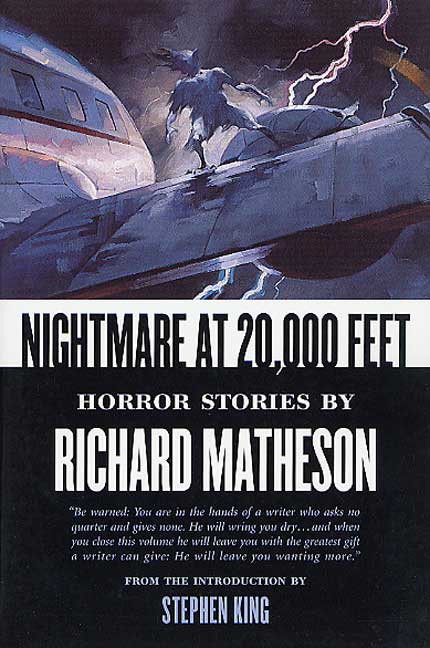
I spent the last week re-reading my favorite Matheson short stories and watching his Twilight Zone episodes as well as scripts he penned for other programs like Thriller and Night Gallery.  I have to admit that I have been away from Matheson’s fiction for a while.  But coming back to his work I find that it isn’t the least bit stale.  In fact I think I take more away from it now than when I first fell in love it over a decade ago.  The first time I heard the name Richard Matheson was when Jordan put a tattered paperback copy of Nightmare at 20,000 Feet in my hands and told me that I would soon have a new favorite writer.  I was 18 at the time (11 years ago for anyone keeping score) so of course I put off reading it because I already had a giant stack of things to read not to mention the piles of homework I wasn’t doing.  So after having it in my possession for a few weeks I picked it up and read the title story.  I was already familiar with both the television and the movie versions so I knew the story fairly well.  But now I saw it in another light.  Matheson’s prose was fast and unforgiving and while I liked both filmed versions of the story, I found that neither one of them quite told the story the way Matheson could on paper.  So I kept reading.  I remember very vividly that the second story I read in this collection was a number called “Legion of Plotters.”  I was blown away.  The thing I found so disturbing about the main character, who ends the story by going on a killing spree, is how much I empathized with him.  He begins the story a reclusive but seemingly harmless individual who becomes frustrated by the irritating habits of those around him.  But somewhere in the middle of the story he betrays the reader and we realize that this person has deeply-rooted psychological problems.  What makes this story so great is that the things that irritate this guy are the same things that most people find unbearable about social interaction.  Matheson knew the human condition well and he used it to his full advantage.  A key characteristic of his fiction is that stories which feature neurotic characters like this one are usually told solely from their point of view.  So the audience has no choice but to find sympathy with them.
               
 So I remained a fan of the man’s work after that.  I read every story or novel I could get my hands on (although I still haven’t read them all).  And as a fan of horror and fantasy I see his influence everywhere.  Matheson wasn’t the first writer to “modernize" the horror genre but he was the first one to make it a defining characteristic of his fiction.  You aren’t likely to see many morose, decaying castles or ancient family tombs in his fiction.  Terror doesn’t exist in a specific time or setting.  It exists in whatever we fear.  Matheson realized this and he set his stories in airplanes, buses, college campuses, coffee shops, and even in normal, contemporary suburban homes.  And he let the characters create their own horror.  He simply dropped a touch of strange into their lives.  He would take something they valued away from them.  Or sometimes he would add an unwanted element.  He often left it ambiguous, in the case of stories like “Mad House” or “Nightmare at 20,000 Feet,” as to whether the element of terror in his stories was real or simply imagined by a paranoid protagonist.   
               
Although he is thought of as a mentor to so many currently working in the fantasy genre and was awarded more accolades than I could possibly mention here, for whatever reason Matheson never became a brand name like Ray Bradbury or Philip K. Dick or Stephen King.  This could be simply due to the fact that the man was not known for being outspoken.  He hardly ever gave speeches or attended conventions and only gave a handful of interviews throughout his career.  But he didn’t have to.  His work is such a representation of his personality that it speaks for itself.  Another reason could be because, unlike the three names I just mentioned, Hollywood rarely got Matheson right.  The Twilight Zone was one of the few television programs that really represented his fiction correctly.  Of the numerous films adapted from his work, even ones written by the man himself, only a handful really stand the test of time.  His masterpiece, I Am Legend, which is considered by many to be one of the best horror novels of all time, has been made into three different films and none of them are particularly remarkable.  I am not sure why his work hasn’t been represented well on the screen (there are exceptions of course, if you are looking for great Matheson movies Steven Spielberg’s Duel and David Koepp’s Stir of Echoes are two of my favorites) but I hope in the future this will change.  I hope that new generations of fans will discover his work for years to come and one way to do that is to adapt it into as many mediums as possible.  Matheson’s work doesn’t age.  It’s as original now as it was sixty years ago.             
               
For the past few days I have been wrestling over what I would write here.  What do you say about someone who you didn't actually know but who, nevertheless, had an immeasurable impact on your life?  A person whose work you connect with on such a personal level.  When I think about Richard Matheson my mind takes me back to images of myself ten years ago, haunting local bookstores and my college library looking for anything with his name on it, spending hours upon hours of my college career reading his stories instead of studying.  And I think back to when I first discovered his work and how it introduced me to the types of literature that I had been looking for, literature I would spend every possible moment of the next decade reading.  After Matheson I discovered Charles Beaumont and after that Bradbury and then Bloch, Ellison, Nolan, Collier, Brown, Kuttner and eventually an entire community of writers with an endless supply of stories in every genre imaginable.  It almost seemed too good to be true.  It felt as if I were scaling a mountain that I never wanted to reach the peak of.  And I remember introducing friends to the works of these writers and how secretly excited I got when they told me how much they loved it.  And I recall the endless nights we spent dissecting the history of popular fiction, and how I never wanted it to end.  I think of these times now and the memories they bring back are warm ones, ones I will cherish for a long time.                                                               

And it all started with Richard Matheson.

His stories were the ones I always felt the strongest connection with.  Matheson more than any other writer made me want to become a writer.  His settings are so familiar and the characters, however neurotic, are so relatable and the language so simple yet effective that it made me want to write stories just like it.  But of course I couldn’t.  I don’t think anyone can.  Many cite Matheson as an influence but his style cannot be duplicated.  And although he leaves behind an enormous body of work for his fans to enjoy, I know that the world will never see another Richard Matheson, and this is something that I admit makes me tremendously sad.  So Cheers, Mr. Matheson, and thanks for all the wonderful memories. 

Richard Matheson
1926 - 2013

--Brian Durant

Friday, May 31, 2013

"The Trouble with Templeton"

Booth Templeton (Brian Aherne) and his late wife Laura (Pippa Scott)

“The Trouble with Templeton”
Season 2, Episode 45
Original airdate: December 9, 1960

Cast:
Booth Templeton: Brian Aherne
Laura Templeton: Pippa Scott
Arthur Willis: Sydney Pollack
Marty: Dave Willock
Sid Sperry: King Calder
Freddie: Larry Blake
Eddie: David Thursby
Barney Flueger: Charles Carlson


Crew:
Writer: E. Jack Neuman (original teleplay)
Director: Buzz Kulik
Producer:  Buck Houghton
Associate Producer: Del Reisman
Production Manager: Darrell Hallenbeck
Director of Photography: George T. Clemens
Art Direction: George W. Davis and Philip Barber
Set Decoration: Henry Grace and H. Web Arrowsmith
Assistant Director: Lindsey Parsons, Jr. 
Casting: Ethel Winant
Editor: Bill Mosher
Sound: Franklin Milton and Charles Scheid
Music: Jeff Alexander

“And Now, Mr. Serling”
“An Attractive and rather imposing room lived in by a man named Templeton.  And like most rooms suggestive really of only a part of the man: the outside part.  Our story next week takes off from here.  Mr. Brian Aherne lends us his considerable talents in a script by E. Jack Neuman called, “The Trouble with Templeton.”  It can best be described as poignant, provocative and a highly diverting trip into the Twilight Zone

Rod Serling’s Opening Monologue:
“Pleased to present, for your consideration, Mr. Booth Templeton, serious and successful star of over thirty Broadway plays, who is not quite alright today.  Yesterday and its memories is what he wants.  And yesterday is what he’ll get.  Soon his years and his troubles will descend on him in an avalanche.  In order not to be crushed Mr. Booth Templeton will escape from his theatre and his world, and make his debut on another stage in another world that we call the Twilight Zone.”

Summary:
Booth Templeton, the famous actor, sits alone in his bedroom, his best years so far behind him they seem to have belonged to someone else.  Out by the pool his young wife makes her time in the company of the new house guest, which Booth takes to be her new lover.  He watches them without contempt for he is too old to be angry and realizes that he no longer loves her and perhaps never did.  Templeton is getting dressed for the first rehearsal of his new Broadway play.  While dressing, he waxes nostalgically to his assistant about his first wife who died when she was only twenty-five.  Now in the twilight of his life he feels like a relic of another time and longs for the brief time when he and his young bride were still together and life still felt fresh.  He pulls on his overcoat, steps out the door and makes his way to rehearsal.
                Once there, he walks into an uncomfortable theater where a militant young director recites a catalog of regulations and commandments to his subjects, the most important of which, he says, is never to be late, especially on the first day of rehearsal.  It is at this moment that he turns his attention to Templeton standing awkwardly in the doorway.  He begins to berate the aging actor for his tardiness in front of the entire cast and crew.  Shocked and embarrassed, Templeton flees into a nearby alley only to run into a crowd of people clapping enthusiastically just for him.  Befuddled, he stumbles his way through them.  Outside its night while only minutes before it was daylight.
                Templeton notices an advertisement for a play and realizes that it is for a play that he starred in more than thirty years ago.  An old man approaches and Templeton asks him what year it is.  “1927,” he responds.  The old man tells Templeton that his wife just phoned and asked that he meet her at a bar nearby.  Stunned, Templeton races to the bar to see his long deceased young wife.
                When he arrives Templeton immediately notices faces that he hasn’t seen years.  And then he sees Laura, the love of his life.  The love that was taken from him so many years before.  Laura sits at a table with a young man.  Templeton recognizes him as Barney Flueger, a friend from many years ago.  Templeton, now aged and forlorn, looks severely out of place next to the jubilant twenty somethings in the middle of the crowded, smoke-filled speakeasy.  Laura and Flueger all but ignore Templeton who pleads with his late wife that they go somewhere more intimate so they can talk.  Neither Laura nor Flueger acknowledge that is has been ages since they have seen Templeton nor do they let on that he is now noticeably twice their age.  Laura tells him that she doesn’t want to leave and that he is ruining the mood.  She ignores him but again he begs her to come with him somewhere private.  Laura begins to fan herself with a magazine and tries to change the conversation.  Templeton, frustrated, rips it out of her hands.  He explains to both of them that he lives in another world where he has grown older without them.  Laura and Flueger seem to find this amusing and they change the subject once again.  Templeton asks his late wife why she is acting so coldly towards him.  She continues to berate him to the point of humiliation, calling him a silly old fool.   Shocked and humiliated, Templeton gathers up his self-respect and flees the crowded bar room.  Upon his exit the music stops.  The faces grow solemn and the lights fade on the crowd as they stare back silently at the tragic Mr. Templeton as he storms out of the bar, his heart broken into tiny pieces. 
                Back inside the theatre it is 1960.  Booth walks into the room where the rest of the cast awaits his arrival so rehearsal can begin.  He reaches into his pocket and finds the magazine he took from Laura but discovers it isn’t a magazine it’s a play.  What to Do When Booth Comes Back.  He flips through the pages and realizes it’s an exact transcription of the conversation from the speakeasy.  It dawns on him that Laura and Flueger were only acting.  They were intentionally cold to him so that he would go back to his own time and live a happier life.
                The director approaches Templeton and wants to know the meaning behind his disappearance.  Templeton, now filled with the confidence of knowing that Laura still cares for him in another world somewhere, fires back at the young director.  He apologizes for being late but insists that the young man treat him with respect.  The director seems pleased by Templeton’s confidence and the two begin rehearsing for what is sure to be one of Booth Templeton’s best performances in years. 

Rod Serlings Closing Narration
“Mr. Booth Templeton, who shared with most human beings the hunger to recapture the past moments, the ones that soften with the years.  But in his case, the characters of his past blocked him out and sent him back to his own time, which is where we find him now.  Mr. Booth Templeton, who had a round-trip ticket…into the Twilight Zone.”

Commentary
Though one might think that this episode came from The Twilight Zone’s regular stock of writers, it is one of the few scripts in the show’s early seasons to be written by an outsider.  Though it is E. Jack Neuman’s only contribution to the series, “The Trouble with Templeton” fits perfectly within the atmosphere created by Serling and the other regular writers.  The first few times I watched this episode I just assumed that it was penned by Rod Serling because both the tone and the subject matter reflect his craftsmanship.  Indeed, it finds its thematic likeness in episodes like “The Sixteen-Millimeter Shrine” and “Walking Distance,” both of which were written by Serling.  It also bares a thematic resemblance to a script Serling later wrote for Night Gallery called “They’re Tearing Down Tim Riley’s Bar.”  Neuman’s dialogue here is also quite similar to Serling’s.
                Neuman was a friend of producer Buck Houghton and he submitted the script to Serling at a time when the show’s popularity was reaching its peak.  Serling, Houghton and associate producer Del Reisman were receiving hundreds upon hundreds of submitted manuscripts a week.  And apparently to no avail because for first four seasons the majority of the writing was done by only five people.  But Neuman’s script must have hit a soft spot with Serling because he gave it the go ahead and it turned out be a fine episode, one that is often overlooked when talking about the high points of the second season. Neuman’s other credits include creating several recognizable television series including Police Story and Dr. Kildare.
                To direct this dream-like episode the producers chose King Nine Will Return” director Buzz Kulik.  Kulik had a knack for directing these types of episodes and the producers would rely heavily upon him throughout Seasons Two and Three.  His other credits on the show include “Static,” “A Hundred Yards Over the Rim,” “A Game of Pool” and “A Quality of Mercy.”  Here his idiosyncratic skill with a camera lends itself nicely to Neuman’s script.  Throughout the episode the atmosphere sways from the warmth of nostalgia to the unsettling feeling of shock and embarrassment and back again.  While the script and the performances are all fantastic, this change in mood, which represents Templeton’s change in mood, is brought to life mostly by Kulik’s direction.  The scene in the speakeasy is the centerpiece of the episode and it is here that Kulik really solidifies the quality of the episode.  There is a sequence near the end of the scene in which the heartbroken Templeton storms out of the club.  Until this point the scene has been jumping with the sounds of roaring jazz music and the raucous laughter of carefree party-goers.  Upon Templeton’s exit, however, the music stops cold and the lights fade one by one on the bar patrons as they stare back at Templeton. A similar effect would be used in the aforementioned Night Gallery episode "They're Tearing Down Tim Riley's Bar."  It is a haunting effect and some of the finest direction to appear on the series.  In an interview with The Twilight Zone Companion writer Marc Scott Zicree, Kulik commented that of the nine episodes he directed for the show "The Trouble with Templeton" was his favorite. 
                To play the lead Kulik and the producers cast veteran stage and screen actor Brian Aherne, whose career spans back to the era of silent films.  Aherne had been a force on the British stage before moving to Hollywood to appear in films.  His noteworthy films include the comedy Merrily We Live (1938), Juarez (1939, for which he was nominated for an Academy Award), The Locket (1946) and I Confess (1953).  Here he is completely believable as the sad, nostalgic Booth Templeton.
                Modern audiences can also spot a young Sidney Pollack playing the part of the pompous, militant theater director.  Pollack was a friend of Kulik’s and, in 1960, was still trying to make it as an actor.  Kulik claims that Pollack based his character’s southern accent on an actual stage director that neither one of them cared for.  Pollack later went on to be an acclaimed director with films like They Shoot Horses, Don’t They (1969), Tootsie (1982) and Out of Africa (1982).
                Filled with all the imagery and thematic elements that give The Twilight Zone its unique appeal, “The Trouble with Templeton” is definitely one of the better episodes of Season Two, which is saying quite a lot.  It’s one of a handful of episodes that I would recommend to viewers who have never seen an episode of the program. 

 Grade: B

Notes:
-"The Trouble with Templeton" was adapted as a Twilight Zone Radio Drama by Dennis Etchison, starring Michael York. 
--Larry Blake appeared in Rod Serling's adaptation of H.P. Lovecraft's classic story "Cool Air" for Night Gallery.

 --Brian Durant

Up Next: Three nickel and dime crooks discover that a picture is worth a thousand words and then some.  That’s next time when we review Rod Serling’s “A Most Unusual Camera.” 

Monday, April 22, 2013

"The Lateness of the Hour"

John Hoyt as Dr. Loren and Inger Stevens as his daughter Jana
"The Lateness of the Hour"
Season Two, Episode 44
Original Air Date: December 2, 1960

Cast:
Jana: Inger Stevens
Dr. Loren: John Hoyt
Mrs. Loren: Irene Tedrow
Nelda: Mary Gregory
Robert: Tom Palmer
Gretchen: Doris Karnes
Suzanne: Valley Keane
Jensen: Jason Johnson

Crew:
Writer: Rod Serling (original teleplay)
Director: Jack Smight
Producer: Buck Houghton
Associate Producer: Del Reisman
Art Direction: Craig Smith
Set Decoration: Arthur Jeph Parker
Technical Director: Jim Brady
Assoc. Director: James Clark
Casting: Ethel Winant
Music: stock

Rod Serling's Opening Narration:
"The residence of Dr. William Loren, which is in reality a menagerie for machines. We're about to discover that sometimes the product of a man's talent and genius can walk amongst us untouched by the normal ravages of time. These are Dr. Loren's robots, built to functional as well as artistic perfection. But in a moment Dr. Loren, wife, and daughter will discover that perfection is relative, that even robots have to be paid for, and very shortly will be shown exactly what is the bill."

Summary:
            Dr. Loren, a genius inventor, and his wife live in comfort and complete solitude in a large, secluded manor along with their thirty-something daughter, Jana, and a household of programmed servants in the form of intelligent robots, all designed and imbued with artificial intelligence by Dr. Loren. While Dr. Loren and his wife enjoy the peace that comes with having all their needs tended to by the skilled automatons that comprise the household staff, Jana feels trapped in the house and unnerved by her parents’ reliance upon the robots. Jana longs for the world outside and refuses to be shut off in the large house any longer. She threatens to leave and go out into the world if her father does not destroy all of his robots. After pleading with Jana not to make him destroy his life's work, Dr. Loren reluctantly relents and agrees to destroy the robots if Jana will stay with them. Delighted, Jana begins speaking of her dream to live a normal life, to meet a man and settle down and have children. At the mention of children, the look on her parents’ faces tells Jana all she needs to know about her own existence. There are no pictures of Jana as a little girl in the family album because she is, in fact, one of her father's creations. The Lorens could not have children naturally and so Dr. Loren built a daughter for them. Horrified by the idea that she was manufactured by the man she thought was her natural father, Jana lashes out and tells the Lorens that she cannot be their daughter anymore. Despite their pleading with Jana, the Lorens realize that Jana is forever changed by this revelation. The shocking solution to the problem of keeping Jana at home is that Dr. Loren reprograms her as the maid, Nelda.

Rod Serling's Closing Narration:
"Let this be the postscript: should you be worn out by the rigors of competing in a very competitive world, if you're distraught from having to share you existence with the noises and neuroses of the twentieth century, if you crave serenity but want it full time and with no strings attached, get yourself  a workroom in a basement and then drop a note to Dr. and Mrs. William Loren. They're a childless couple who made comfort a life's work, and maybe there are a few do-it-yourself pamphlets still available. . . in the Twilight Zone."

Commentary:
            "The Lateness of the Hour" has the dubious distinction of being the first of six videotaped Twilight Zone episodes to see broadcast. Turning to videotape was an attempt on the part of the network (CBS) to implement cost cutting measures on the production of the show. The cost for filming an episode crept up toward $65,000 apiece and the network hit the panic button. Videotape was less expensive than film and required virtually no editing since the editing process could be performed on the spot. The limitations of videotape, however, were many. No exterior locations could be used because of the primitive nature of the videotape process at the time. With all work needing to be done on a soundstage, it greatly limited the type of story Rod Serling and company could tell on the videotaped episodes. "The Lateness of the Hour" is a good example of how Serling, never a fan of the use of videotape on Twilight Zone, compromised with the new process, setting his story in a very enclosed environment and requiring virtually no more movement of the scene than would a stage play. It is no coincidence that producer Buck Houghton sought out directors with experience in the live television format since videotape was used in that arena. Director Jack Smight knew well the limitations of videotape and concentrated instead on developing atmosphere in the episode and achieved this to fine effect. What is sorely missed in the episode is the Emmy Award-winning work of photographer George T. Clemens. No director of photography was needed on the videotaped episodes since a technical director operated the switches from a standard four camera setup at the behest of the episode's director.

          "The Lateness of the Hour" is ultimately a fable-like episode already limited by a threadbare, predictable plot and further limited by the videotape method. Serling's script comes off as overly melodramatic and the actors, especially Inger Stevens as Jana, have no choice but to play to the material as presented and therefore play it over the top. Director Smight does a fine job of establishing the atmosphere of dread beneath the serene surface leading up to the confrontational climax and final revelation. The ending is another in a long line of obligatory twist endings for the show and, unfortunately, can be seen coming from a long way away by most sophisticated viewers. It is more unfortunate that the entire episode hinges on the final revelation. It is Inger Stevens’s performance that ultimately comes across as too over-dramatic, especially when placed against the muted performances of the other two leads. It is surprising that Stevens would be the weak link in the acting chain for "The Lateness of the Hour" as she certainly gives a strong performance as the lead in the classic first season episode, "The Hitch-Hiker."  See our post on the earlier episode for more information about the actress's career and tragic brief life.
            Veteran character actors John Hoyt and Irene Tedrow brought a veteran presence to their roles and would both work for The Twilight Zone on more than one occasion. Hoyt turned in a coldly menacing performance as the Martian invader in the classic second season episode "Will the Real Martian Please Stand Up?" , shown the following May after the initial broadcast of "The Lateness of the Hour." Irene Tedrow starred previously in the equally esteemed first season episode "Walking Distance" as the main character's, Martin Sloan's, mother.
            In terms of quality, "The Lateness of the Hour" lands right in the middle of one of the most often tread themes of the show, that of the robot and its relation to its human counterpart. The show treated the theme very well ("The Lonely," "In His Image") and poorly ("Uncle Simon," "The Mighty Casey") but the episode with which "The Lateness of the Hour" shares the most thematic ground is Ray Bradbury's single contribution to the show, "I Sing the Body Electric," broadcast during the third season. The two episodes, when taken together, nicely display the light and dark sides of the theme of the automated domestic servant and its effect on the household.
            In all, "The Lateness of the Hour" is an episode hampered by a thin script, occasional over-acting, and a videotape method which hindered the entire production on a basic level. That said, the nice atmosphere, quick pacing, presence of veteran character actors, and predictable yet enjoyable twist in the tale mark the episode par for the course as the second season kept rolling on. However, following in line behind episodes the caliber of "The Howling Man," "Eye of the Beholder," and "Nick of Time," "The Lateness of the Hour" simply pales in comparison.

Grade: C

Notes:
--Inger Stevens also appears in the first season episode "The Hitch-Hiker"
--John Hoyt also appears in the second season episode "Will the Real Martian Please Stand Up?"
--Irene Tedrow also appears in the first season episode "Walking Distance"
--Mary Gregory appeared in an episode of Rod Serling's Night Gallery titled "The Different Ones." 
--Director Jack Smight also helmed the first season episode "The Lonely," also about a robot, and two additional videotaped episodes from the second season, "Night of the Meek" and "Twenty Two."
--"The Lateness of the Hour" was produced as a Twilight Zone Radio Drama starring Jane Seymour and James Keach.

--Jordan Prejean

Up Next: We take a trip back to the past with Booth Templeton (Brian Aherne), an aging actor who gets an unnerving second look at the old days for which he longs. That’s next time with “The Trouble with Templeton” on The Twilight Zone Vortex.