Tuesday, January 24, 2017

"The Hunt"

Hyder Simpson (Arthur Hunnicutt) and his faithful hound dog, Rip,
resting at the end of a very strange day.

“The Hunt”
Season Three, Episode 84
Original Air Date: January 26, 1962

Cast:
Hyder Simpson: Arthur Hunnicutt
Rachel Simpson: Jeanette Nolan
Gatekeeper: Robert Faulk
Wesley Miller: Titus Moede
Tillman Miller: Orville Sherman:
Reverend Wood: Charles Seel
Angel: Dexter DuPont
Pallbearer: Robert McCord

Crew:
Writer: Earl Hamner (original teleplay)
Director: Harold Schuster
Producer: Buck Houghton
Production Manager: Ralph W Nelson
Director of Photography: George T. Clemens
Art Direction: George W. Davis, Phil Barber
Set Direction: H. Web Arrowsmith
Assistant Director: E. Darrell Hollenbeck
Casting: Stalmaster-Lister
Editor: Bill Mosher
Story Consultant: Robert McDonagh
Sound: Franklin Milton, Bill Edmonson
Music: Robert Drasnin

And Now, Mr. Serling:
“Perhaps no character, in or out of fiction, has had as much notoriety or publicity as the so-called Grim Reaper. Next week on the Twilight Zone, through the good offices of Mr. Earl Hamner, we present a unique story called ‘The Hunt.’ It concerns the demise of an old hunter and his dog…and this one we rather urgently recommend to people who have lost their senses of humor and who’d like to recover same.

“As one of my kids says, ‘there’s a trillion, trillion ways of telling a story.’ But there’s only one way to tell the Chesterfield story and that’s simply to say that great tobaccos make a wonderful smoke. Try Chesterfields. They satisfy.”

Rod Serling’s Opening Narration:
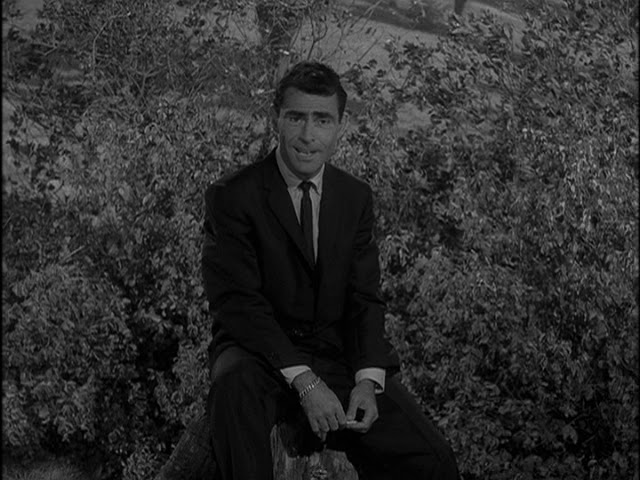
“An old man and a hound named Rip, off for an evening’s pleasure in quest of raccoon. Usually, these evenings end with one tired old man, one battle-scarred hound dog, and one or more extremely dead raccoons. But as you may suspect that will not be the case tonight. These hunters won’t be coming home from the hill. They’re headed for the backwoods…of the Twilight Zone.”

Summary:
            Hyder Simpson, now in his twilight years, has lived a quiet life with his wife Rachel in the same peaceful mountain community in which they were born. Simpson adores his wife and the two of them are happy here. At dinner one evening Hyder tells his wife that he intends to take his dog, Rip, raccoon hunting after he eats. Rachel, highly religious and a bit impressionable, tells him that she has recently witnessed several omens and is afraid that something bad is going to happen to him. She asks him not to go hunting. He goes anyway.
While chasing a raccoon, Rip falls into a ravine. When he does not resurface Hyder jumps in to rescue him.
The next morning Hyder wakes up under a tree, having apparently fallen asleep in the night. As he and Rip make their way home Hyder spots his neighbors digging a hole on his property. He attempts conversation but gets no response. He sees that they are digging a grave, presumably for a beloved pet, and he leaves them to their task. When he arrives home he finds Rachel dressed entirely in black. Reverend Wood is also there. He attempts to speak to them but again gets no response. He sees what appears to be a funeral procession exiting his living room. Rachel begins to sob. Hyder follows the procession to the graveyard near his house but a fence, unfamiliar to him, blocks his path. He follows it to see if he can find a way around it.
            After walking for what seems like an eternity, Hyder and Rip reach a driveway with a gatekeeper at the end of it. The gatekeeper tells them that they have died and that this is the afterlife. Not a religious man, Hyder is skeptical of the situation. The gatekeeper tells Hyder that he must leave Rip as dogs are sent to their own afterlife. Hyder refuses and he and Rip keep walking.
          Later, while resting in the shade, Hyder and Rip are approached by a man who says he is looking for them. He claims to be from Heaven. When Hyder tells him about the gatekeeper and his “no dog” policy, the man informs him that they were actually at the gates of Hell. Dogs, highly perceptive animals, are not allowed to enter Hell for fear that they will sense danger. The man says that all creatures are welcome in Heaven. He also informs Hyder that Rachel will be arriving shortly. Feeling at peace, Hyder and Rip follow the stranger to the Great Hereafter to reap their rewards.


Rod Serling’s Closing Narration:
“Travelers to unknown regions would be well advised to take along the family dog. He could just save you from entering the wrong gate. At least, it happened that way, once, in a mountainous area…of the Twilight Zone.”

Commentary:
            “The Hunt” marks writer Earl Hamner’s arrival to The Twilight Zone where he would remain a regular contributor until the end of the series. Hamner wrote eight original teleplays for the show making him the fourth major contributor after Matheson (14), Beaumont (22), and Serling (92). A native of rural Virginia, Hamner brought a sensibility to the show that was uniquely his own. Episodes like “The Hunt” and season four’s “Jess-Belle” depict a culture that was rarely seen on television at the time. The Andy Griffith Show, one of the first programs set in the rural south, premiered on CBS in October of 1960, sparking a trend that would continue throughout the decade with shows like The Beverly Hillbillies, Petticoat Junction, and Green Acres. While situational comedies like these often exploited the eccentric behavior of their characters—as is the purpose of such a show—Hamner was writing about a culture which was important to him and he did so with great affection. Unfortunately, as his first teleplay for The Twilight Zone demonstrates, his vision and the show’s vision were not always compatible.
Earl Hamner, Jr.
(1923 - 2016)
Hamner was born in 1923 and grew up in a small village on the edge of the Blue Ridge Mountains called Schuyler, Virginia. Hamner’s family made their living from tobacco farming and mining soapstone. He grew up during the Great Depression and his humble upbringing and close-knit sense of family—he was the oldest of eight children—would have an enormous impact on his writing. His Baptist roots would also hold a significant influence on his work as several of his Twilight Zone scripts would demonstrate. Hamner realized that he wanted to pursue writing professionally while serving in the Army in France during World War II. He began to submit short stories to literary magazines but soon amassed a large collection of rejection letters.
In 1949, while working as a writer on Cincinnati radio station WLW, Hamner won a scriptwriting contest for Dr. Christian, a nationally syndicated radio show on CBS starring Jean Hersholt which ran from 1937 to 1954. The show was famous for accepting unsolicited manuscripts and proclaimed that it was the only show scripted by its audience. Each year the show held a contest for best script with a grand prize of $2,000 and several subsequent prizes. Hamner’s script, “All Things Come Home,” was one of several winners and he flew to New York to receive his prize money. At the ceremony Hamner met another aspiring writer named Rod Serling whose script, “To Live a Dream,” had also won. The two talked at length about writing and the publishing industry. When Hamner left WLW a few years later to pursue writing full time, Serling, who had recently graduated from Antioch College in nearby Yellow Springs, was hired as his replacement.
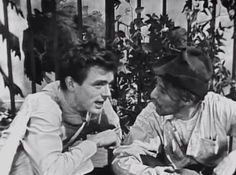
James Dean and John Carradine
"The Hound of Heaven" (1953)
In 1952 Hamner moved to New York City where he got a job as a staff writer at NBC. His first major job in television was writing freelance pieces for The Today Show. In 1953 Random House published Hamner’s first novel, Fifty Roads to Town. That same year Hamner sold a short dramatic skit called “The Hound of Heaven” to The Kate Smith Hour, a daytime variety show which ran on NBC from 1950 to 1954. This short three-person play is actually an early version of “The Hunt” and features John Carradine as Hyder Simpson with Edgar Staley as the Gatekeeper and James Dean as the messenger. Aside from a difference in running time—“The Hound of Heaven” clocks in at around twelve minutes—this early version appears to be very similar to its later counterpart.* The scene in which Simpson meets the heavenly messenger, played by an unknown James Dean dressed in white overalls with enormous feathered wings strapped to his back, is almost identical to the same scene in “The Hunt” right down to the dialogue. Dean gives a great performance although his absurd costume prevents us from taking him seriously. Veteran actor John Carradine, who would later appear in Charles Beaumont’s “The Howling Man,” gives Hyder Simpson a mildly incoherent personality which is actually sort of compelling.
            As the 1950’s drew to a close, live television was becoming a fading art form. Radio’s popularity had become more or less irrelevant. Television was now looking to film as the way of the future. It looked better, it was cheaper, and the technological possibilities seemed endless. So the television industry left New York and headed for Hollywood. And Earl Hamner, Jr. left with it. He arrived in Los Angeles in 1961. Having never written for film, he found himself almost starting from scratch. For many months he lived in a cheap hotel with virtually no income. By this time Hamner had a wife and two children to support as well. Finally, following the advice of his literary agent, Don Congdon, who also happened to be literary agent to Ray Bradbury and Charles Beaumont, Hamner called the two for advice. Until then he hadn’t considered submitting his material to The Twilight Zone because it was a fantasy program. Upon Bradbury and Beaumont’s recommendations, however, he submitted two ideas to Serling, fully expecting them to be rejected. To his amazement Buck Houghton wrote back just a few weeks later informing him that they wanted to purchase both of them. The two ideas eventually became “The Hunt” and “A Piano in the House.” After a decade of working in television Hamner had finally launched his career as a screenwriter.
            Hamner would write six more scripts for the show including the hour-long “Jess-Belle,” for the fourth season and five teleplays for the fifth season. In 1961 Dial Press published his second novel Spencer’s Mountain which was made into a successful film in 1963 starring Henry Fonda and Maureen O'Hara. When Random House published his novel The Homecoming in 1970 Hamner was approached by CBS to adapt it into a feature-length Christmas special. The special did well and Hamner was then asked to expand his novel into a series. So he created The Waltons. It ran for nine seasons and became one of the most celebrated television shows of all time, winning thirteen Emmy Awards. Hamner had finally found an audience for his unique brand of wholesome folklore. The Waltons offered a welcome escape from a decade marked by war and political corruption and an alternative to the increasing cynicism of American television. Similar to Serling’s involvement on The Twilight Zone, Hamner acted as executive producer, head writer, and host of the program, providing the opening and closing narration to each episode. The show ended in 1981 but several television specials aired in the subsequent years. After The Waltons, Hamner created Falcon Crest, a soap-opera style series about the California wine industry starring Jane Wyman. This show was also an enormous success and ran for nine seasons, although Hamner left after the fifth season. He also found success on the big screen scripting the films Palms Springs Weekend (1963), Where the Lilies Bloom (1974), and an adaptation of Charlotte’s Web in 1973 for which author E.B. White chose him personally.
            In an interview with Marc Scott Zicree, Hamner says that Hyder and Rachel were actually early versions of Grandma and Grandpa Walton. Around the time that he wrote the episode he was also writing a series of short stories called “The Old Man and the Old Woman” and he decided to use the two main characters, who were fully-developed already, as the main characters of "The Hunt." He continued to write stories featuring the elderly couple and they eventually ended up in The Waltons.
Although Hamner is remembered mostly for his tales of rural life in the Blue Ridge Mountains, the majority of his Twilight Zone episodes feature urban settings and characters that bear little resemblance to the Walton family. “The Hunt” and “Jess-Belle,” and to a lesser extent “The Bewitchin' Pool,” are his only forays into the backwoods utopia found in his novels. The rest of his episodes possess an overtly modern atmosphere. As a writer largely unfamiliar with fantasy and science fiction, Hamner sometimes relied on imitating the style and formula that had been carefully established on the program during the first two seasons. Of his scripts set in a contemporary American city, the two which feel the most like a typical episode of The Twilight Zone are probably “A Piano in the House” and season five’s “Stopover in a Quiet Town.” The rest feel as if they would be more at home on a different show.
This was only further evidence that Hamner was at his best when writing about what he knew. Unfortunately, not everyone on the show seemed to understand what he was trying to explore with his writing. “The Hunt” has good intentions but the finished product is an incredibly flawed episode. The pacing is slow, the direction tiresome, and the premise derivative. Arthur Hunnicutt, a brilliant actor who was nominated for an Academy Award for Best Supporting Actor in 1952 for his role in the Howard Hawks film The Big Sky, delivers a performance that is both unconvincing and culturally insensitive. Hamner’s dialogue is also hokey at times particularly during the scene in which Simpson stumbles upon his neighbors burying Rip and in the final scene with Simpson and the angel.
Hunnicutt was a prolific character actor known primarily for his roles in westerns. His film credits include Broken Arrow (1950), The Red Badge of Courage (1951), and Cat Ballou (1965). A native of rural Arkansas, Hunnicutt would have been at least vaguely familiar with southern dialect. His delivery, however, is too simple. He comes across wooden and unsympathetic. Hamner later said that he was unhappy with the performance and suggested that Hunnicutt should have had fun with the character and played him more upbeat.
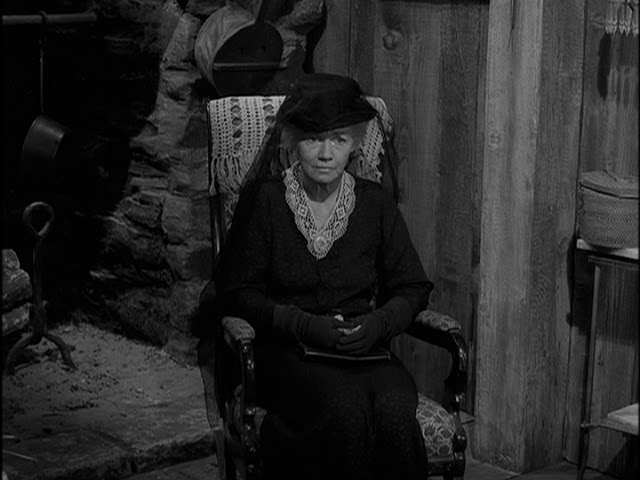
Jeanette Nolan, however, gives a brief but terrific performance as Rachel. Her pleasant demeanor is so infectious it even excuses her character’s religious idiosyncrasies which could have easily become cartoonish in the hands of a lesser performer. A theatrically trained actress, she made her screen debut as Lady Macbeth in 1948, opposite director Orson Welles. She also appeared in Fritz Lang’s The Big Heat in 1953, John Ford’s The Man Who Shot Liberty Valance (1962), and Robert Redford’s The Horse Whisperer (1998). A prolific radio performer, she possessed a talent for accents and peculiar voices. In 1960 she was the voice of Norma Bates in Psycho and later provided the voices to many animated children's films including Disney's The Rescuers (1977) and The Fox and the Hound (1981). Nolan would return to The Twilight Zone the following season to play a witch in Hamner’s “Jess-Belle.”
Another saving grace of this episode is Robert Drasnin’s soft and subdued musical score. Most of the episode features a simple melody played on a single harmonica. It manages to be both somber and warm and it captures the mood of the episode perfectly. Drasnin worked primarily in film and television but recorded his own albums as well. This was his only appearance on The Twilight Zone.
            Despite its flaws, “The Hunt” remains a well-known episode which continues to divide fans of the show. Its critics usually cite many of the same shortcomings mentioned above: casting errors, uninspired direction, stilted dialogue. However, many fans have warm memories of this episode. One such admirer was fellow Twilight Zone writer George Clayton Johnson who regards it as one of his favorite episodes. “With this story, Earl brings a southern country sensibility to The Twilight Zone that is American to the core,” Johnson said in an interview, “which assures us that being simple is not being stupid…the story has such a classic feeling that one is tempted to believe that Hamner may not have made the story up but instead borrowed it from some ancient book of folk tales…It has stuck in my mind like fishhooks.”
            Johnson hits upon the two likely reasons for this episode’s dedicated fan base. The first is Hamner’s affection for “the little man,” a seemingly insignificant protagonist who outsmarts a force much greater than himself. It comes as no surprise that Johnson, who penned episodes like “Kick the Can” and “A Game of Pool,” would feel a connection to a character like Hyder Simpson. He also brings to light the influence of traditional American folklore. Hamner’s arrival to The Twilight Zone happened to come at a time when Serling and Houghton seemed interested in exploring different areas of American literature with folklore being the next logical step. Relying on folklore as inspiration also meant exploring the rural areas in which much of this type of fiction originated including the Midwest and the American South. The third season had already featured Serling’s “Still Valley,” an adaptation of Manly Wade Wellman’s Civil War story “And the Valley Was Still” about a confederate soldier who struggles with the decision to use black magic to assure a victory for the south. Wellman was a highly regarded folklorist and historian who set a great deal of his fiction in the Blue Ridge Mountains. Serling also adapted the free-spirited, fable-like “Hocus-Pocus and Frisby,” from an unpublished story by Frederic Louis Fox about a lovable country braggart who learns the consequences of lying after being abducted by aliens from his sleepy midwestern town. Montgomery Pittman also made his Twilight Zone writing debut during the third season. Like Hamner, he was a native southerner and a student of folklore. His western episode “The Grave” was based on an English folk tale that has had dozens of variations over the years. His final teleplay “The Last Rites of Jeff Myrtlebank” is about a young man who miraculously returns to life after being declared dead. The episode, which relies heavily on folkloric themes, explores the quirks of small-town life in the midwest at the turn of the twentieth century.
            While “The Hunt” takes its influence from folklore it is not based on an actual folk tale. Hamner says he got the idea from a childhood memory of his father searching for days for his beloved hunting dog which he had accidently shot. His father’s guilt over shooting the animal and his devotion to finding it had a profound effect on young Hamner and he eventually turned the incident into an episode of The Twilight Zone.
            “The Hunt” has some serious flaws but in Hamner’s defense his original script, while far from being a masterpiece, is still more enjoyable than the finished product. Time is one factor. The story has a wholesome quality that has not aged well. The bits of uplifting humor, like the famous line in the final scene in which the angel remarks that “even the Devil can’t fool a dog,” feel dated. But the main reason why this episode is not of the quality that it should be is simply because a lot of the major contributors didn’t seem to understand the culture Hamner was writing about. Fortunately, he had better luck the following season with his fantastic hour-long script “Jess-Belle,” a dark, atmospheric folk tale about witchcraft and superstition. It stars Anne Francis and James Best and was directed by the great Buzz Kulik. This episode is a far better example of Hamner’s ability as a writer than “The Hunt.” It’s a highlight of the fourth season and, without question, Hamner’s crowning achievement on the show.
            “The Hunt” will likely continue to be a topic of debate among Twilight Zone fans for years to come. There are certainly positive things to be said about it. It launched the career of an Emmy and Peabody Award-winning writer and producer and laid the foundation for a much-beloved television program. It also cast a light on a culture many Americans knew little about. And, for some, it became a warm and familiar story to revisit on a crummy day, a factor which gives it an unquestionable validity. So because this is a hit-or-miss episode depending on the viewer, my review is admittedly biased. I have seen this episode numerous times and I have never developed an attachment to it. Hamner was a remarkably talented writer but this is certainly not his best work on the show. Harold Schuster’s direction is slow and uninspired, which makes watching this twenty-three minute episode rather exhausting. Hunnicutt, as I’ve stated several times by now, is wrong for the part and his performance is the fatal flaw of the episode. While not everything about this episode is bad, the few enjoyable elements are outnumbered and overshadowed by the much less enjoyable ones rendering it almost unwatchable. “The Hunt,” unfortunately, does not come recommended.


Grade: D


*I found very little information about this early version. I was unable to locate the full performance anywhere online, only a short clip (which you can check out on our Facebook page), but it was included in a DVD box set called James Dean: The Lost Television Legacy available from Turner Classic Movies. If you happen to be familiar with it please comment below or email us and let us know what you thought!


Grateful acknowledgement is made to the following:


The Twilight Zone Scripts of Earl Hamner by Earl Hamner and Tony Albarella (Cumberland House Publishing, 2003)

Archive of American Television
--interview with Earl Hamner, Jr. conducted by Jennifer Howard (September, 2003)

Earl Hamner: From Walton’s Mountain to Tomorrow by James E. Person, Jr. (Cumberland House Publishing, 2005)

Earl Hamner Official Website

The Twilight Zone Companion by Marc Scott Zicree (Second Edition, 1989)

moviemagg.blogspot.com “Kate Smith Hour: ‘The Hound of Heaven’ (NBC, 1/15/53)” by Mark Gabrish Conlan. (July 1, 2016). 


Notes:
--Earl Hamner, Jr. wrote eight episodes of the show including season three’s “A Piano in the House,” season four’s “Jess-Belle,” and the season five episodes “You Drive,” “Black Leather Jackets,” “Ring-a-ding Girl,” “Stopover in a Quiet Town,” and the final episode of the series, “The Bewitchin' Pool.” His story "The Art of the Miniature" appeared in Carol Serling's anthology Twilight Zone: 19 Original Stories on the 50th Anniversary (2009, Tor).
--Jeanette Nolan also appeared in the season four episode “Jess-Belle,” written by Earl Hamner, Jr. She later appeared in the Night Gallery segments “The Housekeeper” (season one) and “Since Aunt Ada Came to Stay” (season two).
--Charles Seel appeared in season four’s “He’s Alive.” He also appeared with Jeanette Nolan in “Since Aunt Ada Came to Stay.”
--This episode features yet another appearance from regular Twilight Zone extra Robert McCord, who appeared in dozens of episodes. Here he plays one of the pallbearers.
--As mentioned, “The Hunt” was adapted from an earlier teleplay by Earl Hamner called “The Hound of Heaven” which first appeared on The Kate Smith Hour in 1953.
--Listen to the Twilight Zone Radio Drama starring original series veteran Shelley Berman and Karen Black.
--One of Rod Serling's early scripts, "A Long Time til Dawn," was also brought to life by James Dean. It featured on Kraft Television Theatre for November 11, 1953. 

--Brian

Wednesday, December 14, 2016

A Twilight Zone Christmas

Celebrate the holidays with these essential episodes of The Twilight Zone for the winter season, in order of original air date.


1.) "What You Need," season one, episode 12 (12/25/59)

           -This episode, which aired on Christmas, concerns a fantastic form of gift-giving. A meek old man helps strangers by giving them things they "need" but falls prey to an angry man who wants to use the old man's talent for personal gain. Adapted by Rod Serling from a story by Henry Kuttner and C.L. Moore, the episode eschews the original story's science fiction trappings in favor of the wintry atmosphere of a gritty urban noir. It is an effective treatment of the theme that no one should know too much about their own destiny.  

Here's Our Look at "What You Need."


2.) "A Passage for Trumpet," season one, episode 32 (05/20/60)

          -This episode marks the first of four appearances by veteran actor Jack Klugman on the series and is often viewed as Rod Serling’s version of It’s a Wonderful Life, the classic Christmas fantasy film from 1946. “A Passage for Trumpet” is essentially a retelling of Philip Van Doren Stern’s 1943 short story “The Greatest Gift,” which formed the basis of It’s a Wonderful Life. In that story, a man contemplating suicide is shown what life without him would be like and decides to backtrack on his attempt to take his own life (life being the greatest gift of the title). Joey Crown, from “A Passage for Trumpet,” is shown the ugly side of the afterlife after a suicide attempt and decides to remain in the land of the living. Despite its derivative nature, the episode is an uplifting fable and features strong performances from Zone regulars Klugman and John Anderson (as Gabriel, the horn-playing herald who shows Joey Crown the error of his ways).

Read our commentary on “A Passage for Trumpet.” 


3.) “The After Hours,” season one, episode 34 (6/10/160)

          -Nothing says Christmas like the rush of holiday shopping, and Rod Serling puts a truly unique spin on the tradition in this exceptionally creepy episode starring Anne Francis. Francis portrays a young woman seeking a gift for her mother who instead discovers a shocking secret about department store mannequins. The journey to a secret level of the store is a particularly disturbing highlight. Francis gives an underrated performance and the unsettling atmosphere of the episode is second to none on the series. It comes highly recommended.

Read our thoughts on “The After Hours.” 


4.) “The Night of the Meek,” season two, episode 47 (12/23/60)

          -The most overtly Christmas episode of the series certainly has its flaws but remains one of the more uplifting episodes due to a strong performance by Art Carney as another of Rod Serling’s “lovable losers.” Carney plays an alcoholic department store Santa Claus who gets a chance at redemption when he discovers Santa’s magical bag of toys and uses it to spread Christmas cheer throughout the city. “The Night of the Meek” is essential Christmas viewing and remains a fan favorite.

Read all about “The Night of the Meek.” 


5.) “Will the Real Martian Please Stand Up?” season two, episode 64 (5/26/61)

          -Two state policemen and a group of bus passengers face off against a harsh winter storm and a hidden adversary at a roadside cafe in this hugely entertaining episode. Another atmospheric gem from Rod Serling heralds the arrival of director Montgomery Pittman to showcase perhaps the finest group of Serling characters created for the series, especially in the form of John Hoyt as a grouchy businessman and Jack Elam as a boisterous eccentric. The twisty narrative and wacky makeup effects are certain to delight those in search of macabre winter fun.

Find out more on “Will the Real Martian Please Stand Up?” 


5.) “Five Characters in Search of an Exit,” season three, episode 79 (12/15/61)

          -Another Christmas tradition is the ringing of donation bells and Rod Serling delivers an imaginative twist on the tradition. Working from a story idea by journalist Marvin Petal, Serling draws on his exceptional skill at characterization to craft one of the more unusual and haunting offerings from the series. The playful title clues the viewer in on the existential nature of the play and fine performances enhance the strange fantasy. The final twist is perhaps overly-familiar now but remains one of the more memorable created for the series. Highly recommended.

Explore the secrets of “Five Characters in Search of an Exit.” 


6.) “Nothing in the Dark,” season three, episode 81 (1/5/62)

          -Bundle up for this frosty bit of dark fantasy. This episode is arguably the finest work from three of the most talented creators on the series, writer George Clayton Johnson, director Lamont Johnson, and actress Gladys Cooper. Cooper gives a heartrending performance as a woman who has shut herself away from the world in fear of meeting “Mr. Death.” The fable-like story has a strong winter atmosphere and features some of the finest camera work of the series. It comes highly recommended.

Here's our review of “Nothing in the Dark.” 


7.) “The Changing of the Guard,” season three, episode 102 (6/1/62)

          -Veteran actor Donald Pleasance gives an emotionally powerful performance in this Christmas episode. It is simultaneously a melancholy and uplifting episode in which an aging professor forced into retirement is confronted by Christmas spirits in order to remind him of his value as an instructor to generations of students. This one has a uniquely haunting quality and directly confronts the subjects of depression and suicide during the Christmas season, a time of reflection and contemplation. It remains a strongly affecting episode from Rod Serling. 

Read our full review of "The Changing of the Guard." 


8.)  “Living Doll,” season five, episode 126 (11/1/63)

         -What says Christmas more than children and their toys? When little Christie brings home a Talky Tina doll, her mean stepfather will pay the price. Telly Savalas is excellent in this creepy classic as a temperamental stepfather who meets his match in an indestructible killer doll. This episode served as the inspiration for numerous subsequent tales of killer dolls and remains an all-time classic from the series. 

Here's our thoughts on “Living Doll.” 

-JP

Sunday, December 11, 2016

"Dead Man's Shoes"

Warren Stevens as Nate Bledsoe
"Dead Man's Shoes"
Season Three, Episode 83
Original Air Date: January 19, 1962

Cast:
Nate Bledsoe: Warren Stevens
Dagget: Richard Devon
Wilma: Joan Marshall
Chips: Ben Wright
Sam: Harry Swoger
Ben: Ron Hagerthy
Dagget's Woman: Florence Marly
Jimmy: Joe Mell
Maitre d': Eugene Borden

Crew:
Writers: Charles Beaumont and OCee Ritch
Director: Montgomery Pittman
Producer: Buck Houghton
Production Manager: Ralph W. Nelson
Director of Photography: George T. Clemens
Art Direction: George W. Davis and Phil Barber
Set Decoration: H. Web Arrowsmith
Assistant Director: E. Darrell Hallenbeck
Casting: Stalmaster-Lister
Editor: Jason H. Bernie
Story Consultant: Richard McDonagh
Sound: Franklin Milton and Bill Edmondson
Music: stock

And Now, Mr. Serling:
"Next week, through the good offices of Mr. Charles Beaumont, we take a walk in some 'Dead Man's Shoes.' It's the story of a hobo who takes some shoes off a recently deceased hoodlum and then discovers that if the shoe fits you have to wear it. And, in this case, you have to do as the shoes do, go where they tell you to, and then perform some services above and beyond the norm. I hope we see you next week for 'Dead Man's Shoes.'"

Rod Serling's Opening Narration:

"Nathan Edward Bledsoe of the Bowery Bledsoes. A man once, a specter now, one of those myriad modern-day ghosts that haunt the reeking nights of the city in search of a flop, a handout, a glass of forgetfulness. Nate doesn't know it but his search is about to end. Because those shiny new shoes are going to carry him right into the capital of The Twilight Zone."

Summary:
            In the early night hours, a dark sedan pulls into an alleyway and dumps a dead body beneath a tenement staircase. The sound of the car awakens Nate Bledsoe, a homeless man sleeping on a bed of newspapers. Nate spies the dead body and proceeds to turn out the pockets of the corpse. Then he sees the nice pair of shoes on the corpse and switches them for his own worn-out shoes. Walking down the street, he is accosted by two fellow homeless men who inquire as to where Nate came upon the nice shoes. But Nate seems confused and much gruffer than his usual meek self. Nate shrugs off the two men and heads to an apartment building on the nicer side of town.
            There he walks in on Wilma, a beautiful woman alone in a top floor apartment. She demands to know who he is. When she sees the shoes on Nate’s feet she recognizes them as belonging to her boyfriend Dane, now a shoeless corpse in an alley across town. Dane may be dead but he’s still pretty lively when Nate’s wearing his shoes.
            Nate comes back to himself when he takes off Dane’s shoes. He doesn’t know where he is or how he got there. Wilma points a gun at him and demands that Nate leave the apartment. When Nate puts the shoes back on, Dane resumes control and easily takes the gun away from Wilma. He kisses her furiously like Dane used to kiss her. Wilma goes into hysterics and Dane slaps her across the face. He’s got business to attend to and Wilma better be there when he gets back.
            Nate/Dane makes his way to a nightclub where he sits close to a table of gangsters and orders tequila with a lump of sugar. Dane’s signature drink. That gets their attention. They don’t recognize Nate so they call him over to the table and ask him who he is and what he’s up to. Nate/Dane tells them that he’s a messenger and he has a private message for Dagget, the leader of the little group.
            Alone in Dagget’s office, Nate/Dane openly talks of Dane’s murder at the hands of Dagget and his goons. Nate/Dane pulls out a hidden gun. One of Dagget’s men springs from a hidden panel in the wall but Nate/Dane gets the drop on him. “You didn’t think that would work twice, did you?” Dane asks. Another of Dagget’s men shoots Nate/Dane though a space in bookcase that conceals another hidden panel.
            “I’ll be back,” Dane warns as he lies dying on the floor of Dagget’s office for the second time that night. “I’ll be back again and again until I get you.”
            Dagget and his men dump Nate’s body in an alley. One of Nate’s fellow homeless friends takes the shoes from Nate’s body and puts them on.      

Rod Serling's Closing Narration:
"There's an old saying that goes: 'If the shoe fits, wear it.' But be careful. If you happen to find a pair of size nine black and grey loafers, made to order in the old country, be very careful. You might walk right into The Twilight Zone."

Commentary:
            “Dead Man’s Shoes” is a breezily entertaining but undistinguished offering from the otherwise exceptional duo of writer Charles Beaumont and director Montgomery Pittman. It is largely derivative in style and subject, bearing a resemblance to the plot and structure of the earlier episode “The Four of Us Are Dying,” along with a number of other noir-ish offerings on the series. Like “The Four of Us Are Dying,” it also features a jazzy, interpretive musical score better suited to a crime drama than a fantasy series. 
Charles Beaumont had help scripting the episode from his friend and occasional collaborator OCee Ritch, who does not receive credit on the episode and who was previously a contributor to the series as the source (via unpublished story) for Beaumont’s second season offering “Static.” Ritch's unpublished story in this case was titled "The Reluctant Genius" and concerned a cowboy hat instead of a pair of shoes as the fantastic device. This approach leaned heavily toward comedy but Beaumont managed to combine the lighter material inherent in Ritch’s idea with an urban edge populated by standard, underworld-type characters. This approach was similar to the method by which Rod Serling adapted Henry Kuttner's and Catherine L. Moore's story “What You Need” for the first season.
Beaumont had yet to display the symptoms of the terrible degenerative disease which would claim his life just five years later, but he remained a freelance writer unwilling to turn down an assignment. Beaumont was frequently overworked and under pressure of deadlines. He’d long assumed the practice of farming out some of his ideas to his writer friends to flesh out into television assignments to which he was contractually obligated. This practice became more frequent as Beaumont began to succumb to the disease (generally believed to be early-onset Alzheimer’s) that would ultimately take his life at the young age of 38.
            OCee Ritch (1922-1981) and Charles Beaumont initially bonded over their shared loved of automobiles and automotive racing. Ritch authored several manuals on motorcycle repair for the Chilton series of publications in the 1960s, and also contributed an article, "The Golden Days of Gilmore," to a volume of sports racing material compiled and edited by Beaumont and William F. Nolan (The Omnibus of Speed: An Introduction to the World of Motor Sport, G.P. Putnam's, 1958). Beaumont and Ritch soon discovered a mutual love of nostalgia and collaborated (under Beaumont's name) on nostalgic essays for Playboy and other magazines ("The Bloody Pulps," "The Golden Age of Slapstick Comedy," "Don't Miss the Next Thrilling Chapter!"). Ritch's talent for dramatic writing was also apparent to Beaumont and, besides their two episodes on The Twilight Zone, the two writers produced collaborative efforts (again under Beaumont's name) for The Alfred Hitchcock Hour ("The Long Silence," with William D. Gordon, based on "Composition for Four Hands" by Hilda Lawrence), Boris Karloff's Thriller ("Guillotine," based on a story by Cornell Woolrich), and Channing ("Gate to Nowhere"). Ritch also appeared in director Roger Corman’s 1962 adaptation of Charles Beaumont’s 1959 novel The Intruder (along with appearances by George Clayton Johnson, William F. Nolan, and Beaumont himself). Ritch published an article on the making of the film in the December, 1961 issue of Rogue magazine. 
            Director Montgomery Pittman graced the series for a brief time from the end of the second season through the middle of the third season and brought with him both a distinguished style and the distinguishing characteristic of being a director that often wrote the episodes he directed. Pittman wrote three of the five episodes he directed (the exceptions being Rod Serling’s “Will the Real Martian Please Stand Up?” and “Dead Man’s Shoes”) and, like many of the series directors, was adept at infusing an episode with a distinctive film noir aesthetic.
            Two areas in which the series shines is in its variety and its outstanding stable of directors. Much like the varieties of writing on the series, Rod Serling and producer Buck Houghton encouraged individual directors to work against any type of “house” style to present unique visions on the series. This practice was aided by the presence of cinematographer George T. Clemens, a man adroit at adapting to the individual styles of the show’s many directors.
            The Twilight Zone is often seen as a science fiction series primarily concerned with the recognizable tropes of the science fiction genre. Though the series did attempt several recognizable forms of science fiction, from time travel to robots to dystopian futures to interplanetary travel to alternate dimensions, the show took great efforts to attempt virtually every form of popular storytelling. Beyond the experimental episodes (including a couple of virtually silent episodes and one in which the faces of the principle cast remain hidden) the series attempted everything from romance to ghost stories to westerns to tales of war to screwball comedy. One style frequently staged on the series was that of film noir, a style distinguished by shadowy lighting and camera effects to illustrate tales of detectives and criminals. 
            It should come as no surprise that the series would approach such subject matter considering the unique type of urban fantasy the creators returned to time and again, evident in such offerings as “What You Need,” “The Four of Us Are Dying,” “Nervous Man in a Four Dollar Room,” “The Prime Mover,” “A Nice Place to Visit,” and some half dozen more. It is even less surprising when one surmises the talented directors Serling and company brought to the show, several of whom made their reputations in film noir or in the earlier, formative mode of expressionism, including Ida Lupino (also notable for both acting and directing on the series as well as being the only female director to helm an episode), Jacques Tourneur, Robert Florey, and John Brahm.
            Montgomery Pittman can be placed in that company as well if one looks to his small but varied output and recognizes the noir-influence style he brings to tales as diverse as “Two,” “The Grave,” and “The Last Rites of Jeff Myrtlebank.”
            “Dead Man’s Shoes,” however, is also part of a smaller subgenre occasionally seen on the series which changes the tonal dynamic of the episode. It is a “magic item” episode and, like its counterparts “A Penny for Your Thoughts,” “A Piano in the House,” and “A Kind of Stopwatch,” there is a liberal sprinkling of levity into the episode’s graver moments (the notable exception being the generally grim episode “What You Need”). One of the more amusing moments in the episode is also the best scene, that in which Nate/Dane (Warren Stevens) returns to Dane’s apartment and is confronted by Wilma (Joan Marshall), Dane’s girlfriend. The moment in which Nate alternately removes the dead man’s shoes and puts them on again is very amusing and played relatively straight. Pittman chooses to focus on the facial expressions of the two principle actors with effective medium shots. One method by which Ritch and Pittman tamper the comedic impulse of the story is in the high level of abrupt violence which ends the second and third acts. Most shocking is the level of domestic abuse which Wilma sufferd under Dane as Nate/Dane both threaten to break her arm and both strike her across the face in the space of a few minutes.
            The pleasingly deadpan style of prolific actor Warren Stevens perfectly illuminates the gallows humor characteristic of the material. Stevens saw Broadway early in his acting career before moving into film and television, the latter medium providing him with more than 150 credits, including plenty of genre material. Stevens had a memorable role (and death) in the 1956 science fiction film Forbidden Planet. On the small screen Stevens appeared in episodes of Inner Sanctum, Alfred Hitchcock Presents, Science Fiction Theatre, One Step Beyond, Star Trek, and a long-running association with producer/director Irwin Allen, appearing in such Allen productions as Voyage to the Bottom of the Sea, The Time Tunnel, Land of the Giants, and The Return of Captain Nemo (also known as The Amazing Captain Nemo).
            Joan Marshall, who portrays Wilma and shares the best scene of the episode with Stevens, has provided even more unique contributions to genre film and television. Marshall used the stage name Jean Arless to portray the dual characters which are climatically revealed to be singular in William Castle’s 1961 film  Homicidal, which was largely an imitation of and attempt to cash in on the success of Alfred Hithcock’s Psycho (1960). As was Castle’s style, the budget was lowered and the shocks were ramped up to create a movie that got a surprising amount of positive buzz at the time of release but is largely considered inferior material by posterity. Homicidal does continue William Castle’s tradition of mounting a novelty marketing campaign in a memorable way. The film was given a 45-second “Fright Break” before the climax, allowing those viewers not brave enough to finish to film to be released from the theater to sit in a “Coward’s Corner” in the lobby.
Marshall is also remembered by genre fans as the first matriarch of The Munsters. In the original, unaired, color-filmed pilot episode, “My Fair Munster,” Marshall portrayed Phoebe Munster, a character replaced by Lily Munster portrayed by Yvonne De Carlo. It has been suggested that the character of Phoebe was too similar to the character of Morticia Addams as portrayed by Carolyn Jones on the ABC series The Addams Family. Another Munsters character that was altered along with Marshall’s Phoebe was the character of Eddie Munster, originally played in a comedic, ferocious style by Happy Derman in the unaired pilot before being re-imagined and replaced by Butch Patrick for the series proper.
            “Dead Man’s Shoes” was re-imagined in an effective episode of the first Twilight Zone revival series, “Dead Woman’s Shoes.” The episode concerns a timid thrift store worker (Helen Mirren) who puts on a pair of donated high heeled shoes which allow the spirit of a murdered woman to assume control of her body in an effort to exact revenge on her husband (Jeffrey Tambor). The episode was adapted by writer Lynn Baker and directed by Peter Medak. Several key scenes from the original are mirrored in the update in interesting ways. “Dead Woman’s Shoes” largely shies away from the violence of the original episode (with the notable exception of a scene in which a woman is slapped across the face) and exchanges the dark, urban landscape of the original for a bright, Beverly Hills setting which does not detract from the effectiveness of the story. Mirren is particularly good in the episode and it features a truly unsettling scene in which the dead woman telephones the husband to announce her return. One other interesting aspect of the adaptation is that a mirror is used in a number of quick edited shots to reflect how the dead woman looked in life. You will notice in the original episode that the character of Nate, after he puts on the dead man’s shoes, looks into a mirror situated on top of a scale but the opportunistic moment is wasted. The new Twilight Zone episode comes recommended for those curious to see an effective updating of the material. "Dead Man's Shoes" was also nominally the inspiration for an episode of the second revival Twilight Zone series titled "Dead Man's Eyes," in which a widow discovers that her deceased husband's eyeglasses reveal the final moments of his life, including his murderer.
            “Dead Man’s Shoes” seems the very definition of an average episode, notable neither for its high or low quality. It contains interesting connections to other aspects of the series but the setting is generic, the characters stereotypes, the story predictable (with requisite twist ending), and the performances vary from memorable to forgettable. Ultimately, “Dead Man’s Shoes” fails to ignite the imaginative power of the third season’s strongest offerings.     

Grade: C

Grateful acknowledgement is made to The Work of Charles Beaumont: An Annotated Bibliography and Guide by William F. Nolan (2nd edition, Borgo Press, 1990)

Notes:
-Montgomery Pittman directed four additional episodes of the series, of which he also wrote three. Use the “Montgomery Pittman” label on the sidebar to access the episodes he wrote/directed.
-Warren Stevens also appeared in the first Twilight Zone revival series episode "A Day in Beaumont," which originally aired April 11, 1986.
-Ben Wright also appeared in the first season episode “Judgment Night” and the third season episode “Deaths-head Revisited.”
-OCee Ritch also wrote the story upon which the second season episode “Static” was based. “Static” was scripted by Charles Beaumont.
-“Dead Man’s Shoes” was remade for the first Twilight Zone revival series as “Dead Woman’s Shoes.” The episode starred Helen Mirren and Jeffrey Tambor, was adapted by Lynn Baker, and directed by Peter Medak. It originally aired on November 22, 1985.
-“Dead Man’s Shoes” was adapted as a Twilight Zone Radio Drama, starring Bill Smitrovitch.


-Jordan Prejean

Sunday, December 4, 2016

"One More Pallbearer"

The great Paul Radin (Joseph Wiseman), shortly before his demise.

“One More Pallbearer”
Season Three, Episode 82
Original Air Date: January 12, 1962

Cast:
Paul Radin: Joseph Wiseman
Mrs. Langford: Katherine Squire
Reverend Hughes: Gage Clark
Colonel Hawthorne: Trevor Bardette
Speaking Electrician: Josep Elic
Silent Electrician: Robert Snyder
Policeman: Ray Galvin

Crew:
Writer: Rod Serling (original teleplay)
Director: Lamont Johnson
Producer: Buck Houghton
Production Manager: Ralph W. Nelson
Director of Photography: George T. Clemens
Art Direction: George W. Davis, Phil Barber
Set Decoration: George R. Nelson
Assistant Director: E. Darrell Hallenbeck
Casting: Stalmaster-Lister
Editor: Bill Mosher
Story Consultant: Richard McDonagh
Sound: Franklin Milton, Bill Edmondson
Music: Stock

And Now, Mr. Serling:
“Next on the Twilight Zone we let you in on an extravagant practical joke: a man who wants to convey an illusion that the world is coming to an end. Now there are jokes and there are jokes, but this one stands all by itself as an exercise in the very different, and the very bizarre. Our play is called ‘One More Pallbearer’ and we commend it to you as something quite special.”

Rod Serling’s Opening Narration:
“What you have just looked at takes place three hundred feet underground, beneath the basement of a New York City skyscraper. It’s owned and lived in by one Paul Radin. Mr. Radin is rich, eccentric, and single-minded. How rich we can already perceive. How eccentric and single-minded we shall see in a moment, because all of you have just entered…the Twilight Zone.”

Summary:
            Eccentric millionaire Paul Radin is making the final preparations for the most important night of his adult life. Sound technicians are placing audio equipment in the underground bomb shelter several hundred feet beneath a New York City skyscraper which bears Radin’s name. Once they are finished Radin bids them goodbye. And waits.
           Later in the evening his three guests arrive, each completely unaware of why they have been summoned to this place. It is revealed that each of them has been the cause of profound mental anguish for their host at various points in his life. Mrs. Langford was Radin’s grade school teacher and once embarrassed him in front of the class after he was caught trying to frame another student for cheating. Colonel Hawthorne was Radin’s commanding officer in the Army and had the young soldier court martialed after his cowardice cost the lives of dozens of men. Reverend Hughes once publicly slandered Radin after he drove a woman he was in a relationship with to suicide.
            Radin reveals to his guests that they are about to witness the end of the world. Nuclear war is imminent and the bunker is their only salvation. He will allow them to seek refuge here if they agree to apologize for the years of emotional anguish they have caused him. He plays a phony government emergency announcement to give his claim authenticity. To his dismay they all choose to leave and risk death rather than stay with him. They shuffle into the elevator and are gone.
            Devastated that his revenge has been ruined after a lifetime of resentment, Radin launches into a fit of rage, smashing things around him, as the sound of thundering explosions fill the tiny bunker. After the explosions stop Radin goes to the surface. To his horror New York City is in ruins. His building demolished. Was it real or had he made it up? He could no longer remember. Alone and broken, Radin crumbles to the ground, sobbing.
           A New York City police officer spots Radin weeping into a water fountain outside of his Manhattan high rise, pedestrians going about their business around him, the city totally unharmed by Radin’s imaginary nuclear attack. The officer attempts to engage him in conversation but his effort is wasted. Paul Radin has abandoned this world for the cold familiarity…of the Twilight Zone.


Rod Serling’s Closing Narration:
“Mr. Paul Radin. A dealer in fantasy, who sits in the rubble of his own making and imagines that he’s the last man on Earth, doomed to a perdition of unutterable loneliness because a practical joke has turned into a nightmare. Mr. Paul Radin. Pallbearer at a funeral that he manufactured himself…in the Twilight Zone.”

Commentary:
            “One More Pallbearer” is one of only a handful of blemishes on an otherwise remarkable season. It is an episode marred by a clumsy plot, over-the-top performances, recycled themes, and a noticeable surplus of unnecessary dialogue. These inconsistencies, however, do not occur independently of one another and all stem from the fact that the premise of this episode simply wasn’t strong enough to support a fully realized dramatic interpretation.  
            The threat of nuclear annihilation in the wake of World War II was a very real fear for much of the world during the middle of the twentieth century. The uneasy relationship between the United States and the Soviet Union, the two world powers at the time, left both nations, and numerous others, in a state of perpetual anxiety. The United States had already demonstrated its nuclear capabilities in 1945, dropping wide-range explosives on two densely-populated Japanese cities, killing hundreds of thousands and effectively soliciting Japan’s surrender. The Soviet Union, bitter at being kept in the dark about these weapons during the war, began manufacturing its own nuclear weapons once the war was over. The panic that arose in the following years was real and pervaded virtually every aspect of American culture for decades.
            In the years after the war the science fiction and fantasy genres experienced a massive hike in popularity in almost every medium. As the world began to heal from unprecedented devastation writers of every genre sought social commentary through their work. Some wrote epic nightmares warning of dystopian futures ruled by fascists and communists while others exploited social paranoia to warn against things like McCarthyism and prejudice. By the early 1960’s, however, many of the themes and tropes common in post-war science fiction, including and especially stories about the end of the world via nuclear fallout, were stale and laughable and often exploited merely as plot devices. Within a few short years this trend would become altogether extinct as America moved into a Vietnam-war era mentality. Serling had already touched on the threat of nuclear war on a more serious note earlier in the season in “The Shelter” and also several times during the previous seasons. So it is fair to assume that by this time he had grown as tired of the idea as his audience had.
            The plot of this episode is problematic from the very beginning. In the opening scene Serling reveals what would normally be the twist ending, that the nuclear attack is simply a hoax orchestrated by Radin. This shifts the viewer’s attention from the impending attack to Radin and his three victims. The audience believes what Radin presumably believes: that they are about to witness an intimate moment as each of Radin’s victims struggles to choose between their loved ones and their instinct for preservation. Instead, none of them show the slightest hesitation in their thought process and immediately abandon the safety of the bomb shelter for a few extra moments with their loved ones, leaving Radin emotionally blindsided and the audience wondering whether that awkward plot twist was intentional. Serling answers this twist with another in which the audience is briefly lead to believe that the nuclear attack actually occurred—even though rational thought quickly reminds them that it did not—and that the three victims, along with the rest of New York City, are now dead. But before they can began to analyze the dozens of possible interpretations this scene has to offer they are derailed once again when Serling reveals that the bomb was a hoax after all and that the previous scene, featuring a totally demolished New York City, was simply a glimpse into Radin’s deteriorating mind which is now completely disconnected from reality.
This episode can be interpreted a number of ways, none of which make it any more enjoyable. Repeat viewings suggest that Serling likely meant this as a character study of an unlikable person and that the continuous plot twists are intended to give the audience the same sense of shock that Radin is experiencing. The episode begins with the audience believing that Radin will be at least marginally successful. By the final scene, however, they should have abandoned what little faith, and compassion, they may have held for him. His intended objective, or so it would seem, is the importance of distinguishing fantasy from reality and the dangers of obsession.
This is a reasonable premise but it proves unsuccessful for a number of reasons. First, the rapid succession of twists are a bit disorienting, at least upon the initial viewing, mainly because several of the twists conflict with one another instead of each naturally building upon the last. The result is an awkward ending which feels as though it is comprised of the endings to several different episodes all rolled into one.
Radin’s mental collapse during the final scenes is also handled poorly. Serling touched on mental health issues quite often in his writing and usually approached the subject from a thoughtful point of view. He most likely intended for the audience to believe that Radin’s mind has simply snapped after such a monumental disappointment. He may also be suggesting that Radin has simply escaped back into his fantasy world where he is the eternal victim. Given his closing narration, however, the former explanation makes more sense. Either way, the sequence simply does not work. It happens far too abruptly and the contrasting visualization between the real New York and Radin’s fantasy world is too severe to be believable. It feels lazy and inappropriate. Wiseman’s absurd over-acting here doesn’t help this scene any and suggests that if he isn’t taking any of this seriously then neither should we.
            Another problem is that the audience isn’t really given a chance to know the characters. It is obvious from the start that Radin is the villain here and that our sympathies are supposed to lie with his three victims. However, none of them seem like redeemable people either. Our impression of them is based solely on their words and actions while they are on screen. Within this short time frame we see a school teacher who publicly humiliates a child instead of addressing the actual problem and a Christian minister who also exploits his public platform in order to slander Radin, an act that seems contrary to the beliefs of his religion. The only punishment that seems appropriate is Radin’s discharge from the Army as a result of his cowardice. However, the colonel’s remark about having him shot, while not totally unwarranted, immediately removes any empathy the audience may hold for him. And the three continue to degrade and insult Radin, Mrs. Langford in particular, even after it becomes clear that he is emotionally disturbed. Likewise, the audience never witnesses Radin doing or saying anything onscreen that is particularly unforgivable. All he wants from his victims is an apology. Just two words. The audience is supposed to form an opinion of him based on the testimonies of the other characters but their cold, unlikable personalities render them unreliable judges of character.
            Finally, Serling’s dialogue is out of control in this episode. As we have stated numerous times, one of Serling’s strongest attributes as a writer was his gift for dialogue. His words had a unique crackle about them, full of emotion and swift consonant sounds that had a mesmerizing quality. His dialogue was very intense and very specific to his personality as a writer. In suitable doses, and in the appropriate context, his words were magic. However, if a script seemed weak, as this one likely did, Serling would flood it with dialogue which often gave it the balance it needed. Unfortunately, it does not seem to help this episode any and the verbose dialogue gives it a bloated quality.
            Lamont Johnson, the stalwart of the third season, delivers the fourth of his eight total episodes—only one of which, season four’s “Passage on the Lady Anne,” appears in a season other than this one. His direction here is quieter than in a lot of his episodes but still effective. A former theatre director, he is adept at using minimalism to his advantage. The majority of the episode takes place in a single room which Johnson chooses to leave open, letting high contrast lighting frame most of his shots. Serling’s on-screen appearance deserves a mention as well. Johnson pans the length of an elevator door until it chimes and the door opens revealing our host, complete with Chesterfield.
            While certain aspects of this episode are interesting, “One More Pallbearer” is a weird, clumsy story which leaves its audience slightly confused and highly dissatisfied. It was probably not destined to be a masterpiece but could have possibly been more effective had Serling the time to flesh out the plot. A demanding writing schedule due to contractual commitments is likely the demise of this particular script. This one, unfortunately, does not come recommended.

Grade: D

Notes:
--Lamont Johnson directed a total of eight episodes of the show including the George Clayton Johnson episodes “Nothing in the Dark,” which aired the previous week, and “Kick the Can.”
--Joseph Wiseman also appeared in an episode of Rod Serling's Night Gallery titled "Room With a View." 
--Katherine Squire also appeared in season four’s “In His Image.”
--Josip Elic also appeared in the season two finale “The Obsolete Man.”
--Check out the Twilight Zone Radio Drama starring Chelcie Ross.

--Brian Durant