Saturday, January 2, 2016

"The Obsolete Man"

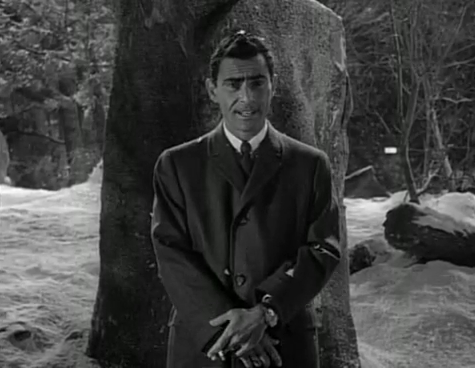
Mr. Romney Wordsworth (Burgess Meredith) stands
ready to be judged by jury and Chancellor (Fritz Weaver)
"The Obsolete Man"
Season Two, Episode 65
Original Air Date: June 2, 1961

Cast:
Romney Wordsworth: Burgess Meredith
The Chancellor: Fritz Weaver
The Subaltern: Josip Elic
The Guard: Harry Fleer
First Man: Barry Brooks
Second Man: Harold Innocent
Third Man: Bob McCord
Woman: Jane Romeyn

Crew:
Writer: Rod Serling (original teleplay)
Director: Elliot Silverstein
Producer: Buck Houghton
Production Manager: Ralph W. Nelson
Director of Photography: George T. Clemens
Art Direction: George W. Davis and Phil Barber
Set Decorations: Henry Grace and H. Web Arrowsmith
Assistant Director: Darrell Hallenbeck
Editor: Jason Bernie
Sound: Franklin Milton and Bill Edmondson
Music: Stock

And Now, Mr. Serling:
            “Mr. Burgess Meredith is no stranger to the Twilight Zone, but his role in next week’s story is a unique one, even for him. The Time will be the future, the place just about anywhere where men have been taken over by a machine state. Our story is called ‘The Obsolete Man.’ It may chill, it may provoke, but we’re certain it will leave a mark. Next week on the Twilight Zone, ‘The Obsolete Man.’”

Rod Serling’s Opening Narration: 
         “You walk into this room at your own risk, because it leads to the future, not a future that will be but one that might be. This is not a new world, it is simply an extension of what began in the old one. It has patterned itself after every dictator who has ever planted the ripping imprint of a boot on the pages of history…since the beginning of time. It has refinements, technological advancements, and a more sophisticated approach to the destruction of human freedom. But like every one of the super states that preceded it, it has one iron rule: logic is an enemy and truth is a menace. This is Mr. Romney Wordsworth, in his last forty-eight hours on Earth. He’s a citizen of the state but will soon have to be eliminated, because he’s built out of flesh and because he has a mind. Mr. Romney Wordsworth, who will draw his last breath…in the Twilight Zone.”


Summary:
            The future. Dark, cold, empty. A door opens onto a large, shadowy court room, and Mr. Romney Wordsworth, rigid with fright, enters to await his doom. Wordsworth is ordered to approach a large podium where a chancellor will tell him if he is worthy of living. The Chancellor takes the podium and asks Wordsworth what his occupation is. “A librarian,” he replies. Laughter rolls from the shadows of the courtroom. “A librarian?” the Chancellor says. He tells Wordsworth that since all books were banned by the state that there is no need for librarians. Wordsworth then mentions God and the Chancellor tells him that the state has proven that there is no God. A state-run jury declares Romney Wordsworth to be obsolete and sentences him to death. He is, however, given a choice as to his execution method. He chooses for his death to be broadcast live from his library. He also asks that his method be known only by himself and his executioner. The Chancellor seems amused by this and eagerly agrees.
            Later. The Chancellor, upon Wordsworth’s request, meets the condemned man in his library hours before his execution. Wordsworth tells the Chancellor that a bomb is set to explode at midnight right there in his library. Frightened, the Chancellor runs for the door but finds it locked. He demands that Wordsworth unlock the door. But the librarian refuses. The Chancellor has no choice but to sit and wait.  They are being filmed live in front of millions.
            Hours, minutes, seconds tick by. The Chancellor squirms like an impatient child. Wordsworth reads his tattered bible paying little attention to his guest. Finally in the last minutes before the explosion the Chancellor begs that Wordsworth release him. “For the love of God!” He shouts. Wordsworth hands him the key and the Chancellor escapes just moments before the room explodes.
           The next day. The Chancellor arrives in the court room to start his work for the day. To his horror he finds that his podium is occupied by another man. The new chancellor informs him that his declaration of a deity renders him unable to perform his task and therefore declares him obsolete. The former chancellor begs like a child for his life as a mob of mindless zombies converge on him and rip him apart.

Rod Serling’s Closing Narration:
“The Chancellor—the late Chancellor—was only partly correct. He was obsolete. But so was the State, the entity he worshipped. Any state, any entity, any ideology that fails to recognize the worth, the dignity, the rights of man, that state is obsolete. A case to be filed under ‘M’ for mankind…in the Twilight Zone.”

Commentary:
            For the second season closer Serling turned in this Orwellian horror story of a machine-like society that disposes of anyone or anything deemed unnecessary by the all-powerful forces of the State. I have always enjoyed this episode but it’s definitely not without flaws. If it is didacticism that Serling strives for then he loses his audience almost from the start. The world he creates here pushes the tolerance of the audience. It is ominous simply for the sake of being ominous. A world populated by mindless, monotone citizens absolutely devoted to a callous, faceless government. The audience never really gets the sense of what the structure of this imagined future is supposed to accomplish, or what exactly constitutes a person or idea as being “obsolete.” Serling simply fills his dystopia with any restriction of personal freedom that allows him to get his point across which is simply that totalitarianism is bad and a lack of free will is never fun. His plot is also littered with implausible circumstances, the most notable of which is that the Chancellor diligently accepts Wordsworth’s invitation to join him in his room on the night of his execution. Why doesn’t the Chancellor bring any kind of entourage or security with him? What if he doesn’t show up at all? This would spoil Wordsworth’s plan and would end Serling’s script rather abruptly. But despite all of these limitations this episode still manages to work quite well and, in many ways, still evokes in the audience the moral dread that Serling intended.
            Now that I have pointed to the flaws in this episode and probably given the impression that it’s basically celluloid garbage I can move on to why I think it’s great.
            He may over-indulge the message here but Serling saves “The Obsolete Man” by filling it with sharp, powerful dialogue between Fritz Weaver and Burgess Meredith. The dialogue works so well because its focus is not on Serling’s message but simply on the difference of ideals between two characters, which is why the tension between these two men seems completely natural instead of forced in order for Serling to make his point. Both characters have lengthy, carefully sculpted monologues saturated with the type of rhetoric that makes Serling’s work memorable.           
           Casting was a key element in this episode. While Serling’s dialogue is amazing it could have been worthless in the hands of lesser actors. So Silverstein and the producers turned to familiar faces as a safety net to assure great performances. Making his third of four appearances on the show is veteran actor Burgess Meredith. All of the characters that Meredith has portrayed thus far on the program have been lowly, bookish types in varying degrees of seriousness. Although some may feel that “Time Enough at Last” is his best effort on the show I have always enjoyed him best in this episode. Making his second and final appearance on the show is Fritz Weaver. In Season One’s “Third from the Sun” Weaver plays a quiet family man trying to keep things afloat while he and his family attempt to leave their planet in the face of a looming nuclear holocaust. Here he plays the complete opposite: a boisterous, unforgiving authority of the State. He displays an impressive range of emotions in this episode and the result is one of the most interesting characters to ever appear on the show. His monologue in the opening scene has always been one of my favorites.
            But the hero of this episode is director Elliot Silverstein. This is his first of four episodes for the show. It’s interesting to point out that his other three episodes (Season Three’s “The Passerby” and “The Trade-Ins” and Season Five’s “Spur of the Moment”) are all episodes that also focus on dialogue and acting rather than story. And like “The Obsolete Man” most would have worked well on the stage (with the exception of “Spur of the Moment,” which features a chase scene on horseback in which the audience isn’t supposed to see the pursuer’s face). Silverstein had a background in theater and began his career as a television director in the live dramas of the fifties. “The Obsolete Man” features only two sets, which are radically different from one another. The first and last acts take place in a large, open courtroom which features sharp, expressionistic shadows reminiscent of the German horror movies of the 1920’s. There are only two pieces of furniture in this room: a long, narrow table in the center of the room and the Chancellor’s tall, obnoxious podium at the far end of the table. The only other visible set piece is a twenty-five foot double door that opens into the courtroom. The walls are covered in black velvet and an off-screen light fixture placed above the door appears to be only source of light inside the courtroom. The government officials, there are about a dozen of them places randomly around the large room, are all dressed in drab, colorless uniforms and stand expressionless behind Wordsworth. The room is cold and unwelcoming. This set is highly effective to both the scene and the story and gives the audience an immediate idea of what this future society is like.
            Act Two takes place in Wordsworth’s apartment. A tiny studio apartment consisting of a single room cluttered with furniture and lined wall-to-wall with overflowing bookshelves, it is a striking juxtaposition to the lifeless courtroom in the other two scenes. The cozy, cluttered room feels immediately warm and welcoming and it gives the audience a better understanding of Wordsworth’s personality. In many ways these two sets are the unspoken stars of the episode.
            While it has some sore spots, “The Obsolete Man” is still a remarkable episode and a good choice for the season finale. The final scene, in which the Chancellor is judged and then presumably ripped apart by his comrades, was an extremely bold choice for the show, especially for 1961. It’s weird and vague and doesn’t really make sense but it somehow works perfectly. It closes out the season on a high and shocking note and leaves the audience talking all summer long while they wait with anticipation for the start of the third season.
            If The Twilight Zone started on a high note with Season One, then it’s safe to say that it hit its stride both creatively and commercially with Season Two. Season Two produced many of the show’s best including “Eye of the Beholder,” “The Howling Man,” “Nick of Time,” and “The Invaders” to name a few. While not every episode is a masterpiece (“A Thing about Machines” and “The Man in the Bottle” among the sore spots), and don’t forget the experiment with videotape that proved unpopular with nearly everyone, the show began to grow into its own during this season. The viewership had grown and the pacing was faster. The producers settled on an opening theme which would become one the show’s trademarks and one of the most well-known pieces of popular culture to ever exist. Serling began to appear onscreen during his opening monologues (also one of the show’s trademarks that has become a universally known and often mimicked phenomenon) and the monologues themselves grew shorter and tighter and were officially given the “…in the Twilight Zone” closing tagline. Also important in Season Two were writers Richard Matheson, Charles Beaumont, and George Clayton Johnson. All three made contributions to the first season but their personalities and writing styles became known to the audience and became part of the personality of the show. When accepting the Emmy for Outstanding Writing Achievement in Drama that summer, Serling held up the award and shared its credit with all three men and stated that they could “carve it up like a turkey.” Director of Photography George T. Clemens also nabbed an Emmy for his work on Season Two. The show also won the Hugo Award for this season.
Unfortunately, the show would begin to unfold toward the end of the next season for numerous reasons. But for now, with two groundbreaking seasons and sixty-five episodes under its belt, The Twilight Zone drifted quite comfortably into its third season.

Grade: B

Notes:
--As mentioned, director Elliot Silverstein also directed Season Three’s “The Passerby” and “The Trade-Ins” and Season Five’s “Spur of the Moment.” He would go on to direct feature films including 1965’s Cat Ballou with Jane Fonda and Twilight Zone alumni Lee Marvin. His last work in television was as the director of four episodes of HBO’s seminal anthology show Tales from the Crypt.
--Burgess Meredith also appears in Season One’s “Time Enough at Last,” Season Two’s “Mr. Dingle the Strong,” and Season Four’s “Printer’s Devil.” He appeared in two episodes of Rod Serling's Night Gallery, "The Little Black Bag" and "Finnegan's Flight."
--Fritz Weaver also appears in Season One’s “Third from the Sun” and in the episode of Rod Serling's Night Gallery titled "A Question of Fear." Weaver also recorded a reading of Rod Serling's prose adaptation of "The Mighty Casey" for Harper Audio in 1992.
--“The Obsolete Man” was adapted into a Twilight Zone Radio Drama starring Jason Alexander.
--This marks the second of three Rod Serling appearances on screen at the end of an episode (excluding promotional material). The first time was the Season One closer "A World of His Own" and the third and final time was the third season episode, "The Fugitive."

-Brian Durant

Thursday, December 24, 2015

George Clayton Johnson (1929-2015)


George Clayton Johnson passed away on December 25, 2015. He was 86 years old. If you are a fan of The Twilight Zone or a reader of this blog then you know his importance both to the show and to us personally. He was a highly gifted writer and delivered some of the most enduring episodes of The Twilight Zone. Johnson had 8 total credits on the show, four for story and four more for story and teleplay. Despite his relatively low volume of output, however, his contributions to the show are of such high quality that his presence looms equally large as those of his personal friends and professional colleagues Richard Matheson and Charles Beaumont, writers who amassed 16 and 22 credits on the series, respectively. Below are George Clayton Johnson's credits for The Twilight Zone: 

Stories:
"The Four of Us Are Dying" (adapted by Rod Serling)
"Execution" (adapted by Rod Serling)
"The Prime Mover" (adapted by Johnson and Charles Beaumont, credited solely to Beaumont)
"Ninety Years Without Slumbering" (as "Johnson Smith," adapted by Richard de Roy)

Teleplays:
"A Penny For Your Thoughts"
"A Game of Pool"
"Nothing in the Dark"
"Kick the Can"

"A Game of Pool," "Nothing in the Dark," and "Kick the Can" are among the most artistic, well-written, and memorable episodes of the series. Johnson broke into writing for television through The Twilight Zone. After selling three of his stories to the series, Johnson's friend, The Twilight Zone writer Charles Beaumont, challenged Johnson to not only sell a story to the series but to also write the teleplay. Johnson used the leverage gained when a fourth story sold to the series, "Sea Change," was subsequently rejected by the series sponsor General Foods, who found the story's subject matter too grisly. Series producer Buck Houghton requested that Johnson buy the story back, so that Johnson could sell the story elsewhere and the series could recoup the expenditure. Johnson agreed to do so if he were also allowed the opportunity to write a script for the series. The resulting episode, the delightful "A Penny for Your Thoughts," was a success and Johnson launched his career as a freelance television writer. The Twilight Zone was his steadiest outlet and he contributed exceptional episodes over the following two seasons. Rod Serling acknowledged Johnson's contributions to the series by name when delivering his acceptance speech for The Twilight Zone's second Emmy Award for writing. Rod Serling accepts Emmy Awards for Twilight Zone.

George Clayton Johnson co-wrote (with William F. Nolan) the 1967 novel Logan's Run, adapted for film in 1976, a television show (1977-1978), and two comic book series. He wrote the story that became the 1960 film Ocean's 11, starring Frank Sinatra, Dean Martin, and Sammy Davis, Jr., which was remade in 2001 starring George Clooney and Brad Pitt. He also wrote the first broadcast episode of Star Trek, "The Man Trap." Johnson wrote memorable episodes of Alfred Hitchcock Presents, Route 66, Honey West, and Kung Fu. He assisted Ray Bradbury in scripting Bradbury's 1956 short story "Icarus Montgolfier Wright" for the Academy Award nominated animated short film. View the short film.

Johnson credited Ray Bradbury and Theodore Sturgeon as two of his mentors as a developing writer. His short stories can be found in the books Twilight Zone Scripts and Stories (Streamline, 1996) and All of Us are Dying and Other Stories (Subterranean Press, 1999). A book length profile, George Clayton Johnson: Fictioneer, by Vivien Cooper, was released by Bear Manor in 2013.

Below are photos from Johnson's set visit for the filming of arguably his best episode, "Nothing in the Dark," filmed during the second season but not broadcast until the third season. Below that, follow the links to Johnson's episodes we've covered here in the Vortex. 

We already miss you, George. Thanks for the stories.

Robert Redford and George Clayton Johnson on the set of "Nothing in the Dark"

George Clayton Johnson and Gladys Cooper on the set of "Nothing in the Dark"

"The Four of Us Are Dying"
"Execution"
"The Prime Mover"
"A Penny For Your Thoughts"
"A Game of Pool"
"Nothing in the Dark"
"Kick the Can"

-Jordan Prejean and Brian Durant
Thursday, October 1, 2015

Playboy Fiction Anthologies of the 1960s and 1970s


Cover by Jack Gregory
Beginning in 1966 with The Playboy Book of Science Fiction and Fantasy, Playboy Press, the book publishing arm of the popular men's magazine, began publishing a series of book anthologies which mined the magazine's accumulated collection of short-form horror, crime, and science fiction. The magazine's fiction editor at the time was Ray Russell (1924-1999), a noted writer of novels and stories (Sardonicus and Other Stories, The Case Against Satan, Unholy Trinity) and films (The Premature Burial; X: The Man With the X-Ray Eyes), whose tastes shaped the fiction featured in the magazine and who had, since the magazine's beginnings, bought fiction from the finest genre writers of the time.
Cover by Richard Tyler
Playboy was a high paying market which allowed its writers to produce works free of the restraining components of genre magazines and of a more violent and sexually exploratory nature than was acceptable to the mainstream "slick" magazines. The result was the accumulation in a single market of some of the most outstanding horror, crime, and science fiction of the time. In a relatively short number of years the magazine had assembled a wealth of high quality genre material with first book publication rights held on nearly all of it. Once Playboy Press was created to compete in the book publishing industry, it became obvious how to use that store of quality genre fiction. 


Cover by Gilbert Stone
The Playboy Press anthologies arrived slowly. 1966 saw the release of The Playboy Book of Science Fiction and Fantasy and The Playboy Book of Crime and Suspense in hardcover. It was followed the next year with the hardcover release of The Playboy Book of Horror and the Supernatural. 1968 saw all three books reprinted in paperback editions. Playboy's Stories of the Sinister & Strange, a paperback, followed in 1969. These titles are still highly sought after items, notable for the quality of the fiction. 

After a quiet 1970 in which Playboy Press published no genre anthologies, nine paperbacks appeared in 1971, most of them under the banner title Playboy Science Fiction, under which additional science fiction novels and single author collections appeared. Many of the stories contained within the anthologies combined elements of science fiction and horror, a type of genre mash-up that was particularly popular at the time. Stories of psychological alienation and of man's diminishing importance in the face of an infinite universe proliferated. A self-consciously modernized form of the horror story matured in the pages of the magazine, as well. These stories were set in a recognizable urban or suburban middle-class milieu, where monstrosity, murder, and mutation were as likely as after-dinner cocktails. 


The anthologies were occasionally themed ("10 Stories of Space Flight," etc.) and usually took the book title from that of the lead story within. A partial list of notable authors represented in the anthologies includes J.G. Ballard, Arthur C. Clarke, Charles Beaumont, Frederik Pohl, Kurt Vonnegut, Jr., Robert Sheckley, Robert Bloch, Algis Budrys, Gerald Kersh, Ray Bradbury, William F. Nolan, Dennis Etchison, Anthony Boucher, Theodore Sturgeon, Norman Spinrad, Henry Slesar, Richard Matheson, Fredric Brown, Avram Davidson, William Tenn, Damon Knight, Italo Calvino, and Arthur Porges. 


After the fruitful year of 1971, the production of this type of book from Playboy Press abruptly slowed down. 1974 saw an anthology of crime stories, Murder, My Love, but Playboy Press began to concentrate efforts on works of original fiction and on non-fiction books consisting of reprint material, such as Beyond Reason: Playboy's Book of Psychic Phenomena (1973).  


There was a brief resurgence of the horror anthology from Playboy Press beginning in 1979 with Nightmares, compiled by noted horror writer and editor Charles L. Grant. This anthology, and those which followed, were unlike the preceding anthologies in that the stories were not first published in the magazine. Grant's work with Playboy Press continued with the paperback edition of the initial volume of his celebrated Shadows series in 1980, followed by Horrors in 1981, and Terrors in 1982. Stuart David Schiff, creator of Whispers magazine (1973-1983), delivered the horror anthology Death in 1982. The contents of these anthologies were a combination of established masters (Fritz Leiber, Robert Bloch, William F. Nolan, Joseph Payne Brennan) and younger writers, many of whom were on the verge of fueling the emerging horror publishing "boom" of the 1980's. These horror anthologies from Playboy Press, along with excellent horror anthologies compiled by literary agent Kirby McCauley between 1975-1980 (Night Chills, Beyond Midnight, Frights, Dark Forces), were a significant part of the foundation upon which the horror publishing boom was built, pushing horror into the mainstream of the publishing industry.  

In 1980, Playboy Press published the retrospective volume Galaxy: Thirty Years of Innovative Science Fiction in hardcover. It is a celebration of the best from Galaxy Science Fiction Magazine with stories from the magazine's archives and memoirs from the writers that contributed to the magazine. It was also a selection of the Science Fiction Book Club.

Ray Russell was succeeded by Alice K. Turner as Playboy fiction editor in 1976. Fortunately, Turner also had a taste for science fiction, fantasy, and horror. She compiled a hardcover volume in 1999 titled The Playboy Book of Science Fiction, about half of which is from her tenure as fiction editor of the magazine.


Checklist:

-Most of the anthologies were compiled by Playboy fiction editor Ray Russell and credited only as by "The Editors of Playboy." It is noted below where Russell was not the editor. Paperback publication for books which originally appeared in hardcover are noted. Cover art credits are given for covers featured in this post. 

1966:
-The Playboy Book of Science Fiction and Fantasy (cover by Jack Gregory; paperback - 1968)
-The Playboy Book of Crime and Suspense (paperback - 1968)

1967:

-The Playboy Book of Horror and the Supernatural (paperback - 1968; paperback cover by Richard Tyler)

1969:
-Playboy's Stories of the Sinister & Strange (cover by Gilbert Stone)

1971:

-Transit of Earth (cover by Shelly Canton)
-Last Train to Limbo (cover by Shelly Canton)
-From the "S" File
-The Dead Astronaut (cover by Pompeo Posar) 
-The Fiend
-Masks (cover by George Suyeoka)
-The Fully Automated Love Life of Henry Keanridge (cover by Don Punchatz)
-Weird Show (cover by Skip Williamson) 
-The Future is Now (cover by Bill Arsenault; edited by William F. Nolan; originally appeared in hardcover in 1970 from Sherbourne Press)

1974

-Murder, My Love (edited by Eric Corder)

1979

-Nightmares (edited by Charles L. Grant)

1980

-Galaxy: Thirty Years of Innovative Science Fiction (edited by Frederik Pohl, Martin H. Greenberg, and Joseph D. Olander; paperback, 2 vols, 1981)
-Shadows (edited by Charles L. Grant)

1981

-Horrors (edited by Charles L. Grant)

1982
-Death (edited by Stuart David Schiff)
-Terrors (edited by Charles L. Grant)

1998

-The Playboy Book of Science Fiction (edited by Alice K. Turner; paperback - 1999)

-JP

Monday, November 17, 2014

"Will the Real Martian Please Stand Up?"

Morgan Jones and Barney Phillips ponder the stranger in their midst
"Will the Real Martian Please Stand Up?"
Season Two, Episode 64
Original Air Date: May 26, 1961

Cast:
Trooper Dan Perry: Morgan Jones
Trooper Bill Padgett: John Archer
Ross: John Hoyt
Haley: Barney Phillips
Avery: Jack Elam
Olmstead: Bill Kendis
Ethel McConnell: Jean Willes
Peter Kramer: Bill Erwin
Rose Kramer: Gertrude Flynn
George Prince: Ron Kipling
Connie Prince: Jill Ellis

Crew:
Writer: Rod Serling (original teleplay)
Director: Montgomery Pittman
Producer: Buck Houghton
Production Manager: Ralph W. Nelson
Director of Photography: George T. Clemens
Art Director: George W. Davis and Phil Barber
Set Decoration: Henry Grace and H. Web Arrowsmith
Assistant Director: Darrell Hallenbeck
Editor: Leon Barsha
Sound: Franklin Milton and Bill Edmondson
Music: Stock
Makeup: William Tuttle

And Now, Mr. Serling:
"It's been said that singularly the most difficult feat of all mankind is to find a needle in a haystack. On the Twilight Zone next time, we do it one better. We pose a problem of finding a Martian in a snow bank. It all adds up to a kind of extraterrestrial who's who with a couple of laughs and more than a couple of tangents. We recommend this to the space buffs and the jigsaw puzzle addicts. Next time on the Twilight Zone, our story is called "Will the Real Martian Please Stand Up?"

Rod Serling's Opening Narration:
"Wintry February night, the present. Order of events: a phone call from a frightened woman notating the arrival of an unidentified flying object. And the check-out you've just witnessed with two State Troopers verifying the event but with nothing more enlightening to add beyond evidence of some tracks leading across the highway to a diner. You've heard of trying to find a needle in a haystack? Well, stay with us now and you'll be part of an investigating team whose mission is not to find that proverbial needle. No, their task is even harder. They've got to find a Martian in a diner. And in just a moment you'll search with them because you've just landed in the Twilight Zone."

Summary:
            On a snowy February night, two state troopers respond to a call to check out an unidentified flying object which has taken off the tops of some trees and landed in Tracy's pond at Hook's Landing. The troopers find evidence that something did indeed land in the pond and, unbelievable as it seems, tracks in the snow appear to indicate that something crawled out of the pond and walked across the highway to a secluded diner. After getting a radio warning about a nearby bridge being too dangerous to pass upon, the troopers follow the tracks in the snow to the diner.
            The troopers find nine people within the diner, seven passengers on a bus line, the bus driver, and the counterman running the diner. After telling the bus driver about the impassable bridge, to the particular disdain of one of the passengers, a grouchy businessman named Ross, the troopers question the bus driver about how many passengers were on the bus. Though the driver does not have any information on the individual passengers, he is certain that there were six passengers on the bus. There are, however, seven passengers within the diner.
            The troopers explain the situation to the people in the diner and set in motion a situation in which each person attempts to exonerate themselves from suspicion of being the outsider. The group of passengers includes an old couple, a young couple, a pretty young woman, the grouchy businessman, and an energetic old coot. The passengers admit that with all the snowfall it is possible that an extra person could have slipped into the diner with the others as they unloaded the bus. None of the passengers are certain about who else was on the bus. 
            Strange phenomena begin to occur in the diner, including the overhead lights blinking on and off and the jukebox playing on its own before even more violent action occurs as the glass sugar containers burst open upon each table. The tension slowly rises as everyone waits for the bridge to open so the bus can go on its way. When the call finally comes that the bridge is now passable, the troopers have no choice but to allow all the passengers onto the bus, as they have no real cause to prevent anybody from leaving.
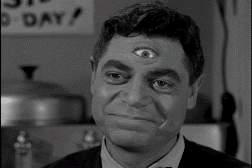
            Some minutes later Ross, the grumpy businessman, returns to the diner. When Haley, the counterman, asks him what happened, Ross replies that the bridge wasn't passable and that the bus and the state trooper car both went down into the river. No one survived. No one, that is, except Ross. And he isn't even wet. When Haley points this out, Ross is ignorant of the term "wet" and suddenly reveals a third arm from beneath his coat and explains that he is a Martian scout sent ahead to clear the Earth for invasion. Haley seems unperturbed. He nods and agrees that Earth is indeed a great place for an alien settlement but that it won't be coming from Mars. Haley is revealed to be from Venus and informs Ross that his alien friends have been overtaken by Venusians. Haley removes his cap to reveal a third eye.

Rod Serling's Closing Narration:
"Incident on a small island, to be believed or disbelieved. However, if a sour-faced dandy named Ross or a big, good-natured counterman who handles a spatula as if he'd been born with one in his mouth, if either of these two entities walks onto your premises, you'd better hold their hands, all three of them, or check the color of their eyes, all three of them. The gentlemen in question might try to pull you into the Twilight Zone."

Commentary:
            "Will the Real Martian Please Stand Up?" is certainly one of the most clichéd, predictable, ludicrous, derivative, and outlandish episodes of the Twilight Zone's first two seasons. That said, it is also certainly one of the most purely enjoyable episodes in the show's entire run. It effectively functions as the cumulative success of all Rod Serling's previous efforts to combine humor, fantasy, and suspense into a workable mix for the show, bettering the substantial failures of previous episodes "The Mighty Casey," "Mr. Dingle, the Strong," and "The Mind and the Matter." Though Serling borrowed from previous sources, including one of his own first season scripts, he produced a fun, fast paced thriller that is fondly remembered as one of the most recognizable and enjoyable episodes of the show.
            Nearly three years prior to the airing of the episode, on October 12, 1958, Serling wrote a story treatment while the show was still in development. The treatment was titled "The Night of the Big Rain," the basics components of which would eventually become "Will the Real Martian Please Stand Up?" For the filmed episode, Serling's switched the heavy rainfall which strands the group inside the diner to snowfall instead, a wise choice as the snowfall adds a distinct atmosphere to the episode. Also in his original treatment, Serling had the alien being revealed as the cafe owner's new pet dog. This ending proved too absurd and unworkable even for an episode with the premise of "find the alien in the diner." Serling wisely chose to change the ending and also the title, first to "Nobody Here But Us Martians," the title used during the filming of the episode, and finally to "Will the Real Martian Please Stand Up?," a play on the catchphrase of the television game show To Tell the Truth, which began airing on CBS in 1956.
            The sources for the episode outside of Serling's initial treatment are not terribly difficult to discern. The first is certainly Agatha Christie's 1939 million copy bestseller And Then There Were None. In Christie's novel, a group of people are coerced into visiting a secluded island only to be killed off one by one. The killer is eventually revealed to be one among the company. This work virtually created the modern "a killer among us" fictional template. The second literary source is probably science fiction writer and editor of Astounding (later Analog) John W. Campbell's 1938 short story "Who Goes There?" Campbell wrote the story under the name Don A. Stuart. It concerns a group of scientists in Antarctica who inadvertently release an alien being that can change its form and image into almost anything, including members of the group. The story was famously filmed as The Thing From Another World in 1951 by director Christian Nyby (at the helm for a pair of Zone episodes) and producer Howard Hawks. It has since been filmed two additional times, once in 1982 by John Carpenter, as The Thing, and again in 2011 as a prequel to the Carpenter film, also titled The Thing. The idea of an isolated group of people against an alien menace was surely an appealing concept to writers working in the science fiction field in the wake of Campbell's story and Hawks’s popular film version.
            Serling also has the character Avery, the eccentric old man, make a reference to Ray Bradbury. Though no Bradbury work directly correlates to the plot of "Will the Real Martian Please Stand Up?” (the closest may be Bradbury’s 1947 short story, “Zero Hour”), Serling was illustrating the level of reverence and respect he held for Bradbury's work. According to an introduction to John Collier's story collection Fancies and Goodnights (New York Review Books, 2003), Serling came to Bradbury's California home in the late 1950's to seek the writer's advice on how best to develop The Twilight Zone. This makes it all the more unfortunate that Bradbury was only able to contribute a single episode to the show, the third season's "I Sing the Body Electric." Bradbury was unable, or perhaps unwilling, to provide scripts which reasonably met budgetary restraints for the show. Combined with a bit of communication error, Bradbury took the subsequent rejection of his work by Serling as a personal slight, doing much to sour the relationship, both personal and professional, between the two men. Marc Scott Zicree, author of the The Twilight Zone Companion (Bantam, 1982; second revised ed. 1989), tells the story of the relationship between the two men and their work on The Twilight Zone here.
            "Will the Real Martian Please Stand Up?" is ultimately informed mostly by Serling's own work, as it directly parallels his grim Cold War masterpiece, "The Monsters Are Due On Maple Street," even including an absurd but somehow thematically perfect ending. With its cast of excellent character actors portraying recognizable American stereotypes in an episode heavy on dialogue, it also resembles a number of Serling's other episodes, including "The Shelter" and "It's a Good Life," the latter taken from the Jerome Bixby short story. The difference here is that Serling is obviously having fun with "Will the Real Martian Please Stand Up?" and this difference is what makes the episode an unqualified success. To adopt the same grim approach used on "The Monsters Are Due On Maple Street" or "The Shelter" would have doomed the episode laughable for the wrong reasons, much like that suffered by the deadly serious episodes "The Rip Van Winkle Caper" or "A Thing About Machines."
            The production wisely used the three most talented character actors in the three prime roles on the show, that of the grouchy businessman Ross, the counterman Haley, and the red herring Avery, played perfectly by John Holt, Barney Phillips, and Jack Elam, respectively. As it played out, these three characters were the only ones that could have possibly been the alien as Serling's script virtually eliminated the remainder of the cast characters. The couples were eliminated because of their pairing of two in a situation where the outsider is a single being. The bus driver was eliminated because, obviously, he was driving the bus. The young woman was eliminated because she was the only person the bus driver noticed. Then you have the two state troopers and the short order cook. What remains is that Ross and Avery are the only possible suspects. One is an obvious red herring in that he behaves in an exaggerated way which draws attention to his eccentricity and tendency for instigation. Ross is left as the grumpy businessman who is the most eager to leave the situation even when doing so requires driving an old bus on a shaky bridge in the middle of a snowstorm. Figuring out which of the people in the diner was the alien is not difficult nor is it really the point of Serling's script. Serling wanted to examine how each of us has little eccentric aspects of our personality which can, when perceived the wrong way, make us an attractive scapegoat in a paranoid situation. We are also, Serling points out, terribly unreliable as observers of the world around us.
            The two special effects in the episode were achieved cheaply and efficiently. Jack Hoyt, as Ross, is to have three arms. This was achieved by having a second person, whose right arm was clothed in the same manner as Hoyt's costume, reach around Hoyt and interact with Hoyt's own two arms. A coat was draped over the actor's shoulders to finish the effect and a bit of rehearsal was required to manage a believable fluidity of motion between the three arms. William Tuttle applied the third eye to the forehead of actor Barney Phillips. Tuttle ran a thin wire from the eye (which could cause the eye to roll) through Phillips's hair to be manipulated by a technician situated behind Phillips. The initial idea for the third eye was to use double exposure photography, but this looked even less convincing that the kitschy fake eye applied to Phillips's forehead. However unconvincing the effect was then or now, it remains one of the more memorable images from the show.
            There are a few other interesting aspects of the episode. The first is that the bus, when seen in the exterior of the diner, is labeled on the side as Cayuga Bus Lines. Cayuga is, of course, the name of Rod Serling's production company which produced The Twilight Zone. It is also interesting to note how Serling slyly hints at Ross being the alien. At one point in the episode, in the midst of strange occurrences within the diner (lights dimming, jukebox playing on its own, etc.), Ross looks at the telephone on the wall two seconds before it starts ringing, in an attempt to make the viewer believe Ross caused the phone to ring when in fact an actual call was coming through for the state troopers. After the bridge is ruled passable and the diners are paying for their tickets, Ross is charged for drinking fourteen cups of coffee. Now, that's an excessive amount of coffee by any standard. It also reminds one of The Outer Limits episode "Controlled Experiment" in which a pair of Martians (Barry More and Carroll O'Connor) are very fond of coffee. There is also a constant, shameless plug for cigarettes in the episode, with the brand finally revealed to be Oasis cigarettes during the final encounter between Ross and Haley. Ross even utters that the cigarettes "taste wonderful" as though he were actually performing in a cigarette commercial. That line was not in Serling's script but added last minute. The constant product placement, according to Martin Grams, Jr.'s book, The Twilight Zone: Unlocking the Door to a Television Classic (OTR, 2008), was planned from the beginning.
            "Will the Real Martian Please Stand Up?" is a highly enjoyable and entertaining episode that has a surprisingly high re-watch value. It comes highly recommended as it might be the most successfully episode of the show that also includes a broad amount of comedy. It is successful because, unlike in previous comedic episodes of the show, Serling spices the script with enough suspense and atmosphere to render a sort of fun, spook house sort of an episode. With its quick pace and fun makeup effects, it is an especially effective episode to introduce younger viewers to the series. 

Grade: B

Illustrations by Kim Zimmerman from the Feb, 1986 issue of Rod Serling's The Twilight Zone Magazine, which presented Serling's teleplay for "Will the Real Martian Please Stand Up?" :


Notes:
-Montgomery Pittman also directed the third season episodes "Two," "The Grave," "The Last Rites of Jeff Myrtlebank," and "Dead Man's Shoes."
-Barney Phillips is also in the first season episode "The Purple Testament," the second season episode "A Thing About Machines," and the exceptional fourth season episode "Miniature."
-John Hoyt was previously in the second season episode "The Lateness of the Hour."
-"Will the Real Martian Please Stand Up?" was adapted as a Twilight Zone Radio Drama, starring Richard Kind.
-Bill Erwin also appeared in the Twilight Zone Radio Drama episode "Ninety Years Without Slumbering." 

--JP 

Wednesday, October 29, 2014

"The Mind and the Matter"


Mr. Archibald Beechcroft (Shelly Berman) in his natural habitat
“The Mind and the Matter”
Season Two, Episode 63
Original Airdate:  May 12, 1961

 Cast:
Archibald Beechcroft: Shelley Berman
Henry: Jack Grinnage
Mr. Rogers: Chet Stratton
Landlady: Jeane Wood
Man in Elevator: Robert McCord

 Crew:
Writer: Rod Serling (original teleplay)
Director: Buzz Kulick
Producer: Buck Houghton
Production Manager: Ralph W. Nelson
Director of Photography: George T. Clemens
Art Direction: George W. Davis and Phil Barber
Set Decoration: Henry Grace and H. Web Arrowsmith
Assistant Director: Darrell Hallenbeck
Editor: Jason Bernie
Sound: Franklin Milton and Bill Edmondson
Music: Stock

 And Now, Mr. Serling:
“Next week, the very considerable talents of Mr. Shelley Berman are utilized to bring you another in our weekly excursions into the never-never-land of the wild, the wooly, and the wondrous. He plays the part of a little man who yearns for the serenity of a world without people and as it happens he gets his wish: to walk an uninhabited Earth and face the consequences. Our story is called the Mind and the Matter. I hope we see you then.
            “Now this isn’t just a word from the sponsor it’s simply a very good suggestion. It stands for real refreshment. Before we meet again, try Oasis for the softest taste of all.”

 Rod Serling’s Opening Narration:
            “A brief if frenetic introduction to Mr. Archibald Beechcraft, a child of the nineteenth century, a product of the population explosion, and one of the inheritors of the legacy of progress.[…] Mr. Beechcraft again. This time act two of his daily battle for survival. And in just a moment, our hero will begin his personal one-man rebellion against the mechanics of his age, and to do so he will enlist certain aids available only in the Twilight Zone.”

 Summary:
            Archibald Beechcroft is a middle-aged curmudgeon who has lost all need for the company of others. He spends his days in a state of perpetual irritation with the people around him. After accidentally spilling coffee on Beechcroft one morning, Beechcroft’s young coworker Henry gives him a book on witchcraft as an apology. He says that he has seen people manipulate the world around them simply through mental concentration. Beechcraft takes the book home and skims through it. He decides that he will rid himself of the daily irritation of others by making every one in the world disappear.
             The next day Beechcroft steps out into a world void of people. His plan has worked. Through simple concentration he has removed everyone else in the world. But later on in his office he finds that now that has solitude he is incredibly bored and he actually misses interaction with other people. He decides to bring everyone back but only this time he makes them in his likeness. He wishes for a world full of people just like himself. But he soon realizes that a world full of Archibald Beechcrafts is even worse than a world full of normal people. So he decides to put everything back the way it was.
            The next day when he arrives at work he is greeted by a bustling, chaotic office full of various types of people. Right on schedule, his young coworker, Henry, spills a cup coffee all over him. Henry asks Beechcroft if he read the book that he gave him. Beechcraft admits that he read it but says that he regards it as nothing more than foolish nonsense. Henry shrugs this off and goes back to his day as Beechcroft grins to himself.

Rod Serling’s Closing Narration”
“Mr. Archibald Beechcroft: a child of the twentieth century, who has found out through trial and error—and mostly error—that with all its faults it may well be that this is the best of all possible worlds—people not withstanding…it has too much to offer. Tonight’s case in point…in the Twilight Zone.”

 Commentary:
Before we give an episode a grade of a D or an F we take into consideration every element that goes into an episode of The Twilight Zone. Story, dialogue, performances, direction, photography, music, art direction, etc. Episodes that exhibit strong amounts of all of these elements get an A. Episodes that have none get an F. Everything else falls somewhere in between. Before I say anything about “The Mind and the Matter” I will disclose that this episode gets an F, meaning that I cannot recommend it to anyone, for any reason. It is only the third F that we have handed out. The first went to “The Mighty Casey,” the second to "The Whole Truth." I can’t say if “The Mind and the Matter” is any better or worse than “The Mighty Casey” or "The Whole Truth," but I can say that this was only the second time that I have seen this episode and it did not inspire me to plan an eventual third viewing.
Like “The Mighty Casey” and "The Whole Truth," “The Mind and the Matter” is a comedy and was written by Serling. It feels very much like a last minute script. A notion of an idea with a story wrapped loosely around it. It is a be-careful-what-you-wish-for morality tale in the tradition of W. W. Jacobs’s famous story “The Monkey’s Paw.” But it feels like Serling didn’t have enough time to construct a proper plot structure for his idea flourish in. What initially distracts me about this episode is that the fantasy element is absurdly weak. Many episodes of the program, especially those dealing with time travel, have no explanation for the fantastical things that happen to or around their characters. They just happen. In “Walking Distance” Gig Young simply revisits his old hometown and finds that he has traveled back in time to when he was a small child. No explanation given. In “A World of Difference” Howard Duff walks into work one morning and finds that his life is actually a film set. Again, no explanation given. The fantasy here though, that Beechcraft can make everyone disappear just by thinking about it, seems to violate some kind of literary fantasy-reality boundary. So if he can make people disappear just by thinking about it then why hasn’t this ever happened before? He hates everyone so surely at one point he must have wished for the world to himself.
Serling wrote this episode specifically for Shelly Berman. Berman started as a straight actor who transitioned to comedy when he landed a spot in the Chicago comedy troupe Compass Players which later became Second City. His performance here isn’t notably bad and even has bursts of clever awkwardness but is ultimately forgetful.
But the biggest blunder of this episode lies in the work of makeup artist William Tuttle. The normally failsafe artist was brought in to mold masks of Shelly Berman’s face to be worn by extras after Beechcraft has made the world in his image. Instead of looking like a lot of Archibald Beechcrafts the extras look like a crowd of leatherfaces.
The only memorable aspect of this episode is the directorial innovations of Buzz Kulick in the scenes where Beechcraft’s argues with his conscience. But ultimately this episode comes off as a poorly written attempt at comedic fantasy and, again, I cannot recommend it for any reason.

Grade: F

Notes:
--This episode was adapted into a Twilight Zone Radio Drama starring Hal Sparks.
--Shelley Berman also appeared in three Twilight Zone Radio Drama episodes, "Hocus Pocus and Frisby," "Kick the Can," and "The Hunt."

--Brian Durant