|
| Dr. Stillman (Abraham Sofaer) tells coach Mouth McGarry (Jack Warden) all about his new star pitcher. |
"The Mighty Casey"
Season One, Episode 35
Original Air Date: June 17, 1960
Cast:
Mouth McGarry: Jack Warden
Casey: Robert Sorrells
Dr. Stillman: Abraham Sofaer
Monk: Don O'Kelly
Doctor: Jonathan Hole
Beasley: Alan Dexter
Commissioner: Rusty Lane
Crew:
Writer: Rod Serling (original teleplay)
Directors: Robert Parrish and Alvin Ganzer
Producer: Buck Houghton
Production Manager: Ralph W. Nelson
Production Manager: Ralph W. Nelson
Director of Photography: George T. Clemens
Art Direction: George W. Davis and Merrill Pye
Set Decoration: Henry Grace and Keogh Gleason
Assistant Director: Don Klune and Edward Denault
Editor: Joseph Gluck
Sound: Franklin Milton and Philip Mitchell
Art Direction: George W. Davis and Merrill Pye
Set Decoration: Henry Grace and Keogh Gleason
Assistant Director: Don Klune and Edward Denault
Editor: Joseph Gluck
Sound: Franklin Milton and Philip Mitchell
Music: stock
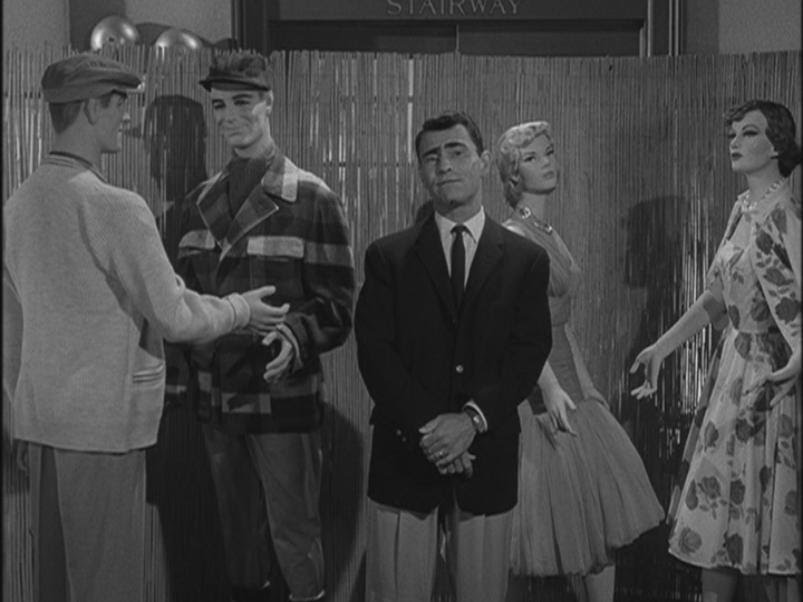
And Now, Mr. Serling:
"This locker and liniment emporium houses a major league baseball team known as the Hoboken Zephyrs, all of which by way of introduction to next week's show, a wild and wooly yarn about the great American pastime. It's called 'The Mighty Casey' and it's all about a left-hander who pitches like nothing human simply because he isn't. Mr. Jack Warden takes us into the stadium next week for nine fast innings on The Twilight Zone."
Rod Serling's Opening Narration:
"What you're looking at is a ghost, once alive but now deceased. Once upon a time it was a baseball stadium that housed a major league ball club known as the Hoboken Zephyrs. Now it houses nothing but memories and a wind that stirs in the high grass of what was once an outfield, a wind that sometimes bears a faint, ghostly resemblance to the roar of a crowd that once sat here. We're back in time now when the Hoboken Zephyrs were still a part of the National League and this mausoleum of memories was an honest-to-Pete stadium. But since this is strictly a story of make-believe, it has to start this way: One upon a time in Hoboken, New Jersey, it was tryout day. And though he's not yet on the field, you're about to meet a most unusual fella, a left-handed pitcher named Casey."
Summary:
 |
| Robert Sorrells as Casey |
Casey is an instant sensation. He pitches shutout after shutout and nobody from any opposing team can figure out how to hit his impossible pitches. The Hoboken Zephyrs zoom into fourth place and make national headlines. Then tragedy strikes and Casey is hit in the head with the baseball, landing him in the hospital where it is quickly discovered by the team doctor that Casey has no heartbeat. He has, in fact, no heart. The commissioner of baseball is brought into the situation and he consults the rules, which state that a team is made up of nine men. It seems that without a heartbeat Casey isn't a man and is disqualified from any further play.
McGarry appeals to Stillman and the inventor agrees that he can give Casey a heart. Soon after, Casey returns to the team fully healed and with a new beating heart that members of the team can hear pounding away in his chest. Casey is reinstated with the league and put back on the mound for the Zephrys. Unfortunately, there is a side effect involved in giving a Casey a heart and it quickly becomes apparent. Casey no longer strikes out opponents but throws easy pitches that batters hammer away at, sending the Zephyrs right back on the path of a losing streak. Stillman explains to McGarry and the rest of the team that Casey's newly installed heart has built a great deal of compassion within the robot and that Casey no longer can bear to strike out opposing batters. With his baseball career effectively washed out, Casey states that he intends to go into social work where he can help people.
As a consolation gift, Stillman gives to McGarry the blueprints to Casey and it doesn't take long for it to dawn on McGarry that there is a very real possibility of creating an entire team of incredible robots.
Rod Serling's Closing Narration:
"Once upon a time there was a major league baseball team called the Hoboken Zephyrs, who during the last year of their existence wound up in last place and shortly thereafter wound up in oblivion. There is a rumor, unsubstantiated of course, that a manager named McGarry took them to the West Coast and wound up with several pennants and a couple of World Championships. This team had a pitching staff that made history. Of course, none of them smiled very much but it happens to be a fact that they pitched like nothing human. And if you are interested as to where these gentlemen come from you might check under "B" for baseball, in the Twilight Zone."
Commentary:
"It was try-out day for the Brooklyn Dodgers and Mouth McGarry, the manager of the club, stood in the dugout, one foot on the parapet, both hands shoved deep into his hip pockets, his jaw hanging several inches below his upper lip."
-"The Mighty Casey" by Rod Serling, Stories from the Twilight Zone (1960)
"It was try-out day for the Brooklyn Dodgers and Mouth McGarry, the manager of the club, stood in the dugout, one foot on the parapet, both hands shoved deep into his hip pockets, his jaw hanging several inches below his upper lip."
-"The Mighty Casey" by Rod Serling, Stories from the Twilight Zone (1960)
"The Mighty Casey" is an episode marred by a series of unfortunate events. To begin with, the episode is a slapstick comedy and this type of episode came across as patently unfunny on the series. Rod Serling and the other writers for the series would continue their attempts to bring comedy to the series and they would more often fail in these attempts as the screwball style of comedy had trouble finding traction on the show. More subtle forms of fantasy/comedy, as displayed in episodes such as Richard Matheson's "A World of His Own" or George Clayton Johnson's "A Penny For Your Thoughts," were much more effective on the series.
"The Mighty Casey" also suffered from the fact that the episode had to be filmed twice. Little or no footage exists from the initial filming of the episode and none is known to have made it into the episode seen today. The reason for the re-shoot was the death of actor Paul Douglas, who portrayed Mouth McGarry in the first version, directed by Alvin Ganzer. Douglas, who had little experience in comedic roles and who also found the script unfunny, took the job due to a personal invitation from Rod Serling to appear on the series. Serling and Douglas were acquaintances from their days on the live anthology show Playhouse 90. Serling's only major reservation about hiring Paul Douglas was the aging actor's propensity for heavy drinking. Serling contacted Douglas's agent about this and was assured that Douglas no longer had a drinking problem. Satisfied, Serling and producer Buck Hougton went ahead with production.
"The Mighty Casey" also suffered from the fact that the episode had to be filmed twice. Little or no footage exists from the initial filming of the episode and none is known to have made it into the episode seen today. The reason for the re-shoot was the death of actor Paul Douglas, who portrayed Mouth McGarry in the first version, directed by Alvin Ganzer. Douglas, who had little experience in comedic roles and who also found the script unfunny, took the job due to a personal invitation from Rod Serling to appear on the series. Serling and Douglas were acquaintances from their days on the live anthology show Playhouse 90. Serling's only major reservation about hiring Paul Douglas was the aging actor's propensity for heavy drinking. Serling contacted Douglas's agent about this and was assured that Douglas no longer had a drinking problem. Satisfied, Serling and producer Buck Hougton went ahead with production.
When Serling viewed the daily rushes from shooting, he suspected that he'd been lied to about Paul Douglas's drinking. The actor appeared haggard, mottled, and high in color on film. Douglas also had trouble delivering his lines, even brief passages, without running out of breath. When Serling contacted Douglas's agent to complain, the agent again guaranteed that Douglas was not drinking. The truth turned out to be much more tragic. Only a handful of days after the completion of photography for the episode, Paul Douglas died. The symptoms that Serling viewed on the daily rushes were those of heart failure and not excessive drinking. As Serling morbidly stated, "we were watching him literally die in front of us."
Devastated, Serling vowed that he wasn't going to send out this knuckleball comedy of an episode with a well respected actor slowly dying on camera. Still, he was obligated to show CBS something and, after screening the completed episode, told the network executives that this could not air as is and would have to be entirely re-shot. CBS agreed that the episode was unfunny but, oddly enough, appeared to have no problem with the fact that Paul Douglas died shortly after the shoot and, as a result, were unwilling to part with the additional money required to re-shoot the episode.
According to Marc Scott Zicree in The Twilight Zone Companion, Serling put $27,000 of his own money on the line to re-cast, re-shoot, and re-edit the episode. Director Robert Parrish was brought in and actor Jack Warden brought on to assume the role of Mouth McGarry. The planned broadcast date of the episode was pushed back from December to the following June with the re-shoot attempting to proceed as efficiently as possible. As a result, little remained on the cutting room floor and nearly all re-shot footage was left in to fill the time length required by the episode.
Martin Grams, Jr., in his book The Twilight Zone: Unlocking the Door to a Television Classic, reprints several unused or alternate intros, outros, and promos from various episodes that, for one reason or another, went unused in the final cut of the corresponding episodes. Many of these unused passages are of insignificant variation but Rod Serling's unused promo for "The Mighty Casey" is of interest because of the fact that the death of actor Paul Douglas necessitated the change. The unused promo is as follows: "Next week we take you into a state of wonderful confusion. The late Mr. Paul Douglas stars in a play we call 'The Mighty Casey.' Bring your imagination as we recount for you the trials and tribulations of a major league ball club called the Hoboken Zephyrs, a put upon manager, and the most fabulous baseball pitcher you'll ever watch in action. Next week on The Twilight Zone, 'The Mighty Casey.'"
One result of Serling taking the initiative to fund the re-shoot from his own money was that CBS would forever after have their eyes glued to the financial books and constantly pressure Rod Serling about the budget for the series, a problem Serling often spoke about in a negative way.
Of additional interest is an early Rod Serling script titled "Old Macdonald Had a Curve." This was one of the earliest sales from Serling to a live drama anthology. The script was performed on August 5, 1953 on Kraft Television Theatre, shortly before Serling rose to prominence with "Patterns" on the same program, a play which brought him the first of six Emmy Awards. "Old Macdonald Had a Curve" appears to have been an early attempt at "The Mighty Casey." "Old Macdonald Had a Curve" is a baseball comedy about a retired major league pitcher (played by Olin Howland) who is wasting away in a nursing home until an accident allows him to throw a wicked curveball. The old man scrambles to join his old team, a team which happens to be in the funk of a long losing streak. Though the old man suffers another accident which takes away his new curveball, he inspires his old team to go on a winning streak. The episode ends with a patent Serling wink, as the old man once again regains his curveball. "Old Macdonald Had a Curve" is also notable for featuring Jack Warden.
Of additional interest is an early Rod Serling script titled "Old Macdonald Had a Curve." This was one of the earliest sales from Serling to a live drama anthology. The script was performed on August 5, 1953 on Kraft Television Theatre, shortly before Serling rose to prominence with "Patterns" on the same program, a play which brought him the first of six Emmy Awards. "Old Macdonald Had a Curve" appears to have been an early attempt at "The Mighty Casey." "Old Macdonald Had a Curve" is a baseball comedy about a retired major league pitcher (played by Olin Howland) who is wasting away in a nursing home until an accident allows him to throw a wicked curveball. The old man scrambles to join his old team, a team which happens to be in the funk of a long losing streak. Though the old man suffers another accident which takes away his new curveball, he inspires his old team to go on a winning streak. The episode ends with a patent Serling wink, as the old man once again regains his curveball. "Old Macdonald Had a Curve" is also notable for featuring Jack Warden.
It would have been difficult for an episode with a fantastic script to come out on the other side of the production of "The Mighty Casey" with any semblance of its initial impact or resonance. By all indications, "The Mighty Casey" was a bad episode with Paul Douglas in the lead role and Alvin Ganzer behind the camera. With an under-budgeted, rushed, and poorly edited re-shoot, the episode comes off as an unfunny blemish on the face of a show generally held to an exacting standard. It is perhaps because of the unfortunate events that characterized its production that "The Mighty Casey" has not simply been forgotten altogether.
Grade: F
Notes:
 --Rod Serling apparently found enough fascination in the story of Casey to make it the very first teleplay he adapted into prose for the three short story collections he wrote based on the series. "The Mighty Casey" can be found in Stories from the Twilight Zone, originally published by Bantam Books in April, 1960.
--Actor Jack Warden also starred in the earlier season one episode, "The Lonely." Warden also appeared in Rod Serling's original drama, "Noon on Doomsday," which appeared on April 25, 1956 on The United States Steel Hour. Serling's script was infamously censored as it originally concerned the murder of black teenager Emmett Till by white men in Mississippi in 1955. Also appearing with Warden were future Zone actors Albert Salmi, Everett Sloane, and Philip Abbott.
--Director Alvin Ganzer also directed the season one episodes, "The Hitch-Hiker," "What You Need," and "Nightmare as a Child."
--Director Robert Parrish also directed the season one episodes, "One for the Angels" and "A Stop at Willoughby."
--Science fiction fans will recognize Abraham Sofaer from a far more memorable role than that of Dr. Stillman. Sofaer played Arch, the Kyben leader who pursued humanity's immortal guardian, Trent, through time in Harlan Ellison's Outer Limits episode, "Demon With a Glass Hand."
--Twilight Zone actor Fritz Weaver ("Third From the Sun," "The Obsolete Man") performed a reading of Serling's story adaptation of "The Mighty Casey" for Harper Audio in 1992.
--Science fiction fans will recognize Abraham Sofaer from a far more memorable role than that of Dr. Stillman. Sofaer played Arch, the Kyben leader who pursued humanity's immortal guardian, Trent, through time in Harlan Ellison's Outer Limits episode, "Demon With a Glass Hand."
--Twilight Zone actor Fritz Weaver ("Third From the Sun," "The Obsolete Man") performed a reading of Serling's story adaptation of "The Mighty Casey" for Harper Audio in 1992.
--"The Mighty Casey" was adapted as a Twilight Zone Radio Drama starring Paul Dooley.
--"The Mighty Casey" was adapted into comic book form for the 1979 book Stories from the Twilight Zone (Bantam; a Skylark Illustrated Book) by Rod Serling, adapted by Horace J. Elias and illustrated by Carl Pfeufer.
--Actor Robert Sorrells, who portrays the robot Casey, received a 32 years to life sentence in 2005 for the 2004 murder of one man in a bar and the attempted murder of another.
--Rod Serling was partially inspired to write "The Mighty Casey" by the famous baseball poem, "Casey at the Bat: A Ballad of the Republic Sung in the Year 1888" by Ernest Thayer, about a batter whose over-confidence causes him to squander the chance to be a hero at the plate.
--"The Mighty Casey" was adapted into comic book form for the 1979 book Stories from the Twilight Zone (Bantam; a Skylark Illustrated Book) by Rod Serling, adapted by Horace J. Elias and illustrated by Carl Pfeufer.
--Actor Robert Sorrells, who portrays the robot Casey, received a 32 years to life sentence in 2005 for the 2004 murder of one man in a bar and the attempted murder of another.
--Rod Serling was partially inspired to write "The Mighty Casey" by the famous baseball poem, "Casey at the Bat: A Ballad of the Republic Sung in the Year 1888" by Ernest Thayer, about a batter whose over-confidence causes him to squander the chance to be a hero at the plate.
--JP